Bitwise Plants Its Flag In ETF Staking With Chorus One Buyout

bitcoinistОпубликовано 2026-02-26Обновлено 2026-02-26

Введение

Crypto asset manager Bitwise has acquired staking infrastructure firm Chorus One, which manages over $2.2 billion in assets across dozens of blockchain networks. The deal brings 50 employees into Bitwise's onchain division and expands its staking services to more than 30 proof-of-stake networks, including Solana, Avalanche, and Sui. While financial terms were undisclosed, the acquisition positions Bitwise to capitalize on staking as a key growth opportunity, especially as the SEC warms to crypto investment products like ETFs that may offer staking rewards. Bitwise, which already manages $15 billion in assets and runs over 40 investment products, including its Bitcoin and Ethereum ETFs, continues to expand beyond its core ETF offerings.

Crypto asset manager Bitwise just made one of its boldest moves yet. The company has acquired Chorus One, a staking infrastructure firm that manages more than $2.2 billion in assets across dozens of blockchain networks. The deal brings 50 Chorus One employees into Bitwise’s growing onchain division, where several billion dollars in crypto assets are already being staked by clients.

Financial Terms Undisclosed

Chorus One has been in the staking business since 2018. Over those years, it built a client base that includes family offices, large funds, exchanges, high-net-worth individuals, and custodians — the kind of institutional relationships that take years to earn. Its founder and CEO, Brian Crain, will stay on in an advisory role as the rest of the team folds into Bitwise Onchain Solutions.

Image: Bitwise Asset Management

Reports say the financial terms of the deal were not made public. Bitwise did not disclose how much it paid.

What is clear, though, is what the company gets out of it. The acquisition extends Bitwise’s staking reach across more than 30 proof-of-stake networks — among them Solana, Avalanche, Sui, Aptos, Hyperliquid, Monad, and Tezos. That is a wide net, and it signals the company is not thinking just about Ethereum.

BTCUSD now trading at $65,247. Chart: TradingView

Staking, for those unfamiliar, works like this: holders of certain crypto tokens lock them up on a blockchain to help keep the network running. In return, they earn rewards — typically somewhere between 2% and 10% a year, on top of any gains from the token itself.

Why The Timing Matters

The US Securities and Exchange Commission has been warming up to a wider range of crypto investment products. That shift has opened the door for new types of exchange-traded funds, including ones that could one day offer staking rewards to ordinary investors. Bitwise appears to be positioning itself for exactly that possibility.

Image: OSL

Bitwise CEO Hunter Horsley described staking as “one of the most compelling growth opportunities” the firm sees for its clients. The company already runs more than 40 investment products and oversees roughly $15 billion in assets under management. Its flagship offerings include the Bitwise Bitcoin ETF and the Bitwise Ethereum ETF, which have pulled in over $2 billion and $387 million in flows respectively since launching in 2024.

Room To Grow

With nearly 200 employees now spread across the world, Bitwise has been steadily building out beyond its core ETF lineup. Reports note that its other products include ETFs tied to Solana, XRP, Chainlink, and even Dogecoin. The Chorus One deal adds staking muscle to that already broad product shelf.

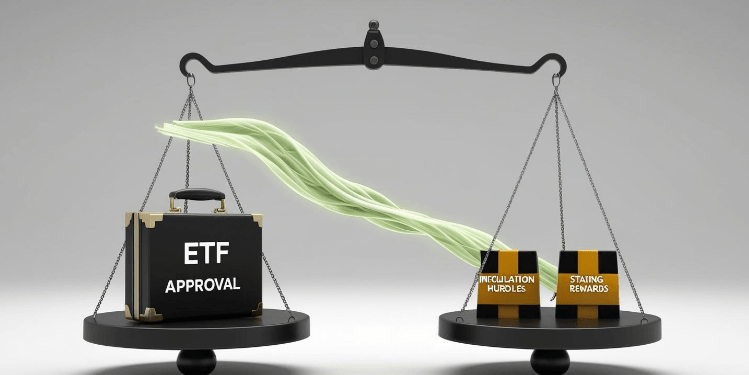
Featured image from Gemini, chart from TradingView

Связанные с этим вопросы

QWhat is the significance of Bitwise's acquisition of Chorus One?

AThe acquisition of Chorus One is a significant move for Bitwise as it expands the company's staking capabilities across more than 30 proof-of-stake blockchain networks, bringing in over $2.2 billion in staked assets and 50 experienced employees to bolster its onchain division.

QWhat types of clients did Chorus One serve prior to the acquisition?

AChorus One's client base included family offices, large funds, exchanges, high-net-worth individuals, and custodians, representing a range of institutional relationships built since 2018.

QHow does staking work in the context of cryptocurrency, according to the article?

AStaking involves holders of certain crypto tokens locking them up on a blockchain to help maintain network operations. In return, they earn rewards, typically between 2% and 10% annually, in addition to any appreciation in the token's value.

QWhy is the timing of this acquisition particularly important for Bitwise?

AThe timing is crucial because the US Securities and Exchange Commission is becoming more open to a wider range of crypto investment products, potentially including exchange-traded funds (ETFs) that offer staking rewards. Bitwise is positioning itself to capitalize on this future opportunity.

QWhat are some of Bitwise's flagship investment products mentioned in the article?

ABitwise's flagship offerings include the Bitwise Bitcoin ETF and the Bitwise Ethereum ETF, which have attracted over $2 billion and $387 million in flows, respectively, since their launch in 2024. The company also has ETFs tied to Solana, XRP, Chainlink, and Dogecoin.

Похожее

TechFlow Intelligence Bureau: Chip Stocks Lose Trillions in a Single Day, Bitcoin Falls Below $60,000, US-Iran Conflict Escalates

**Daily Tech & Markets Roundup: AI Advances, Market Turmoil, and Geopolitical Tensions** **AI / LLMs**: Anthropic's internal report on AI self-improvement sparked serious discussions about Recursive Self-Improvement (RSI). Meanwhile, debate continues on AI coding tools after Claude was accused of introducing bugs into the rsync codebase. In positive news, DeepSeek V4 Flash impressed in local deployment tests, and GitHub Copilot now supports custom endpoints for local models. A surprising research turn suggests removing chain-of-thought prompting can sometimes improve LLM performance. **Crypto / Web3**: Bitcoin plunged below $60,000, with its RSI hitting levels last seen during the COVID-19 crash, driven by strong U.S. jobs data reviving interest rate hike fears. Discussions highlight Ethereum DeFi's continued lack of a smooth consumer payment layer. **Chips / Hardware**: Chip stocks suffered a massive sell-off, with the Philadelphia Semiconductor Index posting its worst single-day drop in six years, erasing over a trillion dollars in value. Marvell, Micron, AMD, and Intel were among the biggest losers. **Tech Companies**: A leaked Microsoft document revealing goals to make Copilot "addictive" drew criticism. LinkedIn founder Reid Hoffman left Microsoft's board to focus full-time on his AI agent startup, Manus. Google was revealed to be paying SpaceX $920 million monthly for AI training compute. **Markets & Macro**: A blowout U.S. jobs report (172k vs. 80k expected) crushed hopes for near-term rate cuts, sending Treasury yields soaring and triggering a broad market sell-off. CEOs from Kraft, McDonald's, and Whirlpool simultaneously warned U.S. consumers are exhausting their savings. **Geopolitics**: U.S.-Iran tensions escalated with missile/drone interceptions and U.S. strikes on Iranian radar sites, keeping the critical Strait of Hormuz largely closed since late February and posing ongoing oil supply risks. **The Bottom Line**: The strong jobs data acted as a single trigger for correlated sell-offs across equities, crypto, and chips. Underlying the volatility is a stark contradiction between robust employment data and warnings of consumer weakness, alongside geopolitical risks that could reignite inflation, leaving markets to price in a fraught macro outlook with no clear "soft landing" path.

marsbit2 ч. назад

TechFlow Intelligence Bureau: Chip Stocks Lose Trillions in a Single Day, Bitcoin Falls Below $60,000, US-Iran Conflict Escalates

marsbit2 ч. назад

It Took Me a Year to See the Bitter Truth About Agent Payments

After a year building infrastructure for the Agent economy, engaging with major players like Stripe, Visa, and Coinbase, the author shares a sobering analysis of the current state of Agent payments. The core finding is a stark lack of genuine, immediate demand across most envisioned use cases. The article breaks down four key market segments: 1. **Agent-to-Merchant (Consumer Shopping):** For most product categories (e.g., clothing, electronics), conversational AI shopping is a step backwards from visual e-commerce interfaces. While agents excel at understanding needs, they can't replace side-by-side product comparison. Real merchant interest is defensive "Agent Engine Optimization," not driven by current customer demand. Potential exists for high-frequency, low-decision purchases (like food delivery) or navigating complex store UIs, but these require massive B2C distribution channels dominated by giants like Amazon. 2. **Agent-to-API (Developer Services):** Developers already have subscriptions and billing relationships for APIs (compute, data). Prepaid balances solve micro-payment issues for low transaction volumes. A deeper structural problem is that major SaaS vendors' business models rely on enterprise contracts, resisting granular pay-per-call pricing. While protocols like MPP and x402 serve the long tail of niche services, this market is small and developers are historically low-willingness-to-pay. 3. **Agent-to-Agent:** This remains largely theoretical with minimal transaction volume. While it represents a long-term bet on a fundamentally new transaction infrastructure (sub-second, micro-penny to million-dollar, multi-party settlements), it does not constitute a present market. 4. **Agent-to-Finance:** This is the only category with existing, paying demand. Integrating AI into financial workflows (trading, portfolio management) is a natural evolution and enables new capabilities like autonomous rebalancing. However, competition favors established, regulated institutions. The "real problem" is not moving money between agents, but the broader challenge of **coordination**—orchestrating work between agents and humans, verifying outcomes, and settling results. Payment is just one component of settlement, which is itself part of coordination. Companies that solve the coordination layer will subsume payment, not the other way around. While well-funded incumbents build defensively for a long-term future, startups must find where the market is today—which, for the author's team, lies outside these four categories in an area of real, growing, and underserved activity.

marsbit3 ч. назад

It Took Me a Year to See the Bitter Truth About Agent Payments

marsbit3 ч. назад

It Took Me a Year to See the Hard Truth About Agent Payments

**Title: It Took Me a Year to See the Hard Truth About Agent Payments** Over the past year, I've worked on infrastructure for the Agent economy, engaging with major players like Stripe, Visa, Coinbase, and numerous startups. The findings reveal a stark reality: genuine, widespread demand for Agent-based payments does not yet exist. **Key Observations:** * **Agent-to-Merchant (Shopping):** The user experience for AI shopping often falls short, especially for visual product discovery. While AI excels at understanding needs, conversational interfaces can't yet replace browsing and comparing multiple products visually. Current merchant interest is largely defensive ("Agent Engine Optimization") for a future that hasn't arrived. High-frequency, low-friction purchases (like food delivery) are potential fits, but lack open APIs and face high AI inference costs. Simpler, more affordable, or cross-language interactions for complex UIs are a niche opportunity but require massive consumer distribution to scale. * **Agent-to-API (Developer Tools):** Developer payment needs for APIs (computing, data, models) are already met through subscriptions and prepaid credits. The core challenge is not payment friction but supplier economics: most large SaaS providers prefer enterprise contracts over micropayments for API calls. Protocols like MPP and x402 suit the long-tail of smaller services but cater to a developer market historically reluctant to pay for these tools. Major infrastructure needs at the top of the stack are already being addressed. * **Agent-to-Agent (Machine Commerce):** This is a long-term vision with almost no current transaction volume. While a future with high-speed, high-frequency, multi-party machine-to-machine transactions would require novel infrastructure, it remains theoretical. The market is not here yet. * **Agent-to-Finance:** This is the only category with clear, present demand. Financial professionals and DeFi users already pay for tools, and AI augmentation is a natural evolution. Autonomous AI agents can enable entirely new financial strategies. However, competition is fierce from established, regulated incumbents who can more easily layer AI onto their existing products. **The Core Insight:** Companies, especially giants with long time horizons, are building defensively for a potential future of mass machine commerce. For them, early investment is a low-cost hedge. For startups, the current market reality is different. The primary challenge isn't just moving money between agents (payments). The larger, unsolved problem is **orchestration** – coordinating work between agents and humans, verifying outcomes, and then settling. Payment is just a part of settlement, which is just a part of orchestration. Companies that solve the orchestration problem will subsume payments, not the other way around. After a year of building, we see the real, growing, and underserved market opportunity lies in this broader domain of orchestration.

链捕手3 ч. назад

It Took Me a Year to See the Hard Truth About Agent Payments

链捕手3 ч. назад

Торговля

Спот
Фьючерсы

Популярные статьи

Как купить ONE

Добро пожаловать на HTX.com! Мы сделали приобретение Harmony (ONE) простым и удобным. Следуйте нашему пошаговому руководству и отправляйтесь в свое крипто-путешествие.Шаг 1: Создайте аккаунт на HTXИспользуйте свой адрес электронной почты или номер телефона, чтобы зарегистрироваться и бесплатно создать аккаунт на HTX. Пройдите удобную регистрацию и откройте для себя весь функционал.Создать аккаунтШаг 2: Перейдите в Купить криптовалюту и выберите свой способ оплатыКредитная/Дебетовая Карта: Используйте свою карту Visa или Mastercard для мгновенной покупки Harmony (ONE).Баланс: Используйте средства с баланса вашего аккаунта HTX для простой торговли.Третьи Лица: Мы добавили популярные способы оплаты, такие как Google Pay и Apple Pay, для повышения удобства.P2P: Торгуйте напрямую с другими пользователями на HTX.Внебиржевая Торговля (OTC): Мы предлагаем индивидуальные услуги и конкурентоспособные обменные курсы для трейдеров.Шаг 3: Хранение Harmony (ONE)После приобретения вами Harmony (ONE) храните их в своем аккаунте на HTX. В качестве альтернативы вы можете отправить их куда-либо с помощью перевода в блокчейне или использовать для торговли с другими криптовалютами.Шаг 4: Торговля Harmony (ONE)С легкостью торгуйте Harmony (ONE) на спотовом рынке HTX. Просто зайдите в свой аккаунт, выберите торговую пару, совершайте сделки и следите за ними в режиме реального времени. Мы предлагаем удобный интерфейс как для начинающих, так и для опытных трейдеров.

715 просмотров всегоОпубликовано 2024.04.12Обновлено 2026.06.02

Как купить ONE

Обсуждения

Добро пожаловать в Сообщество HTX. Здесь вы сможете быть в курсе последних новостей о развитии платформы и получить доступ к профессиональной аналитической информации о рынке. Мнения пользователей о цене на ONE (ONE) представлены ниже.

活动图片