Bitcoin's Post-Halving Supply Change Is Permanently Locked by Mathematical Rules

marsbitОпубликовано 2025-12-28Обновлено 2025-12-28

Введение

The fourth Bitcoin halving occurred on April 20, 2024, at block height 840,000, reducing the block reward from 6.25 BTC to 3.125 BTC. This event, programmed into Bitcoin’s protocol and triggered automatically every 210,000 blocks, reinforces its deterministic and transparent monetary policy. Post-halving, daily Bitcoin issuance dropped by approximately 50%, from about 900 BTC to 450 BTC, with annualized issuance falling to around 164,250 BTC. This reduced Bitcoin’s annual supply inflation rate to roughly 0.83%, lower than gold's estimated 1–2% growth and contrasting sharply with central bank-controlled fiat systems. By the end of 2024, approximately 19.7 million BTC were in circulation, leaving fewer than 1.3 million left to be mined. Over 93.8% of the total supply has already been issued. The halving also shifted miner economics, significantly increasing the proportion of transaction fees in their total revenue. This aligns with Bitcoin’s long-term design, where security gradually transitions from block subsidies to fee-based incentives. Unlike traditional monetary systems, Bitcoin’s supply schedule is fixed, irreversible, and independent of market conditions. The next halving, expected around 2028, will further reduce the block reward to 1.5625 BTC. With the latest halving complete, Bitcoin’s low issuance rate is no longer a short-term event but a permanent baseline feature—verifiable, predictable, and enforced by code and consensus.

Bitcoin's fourth block reward halving occurred on April 20, 2024, at block height 840,000, reducing the block reward from 6.25 BTC to 3.125 BTC. This process strictly follows the pre-defined issuance mechanism in the Bitcoin protocol, automatically triggered every 210,000 blocks.

This supply adjustment is automatically executed by Bitcoin's consensus rules, requiring no governance votes or human intervention, further reinforcing the deterministic, transparent, and unalterable nature of Bitcoin's monetary policy.

Bitcoin's Daily New Issuance Decreases by 50%

After the April 2024 halving, Bitcoin's daily new issuance mathematically decreased from approximately 900 BTC/day to about 450 BTC/day. This change is based on the fixed 3.125 BTC block reward and an average block time of about 10 minutes.

On an annualized basis, Bitcoin's yearly new issuance dropped from about 328,500 BTC/year to approximately 164,250 BTC/year. This supply contraction is permanent and entirely independent of market demand, miner behavior, or macroeconomic conditions.

Annualized Supply Inflation Rate Drops Below 1%

As a direct result of the April 2024 halving, Bitcoin's annualized supply inflation rate fell to approximately 0.83%. This figure is calculated based on the circulating supply at the time and the new issuance rate post-halving.

In comparison, gold's annual supply growth rate is typically estimated to be in the 1%–2% range, while the monetary expansion speed of fiat systems depends on central bank policies, not pre-coded fixed rules.

As of the End of 2024, Bitcoin's Circulating Supply Is Approximately 19.7 Million Coins

Blockchain data shows that as of December 31, 2024, Bitcoin's circulating supply was approximately 19.7 million BTC. This leaves less than 1.3 million BTC yet to be mined before reaching the protocol's maximum supply cap of 21 million BTC.

At this stage, over 93.8% of all Bitcoin has been issued, meaning the impact of future halvings on the absolute supply quantity will continue to diminish, but their proportional significance will become even more pronounced.

Post-Halving, Miner Revenue Structure Changes

The halving event cut miners' block subsidy income in half overnight, significantly increasing the relative proportion of transaction fees in their total revenue.

In the months following the halving, the share of transaction fees in miner revenue saw a noticeable increase compared to the pre-halving period. This shift aligns with Bitcoin's original long-term design expectation, where network security will gradually transition from being block subsidy-driven to an economic model primarily based on transaction fees.

Supply Is Fixed, Adjustment Is Complete

Unlike the adjustable policies of traditional financial systems based on economic conditions, the supply change after the April 2024 Bitcoin halving is final and irreversible. There is no mechanism to accelerate issuance during rising demand or slow it down during market downturns.

By the end of 2024, the market no longer faces an "upcoming halving event" but rather an already adjusted, low-issuance baseline that will persist until the next halving. The next halving is expected to occur around 2028, when the block reward will drop again to 1.5625 BTC.

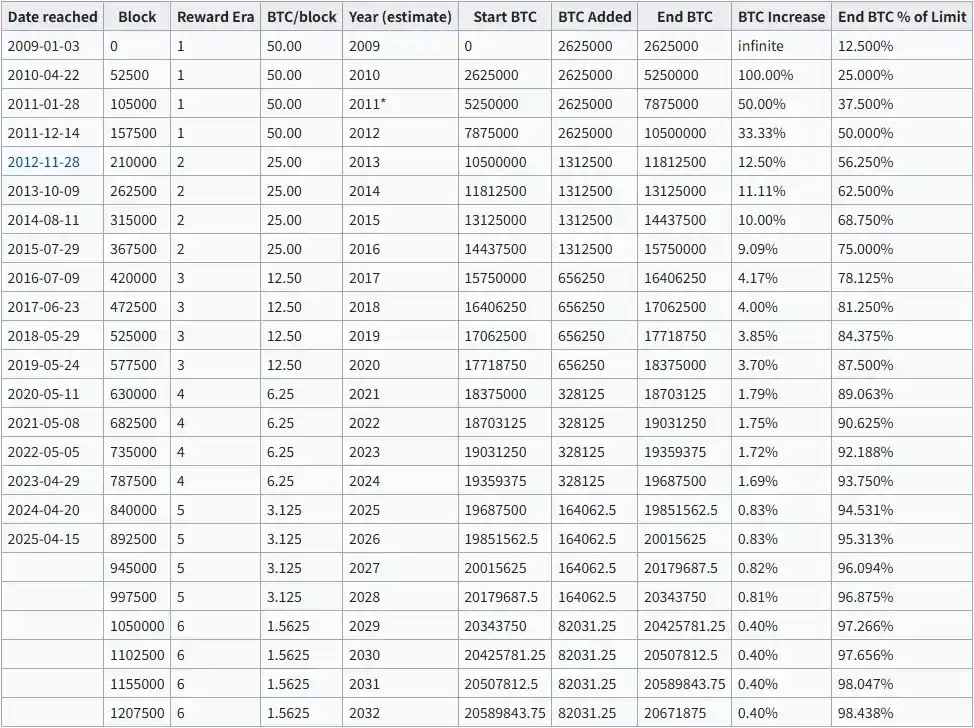
This chart shows the number of bitcoins that will exist in the near future. The Year is a forecast and may be slightly off.

From Event to Baseline Condition

With the fourth halving fully implemented, Bitcoin's low issuance rate is no longer a short-term narrative driver but has become a long-term foundational condition. It reshapes the supply structure in a transparent, predictable manner that can be independently verified by any participant running a full node.

This change does not rely on market sentiment, policy signals, or the pace of institutional adoption. Instead, it is directly written into Bitcoin's code and enforced by network consensus, making the post-halving supply mechanism one of the few variables in the global financial system that can be precisely described mathematically.

Связанные с этим вопросы

QWhat was the new block reward for Bitcoin after the fourth halving in April 2024?

AThe block reward was reduced from 6.25 BTC to 3.125 BTC.

QWhat is the estimated annualized supply inflation rate of Bitcoin after the 2024 halving?

AThe annualized supply inflation rate dropped to approximately 0.83%.

QHow does Bitcoin's supply adjustment mechanism differ from traditional monetary systems?

ABitcoin's supply adjustment is automatic, predetermined by code, and cannot be altered by governance votes or human intervention, unlike traditional systems which rely on central bank policies.

QWhat was the approximate circulating supply of Bitcoin at the end of 2024, and how much remains to be mined?

AThe circulating supply was approximately 19.7 million BTC, with less than 1.3 million BTC remaining to be mined out of the 21 million maximum supply.

QHow did the 2024 halving affect the structure of miner revenue?

AThe halving cut miners' block subsidy income in half, causing the relative proportion of transaction fees in their total revenue to increase significantly.

Похожее

Why Do You Always Lose Money on Polymarket? Because You're Betting on News, While the Pros Read the Rules

Why do you always lose money on Polymarket? Because you bet on news, while the pros study the rules. This article explains how top traders ("che tou") profit by meticulously analyzing market rules, not just predicting events. Polymarket, a prediction market platform, often sees disputes over event outcomes due to ambiguous rule wording. For instance, a market asking "Who will be the leader of Venezuela by the end of 2026?" was misinterpreted by many who bet on Delcy Rodríguez, assuming she held power. However, the rules specified "officially holds" as the formally appointed, sworn-in individual. Since Nicolás Maduro was still recognized as president officially, he won the market—even being in prison. To resolve such disputes, Polymarket uses a decentralized arbitration system via UMA protocol. The process involves: 1. Proposal: Anyone can propose a market outcome by staking 750 USDC, earning 5 USDC if unchallenged. 2. Dispute: A 2-hour window allows challenges with a 750 USDC stake; successful challengers earn 250 USDC. 3. Discussion: A 48-hour period on UMA Discord for evidence and debate. 4. Voting: UMA token holders vote in two 24-hour phases (blind then public). Outcomes require >65% consensus and 5M tokens voted; otherwise, four re-votes occur before Polymarket intervention. 5. Settlement: Results are final and automatic. Unlike traditional courts, Polymarket’s system lacks separation between arbitrators and stakeholders—voters often hold market positions, creating conflicts of interest. This leads to herd mentality in discussions and non-transparent outcomes without explanatory rulings, preventing precedent formation. Thus, success on Polymarket hinges on deep rule interpretation, not just event prediction, exploiting gaps between reality and contractual wording.

marsbit2 ч. назад

Why Do You Always Lose Money on Polymarket? Because You're Betting on News, While the Pros Read the Rules

marsbit2 ч. назад

DeepSeek Funding: Liang Wenfeng's 'Realist' Pivot

DeepSeek, a leading Chinese AI company, has initiated its first external funding round, aiming to raise at least $300 million at a valuation of no less than $10 billion. This move marks a significant shift from its founder Liang Wenfeng’s previous idealistic stance of rejecting external capital to maintain independence. Despite strong financial backing from its parent company, quantitative trading firm幻方量化 (Huanfang Quant), which provided an estimated $700 million in revenue in 2025 alone, DeepSeek faces mounting challenges. Key issues include a 15-month gap in major model updates, delays in its flagship V4 release, and the loss of several core researchers to competitors offering significantly higher compensation. The company is also undergoing a strategic pivot by migrating its infrastructure from NVIDIA’s CUDA to Huawei’s Ascend platform, a move aligned with China’s push for technological self-reliance amid U.S. export controls. However, DeepSeek lags behind rivals like智谱AI and MiniMax—both now publicly listed—in areas such as product ecosystem, multimodal capabilities, and commercialization. The funding round, though relatively small in scale, is seen as a way to establish a market-validated valuation anchor, making employee stock options more competitive and facilitating talent retention. It also signals DeepSeek’s transition from a pure research-oriented organization to a commercially-driven player in the global AI ecosystem.

marsbit3 ч. назад

DeepSeek Funding: Liang Wenfeng's 'Realist' Pivot

marsbit3 ч. назад

Торговля

Спот
Фьючерсы

Популярные статьи

Как купить S

Добро пожаловать на HTX.com! Мы сделали приобретение Sonic (S) простым и удобным. Следуйте нашему пошаговому руководству и отправляйтесь в свое крипто-путешествие.Шаг 1: Создайте аккаунт на HTXИспользуйте свой адрес электронной почты или номер телефона, чтобы зарегистрироваться и бесплатно создать аккаунт на HTX. Пройдите удобную регистрацию и откройте для себя весь функционал.Создать аккаунтШаг 2: Перейдите в Купить криптовалюту и выберите свой способ оплатыКредитная/Дебетовая Карта: Используйте свою карту Visa или Mastercard для мгновенной покупки Sonic (S).Баланс: Используйте средства с баланса вашего аккаунта HTX для простой торговли.Третьи Лица: Мы добавили популярные способы оплаты, такие как Google Pay и Apple Pay, для повышения удобства.P2P: Торгуйте напрямую с другими пользователями на HTX.Внебиржевая Торговля (OTC): Мы предлагаем индивидуальные услуги и конкурентоспособные обменные курсы для трейдеров.Шаг 3: Хранение Sonic (S)После приобретения вами Sonic (S) храните их в своем аккаунте на HTX. В качестве альтернативы вы можете отправить их куда-либо с помощью перевода в блокчейне или использовать для торговли с другими криптовалютами.Шаг 4: Торговля Sonic (S)С легкостью торгуйте Sonic (S) на спотовом рынке HTX. Просто зайдите в свой аккаунт, выберите торговую пару, совершайте сделки и следите за ними в режиме реального времени. Мы предлагаем удобный интерфейс как для начинающих, так и для опытных трейдеров.

1.1k просмотров всегоОпубликовано 2025.01.15Обновлено 2025.03.21

Как купить S

Sonic: Обновления под руководством Андре Кронье – новая звезда Layer-1 на фоне спада рынка

Он решает проблемы масштабируемости, совместимости между блокчейнами и стимулов для разработчиков с помощью технологических инноваций.

2.2k просмотров всегоОпубликовано 2025.04.09Обновлено 2025.04.09

Sonic: Обновления под руководством Андре Кронье – новая звезда Layer-1 на фоне спада рынка

HTX Learn: Пройдите обучение по "Sonic" и разделите 1000 USDT

HTX Learn — ваш проводник в мир перспективных проектов, и мы запускаем специальное мероприятие "Учитесь и Зарабатывайте", посвящённое этим проектам. Наше новое направление .

1.8k просмотров всегоОпубликовано 2025.04.10Обновлено 2025.04.10

HTX Learn: Пройдите обучение по "Sonic" и разделите 1000 USDT

Обсуждения

Добро пожаловать в Сообщество HTX. Здесь вы сможете быть в курсе последних новостей о развитии платформы и получить доступ к профессиональной аналитической информации о рынке. Мнения пользователей о цене на S (S) представлены ниже.

活动图片