Bitcoin whale count tops 20K – Is a BTC supply crunch ahead?

ambcryptoОпубликовано 2026-03-20Обновлено 2026-03-20

Введение

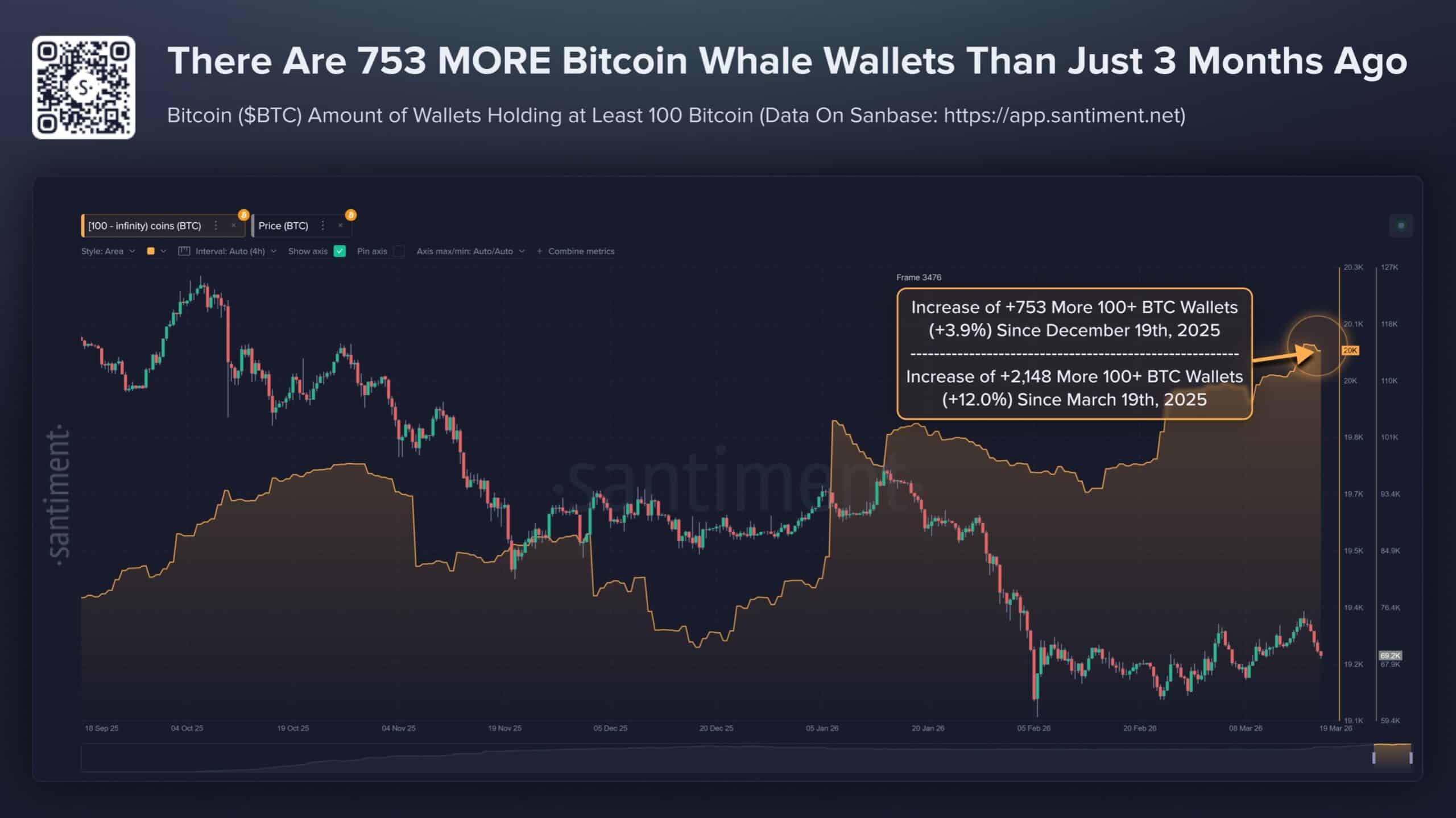
Bitcoin (BTC) price declined toward $70,000, down 20.2%, but large holders continued accumulating, with wallets holding ≥100 BTC increasing by 753 to over 20,000. This reflects strategic buying during weakness, as strong hands absorb supply from weaker participants. Meanwhile, exchange balances decreased by about 5,500 BTC over 30 days, indicating coins are moving to custodial wallets. ETF inflows, totaling over $56.64 billion, reinforce this trend, with BlackRock’s IBIT holding nearly 765,000 BTC. The alignment of whale accumulation and institutional demand is tightening liquid supply, reducing sell-side pressure, and increasing the likelihood of a supply squeeze and potential upward price movement once demand strengthens.

Bitcoin [BTC] declined towards $70,000 at press time, losing 20.2%, yet large holder behavior shifted upward, forming a clear divergence. As price prints lower highs through January and February, ≥100 BTC wallets rise to 20,087–20,102, adding 753 addresses.

This steady expansion during weakness shows strategic accumulation, as strong hands absorb supply released by weaker participants. As selling pressure slows, price begins stabilizing, while wallet growth remains elevated, reinforcing underlying demand.

Source: Santiment

At press time, the 100–1,000 cohort reached 18,073 wallets holding 5.193 million BTC, while addresses holding over 1,000 BTC controlled 7.14 million. As older supply stays inactive and new entities enter, liquid supply tightens, reducing downside volatility while increasing the probability of a supply squeeze that can drive a sharp upward repricing once demand returns.

Bitcoin supply tightens as ETF and whale demand align

As Bitcoin’s supply tightens under whale accumulation, ETF flows began reinforcing the same structural shift rather than offsetting it. Cumulative inflows surpassed $56.64 billion, or 713,880 BTC, while AUM nears $96.76 billion, reflecting sustained institutional entry.

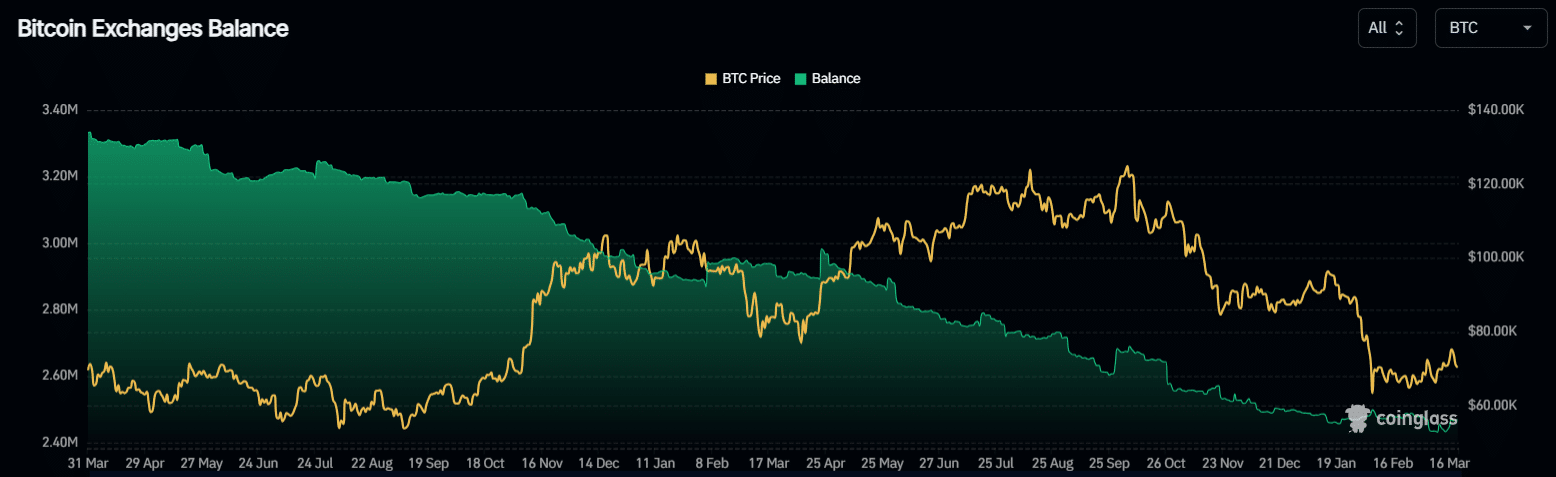
Although short-term flows fluctuate, including a -$90.20 million session, creations remain, indicating fresh demand rather than internal rotation. As this demand builds, Exchange Balances held near 2.47 million BTC, at press time but trended lower by about 5,500 BTC over 30 days, showing coins steadily leaving liquid venues.

Source: CoinGlass

As buy-side pressure persists through positive spot CVD, both ETF flows and whale behavior align, absorbing available supply. This alignment reduces market slack, limits sell-side depth, and increases the likelihood of a demand-driven breakout as liquidity conditions tighten further.

ETF inflows map directly to Bitcoin supply drain

As ETF inflows expand, they translate directly into on-chain accumulation, strengthening the link between institutional demand and spot supply. BlackRock’s IBIT approaches 765,000 BTC, while FBTC holds around 187,000 BTC, lifting total custodial balances sharply.

As coins exit exchanges, they move into custodian wallets, tightening liquid supply. With ETF additions of 45,700 BTC aligning with platform outflows, capital flow remains efficient. This flow confirms real absorption, reducing available liquidity and reinforcing Bitcoin’s supply-driven market structure.


Final Summary

  • Bitcoin [BTC] shows coordinated whale accumulation and ETF-driven demand, tightening liquid supply as exchange reserves decline and custodial balances rise steadily.
  • Bitcoin faces reduced sell-side pressure and deepening supply constraints, increasing the likelihood of a demand-led breakout as liquidity conditions continue tightening.

Связанные с этим вопросы

QHow many Bitcoin whale addresses (≥100 BTC) were added during the recent decline, and what does this indicate?

A753 new whale addresses (≥100 BTC) were added, bringing the total to 20,087–20,102. This indicates strategic accumulation by large holders during price weakness, as they absorb supply sold by weaker participants.

QWhat is the significance of the alignment between ETF inflows and whale accumulation?

AThe alignment between ETF inflows (over $56.64 billion cumulative) and whale accumulation reinforces structural supply tightening. Both mechanisms absorb available Bitcoin from the market, reducing liquid supply and increasing the probability of a demand-driven price surge.

QHow much Bitcoin is held by the 100–1,000 BTC cohort and addresses with over 1,000 BTC?

AThe 100–1,000 BTC cohort holds 5.193 million BTC, while addresses with over 1,000 BTC control 7.14 million BTC. Combined, these large holders significantly reduce liquid supply, contributing to potential supply constraints.

QWhat trend is observed in Bitcoin exchange balances, and what does it imply?

AExchange balances decreased by approximately 5,500 BTC over 30 days, trending lower to around 2.47 million BTC. This implies coins are steadily moving off liquid trading venues into custodial or long-term storage, tightening available supply and reducing sell-side pressure.

QHow do ETF inflows directly impact Bitcoin's on-chain supply?

AETF inflows (e.g., BlackRock’s IBIT holding 765,000 BTC and Fidelity’s FBTC holding 187,000 BTC) directly drain Bitcoin from exchanges into custodian wallets. This process reduces liquid supply, confirms real demand absorption, and reinforces a supply-driven market structure prone to volatility spikes.

Похожее

$9.4 Billion: The Largest Robotics Funding This Year Has Emerged

Munich-based humanoid robotics company Neura has completed a $1.4 billion (approximately RMB 94.9 billion) Series C funding round, valuing the company at around $7 billion and positioning it among the global leaders in the sector. The investment round is notable not just for its size—reportedly the largest in robotics this year—but also for its strategic backers, which include tech giants like NVIDIA and Amazon, alongside established industrial players such as German engineering firms Bosch and Schaeffler. This mix of investors signals a significant shift in the industry's focus from technological demonstrations and general-purpose narratives toward practical, industrial deployment and commercialization. Neura's approach centers on developing humanoid robots for defined, high-value industrial tasks rather than pursuing a general-purpose model. Its early validation comes from a partnership with BMW, where its robots are being tested on actual production lines. The involvement of Bosch and Schaeffler, companies deeply embedded in global manufacturing, underscores a growing belief that humanoid robots are transitioning from labs to viable factory-floor solutions. The article highlights two converging trends driving investment: advancements in AI and large language models, which enhance robots' perception and decision-making in unstructured environments, and mounting pressure from labor shortages and rising costs in major manufacturing regions. The funding landscape is now bifurcating between companies like Figure AI, focusing on versatile general-purpose robots, and firms like Neura, targeting specific vertical industrial applications with clearer, shorter paths to ROI. While technical hurdles remain, the core challenges for widespread adoption are increasingly seen as engineering and commercial in nature: managing the high integration and customization costs for different factory environments and establishing robust, localized maintenance and service networks. The record investment in Neura, particularly from industrial capital, indicates the industry's growing confidence in moving from proving feasibility to solving the practical problems of scalability, reliability, and building sustainable business models around humanoid robots in real-world settings like automotive manufacturing and hazardous labor environments.

marsbit12 ч. назад

$9.4 Billion: The Largest Robotics Funding This Year Has Emerged

marsbit12 ч. назад

Торговля

Спот
Фьючерсы
活动图片