Bitcoin Supports The US Dollar’s Reserve Status, Says Coinbase CEO

bitcoinistОпубликовано 2025-12-29Обновлено 2025-12-29

Введение

Coinbase CEO Brian Armstrong argues that Bitcoin strengthens the US dollar by acting as a market-based constraint on fiscal and monetary excess. He contends that Bitcoin creates healthy competition, serving as a "check and balance" against high inflation and deficit spending. By offering an alternative store of value, Bitcoin increases the political and economic costs of poor monetary policy, as capital can flee to Bitcoin during periods of uncertainty. This external pressure incentivizes policymakers to maintain currency stability, thereby helping the US retain its reserve currency status. Armstrong suggests that Bitcoin could extend the "American experiment" by reinforcing monetary credibility amid global competition and domestic fiscal challenges.

Coinbase CEO Brian Armstrong argued that Bitcoin ultimately strengthens the US dollar by acting as a market-based constraint on fiscal and monetary excess, framing the asset as a “check and balance” that could help the US retain reserve-currency credibility.

In a Dec. 28 post on X accompanied by a short voice recording, Armstrong pushed back on the idea that Bitcoin is inherently a threat to the dollar. “Bitcoin is good for USD,” he wrote, saying it “It creates competition in a way that’s healthy for the dollar, which helps to provide a check and balance against high inflation and deficit spending.”

Bitcoin Acts As A Check On Dollar Inflation

Armstrong’s core claim is that the existence of a credible alternative store of value increases the political and economic cost of letting inflation or debt dynamics deteriorate. In the recording, he said that if the US veers into “too much deficit spending or inflation,” capital can “flee to Bitcoin in times of uncertainty,” creating external pressure on policymakers and, by extension, a stronger incentive to maintain currency stability.

He situated the argument inside a broader critique of budgeting incentives in democratic systems. “Democracies around the world, including the United States... are trying to figure out how to fix deficit spending,” he said, adding that “the incentives are just not aligned to actually balance the budget.” The implication, as Armstrong laid it out, is not that Bitcoin repairs those incentives directly, but that it makes ignoring them more costly by offering an exit valve when credibility erodes.

Armstrong also tied reserve-currency status to the relationship between inflation and real growth. “It might be okay to have 2% to 3% inflation if the economy is growing 2% to 3%,” he said. But if “inflation outstrips the growth of the economy,” Armstrong warned the US could “eventually lose the reserve currency status,” which he described as “a massive blow” to the country.

He added a geopolitical layer, arguing that reserve-currency privilege is not static. “China, these other superpowers are coming in trying to compete for that over time,” Armstrong said, positioning monetary credibility as an axis of long-run strategic competition.

The conclusion he offered was a reframing of Bitcoin’s role: less an adversary to the dollar than a disciplining force that could lengthen the runway for US financial leadership. “So I actually think in a strange way, Bitcoin is helping extend the American experiment,” he said.

Armstrong’s comments land in the middle of a growing debate inside crypto about whether Bitcoin’s maturation makes it a parallel system or a pressure mechanism within existing ones. If his framing resonates, it could reinforce an emerging narrative among institutional allocators and policy-adjacent crypto advocates: that Bitcoin’s competitive presence may be compatible with, rather than corrosive to, dollar dominance, so long as it keeps signaling costs when confidence starts to slip.

At press time, BTC traded at $87,604.
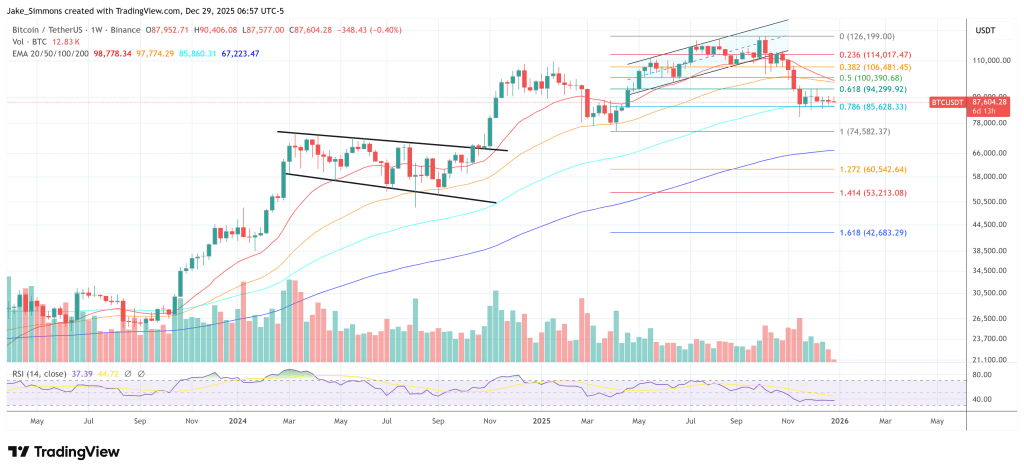
Bitcoin remains stuck between the 0.618 and 0.786 Fib, 1-week chart | Source: BTCUSDT on TradingView.com

Связанные с этим вопросы

QWhat is the main argument made by Coinbase CEO Brian Armstrong regarding Bitcoin and the US dollar?

ABrian Armstrong argues that Bitcoin strengthens the US dollar by acting as a market-based constraint on fiscal and monetary excess, serving as a 'check and balance' that helps maintain the dollar's reserve-currency credibility.

QHow does Armstrong suggest Bitcoin creates a 'check and balance' for the US dollar?

AHe states that Bitcoin creates healthy competition by providing an alternative store of value, which pressures policymakers to avoid high inflation and deficit spending, as capital can flee to Bitcoin during times of economic uncertainty.

QWhat potential consequence does Armstrong warn about if US inflation outpaces economic growth?

AArmstrong warns that if inflation outstrips economic growth, the US could eventually lose its reserve currency status, which he describes as 'a massive blow' to the country.

QHow does Armstrong frame Bitcoin's role in relation to the 'American experiment'?

AHe reframes Bitcoin not as an adversary to the dollar, but as a disciplining force that could help extend the 'American experiment' by incentivizing monetary stability and prolonging US financial leadership.

QWhat broader strategic competition does Armstrong mention in relation to reserve-currency status?

AArmstrong adds a geopolitical layer, noting that reserve-currency privilege is not static and that China and other superpowers are competing over time to challenge the US dollar's dominance.

Похожее

Торговля

Спот
Фьючерсы

Популярные статьи

Как купить S

Добро пожаловать на HTX.com! Мы сделали приобретение Sonic (S) простым и удобным. Следуйте нашему пошаговому руководству и отправляйтесь в свое крипто-путешествие.Шаг 1: Создайте аккаунт на HTXИспользуйте свой адрес электронной почты или номер телефона, чтобы зарегистрироваться и бесплатно создать аккаунт на HTX. Пройдите удобную регистрацию и откройте для себя весь функционал.Создать аккаунтШаг 2: Перейдите в Купить криптовалюту и выберите свой способ оплатыКредитная/Дебетовая Карта: Используйте свою карту Visa или Mastercard для мгновенной покупки Sonic (S).Баланс: Используйте средства с баланса вашего аккаунта HTX для простой торговли.Третьи Лица: Мы добавили популярные способы оплаты, такие как Google Pay и Apple Pay, для повышения удобства.P2P: Торгуйте напрямую с другими пользователями на HTX.Внебиржевая Торговля (OTC): Мы предлагаем индивидуальные услуги и конкурентоспособные обменные курсы для трейдеров.Шаг 3: Хранение Sonic (S)После приобретения вами Sonic (S) храните их в своем аккаунте на HTX. В качестве альтернативы вы можете отправить их куда-либо с помощью перевода в блокчейне или использовать для торговли с другими криптовалютами.Шаг 4: Торговля Sonic (S)С легкостью торгуйте Sonic (S) на спотовом рынке HTX. Просто зайдите в свой аккаунт, выберите торговую пару, совершайте сделки и следите за ними в режиме реального времени. Мы предлагаем удобный интерфейс как для начинающих, так и для опытных трейдеров.

1.1k просмотров всегоОпубликовано 2025.01.15Обновлено 2025.03.21

Как купить S

Sonic: Обновления под руководством Андре Кронье – новая звезда Layer-1 на фоне спада рынка

Он решает проблемы масштабируемости, совместимости между блокчейнами и стимулов для разработчиков с помощью технологических инноваций.

2.2k просмотров всегоОпубликовано 2025.04.09Обновлено 2025.04.09

Sonic: Обновления под руководством Андре Кронье – новая звезда Layer-1 на фоне спада рынка

HTX Learn: Пройдите обучение по "Sonic" и разделите 1000 USDT

HTX Learn — ваш проводник в мир перспективных проектов, и мы запускаем специальное мероприятие "Учитесь и Зарабатывайте", посвящённое этим проектам. Наше новое направление .

1.8k просмотров всегоОпубликовано 2025.04.10Обновлено 2025.04.10

HTX Learn: Пройдите обучение по "Sonic" и разделите 1000 USDT

Обсуждения

Добро пожаловать в Сообщество HTX. Здесь вы сможете быть в курсе последних новостей о развитии платформы и получить доступ к профессиональной аналитической информации о рынке. Мнения пользователей о цене на S (S) представлены ниже.

活动图片