Coinbase Launches Crypto-Backed USDC Loans For UK Users In Latest Expansion

bitcoinistОпубликовано 2026-04-21Обновлено 2026-04-21

Введение

Coinbase has expanded its crypto-backed USDC lending service to UK residents, allowing them to use Bitcoin (BTC), Ethereum (ETH), and Coinbase Wrapped Staked Ether (cbETH) as collateral. Powered by the on-chain protocol Morpho on the Base network, the service enables users to borrow up to $5 million in USDC without selling their crypto holdings. Collateral is locked in a smart contract until the loan is repaid, with liquidation triggered if the loan-to-value ratio exceeds a threshold. This follows the service’s successful US launch, where originations surpassed $2.17 billion. The move is part of Coinbase’s broader expansion in the UK, including savings accounts and DEX trading, and aligns with its efforts to integrate crypto into traditional finance, such as recently offering crypto-backed mortgages.

Building on its US success, crypto exchange Coinbase has rolled out crypto-backed USDC loans for UK residents, using Bitcoin (BTC) and Ethereum (ETH) as collateral. This expands the exchange’s growing suite of financial services in the region.

Crypto-Backed Loans Cross The Pond

On Monday, Coinbase, the largest crypto exchange in the US, announced that it has expanded its Borrow product to UK residents, unlocking more liquidity for users without having to sell their crypto holdings.

UK customers can now instantly borrow USDC using their Bitcoin, Ethereum, and Coinbase Wrapped Staked Ether (cbETH) as collateral, powered by Morpho, an on-chain protocol on the Base network.

Notably, Coinbase users will be able to borrow up to $5 million in USDC for Bitcoin-backed loans, depending on the amount of BTC pledged as collateral, the announcement explained.

The crypto exchange stated that collateral will be locked in a Morpho smart contract until the loan is fully repaid, and there is no fixed repayment schedule. However, it will be liquidated to repay the loan if the loan-to-value ratio exceeds a certain threshold, and Morpho will charge a liquidation penalty fee.

According to the Monday announcement, the launch expands access to the exchange’s crypto-backed lending service, which has seen multi-billion-dollar demand since launch in the US last year.

Providing access to crypto-backed loans in the UK is the first step in Coinbase’s ongoing efforts to expand following the launch of this offering in the US in January 2025. Initial interest in the service in the US has been substantial with total loan originations through Coinbase on Morpho growing to over $2.17B USDC as of April 14, 2026. Coinbase plans to continue expanding access to crypto-backed loans in more countries in the near future.

It also marks another step in Coinbase’s efforts to build a broader lineup of financial products in the country, following its successful registration as a crypto service provider by the Financial Conduct Authority (FCA) in February 2025. The exchange also launched savings accounts in the UK and DEX trading in November 2025 and April 2026, respectively.

Coinbase Expansion Continues

Coinbase’s latest launch also follows the company’s recent push to expand crypto-backed lending in traditional finance use cases. As reported by Bitcoinist, the exchange and Better Home & Finance launched a joint mortgage product for prospective home buyers to use their crypto holdings as collateral to fund their down payments on a Fannie Mae‐backed loan.

Per the announcement, the product aims to create a “direct pathway from digital wealth to homeownership” by allowing users to pledge Bitcoin and USDC held in a Coinbase account to secure a separate loan for their down payment.

Earlier this month, the exchange also achieved a crucial milestone in the US after receiving key approval that may unlock a broader market for the company. On April 2, Coinbase secured conditional approval from the Office of the Comptroller of the Currency (OCC), the main banking regulator, to charter Coinbase National Trust Company.

Although the company will not become a commercial bank and will not take retail deposits or engage in fractional reserve banking, the exchange noted the conditional approval marked a major step toward becoming a federally regulated crypto custodian, as it will allow Coinbase to “build the next chapter of finance,” boosted by the regulatory confidence.

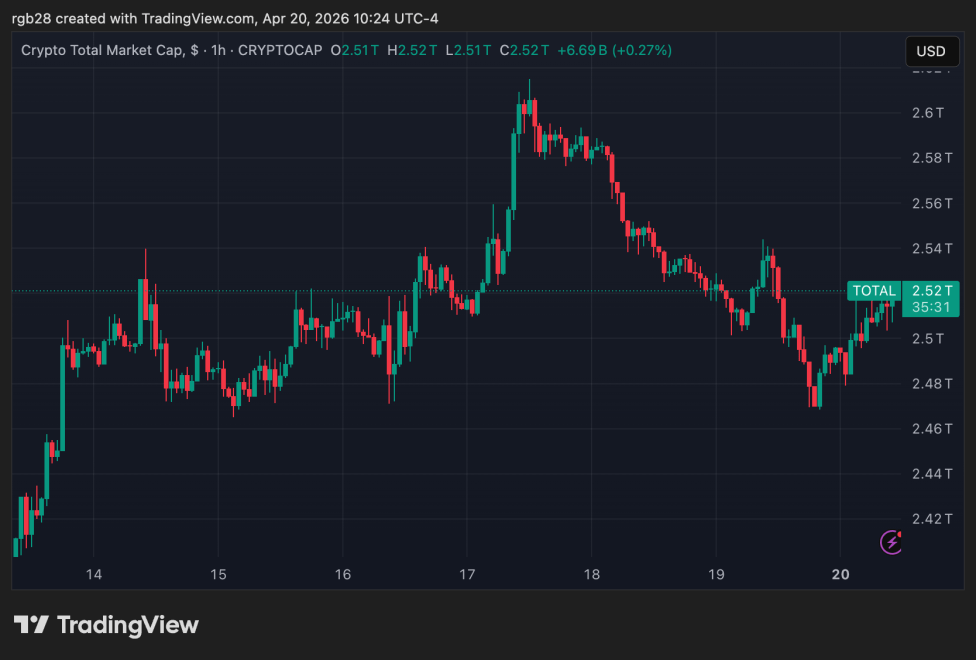
The total crypto market capitalization is at $2.52 trillion in the one-week chart. Source: TOTAL on TradingView

Связанные с этим вопросы

QWhat new service has Coinbase launched for UK users and which cryptocurrencies can be used as collateral?

ACoinbase has launched crypto-backed USDC loans for UK users, allowing them to use Bitcoin (BTC), Ethereum (ETH), and Coinbase Wrapped Staked Ether (cbETH) as collateral.

QWhat is the maximum loan amount a user can borrow for a Bitcoin-backed loan and what determines this amount?

AUsers can borrow up to $5 million in USDC for a Bitcoin-backed loan, with the specific amount depending on the value of the BTC pledged as collateral.

QWhich on-chain protocol powers this new lending service and what happens to the collateral if the loan-to-value ratio is exceeded?

AThe service is powered by the Morpho protocol on the Base network. If the loan-to-value ratio exceeds a certain threshold, the collateral will be liquidated to repay the loan, and a liquidation penalty fee will be charged.

QWhat was the total value of loan originations through Coinbase on Morpho in the US as of April 14, 2026?

AThe total loan originations through Coinbase on Morpho in the US grew to over $2.17 billion USDC as of April 14, 2026.

QWhat recent regulatory approval did Coinbase receive in the article mentions as a crucial milestone for its expansion?

ACoinbase received conditional approval from the Office of the Comptroller of the Currency (OCC) to charter Coinbase National Trust Company, a major step toward becoming a federally regulated crypto custodian.

Похожее

Apple's Desired On-Device AI Sees a Dark Horse Emerge: The First Cognitive Model is Born, 4B Matches GPT-5.4

A Chinese company, Tomorrow's Journey (Nextie), has introduced what it is calling the industry's first "cognitive model" for edge devices. Named New Journey Alpha, this 4-billion-parameter model reportedly matches the performance of trillion-parameter giants like GPT-5.4 in group intelligence tasks such as debate and collective decision-making. The development follows Andrej Karpathy's vision of stripping vast factual knowledge from large language models to retain only a smaller "cognitive core" capable of reasoning, planning, and knowing its own limits. This approach directly addresses the soaring computational costs and token expenses hindering AI's widespread deployment, as highlighted by incidents like Amazon shutting down an internal AI tool due to prohibitive costs. Trained via reinforcement learning on a corpus of academic papers from 1800-2020 to enhance generalization, the model enables three key advancements: 1) Improved decision quality in multi-agent systems, 2) Drastically reduced compute costs, allowing for cost-effective cloud or on-device (e.g., MacBook) deployment, and 3) The feasibility of "proactive" AI agents that act autonomously without user prompts, unlocking new commercial possibilities beyond today's reactive models. Built by the former Microsoft Xiaoice team—known for creating a 3.6B model that outperformed a 65B Llama model—the company is now focusing on the multi-agent systems sector, a field gaining significant investor interest. The model's economic impact is profound; by achieving high-level performance with minimal parameters, it fundamentally alters the cost structure of AI services, challenging the prevailing model of ever-larger parameter counts.

marsbit2 ч. назад

Apple's Desired On-Device AI Sees a Dark Horse Emerge: The First Cognitive Model is Born, 4B Matches GPT-5.4

marsbit2 ч. назад

OpenAI's 'Blueprint for the Future': Making AI Beneficial for Every Person on the Planet

A new transformative technology emerges every few generations. OpenAI draws a parallel with the advent of electricity in the 1920s, which initially brought convenience but ultimately enabled unprecedented progress in medicine, engineering, and living standards by empowering people to create new possibilities. AI is poised to recreate this phenomenon. Its true significance lies not in the technology itself, but in what people can achieve with it—from understanding a medical bill or starting a business to aiding scientific discovery. OpenAI believes AI should be universally accessible, allowing everyone to use it according to their own needs. This future, however, is not guaranteed. While transformative tech can centralize power, OpenAI's philosophy is that AI must serve humanity, augmenting human capabilities and broadly distributing its benefits. The company's first commitment is to build AI for human service, aiming to empower the many rather than concentrate power in a few. Safety, alignment with human intent, and oversight are paramount. OpenAI is optimistic about AI's potential to expand human welfare but remains clear-eyed about risks. The goal is to help people achieve more, not to replace them. Full automation is not the desired future; human judgment, values, and direction will become even more critical. OpenAI outlines three core goals: 1. Build automated AI researchers to accelerate and increasingly automate the research process itself, maintaining close human collaboration. The internal projection is that by March 2028, a significant portion of their research will be conducted by AI systems working alongside human researchers. 2. Accelerate economic development by advancing science, boosting productivity, and fostering growth, while ensuring the fruits are widely shared. 3. Provide a personal AGI for everyone on Earth, allowing individuals to benefit from this transformative technology in their own way. The company is entering its third phase, moving from foundational AGI research (Phase 1) to product deployment and learning from real-world use (Phase 2). The current challenge is making advanced AI abundant, affordable, safe, practical, and usable for all individuals and organizations. OpenAI concludes that a widely distributed power structure leads to a more resilient, adaptable, and free society. A positive AI future should not be controlled by a handful of entities but built, benefited from, and owned by many. If realized correctly, AI can become a cornerstone for enhancing global productivity, creativity, scientific advancement, and economic opportunity, fulfilling the mission to ensure AGI benefits all of humanity.

marsbit3 ч. назад

OpenAI's 'Blueprint for the Future': Making AI Beneficial for Every Person on the Planet

marsbit3 ч. назад

Торговля

Спот
Фьючерсы
活动图片