Bitcoin ETF Sees First Inflow in Three Weeks After Record $4.4 Billion Outflow Streak

marsbitОпубликовано 2026-06-15Обновлено 2026-06-15

Введение

US Bitcoin spot ETFs experienced a record-breaking outflow streak, with a net withdrawal of $4.4 billion over 13 consecutive trading days from May 15 to June 3, more than doubling the previous record set in February 2025. This sell-off, led predominantly by BlackRock's IBIT, coincided with a Bitcoin price drop from above $80,000 to around $63,000, reducing total ETF assets under management from $104.3 billion to $82.8 billion. A potential turning point emerged on June 12, when the funds collectively recorded zero net outflows and a net inflow of $85.84 million. Geoff Kendrick of Standard Chartered cited this as one of three signals indicating Bitcoin may have reached a cycle bottom. While the single day's inflow is small relative to the preceding outflows, it marks a crucial shift in momentum. Analysts view the halt in sustained selling pressure as a key indicator, suggesting the recent downturn was a significant correction rather than a structural collapse for the ETF market.

Author: Claude, Shenchao TechFlow

Shenchao Introduction: US spot Bitcoin ETFs have just weathered their most brutal withdrawal since listing: from May 15th to June 3rd, they experienced 13 consecutive trading days of net outflows, totaling $4.4 billion, more than double the old record set in February 2025. Combined with the drop in Bitcoin's price, the total assets under management (AUM) for these ETFs shrank from $104.3 billion to $82.8 billion over three weeks.

On June 12th, a turnaround signal emerged: all 12 funds saw zero outflows collectively, with a single-day net inflow of $85.84 million. Standard Chartered listed this signal as one of three pieces of evidence pointing to a Bitcoin price bottom.

13 Days, $4.4 Billion: Bitcoin ETFs End Longest Outflow Streak Since Listing

Measuring institutional sentiment towards Bitcoin, fund flows are the most direct yardstick.

These ETFs buy and sell spot Bitcoin in real-time based on investor subscriptions and redemptions. Money in and out directly corresponds to institutional position adjustments, free from the distortions of verbal statements.

Over the past month, this yardstick has revealed the worst numbers since their debut. According to Galaxy Research statistics, from May 15th to June 3rd, US spot Bitcoin ETFs saw net outflows for 13 consecutive trading days, accumulating approximately $4.37 billion, equivalent to about 59,000 BTC. This marks the longest continuous outflow streak since these products launched in January 2024. The previous record was 8 days and $3.2 billion in February 2025, a record this round more than doubled.

Galaxy Research also noted that outflow volumes across multiple time windows—7-day, 10-day, and 20-day—all hit historic highs during this period, indicating that selling pressure was not concentrated on a single day but persisted for a considerable duration. This round of withdrawals pushed the cumulative net inflows for 2026 into negative territory for the first time. Bloomberg ETF analyst Eric Balchunas confirmed that the year-to-date cumulative fund flows turned negative for the first time.
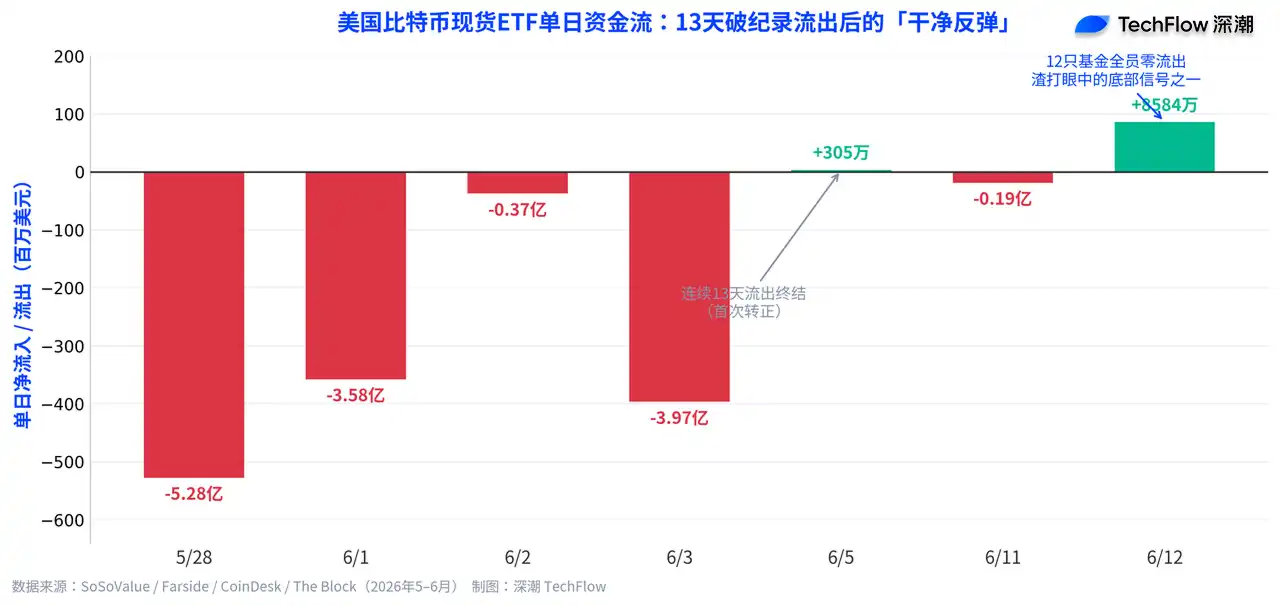
The most aggressive withdrawal came from BlackRock's IBIT. According to Farside Investors data, during the entire outflow period, IBIT alone saw outflows of about $3.3 billion, accounting for three-quarters of the total outflow. Fidelity's FBTC followed with outflows of approximately $456.6 million, and Grayscale's GBTC saw outflows of about $303.6 million. IBIT, the strongest fund in terms of attracting inflows since listing, became the epicenter of redemptions this time.

Capital Flight and Price Decline Mutually Reinforce, $21.5 Billion Evaporates in Three Weeks

The destructive force of the outflows was amplified by the simultaneous decline in Bitcoin's price.

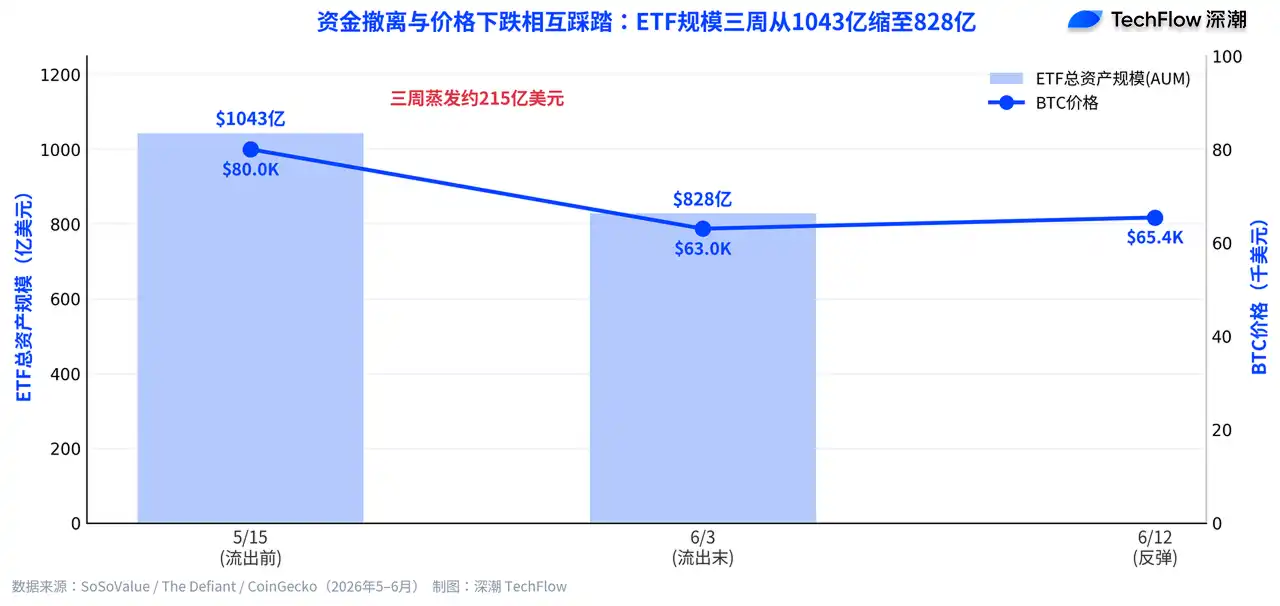
According to The Defiant citing SoSoValue data, the total AUM of all US spot Bitcoin ETFs dropped from approximately $104.29 billion on May 15th to around $82.83 billion on June 3rd, shrinking by about $21.5 billion in three weeks. This decline stems from the combined effect of two forces: the redemptions themselves withdrawing capital, and Bitcoin's price falling from above $80,000 to around $63,000 during the same period—a drop of about 21%—causing the market value of holdings to shrink accordingly. The two factors exacerbated each other.

In terms of holdings, the ETFs' Bitcoin holdings fell to approximately 1.277 million BTC, about 7.2% lower than the peak in October 2025. These ETFs currently hold about 6.36% of Bitcoin's circulating market cap, down from over 7% in mid-May.

A particularly striking redemption occurred on May 28th. That day, BlackRock's IBIT saw a single-day net outflow of $527.8 million, the second-largest daily redemption in the fund's history. For the entire month of May, US Bitcoin ETFs recorded a monthly net outflow of $2.43 billion, setting a record for the largest monthly outflow, with the final week alone accounting for $1.42 billion.

A 'Clean Rebound' After the Outflow Ends, Standard Chartered Counts It as a Bottom Signal

The turning point arrived in early June.

On June 5th, Bitcoin ETFs ended the 13-day outflow streak with a meager net inflow of $3.05 million. While $3.05 million is almost negligible in a market of this size, the direction had changed. On the same day, Ethereum ETFs also ended a 17-day consecutive outflow streak, with a net inflow of $19.3 million, entirely from BlackRock's ETHA fund alone.

The signal truly regarded by institutions came on June 12th (Friday). According to SoSoValue data, US spot Bitcoin ETFs recorded a single-day net inflow of $85.84 million that day. Five funds saw inflows, while the other seven recorded zero net flow; none experienced net outflows. This state of "collective zero outflows" across all 12 products is a key indicator for bullish observers to gauge whether selling pressure has eased.

Geoff Kendrick, Global Head of Digital Assets Research at Standard Chartered, included it in his checklist for a Bitcoin bottom. In a brief report to clients on Friday, Kendrick stated that cryptocurrency asset prices have likely seen the low for this cycle, corresponding to a Bitcoin price around $59,000, down 53% from the $126,000 high. He said three indicators should be watched for confirmation: Strategy reportedly bought Bitcoin again last week, ETFs recorded positive inflows on Friday, and oil prices continue to decline. The report concluded with his words: "Winter is over, welcome back to crypto spring."
However, a single-day inflow of $85.84 million cannot reverse the $4.4 billion withdrawal over three weeks. But a clean trading day is the starting point for observing whether selling pressure has peaked.

ETF fund flows now exert increasing influence on Bitcoin's price. According to calculations cited by Cryptopolitan, ETF flows can currently explain about 45% of Bitcoin's weekly price volatility. The cumulative net inflows for this batch of Bitcoin ETFs since their January 2024 launch still exceed $55 billion, remaining less than $10 billion away from their historical peak. Balchunas therefore judges the $4.4 billion outflow as a significant momentum reversal, not a structural collapse.


Связанные с этим вопросы

QAccording to the article, what was the most significant period of continuous net outflows for U.S. Bitcoin spot ETFs since their listing?

AThe most significant period was from May 15 to June 3, which saw 13 consecutive trading days of net outflows, totaling approximately $4.37 billion.

QWhich ETF was responsible for the largest share of outflows during the mentioned withdrawal period?

ABlackRock's iShares Bitcoin Trust (IBIT) was responsible for the largest share, accounting for about $3.3 billion or roughly three-quarters of the total outflows during that period.

QWhat key event on June 12, 2026, did Geoff Kendrick of Standard Chartered cite as one of the signs of a market bottom for Bitcoin?

AOn June 12, 2026, all 12 U.S. Bitcoin spot ETFs collectively recorded zero outflows, with a net daily inflow of $85.84 million. Geoff Kendrick cited this event as one of the three indicators confirming the market had reached a bottom.

QHow did the article describe the combined impact of ETF outflows and Bitcoin's price decline over the three weeks from May 15?

AThe article described it as a mutually reinforcing downward spiral. The combined impact of net redemptions and Bitcoin's price falling approximately 21% (from above $80,000 to around $63,000) caused the total assets of all U.S. Bitcoin spot ETFs to shrink by about $21.5 billion, from around $104.29 billion to $82.83 billion.

QWhat is the approximate explanatory power of ETF fund flows on Bitcoin's weekly price volatility according to the article?

AAccording to the article, citing a calculation, ETF fund flows can explain approximately 45% of Bitcoin's weekly price volatility.

Похожее

How to Do Research Well: Deliberately Practice the Real Skills That Matter

No one truly teaches you how to do research. You're often given a desk, a pre-selected problem, and vague instructions to "create something new." Consequently, many people reverse-engineer the job based on visible outputs—papers, posts, announcements—learning only how to *appear* like a researcher rather than how to *become* one. True research capability is built from stacking small, trainable skills, nearly all of which can be developed through deliberate practice. **Pick Your Own Problem:** Most researchers absorb problems from advisors or trends, lacking the underlying reasoning. Choosing a problem you genuinely care about, as John Schulman advises, leads to original work. Develop "taste" like a muscle: predict experiment outcomes, guess paper results from methods, and track which findings remain important over time. **Upgrade Your Inputs:** Relying on shared reading lists (arXiv hot lists, filtered group chats) leads to unoriginal conclusions. Undervalued old literature often holds crucial insights (e.g., MoE, LSTM, backpropagation). Richard Sutton's "The Bitter Lesson" or Claude Shannon's 1952 talk on creative thinking are more predictive than lengthy modern surveys. Breadth matters as much as depth: draw from neuroscience, mechanism design, hardware knowledge, and honest statistics. Read papers directly, especially appendices and limitations sections. **Write Everything Down:** As Paul Graham noted, writing exposes flaws in seemingly mature ideas. Writing is the cheapest defense against self-deception. Following Feynman's principle, Darwin programmatically wrote down facts contradicting his theory to combat memory bias. Maintain a detailed log of hypotheses, setups, predictions, results, and updated understandings. Reviewing past logs fosters essential humility.

marsbit56 мин. назад

How to Do Research Well: Deliberately Practice the Real Skills That Matter

marsbit56 мин. назад

Following US Ban on Fable 5, Zhipu AI's Stock Soars 47%

On June 15th, shares of Zhipu AI surged dramatically on the Hong Kong stock market, peaking at a 47.6% gain before closing 32.82% higher. This sharp increase was directly triggered by two recent industry events. On June 12th, Anthropic announced it was suspending global access to its latest flagship models, Claude Fable 5 and Claude Mythos 5, to comply with a U.S. government export control order. The next day, Zhipu AI announced it would open access to its latest open-source flagship model, GLM-5.2, under the permissive MIT license. The Anthropic incident highlighted a critical issue beyond raw model capability: the risk of sudden, unpredictable loss of access to advanced AI models, especially for developers and enterprises deeply integrated with them. This has shifted industry and market focus toward factors like stability, sustainable access, and controllability. Zhipu's move, promoting "frontier intelligence for all," positions its openly available model as a reliable and accessible alternative. The GLM-5.2 model emphasizes "Long Horizon Task" capabilities with a 1M context window, targeting complex, multi-step coding and engineering workflows where maintaining context is crucial. Analysts note this event exposes the risk of dependency on closed-source models subject to single jurisdictional controls, potentially accelerating a shift toward domestic base models and localized deployments. The market's reaction signals a new valuation dimension in AI: providers who can offer stable, long-term, and sustainably accessible AI capabilities are gaining strategic importance.

marsbit1 ч. назад

Following US Ban on Fable 5, Zhipu AI's Stock Soars 47%

marsbit1 ч. назад

Fully Entering the AI Era: Alipay Bets on Conversation, WeChat Holds Fast to Social

In May 2026, Alipay announced over 300 million AI payment transactions. Shortly after, WeChat opened its mini-programs for AI integration, sparking controversy by requiring developer source code access. This highlights their diverging approaches to AI integration. Alipay is testing "Project Treasure," an optional AI-native interface replacing traditional app grids with a conversational window. Users can command complex tasks (e.g., "book a ride and order coffee") handled end-to-end by AI. This shift follows an abandoned standalone AI app, focusing instead on enhancing its existing user base. For unmodified mini-programs, Alipay's AI uses "screen-reading" to simulate user interactions, bypassing the need for developer overhaul. It also introduced "Token Pay" for micro-transactions and "AI Wallets" for autonomous agent spending. WeChat, prioritizing its core social function, is taking an embedded approach. Its AI agent will operate within existing contexts like group chats and official accounts, assisting without a separate interface. To enable this, WeChat offers developers two paths: granting source code access for direct AI control ("Automatic Mode") or manually encapsulating services into standardized "Skills." Both place significant burden on developers. Key differences emerge in handling legacy services: WeChat demands developer cooperation (code or labor), while Alipay's screen-reading offers immediate, if potentially less stable, compatibility. Alipay's 3 billion AI transactions demonstrate user acceptance of AI-driven commercial actions. The divergent strategies may reshape mini-program ecosystems—Alipay passively "AI-fying" services, WeChat potentially favoring resource-rich developers—and set competing technical standards. Ultimately, the competition centers on where users entrust the command to "help me get things done."

marsbit1 ч. назад

Fully Entering the AI Era: Alipay Bets on Conversation, WeChat Holds Fast to Social

marsbit1 ч. назад

Торговля

Спот
Фьючерсы

Популярные статьи

Тест по Bitcoin Биткоина

HTX Learn: Изучите Bitcoin halving и Заработаете Токены USDT

3.1k просмотров всегоОпубликовано 2024.04.16Обновлено 2024.04.16

Тест по Bitcoin  Биткоина

Что такое $BITCOIN

ЦИФРОВОЕ ЗОЛОТО ($BITCOIN): Комплексный анализ Введение в ЦИФРОВОЕ ЗОЛОТО ($BITCOIN) ЦИФРОВОЕ ЗОЛОТО ($BITCOIN) — это проект на основе блокчейна, работающий в сети Solana, который стремится объединить характеристики традиционных драгоценных металлов с инновациями децентрализованных технологий. Хотя он носит имя Биткойн, часто называемого “цифровым золотом” из-за его восприятия как средства хранения ценности, ЦИФРОВОЕ ЗОЛОТО является отдельным токеном, предназначенным для создания уникальной экосистемы в ландшафте Web3. Его цель — позиционировать себя как жизнеспособный альтернативный цифровой актив, хотя детали его применения и функциональности все еще развиваются. Что такое ЦИФРОВОЕ ЗОЛОТО ($BITCOIN)? ЦИФРОВОЕ ЗОЛОТО ($BITCOIN) — это токен криптовалюты, специально разработанный для использования в блокчейне Solana. В отличие от Биткойна, который выполняет широко признанную роль хранения ценности, этот токен, похоже, сосредоточен на более широких приложениях и характеристиках. Примечательные аспекты включают: Инфраструктура блокчейна: Токен построен на блокчейне Solana, известном своей способностью обрабатывать высокоскоростные и недорогие транзакции. Динамика предложения: ЦИФРОВОЕ ЗОЛОТО имеет максимальное предложение, ограниченное 100 квадриллионами токенов (100P $BITCOIN), хотя детали о его обращающемся предложении в настоящее время не раскрыты. Утилита: Хотя точные функциональные возможности не описаны, есть указания на то, что токен может быть использован для различных приложений, потенциально связанных с децентрализованными приложениями (dApps) или стратегиями токенизации активов. Кто создатель ЦИФРОВОГО ЗОЛОТА ($BITCOIN)? На данный момент личность создателей и команды разработчиков, стоящих за ЦИФРОВЫМ ЗОЛОТОМ ($BITCOIN), остается неизвестной. Эта ситуация типична для многих инновационных проектов в области блокчейна, особенно тех, которые связаны с децентрализованными финансами и феноменом мем-криптовалют. Хотя такая анонимность может способствовать культуре, ориентированной на сообщество, она усиливает опасения по поводу управления и ответственности. Кто инвесторы ЦИФРОВОГО ЗОЛОТА ($BITCOIN)? Доступная информация указывает на то, что у ЦИФРОВОГО ЗОЛОТА ($BITCOIN) нет известных институциональных спонсоров или значительных венчурных капиталовложений. Проект, похоже, функционирует по модели пирингового взаимодействия, сосредоточенной на поддержке и принятии сообществом, а не на традиционных путях финансирования. Его активность и ликвидность в основном сосредоточены на децентрализованных биржах (DEX), таких как PumpSwap, а не на устоявшихся централизованных торговых платформах, что еще больше подчеркивает его подход, ориентированный на grassroots. Как работает ЦИФРОВОЕ ЗОЛОТО ($BITCOIN) Операционные механизмы ЦИФРОВОГО ЗОЛОТА ($BITCOIN) можно подробно описать на основе его дизайна блокчейна и характеристик сети: Механизм консенсуса: Используя уникальный механизм доказательства истории (PoH) Solana в сочетании с моделью доказательства доли (PoS), проект обеспечивает эффективную валидацию транзакций, что способствует высокой производительности сети. Токеномика: Хотя конкретные дефляционные механизмы не были подробно описаны, большое максимальное предложение токенов подразумевает, что оно может быть предназначено для микротранзакций или нишевых случаев использования, которые еще предстоит определить. Интероперабельность: Существует потенциал для интеграции с более широкой экосистемой Solana, включая различные платформы децентрализованных финансов (DeFi). Однако детали относительно конкретных интеграций остаются неуточненными. Хронология ключевых событий Вот хронология, которая подчеркивает значимые вехи, касающиеся ЦИФРОВОГО ЗОЛОТА ($BITCOIN): 2023: Первоначальное развертывание токена происходит в блокчейне Solana, отмеченное его адресом контракта. 2024: ЦИФРОВОЕ ЗОЛОТО приобретает видимость, когда оно становится доступным для торговли на децентрализованных биржах, таких как PumpSwap, позволяя пользователям обменивать его на SOL. 2025: Проект наблюдает спорадическую торговую активность и потенциальный интерес к инициативам, возглавляемым сообществом, хотя на данный момент не зафиксировано никаких значительных партнерств или технических достижений. Критический анализ Сильные стороны Масштабируемость: Основная инфраструктура Solana поддерживает высокие объемы транзакций, что может повысить полезность $BITCOIN в различных сценариях транзакций. Доступность: Потенциально низкая цена торговли за токен может привлечь розничных инвесторов, способствуя более широкому участию благодаря возможностям дробного владения. Риски Отсутствие прозрачности: Отсутствие публично известных спонсоров, разработчиков или процесса аудита может вызвать скептицизм относительно устойчивости и надежности проекта. Волатильность рынка: Торговая активность сильно зависит от спекулятивного поведения, что может привести к значительной волатильности цен и неопределенности для инвесторов. Заключение ЦИФРОВОЕ ЗОЛОТО ($BITCOIN) является интригующим, но неоднозначным проектом в быстро развивающейся экосистеме Solana. Хотя он пытается использовать нарратив “цифрового золота”, его отход от установленной роли Биткойна как средства хранения ценности подчеркивает необходимость более четкого различения его предполагаемой утилиты и структуры управления. Будущее принятие и усвоение, вероятно, будут зависеть от решения текущей непрозрачности и более четкого определения его операционных и экономических стратегий. Примечание: Этот отчет охватывает синтезированную информацию, доступную на октябрь 2023 года, и с тех пор могут произойти события.

99 просмотров всегоОпубликовано 2025.05.13Обновлено 2025.05.13

Что такое $BITCOIN

Fractal Bitcoin: масштабирование Биткоина с помощью рекурсивной системы

Fractal Bitcoin — масштабное Layer-1-решнение, созданное на базе кода Биткоина, позволяющего достигать бесконечного масштабирования с помощью рекурсивного подхода.

2.3k просмотров всегоОпубликовано 2025.06.30Обновлено 2025.06.30

Fractal Bitcoin: масштабирование Биткоина с помощью рекурсивной системы

Обсуждения

Добро пожаловать в Сообщество HTX. Здесь вы сможете быть в курсе последних новостей о развитии платформы и получить доступ к профессиональной аналитической информации о рынке. Мнения пользователей о цене на BTC (BTC) представлены ниже.

活动图片