Bessent Urges Senate to Fast-Track Warsh Nomination as Institutional Liquidity Pivot Favors LiquidChain

bitcoinistОпубликовано 2026-02-09Обновлено 2026-02-09

Введение

Treasury Secretary Scott Bessent is urging the Senate to fast-track the confirmation of Kevin Warsh to the Federal Reserve Board, signaling a potential shift toward pro-growth monetary policies and reduced regulatory uncertainty. This move is seen as a precursor to a more disciplined economic environment, which could slash uncertainty premiums and push institutional capital toward risk assets. Concurrently, institutional investors are seeking unified infrastructure to manage liquidity across fragmented blockchain ecosystems. LiquidChain ($LIQUID) emerges as a key solution, offering a Layer 3 infrastructure that merges Bitcoin, Ethereum, and Solana into a single execution layer. Its 'Deploy-Once' architecture and Cross-Chain Virtual Machine eliminate the need for complex bridges and multiple gas tokens, addressing critical friction points for capital efficiency. The protocol has raised over $532K in its ongoing presale, indicating smart money is positioning for a liquidity rotation. As macro conditions improve and federal policy evolves, interoperability layers like LiquidChain are poised to capture the volume from traditional finance entering the digital asset space.

Trusted Editorial content, reviewed by leading industry experts and seasoned editors. Ad Disclosure

Quick Facts:

  • ➡️ Treasury Secretary Bessent’s push for Kevin Warsh’s confirmation signals a potential shift toward pro-growth monetary policies and reduced regulatory uncertainty.
  • ➡️ Institutional investors are seeking a unified infrastructure to manage liquidity across fragmented blockchains as macro conditions improve.
  • ➡️ LiquidChain ($LIQUID) merges Bitcoin, Ethereum, and Solana into a single execution layer, solving critical friction points for capital efficiency.
  • ➡️ Capital rotation into risk assets historically accelerates following major shifts in Federal Reserve leadership and policy direction.

In an interview with Fox News, U.S. Treasury Secretary Scott Bessent indicated he wants the Senate to move fast on Kevin Warsh’s confirmation to the Federal Reserve Board. That’s not just procedural housekeeping. It signals a coordinated push to reshape the Fed’s doctrinal approach before the next tightening cycle can even take hold.

Wall Street sees the Warsh nomination as a precursor to a more disciplined, pro-growth environment. Historically, clarity at the central bank slashes uncertainty premiums, pushing capital further out on the risk curve. That matters. Institutional allocators are currently sitting on record levels of dry powder, just waiting for a signal that the headwinds are finally abating.

If confirmed, Warsh, a former Morgan Stanley banker, will likely champion capital formation over aggressive interventionism. For digital assets? The implications are massive. While the Treasury pushes for leadership that understands modern financial plumbing, the infrastructure underneath is evolving rapidly. (The timing here isn’t exactly coincidental.)

Smart money is prepping for a liquidity rotation, shifting focus from accumulation to efficiency. This macro setup creates a perfect storm for interoperability layers like LiquidChain ($LIQUID), designed to capture the volume traditional rails are about to unleash.

Unified Execution Environments Solve the Fragmentation Crisis

While the Treasury streamlines federal policy, crypto faces its own bureaucracy: liquidity silos that trap capital. Institutional investors entering the space are finding that managing positions across Bitcoin, Ethereum, and Solana requires a messy web of bridges and distinct wallets. Frankly, it’s a friction point that kills true institutional adoption.

LiquidChain tackles this by establishing a Layer 3 (L3) infrastructure that fuses these major ecosystems into one execution environment. Using a ‘Deploy-Once’ architecture, the protocol allows developers to write code interacting simultaneously with $BTC, $ETH, and $SOL liquidity. That’s a game-changer. It eliminates the security risks of traditional bridges (often the weak link in DeFi) while providing the unified experience Wall Street desks demand.
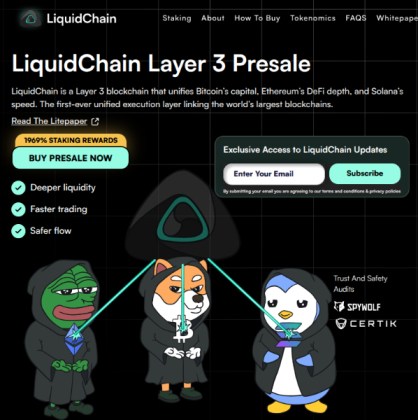
The protocol’s Cross-Chain Virtual Machine acts as a universal translator for value. Instead of forcing users to juggle different gas tokens, LiquidChain abstracts the complexity for single-step execution. For an asset manager looking to stake Bitcoin while accessing Solana’s high-velocity markets, this isn’t just convenient; it’s an operational necessity.

LEARN MORE ON THE OFFICIAL LIQUIDCHAIN WEBSITE

Presale Data Suggests Smart Money is Front-Running the Pivot

The appetite for infrastructure plays is already showing up in the data. LiquidChain has raised over $532K in its ongoing presale, a figure pointing to specific accumulation patterns rather than broad retail speculation. With tokens currently priced at $0.0136, the valuation implies significant room for growth relative to interoperability competitors trading at multi-billion dollar caps.

This traction validates a core thesis: the next cycle will be defined by utility, not just meme-driven hype. Funds are bolstering the Unified Liquidity Layer to ensure the pipes are wide enough when the macro floodgates open. Unlike governance-only tokens, $LIQUID functions as transaction fuel, creating a direct link between network usage and token demand.

The risk here, of course, is execution. Building a secure L3 that interoperates with Bitcoin’s rigid scripting and Solana’s speed is technically demanding. But the market’s willingness to fund this vision early suggests high conviction that fragmentation is a problem worth solving.

As the Treasury works to unclog the regulatory gears in D.C., LiquidChain is quietly building the machinery to unclog the flow of value on-chain.

BUY YOUR $LIQUID HERE

This article is for informational purposes only and does not constitute financial advice. Cryptocurrency investments carry inherent risks, and readers should perform their own due diligence before making any investment decisions.

Editorial Process for bitcoinist is centered on delivering thoroughly researched, accurate, and unbiased content. We uphold strict sourcing standards, and each page undergoes diligent review by our team of top technology experts and seasoned editors. This process ensures the integrity, relevance, and value of our content for our readers.

Ben Wallis

Follow

Ben is a freelance writer, and AI editor specializing in crypto developments (mainly altcoins) and the intricate ways global economics shape the digital asset space. His B.Ed. in Education provides a unique foundation for his writing, enabling him to distill complex crypto concepts and market shifts into clear, digestible insights. This skill is key to helping readers adapt and apply their understanding to the ever-evolving world of crypto investment. Passionate about making crypto accessible, Ben crafts content designed to educate a broad audience, from current market events to the essential foundational knowledge that underpins them. His goal is to empower readers through understanding. When he’s not immersed in crypto analysis and breaking down complex topics, Ben is an avid Pokémon fan and enjoys all things Disney.

Full Profile

Related Posts

South Korea’s FSS To Probe Whale Manipulation: How SUBBD Is Built For Fair And Transparent Trading

Infini Exploiter Hackers Resurface to Buy the $ETH Dip: How $BMIC Adds Security for the Future

Turkey & Tether Freeze $544M: Why $BMIC Is The Safe Haven

Tether’s $23B Gold Hoard Rivals Nation States As Smart Money Pivots To $HYPER

Story Co-Founder Defends Token Unlock Delays; Why Long-Term Scaling Matters For $MAXI

Takaichi’s Victory Sends Nikkei to Records as Bitcoin Reclaims $72K; What this Means for $HYPER

Связанные с этим вопросы

QWhat is the significance of Treasury Secretary Scott Bessent urging the Senate to fast-track Kevin Warsh's nomination to the Federal Reserve Board?

AIt signals a coordinated push to reshape the Fed's doctrinal approach toward a more disciplined, pro-growth monetary policy and reduced regulatory uncertainty, which is seen as a precursor to slashing uncertainty premiums and encouraging capital to move further out on the risk curve.

QWhat problem does LiquidChain ($LIQUID) aim to solve in the cryptocurrency space?

ALiquidChain aims to solve the liquidity fragmentation crisis by creating a unified Layer 3 (L3) infrastructure that merges Bitcoin, Ethereum, and Solana into a single execution layer, eliminating the friction and security risks of managing capital across multiple, distinct blockchains and bridges.

QHow does LiquidChain's 'Deploy-Once' architecture function?

ALiquidChain's 'Deploy-Once' architecture allows developers to write code that can interact simultaneously with $BTC, $ETH, and $SOL liquidity, creating a unified execution environment that abstracts away the complexity of using different gas tokens and separate wallets.

QWhat does the presale data for LiquidChain ($LIQUID) indicate about investor sentiment?

AThe presale raising over $532K indicates smart money is accumulating and front-running a potential macro pivot, showing high conviction that solving blockchain fragmentation is a critical utility play for the next market cycle, rather than mere retail speculation.

QHow is the potential confirmation of Kevin Warsh linked to the thesis for investing in infrastructure like LiquidChain?

AA Warsh-led Fed is expected to create a pro-growth, clarity-driven environment that reduces uncertainty. This macro shift is anticipated to unleash a wave of institutional capital into risk assets, making high-efficiency infrastructure like LiquidChain essential for capturing and managing that incoming liquidity.

Похожее

The Shutdown of Claude Mythos Revealed the True Cost of Renting AI to Me

The sudden shutdown of Claude Mythos this week starkly highlights a critical, often overlooked risk for founders: when your core capability relies entirely on someone else's platform, your fate is not in your own hands. The key question becomes: who truly owns the intelligence your product depends on? For years, the debate around open-source models focused on cost. Now, the evidence is clear: fine-tuned open-source models can achieve frontier-level quality for specific, mission-critical tasks at a fraction of the cost. However, the deeper issue is control. Relying on a third-party API is like renting; it works until the landlord changes the rules, raises the rent, or asks you to leave—as Mythos experienced. The lesson is not to stop using frontier models—they are incredible infrastructure. The goal is ownership. Ownership means starting with a powerful open-source model and shaping it around what makes your company unique: your data, workflows, domain expertise, and definition of "good." Over time, the model becomes less generic and more reflective of your business, creating durable value. The optimistic conclusion is that AI's future doesn't hinge on one superior model. There is no single frontier. The frontier includes proprietary models, models fine-tuned on company-specific knowledge, specialized models for narrow problems, and intelligent routers orchestrating model ensembles. The most interesting development is not models getting smarter, but intelligence becoming increasingly customizable. The winning companies will be those that transform intelligence into a unique, owned asset. Looking ahead, the vision is not one model dominating all, but many teams owning the part of the frontier that matters most to them.

marsbit9 мин. назад

The Shutdown of Claude Mythos Revealed the True Cost of Renting AI to Me

marsbit9 мин. назад

Tiger Research: U.S. Strategic Bitcoin Reserve - Should the Market Be Happy or Disappointed?

Tiger Research analyzes the evolution of U.S. legislative efforts regarding a strategic Bitcoin reserve, concluding the market impact is limited in the short term but potentially positive long-term. The core event was a March 2025 executive order by former President Trump, which designated confiscated Bitcoin as a strategic reserve and promised not to sell existing holdings (approx. 190k BTC). As it contained no mandate to purchase new Bitcoin, the market reacted negatively, with prices dropping 5.7%. Legislative history shows a significant retreat from initial ambitions. The 2024 "BITCOIN Act" proposed mandatory purchases of 1 million BTC over five years. Reintroduced in 2025, it stalled due to high fiscal costs, concerns over dollar hegemony, and opposition from the Treasury Secretary. The current frontrunner, the 2026 "American Retirement and Monetary Advancement (ARMA) Act," is a compromise. It lacks any purchase requirement, instead focusing on consolidating existing government-held Bitcoin and legally prohibiting its sale for at least 20 years. While ARMA has higher passage odds due to bipartisan support and no purchase mandate, its immediate market effect is neutral. It eliminates potential government selling pressure but creates no new demand. The long-term significance is that formally establishing Bitcoin as a national reserve asset in law could later reignite debates on mandatory purchases. Therefore, the path to a government buyer is longer than initially priced by the market, but the directional narrative remains intact.

marsbit11 мин. назад

Tiger Research: U.S. Strategic Bitcoin Reserve - Should the Market Be Happy or Disappointed?

marsbit11 мин. назад

US Stock Market Trend (June 16): SpaceX Rises 42% in Two Days, New Fed Chairman Takes Office Today

**U.S. Stocks Trend (June 16): SpaceX Soars 42% in Two Days, New Fed Chair Takes Office Today** Markets surged on Monday following former President Trump's social media announcement of a completed U.S.-Iran deal to reopen the Strait of Hormuz, pending a June 19 signing. The news triggered a broad risk-on rally: oil prices crashed, tech stocks soared, bond yields fell, and defensive sectors lagged. **Market Performance:** The Nasdaq jumped 3.07%, led by semiconductor stocks like Micron (+9.2%). The S&P 500 gained 1.65%, and the Dow rose 0.92% to a record high. However, the Russell 2000 small-cap index underperformed (+0.72%). SpaceX continued its hot streak, rising another 5% pre-market after disclosures of large buys by an Australian billionaire and Cathie Wood's ARK. Boeing also rallied on the transportation optimism. Conversely, energy stocks like Chevron fell over 3% on the oil price plunge, with other defensive sectors also selling off. The day's action showed a clear rotation of funds from energy/defensive plays into AI and tech narratives. **Macro & Outlook:** The VIX fear index fell 8.37%. Treasury yields declined, and WTI crude dropped over 5%. Attention now shifts to a packed schedule: the Bank of Japan is widely expected to hike rates to 1.0% on Tuesday. The Fed's June meeting concludes Wednesday, marking new Chair Wash's debut. While rates are expected to hold, his tone on stubborn inflation and the "dot plot" will be crucial for gauging the 2024 rate path. The formal Iran deal signing is set for Friday. **Trend Perspective:** While the peace deal is a genuine positive, Monday's explosive rally may have gotten ahead of itself, pricing in a swift resolution to inflation concerns. The shortened trading week faces a triple test: BoJ tightening, the Fed's policy stance, and deal implementation details. Tech and semiconductors, which led the surge, remain vulnerable to any disappointment from these key events. The real price discovery begins with the central banks' communications this week.

marsbit32 мин. назад

US Stock Market Trend (June 16): SpaceX Rises 42% in Two Days, New Fed Chairman Takes Office Today

marsbit32 мин. назад

Xiaohongshu's Second Great Voyage, This Time Sailing Towards AI

Xiaohongshu's Second Voyage: Navigating Towards AI Since ChatGPT's emergence, Xiaohongshu's founder Mao Wenchao has been acutely aware of AI's potential threat, recognizing that the life advice people seek from chatbots overlaps directly with his platform's core business. Founded in 2013 as a PDF shopping guide for Chinese tourists, Xiaohongshu evolved into a massive community where millions share authentic, personal experiences—from product reviews to travel tips. This vast repository of "I've tried this" human judgment became its most valuable asset. However, the rise of AI, which delivers instant answers, challenges the very need for users to sift through numerous personal notes. Fearing its treasure trove of lived experience could become mere training data for others, Xiaohongshu is proactively adapting. In 2026, it established a dedicated AI division (Dots), launched RED Skill to turn user experiences into usable AI tools, and acquired the AI search product "Diandian." Its investments now extend to AI firms like MiniMax and hardware startups, moving upstream to address needs before they even become search queries. The platform's commercialization strategy is also evolving. With a newly acquired payment license and tools like the AIPS model to track consumer decision journeys, Xiaohongshu aims to seamlessly integrate recommendations with transactions, embedding commerce within AI-generated answers. Yet, a critical tension remains. While building smarter machines to organize and leverage its human experiences, Xiaohongshu must prevent AI from drowning out the authentic, flawed, and trustworthy "I've tried this" voices that built its community. Its core challenge is to harness AI's power without letting the map—the machine's perfect, synthesized answer—replace the territory of genuine human experience. This balance between technological advancement and preserving human trust defines its current journey and its future.

marsbit1 ч. назад

Xiaohongshu's Second Great Voyage, This Time Sailing Towards AI

marsbit1 ч. назад

Торговля

Спот
Фьючерсы
活动图片