Based on a16z's Annual Predictions, Which Crypto Projects Are Worth Watching?

marsbitОпубликовано 2026-01-04Обновлено 2026-01-04

Введение

Based on a16z's 2026 predictions, several key crypto sectors and projects are worth watching. 1. **Payments & Stablecoins**: Stablecoins are becoming the internet's settlement layer. Key projects include Circle (USDC) for regulatory compliance, m0 for zero-fee USDC issuance, Ether_fi and Plasma as crypto-native neobanks, and x402 for agent-native programmable payments. 2. **RWA & On-Chain Credit**: The focus shifts from tokenization to native on-chain credit origination for efficiency. Projects to watch: Centrifuge, Blackrock's BUIDL, Maple, Plume, Pendle, Ondo, and Backed. 3. **AI Agents & Payments**: As autonomous AI agents transact, payments must become internet-native, instant, and programmable. Key players: Catena (KYA standards), Nevermined (data markets), KiteAI, ASI, EigenCloud, Fetch, and x402 implementations. 4. **Privacy**: Privacy creates user lock-in and becomes a key moat. Projects: Aztec, Nillion, Arcium, Aleo, Walrus/Seal (Sui), Payy_link, Zcash, and Monero. 5. **Security**: The shift from "code is law" to "spec is law" requires runtime enforcement and continuous monitoring. Leaders: OpenZeppelin, Trailofbits, SpearbitDAO, Cyfrin, and Immunefi. 6. **Prediction Markets**: Evolving from niche betting to real-time information infrastructure. Top platforms: Polymarket, Kalshi, FractionAI, Opinion, and Myriad Markets. 7. **zkVMs & Verifiable Computation**: zkVMs are making verifiable computation a viable systems primitive. Key projects: RiscZero, Succinct, ...

Source: Stacy Muur

Compiled by: Ken, ChainCatcher

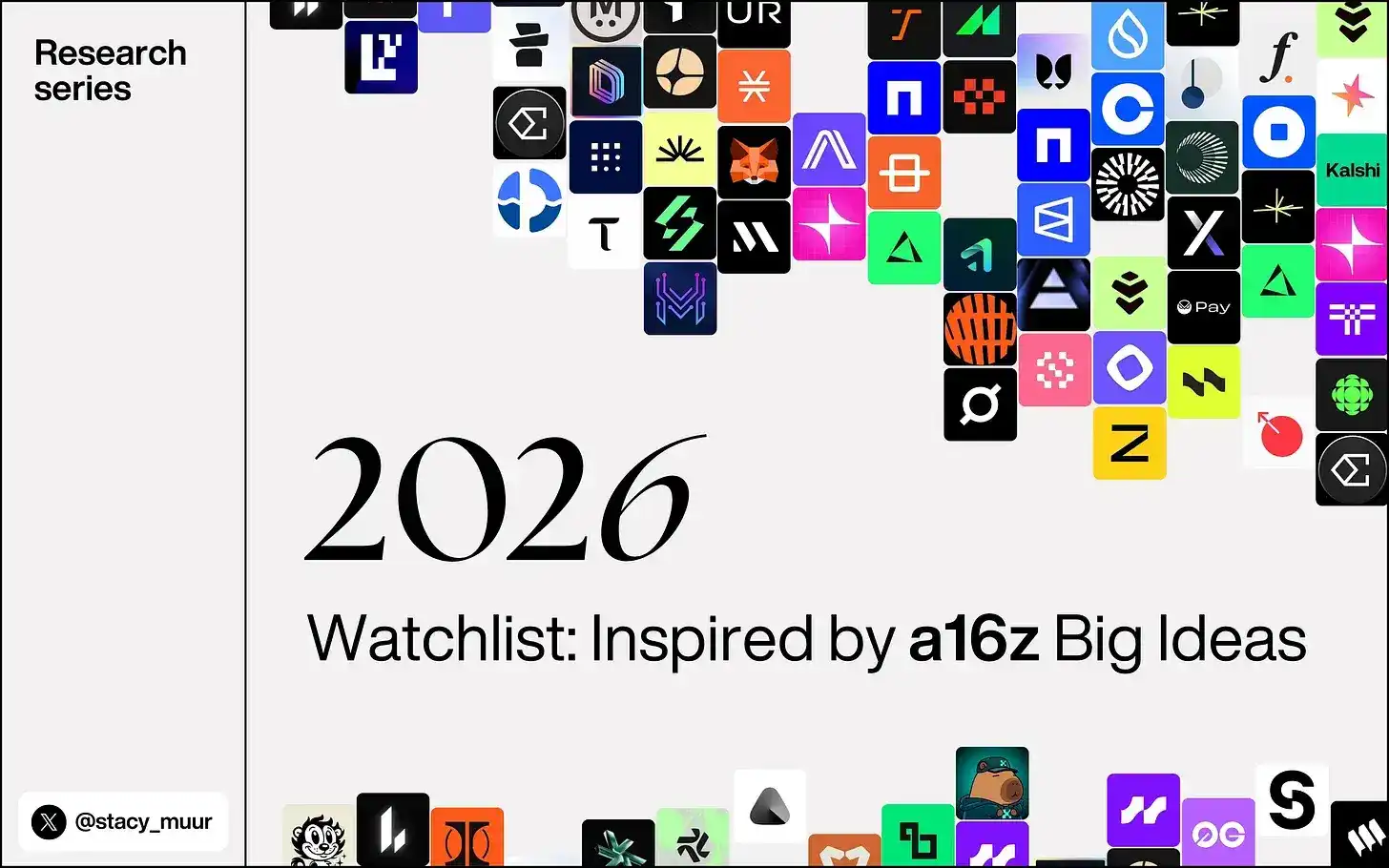
In mid-December, a16z released its annual "Big Ideas for 2026." Below is a watchlist organized according to the main theses in their vision.

1. Payments, Stablecoins, and the Reshaping of Financial Rails

Thesis: Stablecoins will become the settlement layer for the internet, not just for cryptocurrency.

The stablecoin story has moved past the proof-of-concept stage. Today, their annual transaction volume has reached trillions of dollars. The question is no longer whether stablecoins work, but whether they can integrate seamlessly with the real-world financial system.

<极简风格,只进行必要的翻译,保留所有标签和格式。>

Связанные с этим вопросы

QAccording to a16z's 2026 predictions, what is the key argument regarding stablecoins and their role in the financial system?

AThe key argument is that stablecoins will become the settlement layer for the internet, not just for cryptocurrencies. They are seen as an upgrade to ledgers, offering real-time settlement, programmability, and global reach, which allows banks and fintech companies to integrate them without rewriting legacy software. The focus shifts from issuing stablecoins to distribution, compliance, and integration.

QWhat is the core insight from a16z regarding Real World Assets (RWA) and the next wave of adoption?

AThe core insight is that merely tokenizing existing off-chain assets is not enough. True efficiency gains come from moving the origination of assets on-chain. When loans are initiated on-chain, underwriting logic becomes programmable, servicing costs drop significantly, and risk can be priced and monitored in real-time. This transforms crypto from a distribution channel into financial infrastructure itself.

QHow does a16z's prediction frame the relationship between AI agents and payments on the internet?

AThe prediction argues that as AI agents begin to transact autonomously, payments can no longer be an external system bolted onto applications. They must be native to the internet: instant, programmable, and fully automated. The shift is from user-driven execution to intent-driven execution, where agents identify conditions, fulfill obligations, and trigger operations autonomously, making value transfer function like network traffic.

QWhy does a16z consider privacy to be a major moat in the context of public blockchains?

Aa16z's core insight is that block space has become commoditized, but confidentiality has not. If everything is public, users can migrate freely and liquidity can be bridged instantly, leading to applications competing in a zero-profit environment. Privacy breaks this symmetry. Once users or applications commit sensitive data to a privacy-preserving environment, switching costs are created, forming a 'privacy network effect' where the more activity there is in a private domain, the more value is locked in, making it riskier to leave due to potential information leakage.

QWhat is the fundamental shift in security philosophy that a16z predicts for 2026, moving away from 'code is law'?

Aa16z predicts a shift from 'code is law' to 'specification is law.' The new security philosophy moves beyond static audits to runtime enforcement of system-level invariants. Protocols will formally define rules that must always hold (e.g., collateral limits, value conservation, solvency conditions) and continuously enforce these properties, not just at deployment. This is achieved through runtime guards, formal specifications, AI-assisted verification, and continuous monitoring.

Похожее

After Burning Tens of Billions of Dollars in Tokens, Silicon Valley Giants Start Limiting Employee Token Usage

After burning tens of billions of dollars on AI tokens, major Silicon Valley firms are now restricting employee usage. Companies like Microsoft, Uber, and Salesforce, which heavily promoted AI for "efficiency," are facing a cost crisis. The practice of "tokenmaxxing"—pushing employees to maximize AI tool usage—led to wasteful spending on trivial tasks like checking the weather or writing birthday messages, with studies showing significant hidden costs for bug fixes and code rewrites. The core issue is a misalignment between individual productivity gains and actual business value. While employees use AI to automate tasks they dislike, such as writing reports, this often doesn't translate to increased company revenue or improved core business outcomes. For instance, AI-generated code speeds up development but also sees an 800% increase in "code churn" (code being discarded or rewritten). As a result, only 14% of CFOs report seeing a clear, measurable return on AI investments. Firms are now shifting strategies. Microsoft has revoked most internal licenses for Claude Code, while others are implementing monitoring and cost controls. New tools from companies like Harness and CloudZero aim to track AI spending and tie costs to business results. Some AI vendors, like HubSpot, are moving from token-based pricing to charging based on outcomes, such as "resolved conversations" or "leads generated." This represents a necessary correction in the AI adoption cycle. The challenge now is for companies to move beyond using AI merely to speed up old tasks and instead rethink their workflows and business models fundamentally. The future of enterprise AI depends on proving its value, not just its usage.

marsbit12 мин. назад

After Burning Tens of Billions of Dollars in Tokens, Silicon Valley Giants Start Limiting Employee Token Usage

marsbit12 мин. назад

I've Been a VC in Web3 for Nine Years: Asian Funds Are Experiencing "Hell Mode"

After nine years as a Web3 VC, the author observes a severe downturn in Asia's crypto venture capital scene, with many funds disappearing or pivoting away. The market has cooled dramatically since the 2021-2024 frenzy, leading to fewer deals and active investors. IOSG Ventures, a firm that has endured three market cycles, has adapted its strategy: shifting from 80-90% early-stage investments to a 50% early-stage, 30% post-TGE, and 20% OTC portfolio to find better value and liquidity. The current bear market is described as "hell mode" for Asian funds due to scarce LP capital, forcing extreme precision in targeting only top projects. The author argues the core industry problem has been the disconnect between tokens and real value, where tokens served as fundraising tools without granting holders rights to protocol revenue. A positive shift is emerging where projects like Uniswap and Morpho are programmatically binding token value to protocol profits. Investment focus has moved towards fundamentals: real-yield financial infrastructure (stablecoins, lending) and crypto-native AI infrastructure, while avoiding narrative-driven projects. The conclusion is that true, durable companies are born in pessimistic times when focus shifts to real user needs and sustainable business models. The industry's future will be shaped by those who remain after the泡沫 dissipates.

marsbit38 мин. назад

I've Been a VC in Web3 for Nine Years: Asian Funds Are Experiencing "Hell Mode"

marsbit38 мин. назад

Cango Releases Q1 Financial Report: Total Revenue of $102 Million, Business Expands into AI Computing Infrastructure

Cango Releases Q1 2026 Financial Results: Total Revenue of $102 Million, Business Expands into AI Compute Infrastructure Bitcoin mining company Cango reported unaudited financial results for Q1 2026. While bitcoin mining remains its core revenue driver, the company is strategically expanding into energy and AI compute infrastructure. **Key Financial & Operational Highlights:** * **Revenue & Performance:** Total revenue for the quarter was $102 million, with $98.4 million coming from bitcoin mining. However, the company reported a net loss of $261.1 million, primarily attributed to non-cash impacts like bitcoin price declines leading to miner impairments and fair value losses on its bitcoin holdings. Notably, long-term debt was significantly reduced to $30.6 million from $557.6 million at the end of 2025. * **Mining Operations:** Cango's total hash rate was 37.01 EH/s. It mined 1,266 bitcoin during the quarter and reduced its average cash cost per bitcoin by 9.0% quarter-over-quarter to $76,928, demonstrating improved operational efficiency. * **AI Business Expansion:** The company introduced EcoHash, a new commercial platform. This initiative leverages Cango's existing expertise in energy management and high-density computing to provide infrastructure for AI workloads, starting with GPU compute leasing. Management emphasized executing a disciplined strategy to strengthen the core mining business while advancing AI infrastructure through EcoHash. They highlighted progress in cost reduction, stable global operations, and a strengthened balance sheet through debt reduction.

marsbit38 мин. назад

Cango Releases Q1 Financial Report: Total Revenue of $102 Million, Business Expands into AI Computing Infrastructure

marsbit38 мин. назад

Торговля

Спот
Фьючерсы

Популярные статьи

Как купить S

Добро пожаловать на HTX.com! Мы сделали приобретение Sonic (S) простым и удобным. Следуйте нашему пошаговому руководству и отправляйтесь в свое крипто-путешествие.Шаг 1: Создайте аккаунт на HTXИспользуйте свой адрес электронной почты или номер телефона, чтобы зарегистрироваться и бесплатно создать аккаунт на HTX. Пройдите удобную регистрацию и откройте для себя весь функционал.Создать аккаунтШаг 2: Перейдите в Купить криптовалюту и выберите свой способ оплатыКредитная/Дебетовая Карта: Используйте свою карту Visa или Mastercard для мгновенной покупки Sonic (S).Баланс: Используйте средства с баланса вашего аккаунта HTX для простой торговли.Третьи Лица: Мы добавили популярные способы оплаты, такие как Google Pay и Apple Pay, для повышения удобства.P2P: Торгуйте напрямую с другими пользователями на HTX.Внебиржевая Торговля (OTC): Мы предлагаем индивидуальные услуги и конкурентоспособные обменные курсы для трейдеров.Шаг 3: Хранение Sonic (S)После приобретения вами Sonic (S) храните их в своем аккаунте на HTX. В качестве альтернативы вы можете отправить их куда-либо с помощью перевода в блокчейне или использовать для торговли с другими криптовалютами.Шаг 4: Торговля Sonic (S)С легкостью торгуйте Sonic (S) на спотовом рынке HTX. Просто зайдите в свой аккаунт, выберите торговую пару, совершайте сделки и следите за ними в режиме реального времени. Мы предлагаем удобный интерфейс как для начинающих, так и для опытных трейдеров.

1.4k просмотров всегоОпубликовано 2025.01.15Обновлено 2025.03.21

Как купить S

Sonic: Обновления под руководством Андре Кронье – новая звезда Layer-1 на фоне спада рынка

Он решает проблемы масштабируемости, совместимости между блокчейнами и стимулов для разработчиков с помощью технологических инноваций.

2.3k просмотров всегоОпубликовано 2025.04.09Обновлено 2025.04.09

Sonic: Обновления под руководством Андре Кронье – новая звезда Layer-1 на фоне спада рынка

HTX Learn: Пройдите обучение по "Sonic" и разделите 1000 USDT

HTX Learn — ваш проводник в мир перспективных проектов, и мы запускаем специальное мероприятие "Учитесь и Зарабатывайте", посвящённое этим проектам. Наше новое направление .

1.8k просмотров всегоОпубликовано 2025.04.10Обновлено 2025.04.10

HTX Learn: Пройдите обучение по "Sonic" и разделите 1000 USDT

Обсуждения

Добро пожаловать в Сообщество HTX. Здесь вы сможете быть в курсе последних новостей о развитии платформы и получить доступ к профессиональной аналитической информации о рынке. Мнения пользователей о цене на S (S) представлены ниже.

活动图片