Auto Research Era: 47 Tasks Without Standard Answers Become the Must-Test Leaderboard for Agent Capabilities

marsbitОпубликовано 2026-05-13Обновлено 2026-05-13

Введение

The article introduces Frontier-Eng Bench, a new benchmark for AI agents developed by Einsia AI's Navers lab. Unlike traditional tests with clear answers, this benchmark presents 47 complex, real-world engineering tasks—such as optimizing underwater robot stability, battery fast-charging protocols, or quantum circuit noise control—where there is no single correct solution, only continuous optimization towards a limit. It shifts AI evaluation from static knowledge retrieval to a dynamic "engineering closed-loop": the AI must propose solutions, run simulations, interpret errors, adjust parameters, and re-run experiments to iteratively improve performance. This process tests an agent's ability to learn and evolve through long-term feedback, much like a human engineer tackling trade-offs between power, safety, and performance. Key findings from the benchmark reveal two patterns: 1) Improvements follow a power-law decay, becoming harder and smaller as optimization progresses, and 2) While exploring multiple solution paths (breadth) helps, sustained depth in a single path is crucial for breakthrough innovations. The research suggests this marks a step toward "Auto Research," where AI systems can autonomously conduct continuous, tireless optimization in scientific and engineering domains. Humans would set high-level goals, while AI agents handle the iterative experimentation and refinement. This could fundamentally change research and development workflows.

If we throw AI into an engineering site with no standard answers, can it still survive?

For a long time, AI Agents have appeared omnipotent, but in reality, most are just 'flipping through memories' within known knowledge bases.

Yet the real engineering world is harsh: the stability of underwater robots, the lithium plating boundary of power batteries, the noise control of quantum circuits... These problems have no 'perfect score', only 'optimizations that inch closer to the limit'.

Recently, the Agent Benchmark released by Navers lab under Einsia AIFrontier-Eng Bench—officially tore off the label of AI being an 'exam-crammer'.
The research team didn't have AI grind through outdated coding problems. Instead, they gave it a complete 'engineering closed loop': propose a solution, connect to the simulator, digest errors, adjust parameters, and re-run.

Faced with 47 hardcore tasks spanning multiple disciplines, AI must behave like a senior engineer, seeking the optimal solution within the 'impossible triangle' of power consumption, safety, and performance.

This is not just a test suite; it's more like a rehearsal for Agent 'evolution'.

When AI begins to learn self-correction from feedback, the Auto Research era, where 'humans set goals and AI iterates non-stop 24/7', might be closer than we imagine.

AI Starts Tackling 'Hard Work'

Past large language models were more like super straight-A students.

You pose a question, it 'flips through memory' from massive training data, then pieces together an answer that seems plausible.

In this mode, the large model is essentially playing 'word chain', not solving real-world problems.

But the emergence of Frontier-Eng Bench has AI doing the work of 'engineering optimization'.

The process has shifted to letting AI first propose a solution, then connect to a simulator to run experiments, subsequently obtain feedback and errors, modify parameters and code, and continue re-running until performance improves further.

In this closed-loop system, AI's identity undergoes a qualitative change.

Want to make the underwater robot more stable? AI must start automatically tuning the controller.

Want to increase the speed of the robotic arm a bit more? AI has to run simulations itself.

To some extent, AIs have shed their purely semantic understanding role and begun to act like professional engineers, continuously optimizing based on real-world environmental feedback.
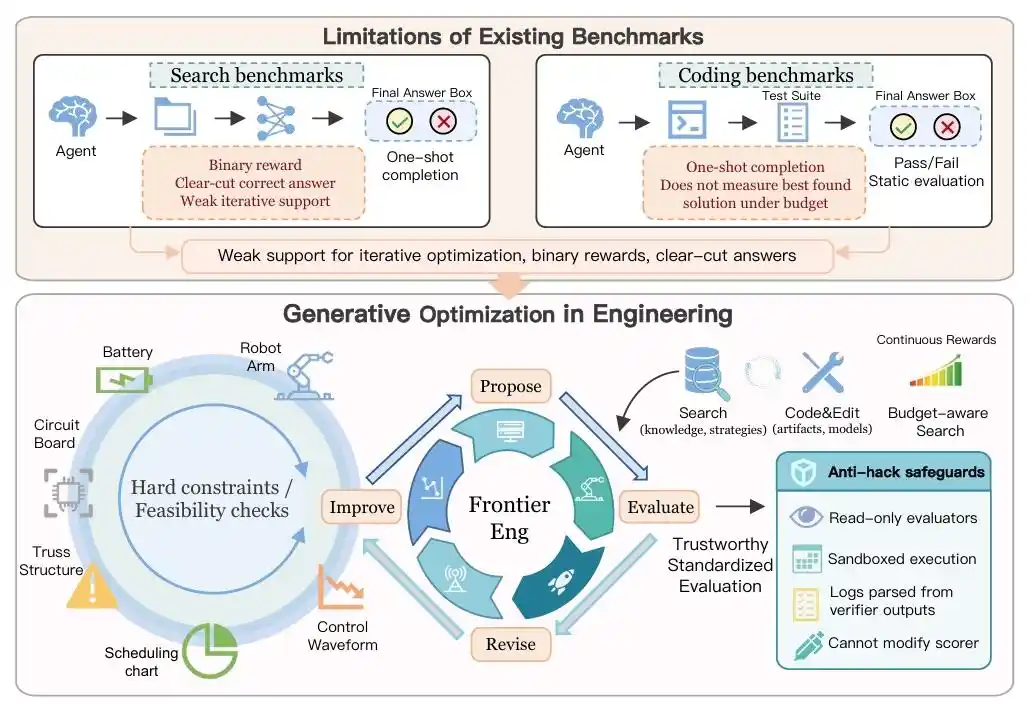
The most interesting aspect of Frontier-Eng Bench is: it doesn't test whether AI 'answered correctly', but rather whether AI can continuously become stronger.

Because real engineering optimization is never about multiple-choice questions; there is no single standard answer.

Take fast-charging batteries as an example: the goal sounds simple—charge as fast as possible, but reality isn't so easy.

Under strict constraints like temperature mustn't spike, voltage can't overspeed, battery life can't drop too fast, and lithium plating must be avoided, AI must precisely hit the balance point of performance.

This means AI cannot pass through by any clever 'test-cramming' tricks; it must demonstrate endurance for continuous evolution through long-term feedback.

Can AI perform long-term optimization in real environments?

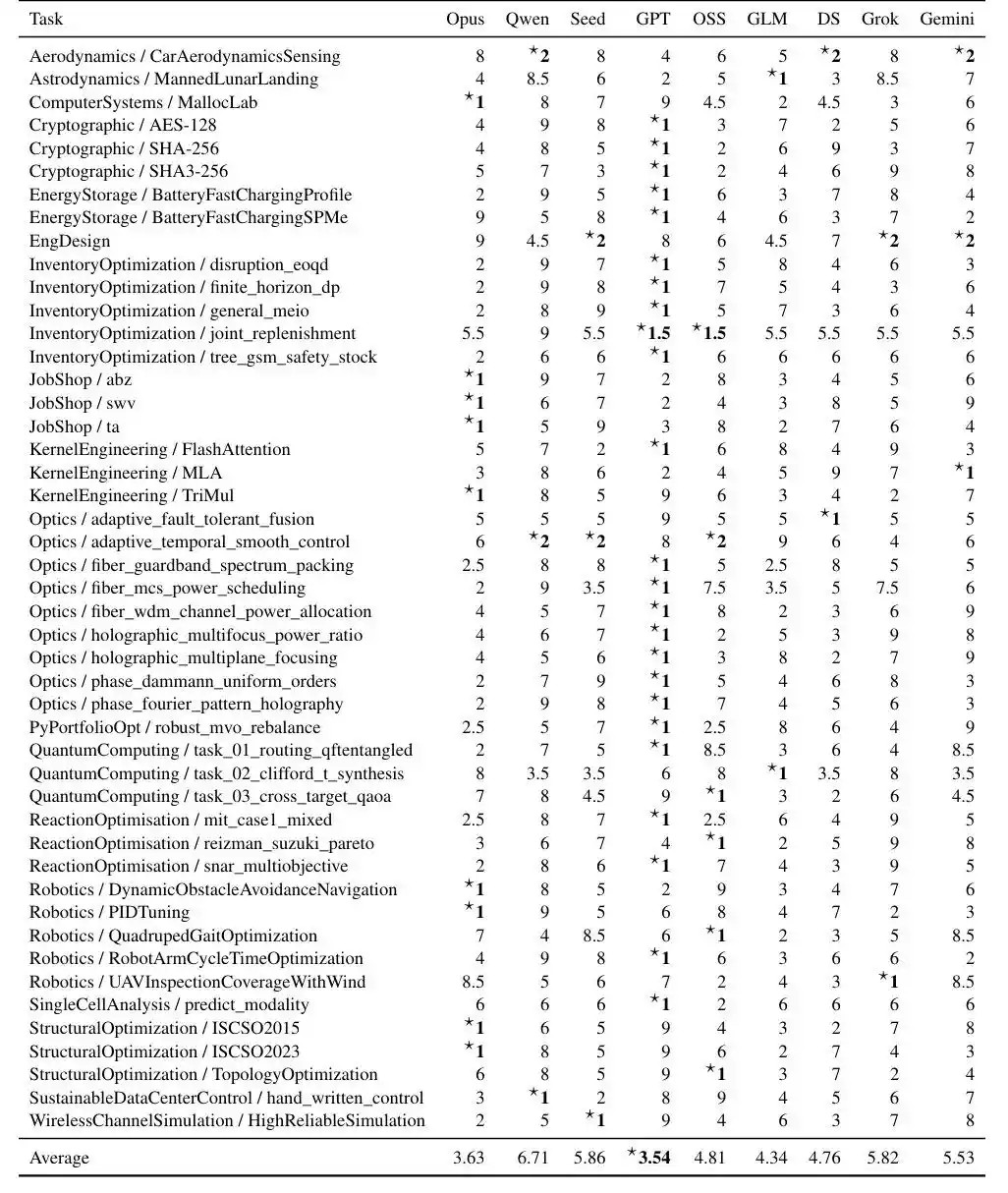
Looking at the results, GPT5.4 showed the most stable overall performance, but AIs still have a long way to go before 'solving' the Benchmark.
Auto Research Enters the 'Iterative Optimization' Era

The research team raised a very interesting point in their paper:

Truly advanced intelligence essentially relies on long-term feedback loops.

Just as AlphaGo could defeat Lee Sedol, it lay in the vast number of simulations and immediate feedback behind each decision, not the rote memorization of established game records.

True scientific research is the same: top labs don't rely on a single burst of inspiration, but continuously propose hypotheses, run experiments, examine results, modify plans, and try again.

Engineering optimization follows the same principle: anyone can create the first version; what's truly difficult is that final 1% performance leap.

The significance of Frontier-Eng Bench lies here: For the first time, it systematically begins testing AI's 'iterative optimization capability', and has summarized two nearly brutal laws of AI evolution.
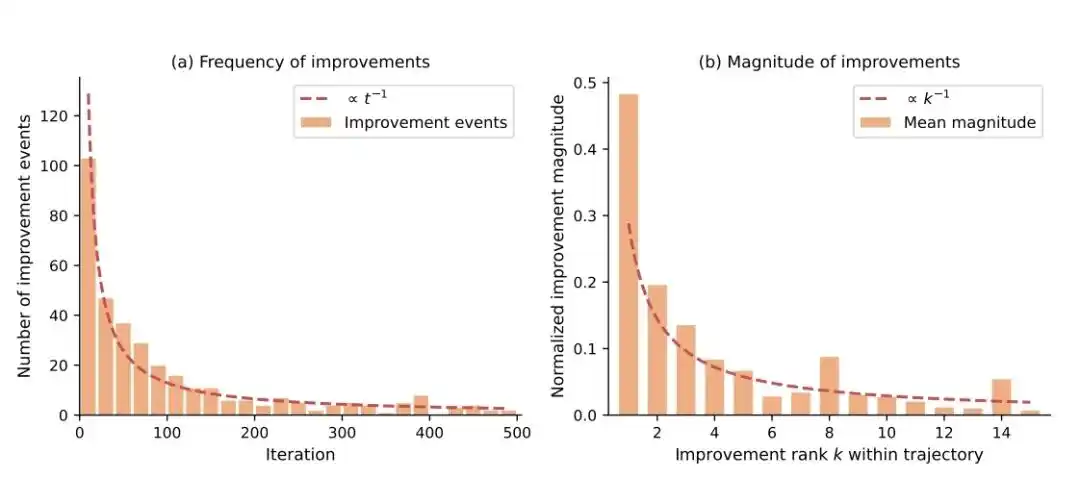
The first law is: The further you go, the harder the improvement.

This paper found that the frequency and magnitude of Agent improvements follow a power-law decay:

  • Improvement frequency ∝ 1 / iteration count
  • Improvement magnitude ∝ 1 / improvement count

Simply put: the fastest gains come in the first few rounds, and it gets progressively harder and smaller later on.

This closely resembles the real R&D process: the first version of AI can quickly eliminate many 'low-hanging fruits', but the closer it gets to the bottleneck, the more effort is required to squeeze out even a bit more performance.

Would it be more cost-effective to explore multiple paths in parallel for trial and error? The answer lies in the second law.
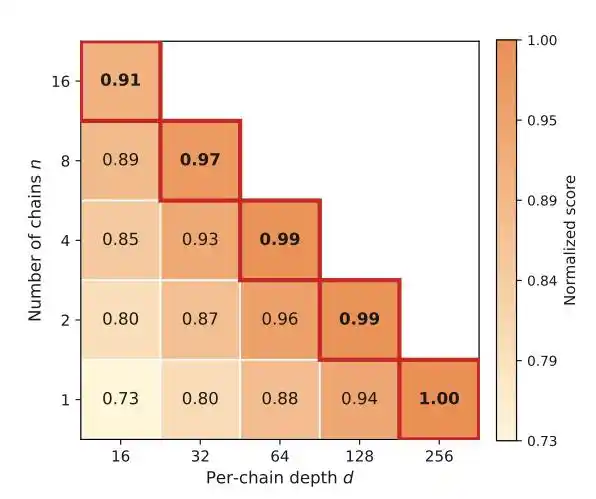
The second law: Breadth is useful, but depth is even more indispensable.

Running multiple parallel paths can avoid getting stuck, but with a fixed budget, each additional chain opened shallows the depth of exploration.

Many engineering breakthroughs require continuous accumulation and constant correction before structural leaps emerge; they can't be achieved simply by 'trying a few more times'.

This actually points towards the development direction of next-generation Agents: not models that 'output an answer once', but systems that can continuously iterate and self-evolve within long-term feedback loops.

AI Engineers Might Really Be Coming

The true far-reaching significance of this research lies in its preliminary outline of an AI system beginning to approach the real engineering cycle.
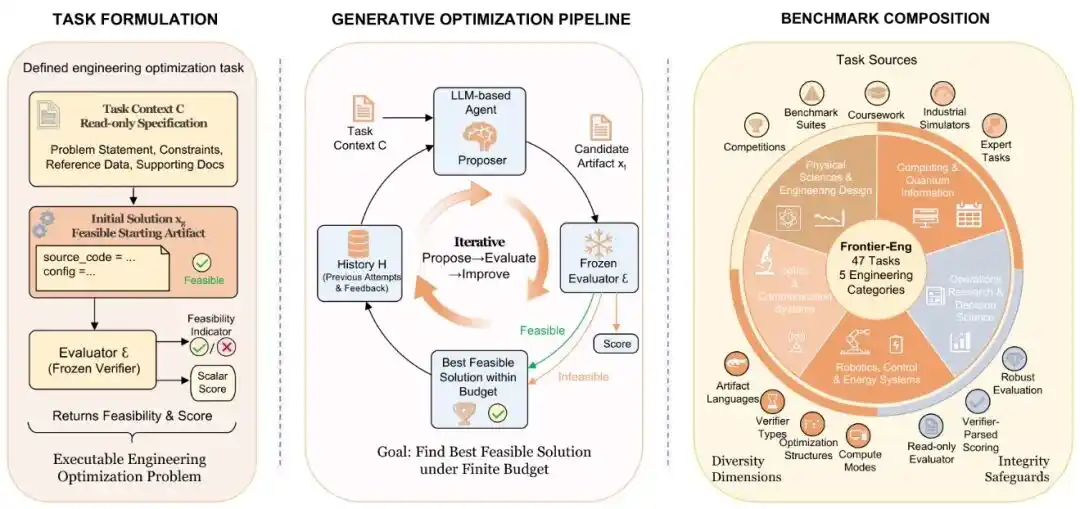
Imagine when AI connects to industrial software, simulation environments, CAD systems, chip design tools, scientific computing platforms...

A dramatic transformation in the modality of productivity is on the verge of emerging.

In future labs, a division of labor like this might appear:

Human researchers are responsible for proposing directions and goals.

For example, 'reduce this component's energy consumption by 30%', 'compress this model's forward pass GPU usage even lower', 'increase the stability of robot control a bit more', 'push the fidelity of this quantum circuit closer to the limit', etc.

And AI is responsible for 'grinding the path'. They focus on these goals, continuously optimizing.

For example, automatically running simulations and experiments, automatically reading feedback from verifiers and simulators, then continuing to modify and optimize, iterating non-stop 24/7.

This evolutionary logic frees AI from the identity of an 'assistive tool', allowing it to begin solving complex system problems like a real engineering team—and tirelessly at that.

And the issues revealed by the Frontier-Eng Benchmark are actually very direct:

When AI begins to learn 'long-term optimization', how far is it from true engineering intelligence?

Paper Title: Frontier-Eng: Benchmarking Self-Evolving Agents on Real-World Engineering Tasks with Generative Optimization

Project Homepage: https://lab.einsia.ai/frontier-eng/

Arxiv: https://arxiv.org/abs/2604.12290

GitHub repo: https://github.com/EinsiaLab/Frontier-Engineering

This article is from the WeChat public account "Quantum Bit", author: Yun Zhong

Трендовые криптовалюты

Связанные с этим вопросы

QWhat is the main purpose of the Frontier-Eng Benchmark released by Einsteina AI's Navers lab?

AThe main purpose of the Frontier-Eng Benchmark is to move beyond testing AI's ability to recall known information. It systematically tests AI agents' capability for 'iterative optimization' on 47 real-world, open-ended engineering tasks without standard answers, evaluating if they can continuously improve performance through a feedback loop involving simulation, error analysis, and parameter adjustment.

QHow does the AI's role change in the Frontier-Eng Benchmark testing process compared to traditional language models?

AIn the Frontier-Eng Benchmark, the AI transitions from acting as a 'super student' that retrieves and assembles answers from training data to performing 'engineering optimization.' Its role becomes akin to a professional engineer: it proposes solutions, runs simulations, analyzes feedback and errors, modifies parameters/code, and reruns experiments in a continuous loop to seek optimal performance under complex constraints.

QWhat are the two key 'AI evolution laws' discovered through the Frontier-Eng Benchmark regarding iterative optimization?

AThe two key laws are: 1) Improvements become progressively harder and smaller (showing a power-law decay: Improvement frequency ∝ 1/iteration count, Improvement magnitude ∝ 1/improvement count). 2) While exploring multiple parallel paths (breadth) is useful, sustained depth in a single optimization path is more critical for achieving structural breakthroughs, as fixed budgets force a trade-off between breadth and depth.

QWhat future work paradigm does the article suggest might emerge from the development of self-evolving AI agents?

AThe article suggests a future 'Auto Research' paradigm where human researchers define the goals and direction (e.g., 'reduce component energy consumption by 30%'), and AI agents take on the role of 'grinding the path.' They would work autonomously and tirelessly—running simulations, interpreting feedback from verifiers and simulators, and iteratively optimizing—24/7 to approach performance limits.

QAccording to the article, what fundamental shift in AI capability does the Frontier-Eng Benchmark represent?

AThe Frontier-Eng Benchmark represents a fundamental shift from evaluating AI's ability to find predetermined 'correct answers' to testing its capacity for 'self-evolution' through long-term feedback loops. It moves the focus to whether AI can demonstrate sustained learning and improvement in complex, real-world scenarios with no single correct answer, pushing AI closer to genuine engineering intelligence.

Похожее

Закон CLARITY Act 'преодолевает ключевое препятствие' – Белый дом согласился на сделку по криптоэтике

Сообщается, что администрация президента США Дональда Трампа согласовала с республиканскими сенаторами этические положения в рамках законопроекта о структуре рынка криптовалют CLARITY Act. Это соглашение рассматривается как преодоление ключевого препятствия на пути к голосованию в Сенате. Однако детали договорённости неизвестны, а демократы, включая сенатора Элизабет Уоррен, ещё не ознакомились с текстом. Для принятия законопроекта требуется около 60 голосов, что означает необходимость поддержки 7-10 демократов. Параллельно советник Белого дома по криптовалютам Патрик Уитт отложил военные сборы, чтобы продолжить лоббирование законопроекта, подчеркивая растущую конкуренцию со стороны других юрисдикций, таких как ЕС, Сингапур и Россия, где уже формируется правовая база для криптоиндустрии. Несмотря на прогресс в урегулировании этических вопросов, рынок скептически оценивает шансы принятия закона до конца 2026 года. Согласно прогнозной платформе Kalshi, вероятность его принятия до 2027 года составляет 38%, но возрастает до 61% на первый квартал 2027 года.

ambcrypto2 мин. назад

Закон CLARITY Act 'преодолевает ключевое препятствие' – Белый дом согласился на сделку по криптоэтике

ambcrypto2 мин. назад

Время давления для Base

**Давление на Base: проблемы децентрализации и растущая конкуренция** Соучредитель Base Джесси Поллак публично признал стратегические ошибки: ставка на социальные и креаторские токены в последний год не привела к устойчивому внедрению. Теперь Base фокусируется на токенизации акций при поддержке Coinbase, отставая от нового конкурента — Robinhood Chain. Несмотря на лидерство Base среди L2 (кроме BNB Chain) с TVL почти в $12 млрд, его централизованное управление стало критической проблемой. Такие инциденты, как сбои в производстве блоков и возможное понижение рейтинга децентрализации L2BEAT до Stage 0, подрывают доверие. На этом фоне быстрое внедрение и рост Robinhood Chain, включая объем DEX, выглядят особенно контрастно. Дополнительный удар по репутации нанес основатель Coinbase Брайан Армстронг: смена его аватара спровоцировала спекулятивный скачок мем-токена BRAIN и последующий обвал, что вызвало волну критики в сообществе. Хотя миссия Base — долгосрочная финансовая инфраструктура, а не краткосрочные спекуляции, появление сильного конкурента обнажило хронические проблемы. Чтобы сохранить позиции в области RWA и машинных платежей, Base необходимо срочно решать вопросы децентрализации и укреплять доверие пользователей.

Foresight News17 мин. назад

Время давления для Base

Foresight News17 мин. назад

Уступка Белого дома расчищает путь для этических норм: успеет ли Закон о ясности (Clarity Act) пройти до летних каникул Конгресса?

Белый дом пошел на уступки по этическим положениям, что может устранить последнее препятствие для принятия «Закона о ясности» (Clarity Act) — ключевого законопроекта о регулировании рынка цифровых активов в США. Согласно информации от источников в отрасли, администрация Трампа согласилась включить в текст закона положения об этике, регулирующие возможные конфликты интересов госчиновников в криптосфере. Текст уже передан некоторым республиканским сенаторам. Одновременно появился позитивный сигнал: Патрик Уитт, исполнительный директор консультативного совета Белого дома по цифровым активам, останется на посту, чтобы помочь продвижению закона, отложив свои военные обязанности. «Закон о ясности» призван создать единые федеральные правила для рынка цифровых активов, четко разграничив полномочия между Комиссией по ценным бумагам и биржам (SEC) и Комиссией по торговле товарными фьючерсами (CFTC), а также определив правовой статус различных активов, таких как цифровые товары, инвестиционные контракты и стейблкоины. До летних каникул Конгресса (середина августа) осталось всего несколько рабочих дней. Если разногласия по этическим вопросам будут урегулированы в ближайшие недели, законопроект имеет шанс на прорыв. В противном случае его рассмотрение может быть отложено на неопределенный срок. Принятие «Закона о ясности» станет историческим поворотным моментом, способным снизить нормативную неопределенность в США и заложить основу для прихода традиционных финансовых институтов в отрасль.

Odaily星球日报22 мин. назад

Уступка Белого дома расчищает путь для этических норм: успеет ли Закон о ясности (Clarity Act) пройти до летних каникул Конгресса?

Odaily星球日报22 мин. назад

Взлом 515 миллионов NIGHT в сети Midnight обвалил токен на 32% – Удержит ли $0,015?

В 2026 году крипторынок столкнулся с ростом хакерских атак. В июле было похищено более $59 млн, а общая сумма убытков с начала года достигла $1 млрд. Среди последних инцидентов — эксплуатация кросс-чейн моста сети Midnight, в результате которой из контракта, содержащего 515 миллионов токенов NIGHT, были выведены все средства. Атакующий продал около 290 миллионов NIGHT через DEX на Cardano, что привело к падению цены токена на 32% до исторического минимума в $0.015. После незначительного восстановления до $0.019 токен остается под сильным давлением продаж. Рыночная капитализация NIGHT упала на 27%, в то время как объем торгов вырос на 829%. Индикатор RSI вошел в зону перепроданности (уровень 17), что свидетельствует о доминировании медвежьего настроения. Основа Midnight заявила, что сама сеть осталась безопасной, а инцидент был изолирован в рамках кросс-чейн операций. Прогнозируется, что при сохранении негативных настроений токен может удерживаться ниже $0.02 с поддержкой на уровне $0.015.

ambcrypto27 мин. назад

Взлом 515 миллионов NIGHT в сети Midnight обвалил токен на 32% – Удержит ли $0,015?

ambcrypto27 мин. назад

Флагман в мире крипто-акций | Резервы наличных в Strategy выросли до 3,23 миллиарда долларов, покупки BTC приостановлены; Vanguard и другие управляющие активы увеличили свои доли в Strategy (21 июля)

Обзор рынка: Риски и возможности на фоне повышенной волатильности Рынки акций, включая корейские, американские и китайские (A-shares), переживают период высокой волатильности из-за ожиданий дальнейшего повышения процентных ставок ФРС, геополитической напряженности (ситуация вокруг США и Ирана) и процесса "очистки" от избыточного кредитного плеча. Инвесторам рекомендуется соблюдать осторожность и избегать использования маржинального кредитования. На американском рынке растут короткие позиции против акций, связанных с искусственным интеллектом (ИИ), достигнув максимумов с 2010 года, что отражает опасения по поводу "пузыря ИИ". Технологические акции, особенно полупроводниковые, значительно снизились. В секторе криптоактивов: * Ключевая компания, держащая биткоин в казначействе, **Strategy (MSTR)**, увеличила свои денежные резервы до 32,3 млрд долларов и приостановила покупки BTC. При этом крупные институциональные инвесторы, такие как Vanguard Group и Capital Group, наращивают свои доли в акциях Strategy. * Глобальные публичные компании (исключая майнинговые) на прошлой неделе приобрели биткоинов на сумму всего 1,33 млн долларов, что на 98,4% меньше неделей ранее. Их совокупные холдинги BTC составляют около 1,14 млн монет. * Другие компании, такие как Bitcoin Japan Corporation и ORANGE JUICE, привлекают финансирование для включения биткоина в свои казначейские активы. * Компания **BitMine**, фокусирующаяся на Ethereum, увеличила свои холдинги ETH до 5,78 млн монет (около 4,8% от предложения) и сообщила о совокупных активах (крипто, деньги, ценные бумаги) в 11,5 млрд долларов. Вывод: Фондовые рынки находятся в режиме коррекции и снижения кредитного плеча. В криптосекторе наблюдается осторожность среди компаний-держателей биткоина, в то время как институциональный интерес к ним как к активам растет. Компании, ориентированные на Ethereum, продолжают накапливать актив.

marsbit34 мин. назад

Флагман в мире крипто-акций | Резервы наличных в Strategy выросли до 3,23 миллиарда долларов, покупки BTC приостановлены; Vanguard и другие управляющие активы увеличили свои доли в Strategy (21 июля)

marsbit34 мин. назад

Торговля

Спот

Популярные статьи

Как купить ERA

Добро пожаловать на HTX.com! Мы сделали приобретение Caldera (ERA) простым и удобным. Следуйте нашему пошаговому руководству и отправляйтесь в свое крипто-путешествие.Шаг 1: Создайте аккаунт на HTXИспользуйте свой адрес электронной почты или номер телефона, чтобы зарегистрироваться и бесплатно создать аккаунт на HTX. Пройдите удобную регистрацию и откройте для себя весь функционал.Создать аккаунтШаг 2: Перейдите в Купить криптовалюту и выберите свой способ оплатыКредитная/Дебетовая Карта: Используйте свою карту Visa или Mastercard для мгновенной покупки Caldera (ERA).Баланс: Используйте средства с баланса вашего аккаунта HTX для простой торговли.Третьи Лица: Мы добавили популярные способы оплаты, такие как Google Pay и Apple Pay, для повышения удобства.P2P: Торгуйте напрямую с другими пользователями на HTX.Внебиржевая Торговля (OTC): Мы предлагаем индивидуальные услуги и конкурентоспособные обменные курсы для трейдеров.Шаг 3: Хранение Caldera (ERA)После приобретения вами Caldera (ERA) храните их в своем аккаунте на HTX. В качестве альтернативы вы можете отправить их куда-либо с помощью перевода в блокчейне или использовать для торговли с другими криптовалютами.Шаг 4: Торговля Caldera (ERA)С легкостью торгуйте Caldera (ERA) на спотовом рынке HTX. Просто зайдите в свой аккаунт, выберите торговую пару, совершайте сделки и следите за ними в режиме реального времени. Мы предлагаем удобный интерфейс как для начинающих, так и для опытных трейдеров.

803 просмотров всегоОпубликовано 2025.07.17Обновлено 2026.06.02

Как купить ERA

Обсуждения

Добро пожаловать в Сообщество HTX. Здесь вы сможете быть в курсе последних новостей о развитии платформы и получить доступ к профессиональной аналитической информации о рынке. Мнения пользователей о цене на ERA (ERA) представлены ниже.

活动图片