Author of 'AI Doomsday Report' Speaks Out: Market Panic Exceeds Expectations, but the Real Risk is the 'Unemployment Loop'

marsbitОпубликовано 2026-02-24Обновлено 2026-02-24

Введение

A report on the potential AI disruption scenario, co-authored by Alap Shah of Lotus Technology Management, triggered significant market sell-offs, with IBM’s stock plunging 13% in a single day. Shah stated that the market reaction "far exceeded expectations" and warned that AI could eliminate 5% of white-collar jobs within 18 months, particularly in service-intensive sectors like insurance and banking. He emphasized a negative feedback loop: companies cut jobs to boost margins, reinvest savings into AI, and cause further layoffs. Shah urged governments to tax AI-generated profits to mitigate unemployment and protect consumer demand, arguing that rapid job loss could severely harm the broader economy. The report, set in a hypothetical 2028 scenario, highlights rising market volatility and growing differentiation between AI beneficiaries (e.g., semiconductors) and vulnerable industries (e.g., software, payment processing).

Author: Zhang Yaqi, Hard AI

Summary: A report on AI impact scenarios triggered a global sell-off, with IBM plummeting 13% in a single day, the worst in 25 years. Report author Shah stated that the market reaction "far exceeded expectations" and warned that white-collar jobs could decrease by 5% in the next 18 months, calling on the government to tax AI to curb the negative feedback loop of unemployment—if jobs disappear faster than expected, the entire consumer economy will be at risk. He said, "Everyone is now fully invested in AI, and there are few incremental buyers left."

Full content below:

After a scenario analysis report on AI impact triggered a global market sell-off storm over the weekend, co-author Alap Shah publicly spoke out on Tuesday, admitting that the market reaction far exceeded expectations and calling on the government to tax AI to address the potential wave of large-scale unemployment.

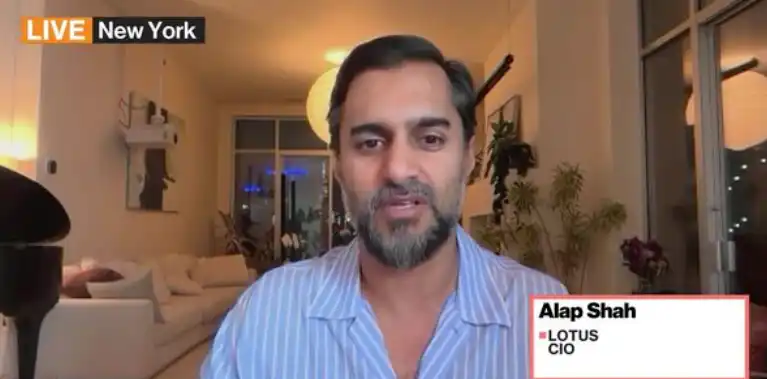
The chief investment officer of Lotus Technology Management warned in an interview with Bloomberg Television that AI advancements could lead to a 5% reduction in white-collar jobs within the next 18 months, with the U.S. facing the greatest impact in the absence of policy intervention. He predicted that service-intensive industries such as insurance and banking are at higher risk.

Shah stated that governments should consider taxing the incremental or unexpected profits brought by AI to offset the impact of labor substitution and protect consumer demand. He believes that the replacement of white-collar labor will create a negative feedback loop: companies lay off employees to boost profit margins, reinvest the savings into AI, and thereby drive further layoffs.

As previously mentioned by Wall Street News, the report released over the weekend assumed a scenario in 2028, depicting rapid advancements in machine intelligence that increase productivity but render a large amount of human labor obsolete, leading to unemployment, a collapse in consumer spending, and dragging down indices such as the S&P 500. Shah admitted, "I originally thought there would be a slight reaction—but it clearly exceeded our expectations." He said that given that AI-related trading has been ongoing for about three and a half years and has basically been rising all the way, there are few incremental buyers left in the market, making this reaction somewhat understandable.
01 Market Reaction Far Exceeds Expectations

This report, released by Citrini Research on social media, combined with Nassim Taleb's market warning and related statements from AI startup Anthropic, triggered a large-scale sell-off. IBM's stock price plummeted 13% in a single day, the largest single-day drop in 25 years; DoorDash, American Express, KKR, and Blackstone all fell more than 6%; related software ETFs fell 4.8%, with the cumulative decline from last September's high expanding to about 35%.

Shah admitted he was surprised by the market reaction. "I originally expected a slight reaction, but it was definitely bigger than we expected," he said on Tuesday.

He analyzed that, considering the level of the U.S. market, this reaction is not entirely unexpected. "AI trading has been going on for three and a half years, basically rising in a straight line. Now everyone is fully invested long, and there are few incremental buyers left."

The report set the hypothetical scenario in 2028. Shah explained that this timeframe is far enough away to drive discussions on how to make amends, but close enough to serve as a warning. Recent market volatility has intensified, with tech stocks falling over the past few weeks due to concerns that AI could disrupt business models. The Citrini report further deepened concerns about widespread disruption and unemployment.

02 White-Collar Jobs in the "Eye of the Storm"

Shah pointed out that the U.S. has not really created any white-collar jobs in the past three years. "A large number of positions will be replaced by AI, specifically AI agents. These tools have only truly landed in the past few months."

He believes that information workers and their recruitment are in the eye of the storm, with the number of information-related jobs falling nearly 8% from the 2023 peak. In the report's hypothetical scenario, due to a severe economic contraction, 15% of white-collar workers will be unemployed within 18 months with no other job opportunities.

Shah warned that without policy responses, this group will be forced into the blue-collar and gig markets, significantly depressing the average wage levels in these markets. Over the next five years, U.S. white-collar employment will be a key indicator for measuring AI impact, with effects likely to appear fastest in the U.S. because its labor market is more dynamic. "It's much easier to fire employees in the U.S. than in other parts of the world," he added.

03 Proposing an AI Tax to Counter Unemployment Impact

Shah called on the government to take action to address the labor substitution brought by AI. He stated that consideration should be given to taxing the incremental or unexpected profits brought by AI to protect consumer demand.

"If we allow AI to replace these jobs without properly taxing AI, it will hit the core of the consumer economy. This is the real risk propagation scenario," Shah said. He emphasized:

"We released this report to the market not only because individual stock risks are important, but more crucially, if jobs disappear faster than expected and there is a lack of countermeasures, the overall economy and the consumer economy will face risks."

Based on the report's discussion results, the negative feedback loop formed by white-collar labor substitution will weaken demand in industries built on intermediary services, such as finance, insurance, and software. Consumer platforms relying on discretionary spending, including delivery services like DoorDash and Uber Eats, are seen as the areas with the greatest risk.

04 Increasing Industry Divergence

Shah pointed out that the benefits of AI are no longer evenly distributed but are beginning to disperse. The market is gradually discerning which industries will become winners and which will face pressure. "The software industry is the best example. The market has been selling software stocks for almost a year due to AI threats, and this trend has clearly accelerated in recent weeks."

He stated that intermediary industries also face tangible risks. According to the potential scenario described in the Citrini report, AI agents could disrupt the payment industry by eliminating transaction fees charged by payment processing companies like Mastercard and Visa to save users money.

Regarding investment strategy, Shah revealed: "We typically short companies that we believe will be disrupted by AI. On the other hand, we hold a large number of semiconductor stocks, which we believe will benefit from this." He expects further market volatility in the short term, including among software companies, as traders assess the long-term impact of AI. "We are entering a period of high market volatility," he said.

According to Bloomberg, Citrini Research was founded by James van Geelen. The report clearly states that "the following content is a scenario assumption, not a prediction," and its sole purpose is to simulate a relatively underexplored scenario. Shah is the CEO of AI company Littlebird and managing partner of Lotus Technology Management. He previously co-founded the meal subscription service Thistle and served as CEO and chairman of the financial data platform Sentieo, which was later acquired by AlphaSense.

Related reading: A Memo from 2028: What Do We Lose If AI Wins?

Связанные с этим вопросы

QWhat was the market reaction to the 'AI Doomsday Report' and why did the author find it surprising?

AThe report triggered a global sell-off, with IBM's stock plunging 13% in a single day, its worst drop in 25 years. Other companies like DoorDash, American Express, KKR, and Blackstone fell over 6%. The author, Alap Shah, stated the reaction was 'far beyond expectations' because he had anticipated only a minor market response.

QAccording to the report's author, what is the core economic risk posed by AI, and what policy does he propose to mitigate it?

AThe core risk is a 'negative feedback loop of unemployment,' where job losses from AI replacement outpace the creation of new roles, threatening the entire consumer economy. To mitigate this, the author proposes that governments tax the incremental or windfall profits generated by AI to offset the impact on displaced workers and protect consumer demand.

QWhich sector of the workforce is identified as being in the 'eye of the storm' for AI-driven job losses in the next 18 months?

AWhite-collar workers are identified as being in the 'eye of the storm.' The report warns that AI advancements could lead to a 5% reduction in white-collar jobs within 18 months, with information-based jobs already down nearly 8% from their 2023 peak.

QHow does the report suggest AI could specifically disrupt the payments industry?

AThe report suggests that AI agents could disrupt the payments industry by eliminating transaction fees charged by intermediaries like Mastercard and Visa, thereby saving users money and undermining the business models of these payment processing companies.

QWhat investment strategy does the author's firm, Lotus Technology Management, employ in response to the AI disruption?

AThe firm's strategy involves shorting companies they believe will be disrupted by AI while holding long positions in semiconductor stocks, which they expect to benefit from the increased demand for AI computing power.

Похожее

Understanding Hash in One Article: The "Browser Miner" on Ethereum

Hash is an Ethereum-based ERC-20 token described as a "browser-minable post-quantum token." Its key features include enabling browser-based GPU mining without specialized hardware, a fixed supply cap of 21 million tokens, immutable and permissionless smart contracts with no team allocation or pre-mining, and an emphasis on post-quantum security using Keccak256 hashing. The mining mechanism is a simplified on-chain proof-of-work where miners solve unique challenges tied to their wallet address. Key design elements prevent answer theft, with epochs resetting every 100 blocks (~20 minutes) and a per-block minting limit. Emission follows a Bitcoin-like halving schedule every 100,000 mints, starting at 100 tokens per mint. Projections suggest all tokens could be mined within approximately 294 days if a target rate of one mint per minute is sustained. Hash emphasizes "post-quantum" security by leveraging hash-based primitives like Keccak256, which are considered more resistant to quantum attacks compared to elliptic-curve cryptography. While not a fully post-quantum asset, it aligns with Ethereum's broader post-quantum research narrative. The project completed its Genesis sale at $0.03 and began trading on Uniswap, with its price reaching around $0.19. The initial circulating supply is small, with 5% sold in Genesis and 5% allocated to liquidity. The majority (47.6% of total supply) is allocated to early-stage mining, leading to a front-loaded emission schedule. This structure, combined with low initial liquidity, makes Hash a high-volatility, high-risk project dependent on sustained miner participation and market demand to absorb new supply.

marsbit2 мин. назад

Understanding Hash in One Article: The "Browser Miner" on Ethereum

marsbit2 мин. назад

OpenAI's Largest Internal Wealth Creation: 600 People Cash Out a Total of $6.6 Billion, 75 Take Home the Maximum $30 Million Each

A Wall Street Journal report reveals OpenAI's unprecedented pre-IPO wealth creation. In a single employee stock sale last October, over 600 current and former employees sold shares, collectively cashing out approximately $6.6 billion. Due to high investor demand, the company tripled the individual sale cap to $30 million, with about 75 employees selling the maximum amount. This event represents the largest such transaction in tech industry history for a private company. OpenAI's valuation was $500 billion for this tender offer. Employees with over two years of tenure were eligible, allowing many post-ChatGPT hires their first liquidity event. The company's stock has reportedly grown over 100-fold in seven years. Following a restructuring, employees collectively hold about 26% of OpenAI. The scale of executive wealth is also staggering. In court testimony related to Elon Musk's lawsuit, President and co-founder Greg Brockman confirmed his OpenAI stake is worth around $30 billion. Analysis indicates about 165 current and former employees hold a combined ~$164.9 billion in equity, averaging nearly $1 billion per person in paper wealth. OpenAI's per-employee stock-based compensation is estimated to be 34 times the average of major tech firms before their IPOs. OpenAI continues its rapid ascent, closing a $122 billion funding round at an $852 billion valuation in March. With monthly revenue hitting $2 billion, over 900 million weekly ChatGPT users, and plans for a potential trillion-dollar IPO in late 2026, this wealth-creation engine shows no signs of stopping.

链捕手24 мин. назад

OpenAI's Largest Internal Wealth Creation: 600 People Cash Out a Total of $6.6 Billion, 75 Take Home the Maximum $30 Million Each

链捕手24 мин. назад

Understanding CPO (Co-Packaged Optics) in One Article: Why Nvidia Is Willing to Spend $3.2 Billion on a Fiber?

NVIDIA and Corning announced a multi-year strategic partnership on May 6, 2026, with NVIDIA committing up to $3.2 billion to support Corning's U.S. expansion. This investment will triple Corning's manufacturing plants and significantly boost its optical fiber and communications production capacity. The core driver behind this massive investment is the fundamental shift from copper to optical interconnect technology within AI data centers. As GPU clusters scale, copper wires face critical limitations: severe signal attenuation over distance, high energy consumption for signal integrity, and excessive heat generation. Optical fiber, transmitting light instead of electrical signals, solves these issues with minimal loss, near-light speed, and lower power needs. The article outlines a three-stage evolution of data center interconnect: 1. **Traditional Copper Interconnects:** The mainstream solution of the 2010s, now being phased out due to scaling bottlenecks. 2. **Pluggable Optical Modules:** The current mainstream, where modules convert electrical signals to light externally. This process still introduces energy loss and latency. 3. **CPO (Co-Packaged Optics):** The next-generation technology where the optical engine is integrated directly with the GPU chip package. This drastically reduces the electrical signal travel distance to mere millimeters, slashing power consumption and latency while boosting data density. NVIDIA CEO Jensen Huang has identified CPO as an essential core technology for AI infrastructure. NVIDIA's investment signifies a strategic shift from being a buyer to actively controlling its supply chain for critical components. With demand for specialized optical fiber far outstripping supply—evidenced by soaring prices—securing long-term manufacturing capacity has become a competitive necessity. While Corning's expansion may pressure some suppliers, a projected global fiber supply gap of 5-15% over the next few years creates a significant opportunity window, particularly for Chinese manufacturers competitive in optical preforms, chips, and modules. Ultimately, NVIDIA's move is not about chasing a trend but an engineering imperative. The transition to light-based interconnects like CPO is driven by the physical limits of copper, marking a definitive step in the ongoing AI computing revolution.

marsbit49 мин. назад

Understanding CPO (Co-Packaged Optics) in One Article: Why Nvidia Is Willing to Spend $3.2 Billion on a Fiber?

marsbit49 мин. назад

Торговля

Спот
Фьючерсы

Популярные статьи

Неделя обучения по популярным токенам (2): 2026 может стать годом приложений реального времени, сектор AI продолжает оставаться в тренде

2025 год — год институциональных инвесторов, в будущем он будет доминировать в приложениях реального времени.

1.8k просмотров всегоОпубликовано 2025.12.16Обновлено 2025.12.16

Неделя обучения по популярным токенам (2): 2026 может стать годом приложений реального времени, сектор AI продолжает оставаться в тренде

Обсуждения

Добро пожаловать в Сообщество HTX. Здесь вы сможете быть в курсе последних новостей о развитии платформы и получить доступ к профессиональной аналитической информации о рынке. Мнения пользователей о цене на AI (AI) представлены ниже.

活动图片