ASTER vs. Hyperliquid: Can USD1’s 34.3% growth shift market leadership?

ambcryptoОпубликовано 2026-04-08Обновлено 2026-04-08

Введение

The market is shifting toward DeFi, with stablecoins acting as a key bridge between traditional and decentralized finance. In this context, Aster’s [ASTER] partnership with WorldLibertyFinancial [WLFI] positions WLFI’s native stablecoin, USD1, as the base layer for ASTER’s perpetual markets and real-world asset (RWA) initiatives. USD1’s market cap grew 34.3% this year, reflecting strong demand for structured, real-world assets. Despite broader market headwinds, the partnership aims to strengthen ASTER’s liquidity and competitiveness. While Hyperliquid [HYPE] dominated Q1 perpetual volume with $620 billion (compared to ASTER’s $318 billion) and saw its token rise 43%, ASTER declined 3.32%. The integration of USD1 could help ASTER narrow the gap with Hyperliquid and expand its presence in both trading and RWA markets.

The market is clearly shifting toward DeFi, and as a result, Layer 1s are rethinking how to stay ahead.

Consequently, it’s no surprise that most strategic partnerships are now centered around stablecoins. By acting as a bridge between TradFi and DeFi, they not only move capital on-chain more efficiently but also reduce friction and unlock access to key growth areas such as RWAs, AI, and NFTs.

In this context, Aster’s [ASTER] partnership with WorldLibertyFinancial [WLFI] fits perfectly. Under this deal, WLFI’s native stablecoin, USD1, becomes the base layer for ASTER’s perpetual markets and RWA initiatives, further reinforcing the broader trend of connecting traditional finance more closely with DeFi via stablecoins.

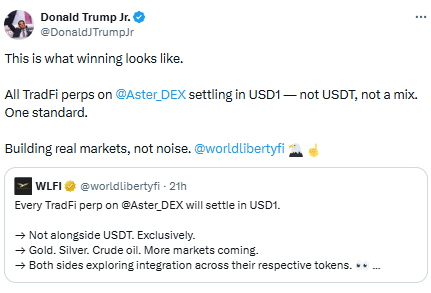
Source: X

Unsurprisingly, the market reacted quickly. The most buzzed-about response came from Donald Trump Jr. on X, calling the partnership a major “win” for both networks. That said, when we look at the technical positioning, it’s clear this move is about more than just strengthening fundamentals.

On the charts, both ASTER and WLFI have been impacted by ongoing macro FUD, closing near critical support levels that could soon be tested. At the same time, on the longer timeframe, these assets still have a significant way to go before reclaiming early-October price levels.

Naturally, the key question becomes, can this partnership actually drive meaningful price gains? That’s especially relevant when you consider that other DEX tokens like Hyperliquid [HYPE] have managed to stay relatively bullish despite the same macro headwinds.

ASTER bets on USD1 to reclaim ground

When you think of stablecoins, USDT usually comes to mind first.

That said, its technical setup doesn’t always tell the full story. So far this year, USDT’s market cap has only grown about 1.6%. Considering that this period overlaps with roughly a 20% correction across the broader crypto market, it’s clear that USDT flows still influence wider price action.

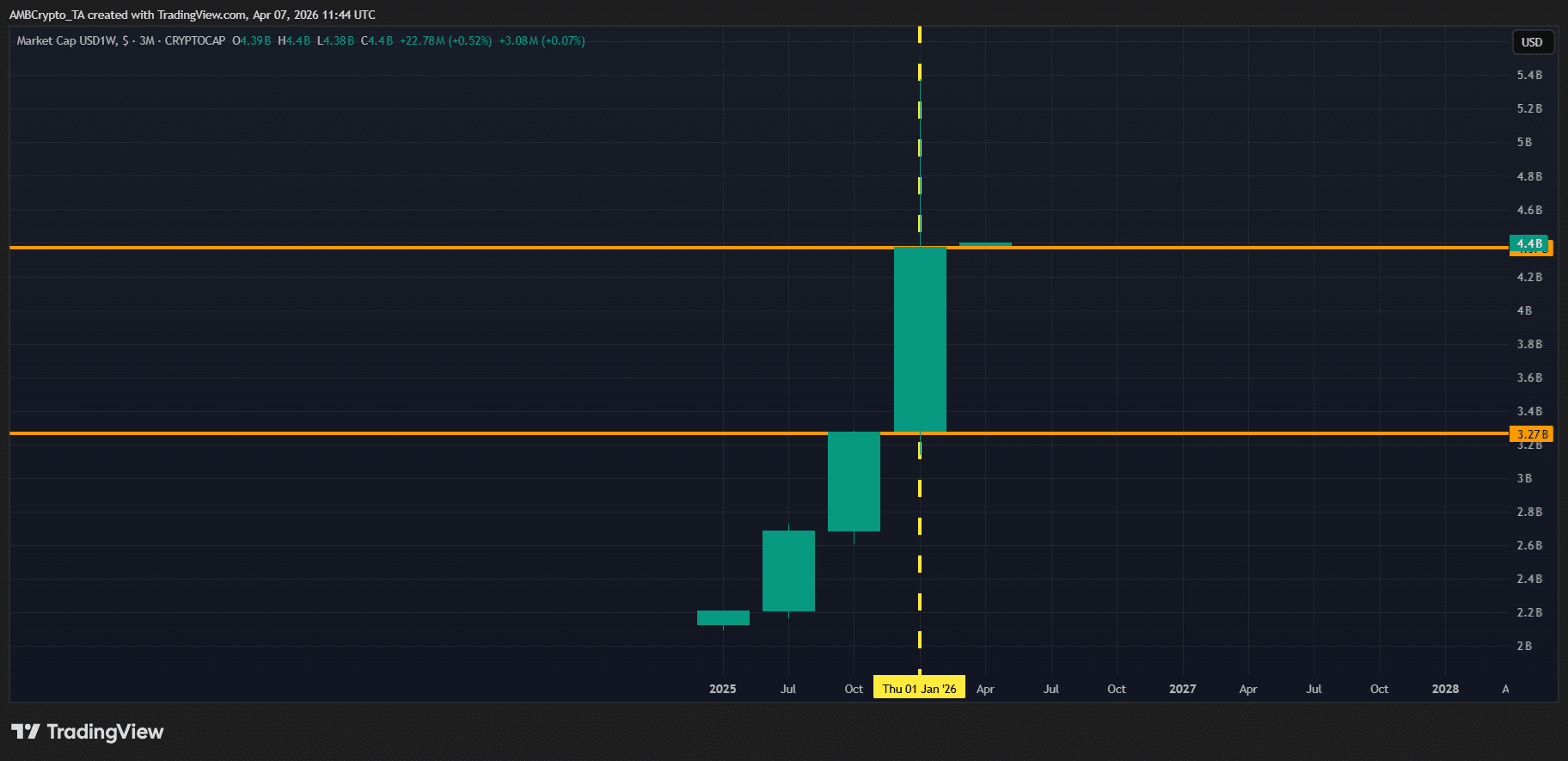
But capital isn’t just chasing speculation anymore. The RWA market, for example, has grown 35% this year, showing that money is moving into more structured, real-world assets. In this context, USD1’s 34.3% jump in market cap highlights how well-positioned stablecoins are driving real growth, making the ASTER-WLFI partnership a clearly strategic play.

Source: TradingView (USD1)

Meanwhile, a similar divergence is visible in perpetual volume, which has cooled overall. Yet, on a chain-by-chain basis, Hyperliquid still dominates, reporting $620 billion in perp volume in Q1. Oil trading, in particular, has been a key driver, keeping Hyperliquid firmly in the lead even as broader market activity slows.

By comparison, ASTER posted $318 billion over the same period. Technically, that’s almost half of Hyperliquid’s volume. The impact shows in price action too, with HYPE ending Q1 up 43%, while ASTER slipped 3.32%. That said, the WLFI partnership puts ASTER in a position to strengthen its liquidity, potentially improving its competitiveness in the DEX perpetual market.

The main catalyst? USD1. Serving as the base layer for ASTER’s perpetual markets and RWA initiatives, it could be the lever that helps ASTER close the gap with Hyperliquid, creating a stronger presence across both trading and real-world asset markets.


Final Summary

  • USD1 now serves as the base layer for ASTER’s perpetual markets and RWA initiatives, strengthening liquidity.
  • While HYPE dominates perp volume, ASTER’s USD1 integration positions it to narrow the gap and expand its presence in both trading and real-world asset markets.

Связанные с этим вопросы

QWhat is the main focus of the strategic partnership between Aster (ASTER) and WorldLibertyFinancial (WLFI)?

AThe partnership centers on WLFI's native stablecoin, USD1, becoming the base layer for ASTER's perpetual markets and Real-World Asset (RWA) initiatives, aiming to bridge traditional finance with DeFi and strengthen liquidity.

QHow did the market cap growth of USD1 compare to that of USDT, and what does this signify?

AUSD1's market cap grew by 34.3%, significantly outperforming USDT's 1.6% growth. This highlights how well-positioned stablecoins like USD1 are driving real growth, particularly in structured areas like RWA, as opposed to just speculation.

QHow did the trading volume and price performance of ASTER compare to Hyperliquid (HYPE) in Q1?

AIn Q1, Hyperliquid dominated with $620 billion in perpetual volume and its token HYPE ended the quarter up 43%. In comparison, ASTER posted $318 billion in volume (about half of HYPE's) and its token price slipped by 3.32%.

QWhat key advantage does the article suggest the USD1 integration could bring to ASTER?

AThe integration of USD1 as a base layer could serve as a lever to help ASTER strengthen its liquidity, improve its competitiveness in the perpetual markets, and narrow the gap with market leaders like Hyperliquid.

QBeyond speculation, what broader market trend is capital moving into, as evidenced by the growth of USD1?

ACapital is moving into more structured, real-world assets (RWA). The RWA market itself grew 35% this year, and USD1's significant growth is a reflection of this trend towards connecting traditional finance with DeFi.

Похожее

Why Hasn't the U.S. Seen the Rise of 'Huabei' or 'Jiebei'?

The article explores why the U.S. lacks large-scale consumer credit products like China's "Huabei" and "Jiebei," despite having a developed financial sector. Key reasons include: 1. **Structural Barriers**: A fragmented federal and state regulatory system, reinforced by post-2008 reforms like the Dodd-Frank Act, raises compliance costs and protects traditional banks, stifling fintech innovation. 2. **Credit Card Dominance**: Credit cards, used by 70-80% of adults, form a $1.28 trillion debt market with high APRs (avg. 22.3%). This system cross-subsidizes users who pay in full with those carrying balances, creating a predatory yet entrenched ecosystem. 3. **Data Privacy Laws**: Strict regulations (e.g., FCRA, CCPA) prevent tech giants from leveraging behavioral data for credit scoring, unlike in China where such data fuels fintech models. 4. **Capital Market Disincentives**: Wall Street penalizes tech firms entering finance due to lower valuations associated with heavy regulation and risk, as seen in Apple’s failure with Apple Card. 5. **Banking Oligopoly**: Major banks control consumer lending, leveraging lobbying power and consumer habits to maintain high-cost credit, while alternatives like payday loans (400% APR) or "unbanked" services remain niche or exploitative. Ultimately, regulatory, structural, and corporate interests collectively block the emergence of accessible, low-cost digital lending in the U.S.

Odaily星球日报40 мин. назад

Why Hasn't the U.S. Seen the Rise of 'Huabei' or 'Jiebei'?

Odaily星球日报40 мин. назад

More and More 'Model Supermarkets' Are Opening: ByteDance, Alibaba, and Tencent Compete to Integrate

Chinese tech giants like ByteDance, Alibaba, and Tencent are accelerating the rollout of integrated AI model subscription services—dubbed “model supermarkets”—to provide developers with bundled access to multiple leading domestic large language models (LLMs). ByteDance’s Volcengine recently upgraded its "Coding Plan" by adding newer models like GLM-5.1, Minimax M2.7, and Kimi k2.6, allowing subscribers to use various top models under a single monthly fee starting at ¥40. However, user feedback reveals significant issues, including rapid consumption of usage limits (e.g., hitting caps within hours), frequent server errors (like HTTP 429), and slow response times during peak hours. Complaints about misleading deduction rates—where calls to advanced models consume more quota—are also common. The trend is industry-wide: Alibaba, Tencent, and Baidu have all launched similar multi-model coding plans. While these platforms reduce trial costs for developers, they also expose challenges in balancing affordability with service quality and computational stability. Amid this shift, independent AI companies like Zhipu, MiniMax, and Moonlight Face (Kimi) are developing strategies to avoid becoming mere “pipes” in this ecosystem—focusing on vertical applications, autonomous agents, and long-context models to retain competitiveness. Analysts suggest that, while platform aggregation may pressure model firms in the short term, specialized and vertical AI capabilities will remain differentiated in the long run.

marsbit43 мин. назад

More and More 'Model Supermarkets' Are Opening: ByteDance, Alibaba, and Tencent Compete to Integrate

marsbit43 мин. назад

Торговля

Спот
Фьючерсы

Популярные статьи

Как купить ASTER

Добро пожаловать на HTX.com! Мы сделали приобретение Aster (ASTER) простым и удобным. Следуйте нашему пошаговому руководству и отправляйтесь в свое крипто-путешествие.Шаг 1: Создайте аккаунт на HTXИспользуйте свой адрес электронной почты или номер телефона, чтобы зарегистрироваться и бесплатно создать аккаунт на HTX. Пройдите удобную регистрацию и откройте для себя весь функционал.Создать аккаунтШаг 2: Перейдите в Купить криптовалюту и выберите свой способ оплатыКредитная/Дебетовая Карта: Используйте свою карту Visa или Mastercard для мгновенной покупки Aster (ASTER).Баланс: Используйте средства с баланса вашего аккаунта HTX для простой торговли.Третьи Лица: Мы добавили популярные способы оплаты, такие как Google Pay и Apple Pay, для повышения удобства.P2P: Торгуйте напрямую с другими пользователями на HTX.Внебиржевая Торговля (OTC): Мы предлагаем индивидуальные услуги и конкурентоспособные обменные курсы для трейдеров.Шаг 3: Хранение Aster (ASTER)После приобретения вами Aster (ASTER) храните их в своем аккаунте на HTX. В качестве альтернативы вы можете отправить их куда-либо с помощью перевода в блокчейне или использовать для торговли с другими криптовалютами.Шаг 4: Торговля Aster (ASTER)С легкостью торгуйте Aster (ASTER) на спотовом рынке HTX. Просто зайдите в свой аккаунт, выберите торговую пару, совершайте сделки и следите за ними в режиме реального времени. Мы предлагаем удобный интерфейс как для начинающих, так и для опытных трейдеров.

706 просмотров всегоОпубликовано 2025.09.25Обновлено 2025.09.25

Как купить ASTER

Обсуждения

Добро пожаловать в Сообщество HTX. Здесь вы сможете быть в курсе последних новостей о развитии платформы и получить доступ к профессиональной аналитической информации о рынке. Мнения пользователей о цене на ASTER (ASTER) представлены ниже.

活动图片