Arthur Hayes Puts $100K On Hyperliquid (HYPE) Outrunning Every $1B+ Altcoin

bitcoinistОпубликовано 2026-02-09Обновлено 2026-02-09

Введение

Arthur Hayes, co-founder of BitMEX, has placed a $100,000 bet that the Hyperliquid (HYPE) token will outperform every altcoin with a market cap over $1 billion during a specific period in 2026. This wager, made against Multicoin Capital's Kyle Samani, who criticized Hyperliquid for being "everything wrong with crypto," reframes the debate into a performance-based challenge. The bet comes amid analysis of Hyperliquid's new HIP-3 product, which offers non-crypto derivatives like equity and commodity perpetuals. Early data suggests these traditional finance instruments are gaining traction, accounting for 31% of the platform's volume. However, a stress test during a silver selloff revealed liquidity gaps compared to established venues like COMEX. Hayes's bet ultimately tests whether Hyperliquid's growth narrative and 24/7 access to non-crypto markets will translate into superior token performance.

Arthur Hayes is turning a long-running debate about Hyperliquid into a price-denominated wager, staking $100,000 that HYPE will beat every altcoin with a $1 billion-plus market cap over a defined window.

“Since HYPE is bad Kyle Samani let’s make a bet,” Hayes wrote on X. “I bet that from 00:00 UTC 10 Feb 2026 to 00:00 UTC 31 July 2026 $HYPE will out perform any shitcoin >$1bn mcap on coingecko in USD terms. You choose your champion. Loser donates $100k to a charity of the winner’s choice.”

Hayes’ post landed in the wake of a pointed takedown from Multicoin Capital co-founder Kyle Samani, who called Hyperliquid “in most respects everything wrong with crypto,” while listing objections “Founder literally fled his home country to build, openly facilitates crime and terror, closed source, permissioned.”

Why Hyperliquid Could Be Superior

The sparring unfolded alongside a separate thread of bullish commentary on Hyperliquid’s push into non-crypto derivatives via HIP-3, a product line that has begun listing equity and commodity perpetuals. Blockworks analyst Shaunda Devens, whose research was shared by Jon Charbonneau, argued that HIP-3 is already pulling meaningful activity outside pure crypto flow.

In devens’ analysis of HIP-3 silver perpetuals versus CME/COMEX Micro Silver futures, Hyperliquid is framed less as a meme-driven venue and more as an attempt to build an always-on, order-driven derivatives market for traditional underlyings. The report notes that “TradFi instruments now [account for] 31% of venue volume” with “daily notional above $5B,” positioning the silver contract as a stress test of whether those markets can hold up when the underlying is moving fast.

“Pre-crash, Hyperliquid was competitive at top-of-book for the sizes that dominate perp flow,” the report said, citing a 2.4 bps median spread versus 3 bps on COMEX, and “median slippage was 0.5 bps from the benchmark.” But it also emphasized the capacity gap: roughly “~$230k within ±5 bps on Hyperliquid vs. ~$13M on COMEX,” a difference that matters as clip sizes rise.

That trade-off sharpened during a violent silver selloff, when the report says both venues degraded but Hyperliquid developed a heavier execution tail. It cites a brief dislocation of more than 400 bps versus the benchmark before mean reversion via funding, and notes that “1% of Hyperliquid trades printed >50 bps from mid, vs. none on COMEX.”

Hayes’ wager effectively reframes the dispute: not whether Hyperliquid is philosophically “good” or “bad,” but whether its growth narrative, especially around 24/7 access to non-crypto risk, translates into token outperformance relative to large-cap peers.

If the next six months validate the thesis embedded in HIP-3: tight execution for retail-weighted flow, continuous trading when legacy venues are closed, and a path to less cycle-sensitive revenue, HYPE’s relative performance becomes a simple scoreboard. If not, the bet offers a high-visibility way for critics to test whether the market is pricing substance or momentum.

At press time, HYPE traded at $32.275.
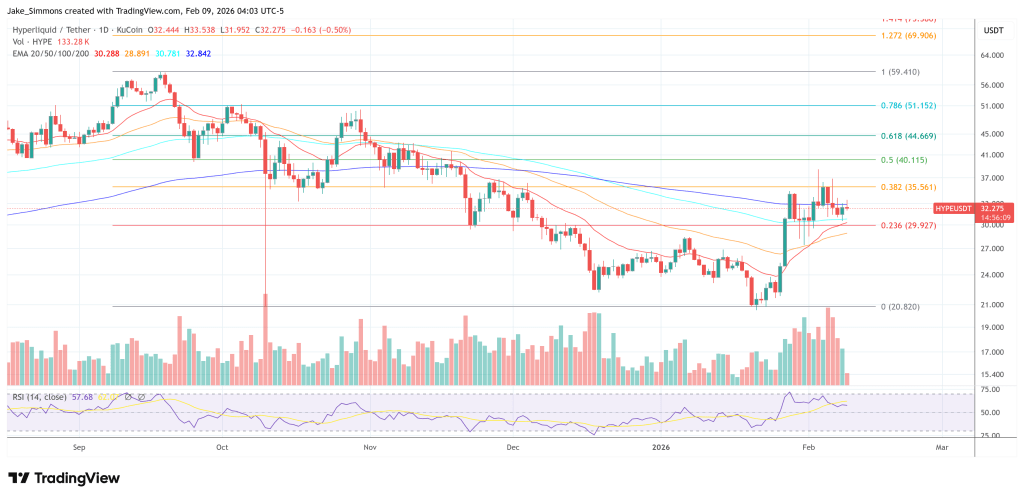
HYPE must break the 0.382 Fib, 1-week chart | Source: HYPEUSDT on TradingView.com

Связанные с этим вопросы

QWhat is the specific bet that Arthur Hayes made regarding Hyperliquid (HYPE)?

AArthur Hayes bet $100,000 that from February 10, 2026, to July 31, 2026, the price of HYPE will outperform any other cryptocurrency with a market cap over $1 billion in USD terms. The loser will donate the money to a charity of the winner's choice.

QWho is the target of Arthur Hayes's bet and what was their criticism of Hyperliquid?

AThe bet is directed at Kyle Samani, co-founder of Multicoin Capital. Samani criticized Hyperliquid, calling it 'in most respects everything wrong with crypto,' citing that its founder fled his home country, it openly facilitates crime and terror, and that it is closed source and permissioned.

QWhat is HIP-3 and why is it significant for Hyperliquid's growth narrative?

AHIP-3 is Hyperliquid's product line for non-crypto derivatives, specifically listing equity and commodity perpetuals. It is significant because it represents the platform's push into traditional finance (TradFi) instruments, aiming to provide 24/7, order-driven derivatives markets and attract activity outside of pure cryptocurrency flow.

QAccording to the analysis cited, how did Hyperliquid's silver perpetuals compare to CME/COMEX futures in terms of market performance?

AThe analysis found that pre-crash, Hyperliquid was competitive with a median spread of 2.4 basis points (bps) versus 3 bps on COMEX, and had median slippage of 0.5 bps. However, it had a significant capacity gap, with ~$230k within ±5 bps on Hyperliquid versus ~$13M on COMEX, which became more apparent during a violent selloff.

QWhat is the ultimate question that Arthur Hayes's bet reframes the debate into?

AThe bet reframes the debate from whether Hyperliquid is philosophically 'good' or 'bad' to whether its growth narrative—particularly its 24/7 access to non-crypto derivatives—will translate into its token (HYPE) outperforming other large-cap altcoins.

Похожее

STRC Breaks Below $95: Why Does It Continue to Depeg? Is There Default Risk?

"STRC Falls Below $95: Why the Persistent Depegging and Is There Default Risk?" The article discusses the recent decline in the price of STRC, a perpetual preferred stock issued by Strategy (MSTR) designed to trade around a $100 par value. As of publication, STRC traded at $94.65, raising market concerns. STRC is described as a high-yield cash flow product, offering an 11.50% annual dividend paid monthly. Its "preferred" status grants it priority over common stock for dividends and in liquidation. Key reasons cited for the price depegging include: 1. **Bitcoin's Price Drop:** MSTR's assets are heavily tied to Bitcoin (BTC), which fell over 21% from its recent high, pressuring all Strategy-related products. 2. **Competitive Pressure:** Rival Strive Asset Management's similar product, SATA, offers daily dividends and has maintained its $100 par value with a ~13% yield. In response, Strategy has proposed changing STRC's dividend frequency from monthly to bi-weekly, pending shareholder vote. 3. **Technical Selling:** A break below $100 may have triggered algorithmic selling and stop-losses, exacerbating the decline. Regarding default risk, the analysis suggests it is currently low. Strategy founder Michael Saylor confirmed the June 2026 dividend rate remains at 11.50% with no cuts or suspensions. The company's massive reserve of 843,706 BTC provides a significant backstop for its obligations. Industry opinions are mixed. Some analysts view the BTC holdings as reliable support for dividends, while critics like Peter Schiff warn of potential dividend cuts leading to price crashes and lawsuits. Others highlight inflation risk and the company's ability to reduce dividends without a formal default. In summary, STRC's drop is attributed to BTC volatility, competition, and technical factors. While immediate default risk appears contained, the product faces challenges from market conditions and competitive dynamics.

marsbit41 мин. назад

STRC Breaks Below $95: Why Does It Continue to Depeg? Is There Default Risk?

marsbit41 мин. назад

AI Trading Cools, South Korean Stocks Plunge 1.8%, Spot Gold Rises 1%, Bitcoin Dives

A sell-off in AI-related stocks, triggered by Broadcom's disappointing earnings forecast, sent shockwaves through global markets. South Korea's KOSPI led Asia's decline, plunging 1.8% as the risks from concentrated chip stock gains and surging leveraged investments came to the fore. The tech-heavy Nasdaq 100 futures fell 0.5% following Broadcom's 14% after-hours plunge, which signaled a slower-than-expected transition to AI clients. This pullback extended Wall Street's weakness, halting the S&P 500's nine-day rally amid hawkish Fed signals and renewed Middle East tensions. South Korean authorities convened an emergency meeting, pledging "immediate measures" against market volatility and warning of record-high stock margin debt. The adjustment rippled across assets: Bitcoin fell to around $64,000, its lowest since February, while safe-haven gold rose 1% on bargain hunting. Oil prices dipped on Middle East ceasefire news. Market analysts noted the sell-off was driven by profit-taking after massive gains, particularly in chip stocks like Samsung and SK Hynix, which now dominate the KOSPI. Wall Street banks are divided on Korea's outlook, with Goldman Sachs raising its target while Citigroup and others warn of overvaluation and a potential bubble. Bridgewater's Ray Dalio noted that great technological shifts often create bubbles. Meanwhile, Fed officials' hints at potential future rate hikes added to the cautious mood ahead of key U.S. jobs data.

华尔街日报1 ч. назад

AI Trading Cools, South Korean Stocks Plunge 1.8%, Spot Gold Rises 1%, Bitcoin Dives

华尔街日报1 ч. назад

Seeking Alpha's Hot Article: Why Might the U.S. Stock Market Crash in June?

In a recent Seeking Alpha article, financial professor and analyst Damir Tokic argues that the US stock market may be poised for a significant crash in June 2026. The core thesis centers on a "mega-bubble" in equities, particularly within the technology sector, which has driven the S&P 500 to near-record valuations, with a Shiller P/E ratio exceeding 40—a level comparable to the 2000 dot-com bubble. Tokic identifies two primary catalysts for a potential collapse. First, he points to unsustainable market exuberance fueled by what he terms the "Trump Stimulus"—massive AI capital expenditure by tech giants, which he believes is politically driven and cannot last. Second, and more urgently, he highlights the escalating Iran war as a critical threat. The ongoing closure of the Strait of Hormuz has created a severe global energy supply crunch. Strategic petroleum reserves are projected to hit critically low operational levels by June, potentially causing oil prices to spike above $200 per barrel and triggering a severe, supply-driven inflationary shock. This scenario, Tokic warns, would force the Federal Reserve's hand. Despite currently maintaining a dovish bias, the Fed would likely be compelled to officially pivot to a hawkish stance at its June FOMC meeting to combat soaring inflation and bond yields. He contends that such a shift—or even a failure to act, which would destroy Fed credibility—could be the trigger that punctures the market bubble. The resulting downturn, he concludes, could rival the bear markets of 2000 and 2008, advising investors to prepare for a major correction.

marsbit1 ч. назад

Seeking Alpha's Hot Article: Why Might the U.S. Stock Market Crash in June?

marsbit1 ч. назад

Торговля

Спот
Фьючерсы
活动图片