ArkInvest Allocates $32.7M to Robinhood as Bitcoin Hyper Pumps

bitcoinistОпубликовано 2026-02-03Обновлено 2026-02-03

Введение

Ark Invest has acquired $32.7 million worth of Robinhood (HOOD) shares, signaling a strategic bet on increased retail market participation, which historically precedes crypto activity surges. This influx could cause Bitcoin network congestion, driving interest in scalability solutions. Bitcoin Hyper ($HYPER) is highlighted as a key infrastructure project merging Solana's speed with Bitcoin's security via the Solana Virtual Machine, enabling fast, low-cost transactions. With over $32 million raised in its presale and immediate staking options, it aims to attract developers and handle high-frequency BTC use cases, positioning itself as a solution to upcoming liquidity and scalability challenges.

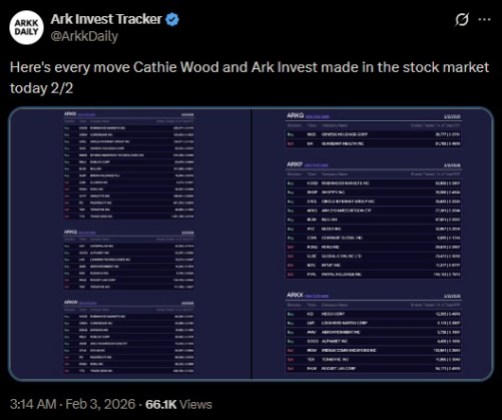
Ark Invest’s latest filing reveals a chunky $32.7M acquisition of Robinhood (HOOD) shares.

On the surface, it’s an equity play, but dig deeper, and it looks like a derivative bet on the resurgence of crypto market participation. Historically, Robinhood’s volume spikes act as a canary in the coal mine for retail capital, typically preceding major on-chain activity by 3-5 weeks.
The timing feels deliberate. As the Federal Reserve signals potential rate pauses, risk-on assets are re-pricing. But buying HOOD is just the surface trade. The inevitable second-order effect of a retail influx? Massive Bitcoin network congestion. When millions of new users try to move $BTC, fees don’t just rise; they skyrocket, making the base layer practically unusable for anyone moving less than six figures.

That bottleneck is exactly why institutional eyes are drifting toward infrastructure that can handle the coming liquidity shock. While Wall Street buys exchange stocks, on-chain capital is positioning into scalability protocols.

Specifically, smart money appears to be front-running the congestion narrative by accumulating Bitcoin Hyper ($HYPER), the first protocol to weld the Solana Virtual Machine (SVM) directly onto a Bitcoin Layer 2.

Buy $HYPER here.

Solving the Velocity Problem: Bitcoin Meets SVM Speed

The thesis here is simple mechanics. Bitcoin is secure but slow; Solana is fast but has faced centralization headaches. By fusing these architectures, Bitcoin Hyper ($HYPER) attempts a ‘best of both worlds’ environment to solve the trilemma plaguing current Layer 2s.

Most existing Bitcoin L2s still feel sluggish compared to modern DeFi standards. Bitcoin Hyper bypasses the lag by using the Solana Virtual Machine (SVM) for execution. The result? Sub-second transaction finality and costs that are fractions of a cent, all while anchoring state to the Bitcoin L1.
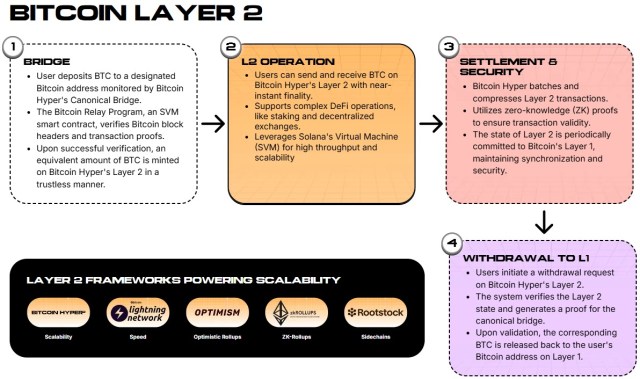
That matters because it finally unlocks high-frequency use cases for $BTC, think gaming, real-time payments, and complex DeFi swaps, that were previously impossible (or just too expensive) on the base layer.

Developers are eyeing the Rust-based environment too. The protocol offers a Developer SDK and API in Rust, meaning the massive pool of Solana devs can port their dApps to the Bitcoin ecosystem without rewriting their codebase. This isn’t just about building a chain; it’s about importing an entire developer economy.

You can buy $HYPER here.

Presale Data Signals Institutional Accumulation

The market’s appetite for high-performance infrastructure shows up in the hard numbers. According to the official presale page, Bitcoin Hyper ($HYPER) has raised over $32M, a figure that frankly outpaces most comparable infrastructure rounds this cycle. The token sits at $0.013675, a valuation that looks modest relative to the utility proposition.
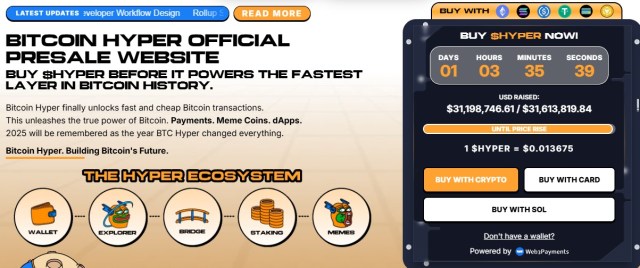
The incentives seem structured to keep that liquidity sticky. Staking opens immediately after the Token Generation Event (TGE), with a 7-day vesting period for presale participants. That lock-up mechanism helps prevent immediate sell-offs, aiming to create a stable floor at launch.

For investors watching Ark Invest buy the ‘shovels’ (Robinhood), Bitcoin Hyper represents the ‘ground’ where the actual digging happens.

Visit the official $HYPER presale here.

The content provided in this article is for informational purposes only and does not constitute financial advice. Cryptocurrency investments, including presales and stocks like Robinhood, carry high risks. Always conduct your own due diligence before investing.


Связанные с этим вопросы

QWhat is the significance of Ark Invest's $32.7M acquisition of Robinhood shares according to the article?

AThe article suggests that while it appears to be an equity play on the surface, it is actually a derivative bet on the resurgence of crypto market participation. Historically, Robinhood's trading volume spikes act as an early indicator (a 'canary in the coal mine') for retail capital entering the market, typically preceding major on-chain activity by 3-5 weeks.

QWhat problem does the Bitcoin Hyper ($HYPER) protocol aim to solve?

ABitcoin Hyper aims to solve the blockchain trilemma for Bitcoin Layer 2s by combining the security of Bitcoin with the speed of Solana. It welds the Solana Virtual Machine (SVM) directly onto a Bitcoin L2 to provide sub-second transaction finality and extremely low costs, thereby solving the 'velocity problem' and enabling high-frequency use cases like gaming and real-time payments on Bitcoin.

QHow does the article connect a potential influx of retail users to Bitcoin network congestion?

AThe article states that an influx of retail users, signaled by increased activity on platforms like Robinhood, leads to massive Bitcoin network congestion. When millions of new users try to move BTC, transaction fees don't just rise but 'skyrocket,' making the base layer practically unusable for transactions under six figures.

QWhat advantage does Bitcoin Hyper's Rust-based development environment provide?

ABy offering a Developer SDK and API in Rust, Bitcoin Hyper allows the massive existing pool of Solana developers to easily port their decentralized applications (dApps) to the Bitcoin ecosystem without having to rewrite their entire codebase, effectively importing an entire developer economy.

QWhat does the presale data for Bitcoin Hyper ($HYPER) indicate, as mentioned in the article?

AThe presale data indicates strong institutional accumulation, having raised over $32 million, which the article states outpaces most comparable infrastructure rounds in the current market cycle. The token's valuation is considered modest relative to its utility, and its staking and vesting mechanisms are designed to create liquidity stability post-launch.

Похожее

a16z: AI's 'Amnesia', Can Continuous Learning Cure It?

The article "a16z: AI's 'Amnesia' – Can Continual Learning Cure It?" explores the limitations of current large language models (LLMs), which, like the protagonist in the film *Memento*, are trapped in a perpetual present—unable to form new memories after training. While methods like in-context learning (ICL), retrieval-augmented generation (RAG), and external scaffolding (e.g., chat history, prompts) provide temporary solutions, they fail to enable true internalization of new knowledge. The authors argue that compression—the core of learning during training—is halted at deployment, preventing models from generalizing, discovering novel solutions (e.g., mathematical proofs), or handling adversarial scenarios. The piece introduces *continual learning* as a critical research direction to address this, categorizing approaches into three paths: 1. **Context**: Scaling external memory via longer context windows, multi-agent systems, and smarter retrieval. 2. **Modules**: Using pluggable adapters or external memory layers for specialization without full retraining. 3. **Weights**: Enabling parameter updates through sparse training, test-time training, meta-learning, distillation, and reinforcement learning from feedback. Challenges include catastrophic forgetting, safety risks, and auditability, but overcoming these could unlock models that learn iteratively from experience. The conclusion emphasizes that while context-based methods are effective, true breakthroughs require models to compress new information into weights post-deployment, moving from mere retrieval to genuine learning.

marsbit1 ч. назад

a16z: AI's 'Amnesia', Can Continuous Learning Cure It?

marsbit1 ч. назад

Can a Hair Dryer Earn $34,000? Deciphering the Reflexivity Paradox in Prediction Markets

An individual manipulated a weather sensor at Paris Charles de Gaulle Airport with a portable heat source, causing a Polymarket weather market to settle at 22°C and earning $34,000. This incident highlights a fundamental issue in prediction markets: when a market aims to reflect reality, it also incentivizes participants to influence that reality. Prediction markets operate on two layers: platform rules (what outcome counts as a win) and data sources (what actually happened). While most focus on rules, the real vulnerability lies in the data source. If reality is recorded through a specific source, influencing that source directly affects market settlement. The article categorizes markets by their vulnerability: 1. **Single-point physical data sources** (e.g., weather stations): Easily manipulated through physical interference. 2. **Insider information markets** (e.g., MrBeast video details): Insiders like team members use non-public information to trade. Kalshi fined a剪辑师 $20,000 for insider trading. 3. **Actor-manipulated markets** (e.g., Andrew Tate’s tweet counts): The subject of the market can control the outcome. Evidence suggests Tate’sociated accounts coordinated to profit. 4. **Individual-action markets** (e.g., WNBA disruptions): A single person can execute an event to profit from their pre-placed bets. Kalshi and Polymarket handle these issues differently. Kalshi enforces strict KYC, publicly penalizes insider trading, and reports to regulators. Polymarket, with its anonymous wallet-based system, has historically been more permissive, arguing that insider information improves market accuracy. However, it cooperated with authorities in the "Van Dyke case," where a user traded on classified government information. The core paradox is reflexivity: prediction markets are designed to discover truth, but their financial incentives can distort reality. The more valuable a prediction becomes, the more likely participants are to influence the event itself. The market ceases to be a mirror of reality and instead shapes it.

marsbit2 ч. назад

Can a Hair Dryer Earn $34,000? Deciphering the Reflexivity Paradox in Prediction Markets

marsbit2 ч. назад

Торговля

Спот
Фьючерсы
活动图片