Anthropic Has Developed the Most Powerful AI Model in History, But Dares Not Release It...

Odaily星球日报Опубликовано 2026-04-08Обновлено 2026-04-08

Введение

Anthropic has developed its most powerful AI model to date, named Mythos, which boasts over 10 trillion parameters—far surpassing current leading models—and a training cost of $10 billion. Mythos demonstrates exceptional capabilities in software coding, academic reasoning, and cybersecurity, significantly outperforming its predecessor, Claude Opus 4.6, in benchmark tests. In a matter of weeks, Mythos autonomously identified thousands of previously unknown zero-day vulnerabilities across major operating systems, browsers, and critical software. Notable discoveries include a 27-year-old flaw in OpenBSD and a 16-year-old vulnerability in FFmpeg, demonstrating its ability to find and exploit complex security weaknesses with minimal human intervention. Due to its unprecedented power and potential for misuse by malicious actors, Anthropic has refrained from publicly releasing Mythos. Instead, it launched the "Project Glasswing" initiative, partnering with leading tech and financial firms like Amazon, Apple, Google, Microsoft, and JPMorgan. Through this program, select organizations gain early access to Mythos Preview to identify and patch vulnerabilities in critical systems. Anthropic is providing $100 million in usage credits to participants and donating millions to open-source security foundations. While AI like Mythos could lower the barrier for cyber attacks, Anthropic emphasizes its potential to greatly enhance defensive capabilities, helping to build more resilient systems...

Original | Odaily Planet Daily (@OdailyChina)

Author | Azuma (@azuma_eth)

On April 8, Anthropic, the AI development company behind Claude, officially announced the launch of a new initiative called "Project Glasswing." This project will be jointly advanced in collaboration with several industry giants including Amazon, Apple, Broadcom, Cisco, CrowdStrike, Google, JPMorgan Chase, the Linux Foundation, Microsoft, NVIDIA, and Palo Alto Networks.

Anthropic stated that this is an urgent measure aimed at protecting the world's most critical software. The parties will jointly use the Mythos Preview version to discover and fix potential flaws in the systems the world currently relies on.

Mythos is the next-generation AI model currently under development by Anthropic. It is the first model in human history to surpass the ten trillion parameter mark (in contrast, mainstream models on the market currently range from hundreds of billions to one trillion parameters), with a staggering training cost of $10 billion. Compared to Claude's current most powerful model, Opus 4.6, Mythos shows significantly improved scores in tests for software coding, academic reasoning, and cybersecurity.

Rumors about Mythos began circulating in the market last week, with widespread concern being — would Mythos, with its specialized cybersecurity capabilities, affect the current security offense and defense landscape? If maliciously used, could it cause larger-scale security incidents? Odaily also reported on this matter and discussed the potential impact on security offense and defense in the cryptocurrency industry with Yu Xian, founder of the security firm SlowMist (see 《Odaily Interview with Yu Xian: Leak of Anthropic's Nuclear-Grade New Model, How Will It Affect Crypto Security Offense and Defense?》). However, Anthropic had not publicly acknowledged the existence of Mythos at that time, so relevant information remained limited.

On April 8, with the announcement of the "Project Glasswing" plan, Anthropic disclosed more details about Mythos. Based on the actual test cases published by Anthropic, the company has not exaggerated Mythos's capabilities. In fact, its power is such that the company dares not release the model publicly directly, for fear of it being maliciously used by hacker groups. Instead, it plans to first allow major corporations to试用 (try out) through the "Project Glasswing" initiative to identify and patch potential vulnerabilities in advance.

Mythos Shows Its Muscle: Unearthing Thousands of "Zero-Day Vulnerabilities" in Weeks

When discussing Mythos's capabilities, Anthropic直言 (stated bluntly) that the model's birth signifies the arrival of a严峻 (grim) reality — the coding ability of AI models has reached an extremely high level, and in terms of discovering and exploiting software vulnerabilities, they can almost surpass all but the most skilled humans.

According to Anthropic's disclosure, within just a few weeks, Anthropic used Mythos to identify thousands of zero-day vulnerabilities (i.e., defects previously unknown even to the software developers themselves). Many of these are high-risk vulnerabilities, affecting all major operating systems and mainstream browsers, and impacting a range of other critical software.

Anthropic provided several representative examples:

  • Mythos discovered a 27-year-old vulnerability in OpenBSD, a system long renowned for being "extremely secure" and widely used in critical infrastructure like firewalls. This vulnerability allows an attacker to remotely crash the system directly;
  • In the widely used video processing library FFmpeg, Mythos found a 16-year-old vulnerability. The code containing this issue had been triggered over 5 million times by automated tests but remained undetected;
  • Mythos was also able to automatically chain multiple vulnerabilities in the Linux kernel to escalate privileges from a regular user level to full control of the server.

More worryingly, Anthropic stated that most of these vulnerabilities were "autonomously discovered and exploitation paths constructed" by Mythos with almost no human intervention. This perhaps indicates that AI has begun to possess automated offensive and defensive capabilities similar to top-tier hacker teams.

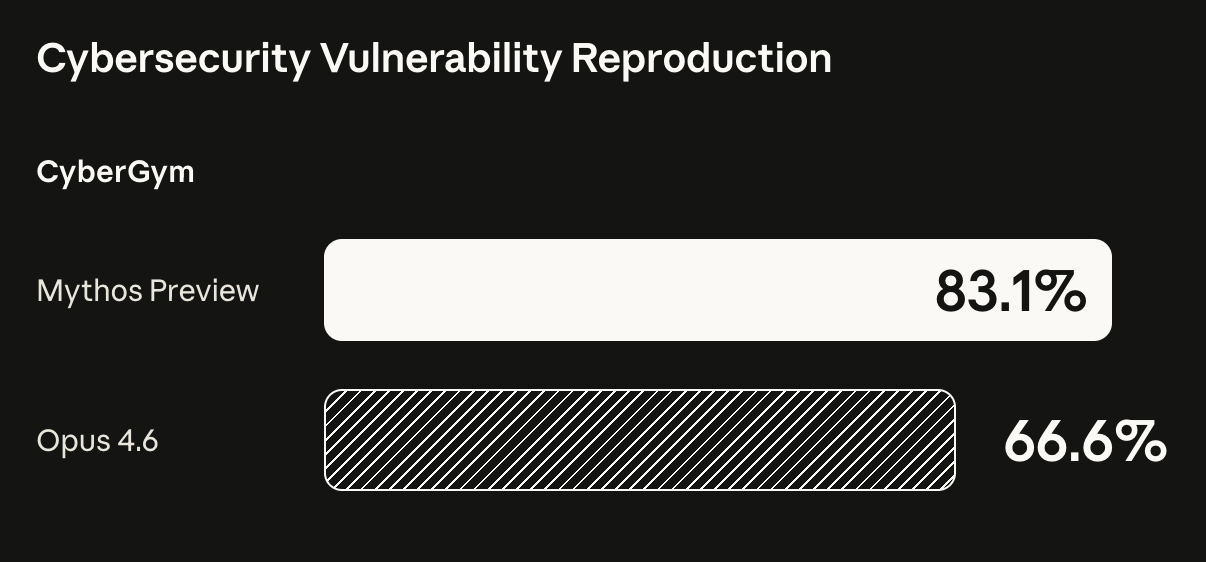
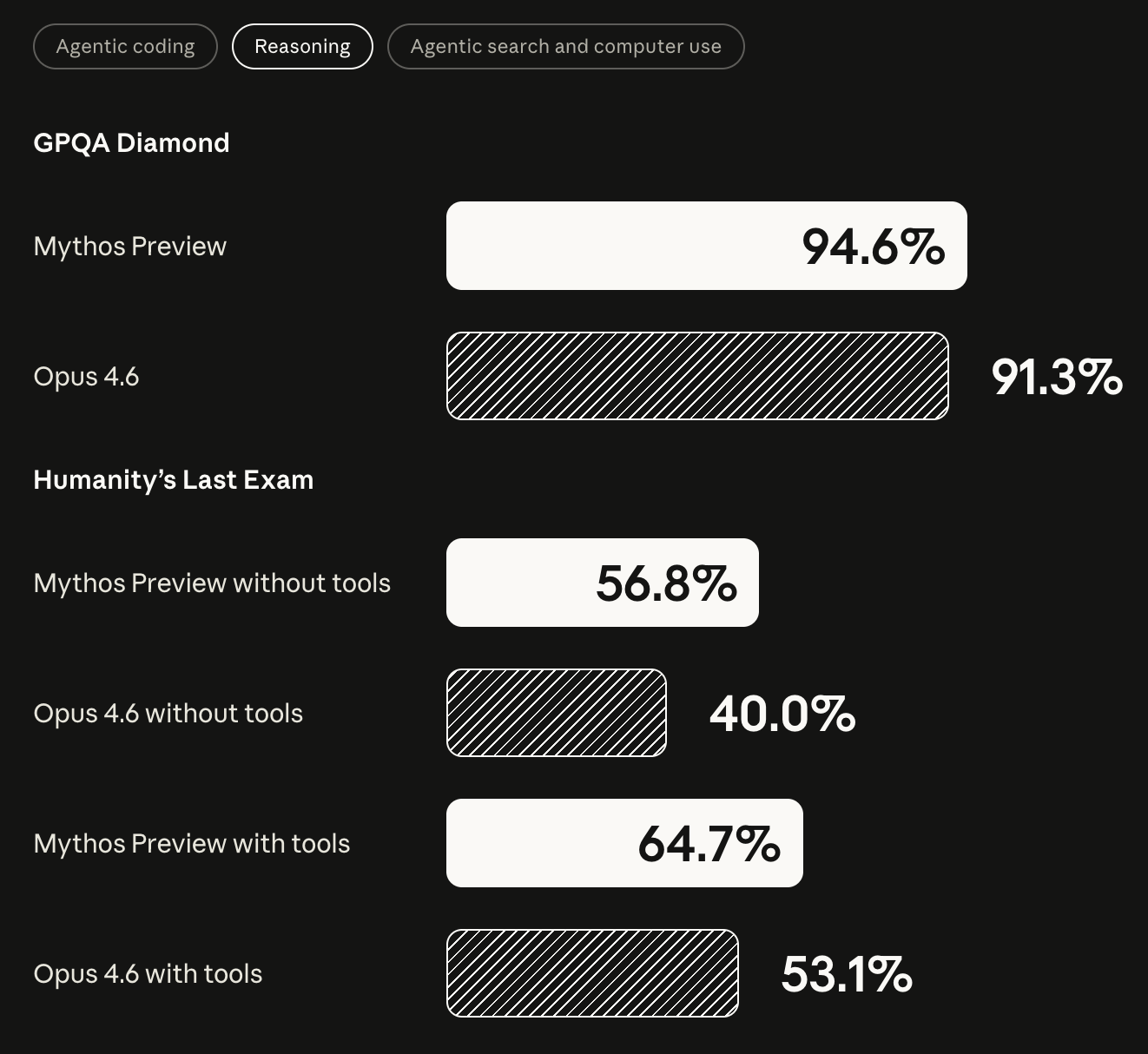
On evaluation benchmarks, Mythos also shows a断层级 (generational leap) evolution compared to Opus 4.6. For example, in cybersecurity vulnerability reproduction tests, Mythos achieved 83.1%, while Opus 4.6 scored 66.6%; it also achieved significant leads in multiple coding and reasoning tests.

Perhaps precisely because Mythos's capabilities are too powerful, Anthropic did not choose to open the model directly but first launched the "Project Glasswing" initiative to allow the entire internet to "fortify" in advance.

Through this initiative, Anthropic will provide early access to the Mythos Preview version to participating parties, for use in discovering and fixing vulnerabilities or weaknesses in their foundational systems — focusing on tasks such as local vulnerability detection, black-box testing of binary programs, endpoint security hardening, and system penetration testing.

Anthropic also承诺 (committed) to provide participating parties with a total of $100 million in model usage credits to support usage throughout the research preview phase. Thereafter, the Mythos Preview version will be available to participants at a price of $25 per million input tokens / $125 per million output tokens (participants can also access the model via Claude API, Amazon Bedrock, Google Cloud Vertex AI, and Microsoft Foundry). In addition to the model usage credits, Anthropic will donate $2.5 million to the Linux Foundation for Alpha-Omega and OpenSSF, and $1.5 million to the Apache Software Foundation, to help open-source software maintainers cope with the evolving security landscape.

Anthropic plans to gradually expand the participation scope of "Project Glasswing" and continue推进 (advancing) it for several months, while sharing experiences as much as possible so that other organizations can apply the relevant insights to their own security construction. Within 90 days, Anthropic will publicly report阶段性成果 (phase results), including fixed vulnerabilities and disclosable security improvements.

Technology Will Only Keep Advancing, But There's No Need for Excessive Worry

AI is irreversibly changing the world we are familiar with, including the field of cybersecurity focused on in this article. As the门槛 (threshold) for discovering and exploiting vulnerabilities is significantly lowered, people inevitably worry: will AI become a sharp blade in the hands of malicious actors, threatening the existing balance of network security? (PS: For cryptocurrency users who need to place real money in wallet systems or on-chain protocols, this concern is particularly strong.)

Addressing this issue, Anthropic believes "there are still reasons for optimism." AI models are dangerous precisely because they have the capability to cause harm in the hands of wrongdoers. But at the same time, AI also holds immeasurable value in discovering and fixing critical software defects and developing newer, safer software.

It is predictable that AI capabilities will continue to evolve rapidly in the coming years. However, as new attack methods emerge, new defense mechanisms will also appear simultaneously. Technological upgrades are inevitable, but this does not mean the risk is必然失控 (necessarily uncontrollable) — as long as the defense system evolves同步 (synchronously), it might even be possible to use AI to build a higher-strength security moat.

Связанные с этим вопросы

QWhat is the name of Anthropic's new AI model and what makes it so powerful?

AThe new AI model is called Mythos. It is the first model in human history to exceed ten trillion parameters (compared to current mainstream models in the hundreds of billions to one trillion range) and was trained at a cost of $10 billion. It demonstrates a massive performance leap over its predecessor, Claude Opus 4.6, particularly in software coding, academic reasoning, and cybersecurity tests.

QWhy is Anthropic hesitant to publicly release the Mythos model immediately?

AAnthropic is hesitant to release Mythos immediately because its capabilities in autonomously discovering and exploiting software vulnerabilities are so advanced that the company fears it could be maliciously used by hackers. To mitigate this risk, they are first launching the 'Project Glasswing' initiative to allow major corporations to use a preview version to find and patch vulnerabilities in critical systems.

QWhat is the goal of Anthropic's 'Project Glasswing' initiative?

AThe goal of 'Project Glasswing' is a critical, urgent effort to protect the world's most crucial software. It involves a coalition of major tech and finance companies (like Amazon, Apple, Google, Microsoft, JPMorgan) who will employ the Mythos Preview version to discover and fix potential flaws in the systems the world relies on before the model is more widely available.

QWhat are some specific examples of vulnerabilities that Mythos was able to discover?

AIn just a few weeks, Mythos identified thousands of zero-day vulnerabilities. Specific examples include: a 27-year-old vulnerability in the 'extremely secure' OpenBSD system that allows remote crashes; a 16-year-old bug in the FFmpeg video processing library that had been triggered over 5 million times in automated tests but never found; and the ability to chain multiple Linux kernel vulnerabilities to escalate from user permissions to full server control.

QAccording to Anthropic, why should we remain optimistic about the rise of such powerful AI models in cybersecurity?

AAnthropic argues for optimism because while AI models like Mythos can be dangerous in the hands of malicious actors, they also possess immense value for discovering and repairing critical software defects and for developing new, more secure software. They believe that as new AI-powered attack methods emerge, new AI-powered defense mechanisms will also be developed, allowing security systems to evolve and potentially build even stronger defenses.

Похожее

Has the 'Digital Gold' Narrative for BTC Failed?

**Title: Has the "Digital Gold" Narrative for Bitcoin Failed?** The article argues that Bitcoin's "digital gold" narrative remains valid despite a recent sharp price decline (from a peak near $126k in Oct 2025 to briefly under $61k in Feb 2026). It presents a long-term investment framework based on three core points: **1. Viewing Bitcoin as an Asset:** Bitcoin is presented as a superior potential store of value compared to gold. Key arguments are its absolute scarcity (21 million cap), superior portability, and transparent auditability via its public ledger. While acknowledging its current use in early, volatile stages (~3-4% global adoption), the author draws parallels to the early, disruptive phases of the internet and e-commerce. **2. Understanding the Recent Downturn:** The current ~50% correction is framed as a predictable, consensus-driven cycle following its post-halving peak (the 2024 halving preceded the Oct 2025 high). A crucial factor is a historic "changing of hands": the influx of new institutional buyers via ETFs allowed early, low-cost holders (miners, OG believers) to take profits. The author notes that while severe, Bitcoin's historical drawdowns (e.g., 93% in 2011, 77% in 2021-22) have been progressively smaller, suggesting maturing holder structure and decreasing volatility over time. **3. The Long-Term Perspective:** The long-term thesis hinges on Bitcoin capturing a portion of gold's market value. With Bitcoin's market cap at ~$1.4 trillion (at $70k) versus gold's ~$20 trillion, significant upside potential exists if the "digital gold" narrative is partially realized. However, the author strongly cautions that short-term risks remain, the bottom is unpredictable, and high volatility is inherent. The real risk is not Bitcoin failing but poor personal position management (over-leverage, wrong capital) and a lack of deep understanding, which can force investors out during severe downturns. The conclusion uses Amazon's 95% crash post-2000 dot-com bubble and subsequent 42x recovery as an analogy. The ultimate question is not if Bitcoin's price will rise, but if an investor's strategy and conviction can withstand the volatility to see the long-term play out. The recent divergence (gold up, Bitcoin down) is posed not as a narrative failure, but as potential evidence of this ongoing, painful transition from a speculative asset to a mainstream allocation.

marsbit7 ч. назад

Has the 'Digital Gold' Narrative for BTC Failed?

marsbit7 ч. назад

Has BTC's 'Digital Gold' Narrative Failed?

The article discusses Bitcoin's "digital gold" narrative, its recent price drop, and long-term outlook through the perspective of "Jason". It argues the narrative is not a failure but that Bitcoin represents a superior, new asset class due to its fixed supply (21 million), portability, and auditability. The piece compares its current ~3-4% global adoption rate to early internet/e-commerce, suggesting significant growth potential. Regarding the 2025-2026 price decline (from ~$126k to briefly under $61k), the author views it as a predictable, consensus-driven sell-off within Bitcoin's ~4-year cycle post-halving, exacerbated by a major "handover" from early, low-cost holders to new institutional buyers via ETFs. A key observation is that historical peak-to-trough drawdowns have lessened over time (e.g., 93% in 2011 to ~50% in 2026), indicating maturing volatility as holder structure changes. For the long term, the author uses a simple framework: Bitcoin's total market cap (~$1.4T at $70k) is only about 7% of gold's (~$20T). Even capturing 30-50% of gold's value would imply substantial upside. However, the article strongly cautions against viewing this as investment advice, emphasizing extreme volatility and the critical importance of risk management, position sizing, and deep fundamental understanding to survive severe drawdowns. It concludes by drawing a parallel to Amazon's 95% crash in 2000 and subsequent 42x recovery, stressing that the key is surviving market cycles to realize long-term potential.

链捕手7 ч. назад

Has BTC's 'Digital Gold' Narrative Failed?

链捕手7 ч. назад

From Code to Cognition: A Ten-Thousand-Word Guide to the Evolution of the Robot Brain

"From Code to Cognition: The Evolution of Robot Brains" The journey of robotic intelligence has shifted dramatically from manually coded systems to AI-driven brains. For decades, robots relied on layered software stacks—perception, state estimation, planning, control—each handcrafted. While predictable, they lacked adaptability. The 2010s saw deep learning revolutionize perception (e.g., object detection) and control (via reinforcement learning), but learned skills remained narrow. The arrival of Large Language Models (LLMs) marked a turning point. LLMs acted as high-level planners, interpreting natural language instructions and generating sequences of actions for traditional robotic systems to execute. However, true integration came with Visual-Language-Action (VLA) models, which fused vision, language, and motion prediction into a single network. Pioneered by models like RT-2 and open-source projects like OpenVLA, VLAs enable robots to reason and act directly from visual input and commands. The most advanced humanoid robots now employ a "dual-brain" architecture: a slow-thinking, large VLA (System 2) for reasoning and planning, and a fast-reacting, small network (System 1) for high-frequency motion control, sometimes with an even lower-level System 0 for balance. This split balances cognition with the physics of real-time movement. Computation is split between onboard hardware (e.g., NVIDIA Jetson) for safety-critical control loops and cloud/edge servers for non-critical tasks like learning and interfaces. A crucial driver is the open-source ecosystem—models like GR00T and OpenVLA allow startups to build upon pre-trained brains and fine-tune them with their own data, accelerating development. Despite progress, current systems struggle with recovery from errors, sample inefficiency, and long-horizon tasks. This has spurred the rise of **World Models**—neural networks that predict the consequences of actions. By simulating possible futures before acting (like NVIDIA Cosmos or Meta V-JEPA), robots can plan, recover, and generalize better. This represents the next frontier: shifting intelligence from learned reactions to an internal model of physics and cause-and-effect. The field is rapidly evolving. While not yet at its "ChatGPT moment," the convergence of cheaper hardware, scalable simulation, and world models points toward robots that are increasingly capable, adaptive, and useful. The question is shifting from "what can robots do?" to "what *should* they do?"

marsbit8 ч. назад

From Code to Cognition: A Ten-Thousand-Word Guide to the Evolution of the Robot Brain

marsbit8 ч. назад

Торговля

Спот
Фьючерсы
活动图片