An AI Version of the 'Subprime Crisis'? A Hidden Debt of $1.8 Trillion is Accumulating in the Shadows Amid the Frenzy

marsbitОпубликовано 2026-06-15Обновлено 2026-06-15

Введение

Amidst the AI infrastructure construction boom, a massive debt expansion is forming, with the most dangerous portion remaining off-balance sheets. Morgan Stanley research reveals approximately $1.8 trillion in off-balance-sheet exposures, including nearly $1 trillion in purchase commitments and over $800 billion in non-active lease contracts. These future cash outflows are not recorded as liabilities. The leverage of hyperscale cloud companies has surged from 0.9x to 1.8x in just two quarters. Private credit firms like Apollo and Blackstone are shifting leverage into the supply chain through complex, opaque SPV (Special Purpose Vehicle) financing structures. Global AI-related bond issuance has skyrocketed, with annual volume projected to exceed $570 billion. However, capital expenditure growth is outpacing revenue and free cash flow. Major cloud providers may see free cash flow approach zero or turn negative in 2026. A significant 'depreciation cliff' looms as vast amounts of current capital spending, recorded as 'construction in progress,' have yet to begin depreciating, artificially inflating current profit margins. Future depreciation could severely pressure earnings. The core risk is identified as a series of timing mismatches, not an immediate solvency crisis. Investment is racing ahead of monetization, leverage is being obscured, and accounting classifications hinder comparability. The entire financing structure faces a fundamental stress test if AI commercialization ...

Amid the frenzy of AI infrastructure construction, an unprecedented debt expansion is quietly taking shape—with its most dangerous portion never appearing on any balance sheet.

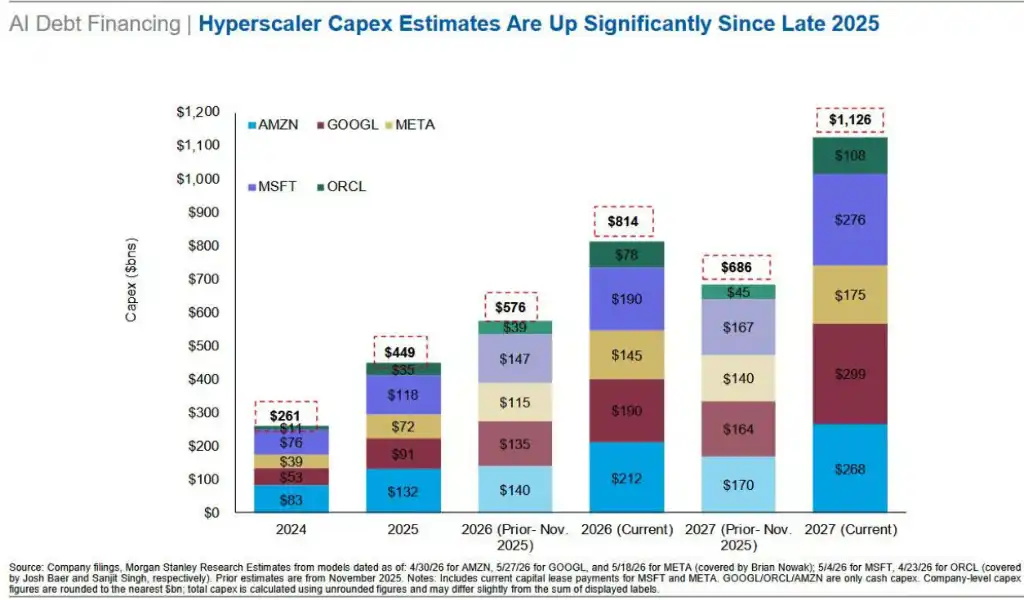
Goldman Sachs's latest report predicts that capital expenditures for hyperscale cloud companies will reach $1.1 trillion to $1.4 trillion by 2027, far exceeding market consensus. However, according to an in-depth study by Morgan Stanley, this already staggering figure is just the tip of the iceberg.
Nearly $1 trillion in purchase commitments, over $800 billion in unactivated lease contracts, and tens of billions of dollars in supplier financing arrangements collectively constitute an off-balance-sheet exposure of approximately $1.8 trillion—these liabilities exist outside the balance sheet but genuinely lock in future cash outflows.

The market has not yet fully priced in these risks.

Morgan Stanley warns that the leverage ratio of hyperscale cloud companies has surged from 0.9x to 1.8x in just two quarters, with capital expenditure growth continuing to outpace revenue and free cash flow growth, while the real impact of depreciation pressure has yet to arrive.

Meanwhile, private credit firms represented by Apollo and Blackstone are transferring leverage to the supply chain level through SPVs (Special Purpose Vehicles), creating a highly circular and difficult-to-penetrate financing structure. If AI commercialization falls short of expectations or enterprise customers shift en masse to cheaper alternatives, the fragility of the entire financing chain will be exposed.

Debt Issuance Frenzy: AI Has Become the Biggest Variable in Public Markets

According to Morgan Stanley's latest "AI Debt Financing Tracker Report," as of the end of May 2026, the scale of global AI-related bond issuance has reached $236 billion, a surge of 357% compared to the same period in 2025.

Morgan Stanley expects the total issuance of AI debt to exceed $570 billion for the full year, with the pace accelerating further in the second half of the year as capital expenditure financing needs are concentrated.
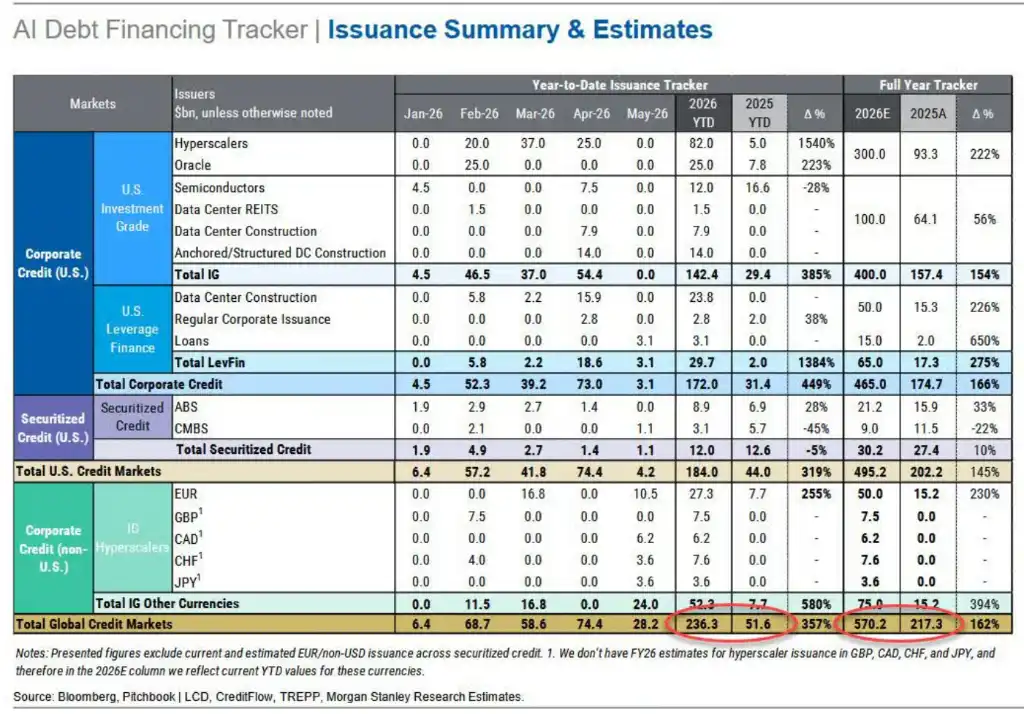
In April alone, AI-related bond issuance exceeded $74 billion, hitting a new high for the year, with project financing structures (for data center construction) accounting for 85% of high-yield bond supply and 40% of investment-grade bond supply. Meanwhile, the five hyperscale cloud companies—Amazon, Meta, Google, Microsoft, and Oracle—now account for 4% of the entire investment-grade bond index.

In terms of leverage, the gross leverage ratio for hyperscale cloud companies has risen from 0.9x in the third quarter of 2025 to the current 1.8x, increasing by approximately 0.3x per quarter, already surpassing the leverage level of the entire energy industry.
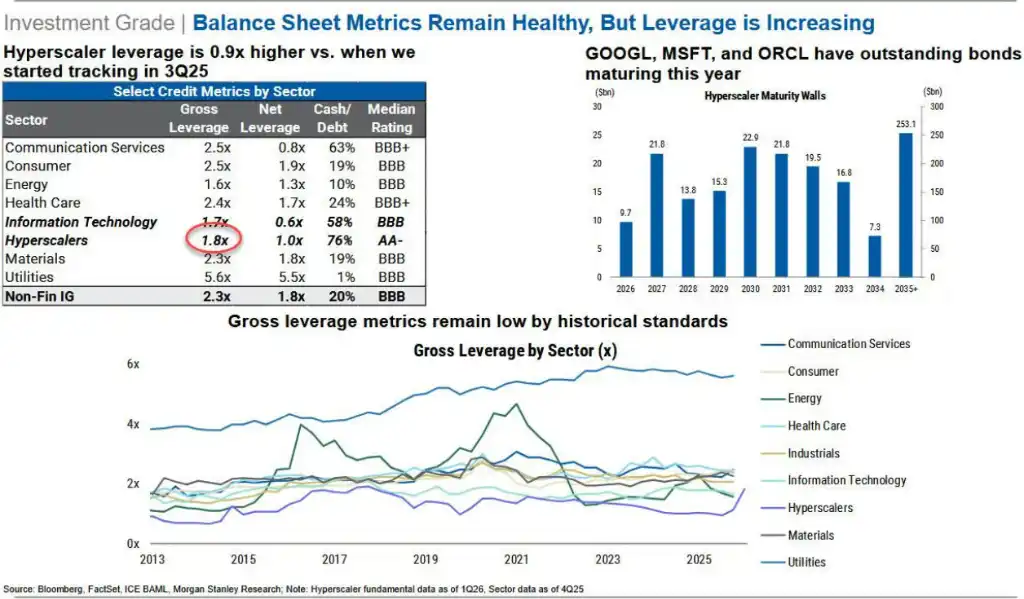
Morgan Stanley points out that, affected by supply pressure, related credit spreads have drifted from the AA range to the A range and may widen further. Meta's credit spread is currently wider than the CDX IG benchmark.

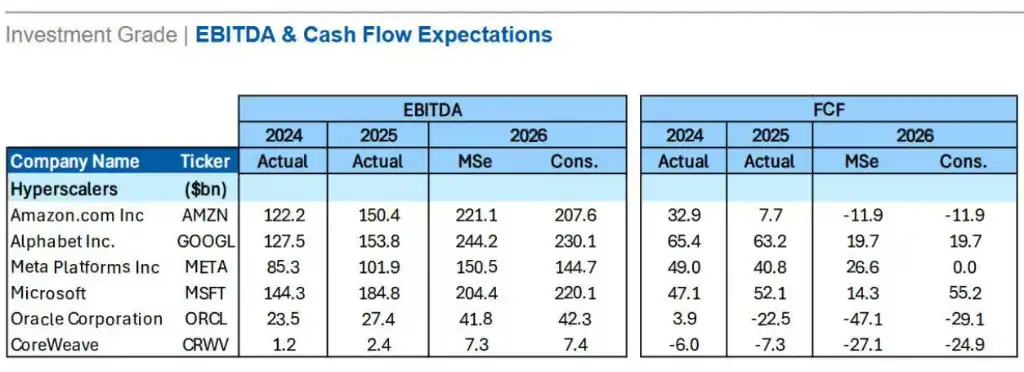
Regarding free cash flow, Morgan Stanley predicts that Amazon and Meta's free cash flow in 2026 will approach zero or even turn negative, at which point incremental financing will almost entirely rely on new debt.
$1.8 Trillion Off-Balance-Sheet Exposure: Invisible Liabilities, Locked-in Cash Outflows

Todd Castagno from Morgan Stanley's Global Valuation, Accounting & Tax team notes in the report that focusing solely on capital expenditure numbers would severely underestimate the true financial commitments of the AI construction cycle. Beyond the disclosed capital expenditures, there are three key types of off-balance-sheet exposure:

Purchase commitments of approximately $982 billion. The total value of long-term purchase contracts by hyperscale cloud companies and Nvidia is close to $1 trillion. Under accounting standards, these obligations are not recorded as liabilities until goods are delivered, unless the company expects a contract loss. Therefore, nearly $1 trillion in future cash outflows currently do not appear as liabilities on any balance sheet.

Notably, Nvidia's own inventory and purchase obligations have risen to about 32% of consensus revenue forecasts for fiscal year 2027, far above the historical range of 15% to 20%, indicating that supply chain commitment risks are extending to chip suppliers.

Unactivated lease commitments of approximately $822 billion. Over $800 billion in lease contracts have been signed but not yet activated and are not included in current lease liabilities. Additionally, arrangements such as variable lease payments, renewal options, and residual value guarantees also exist outside the balance sheet.
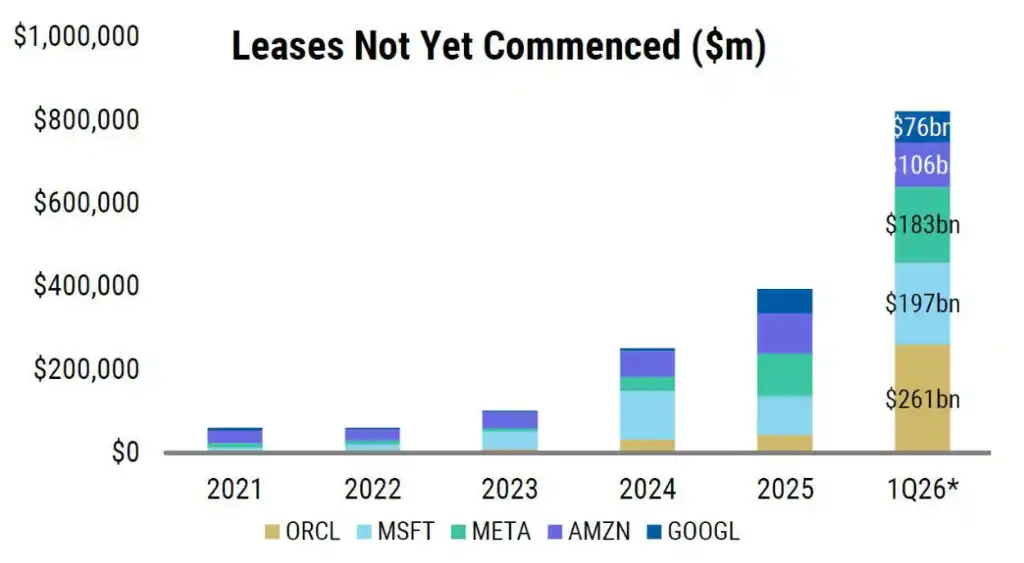
Morgan Stanley estimates that if finance leases were included in the calculation, Microsoft's capital expenditure-to-sales ratio would jump from 33%/50% (fiscal 2026/2027) to 44%/64%, while Oracle's could rise from 76%/115% to 101%/189%.

Unpaid capital expenditures in accounts payable of approximately $110 billion. The days payable outstanding (DPO) of hyperscale cloud companies have significantly lengthened—Oracle's increased by 370% year-on-year, Meta's by 73%, Microsoft's by 69%—meaning the entire supply chain is effectively financing AI construction, with suppliers bearing the liquidity pressure that should be carried by the buyers.

SPVs and Circular Financing: Leverage Moves to the Shadows

Another core dimension of off-balance-sheet risk is the circular financing structure built through SPVs.

A $35 billion "chip-collateralized" private credit deal completed this week by Apollo and Blackstone for Anthropic vividly illustrates the logic of this model:

Broadcom provides backing for this SPV; Anthropic uses the raised funds to purchase Google chips manufactured by Broadcom, with Google holding a 14% stake in Anthropic; Morgan Stanley, which arranged the deal, simultaneously provides loans to the investors participating in the transaction.

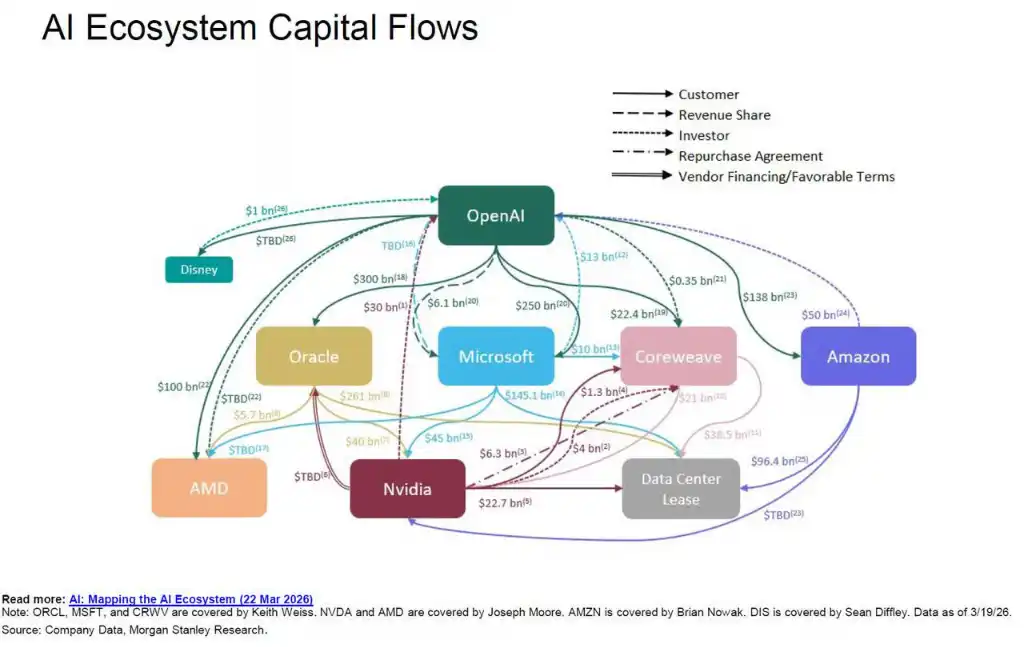
Morgan Stanley's AI ecosystem financing correlation map shows multiple circular relationships—customer, investor, supplier financing, and repurchase—among OpenAI, Oracle, Nvidia, Microsoft, CoreWeave, AMD, and Amazon. The same funds circulate repeatedly among a few key entities, with SPVs being the core tool enabling this circulation.
It is reported that Athene, the insurance subsidiary of Apollo, is particularly active in this structure—raising funds by selling annuities to retirees and then injecting the capital into SPVs to participate in AI infrastructure financing.

This model shifts leverage from the visible balance sheets of hyperscale cloud companies to suppliers and the private credit ecosystem, making the true systemic risk exposure difficult for external observers to identify and aggregate.

Depreciation Cliff and Monetization Gap: The Delayed Shock

Current financial data exhibits systematic optimism bias. A large amount of capital expenditure is currently booked as "construction in progress" (CIP) and has not yet begun to depreciate, artificially inflating reported profit margins and underestimating future expense pressure.

The CIP balances of Oracle, Meta, and Google have grown by approximately 200%, 90%, and 55% year-on-year, respectively.
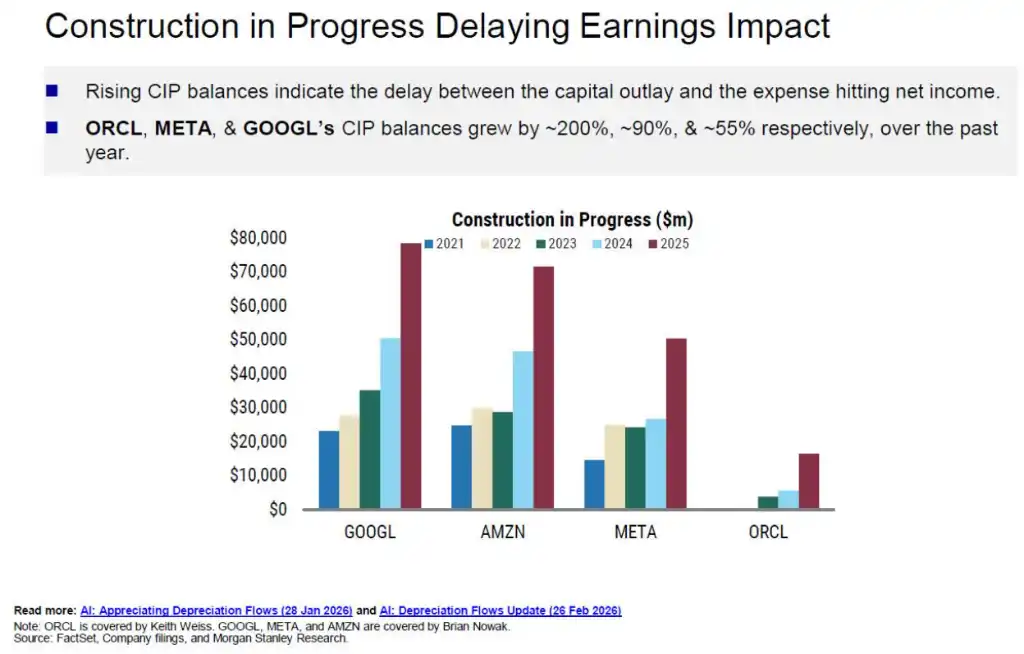
Once these assets gradually transition to depreciation, the impact will be concentrated.

Morgan Stanley predicts that the cumulative depreciation for Microsoft, Oracle, Meta, and Google over the next three years will exceed $520 billion. Taking Oracle as an example, depreciation as a percentage of revenue could rise from the current 7% to 28% in fiscal year 2028; Meta's could rise from 9% to 19%.

In this context, the only path to maintaining profit margins is for revenue to grow significantly in sync—yet the upward revisions to revenue forecasts currently lag far behind the upward revisions to capital expenditure forecasts.

Data shows that consensus capital expenditure forecasts for Google for 2026 have been raised by 139% compared to a year ago, while Meta's and Amazon's were raised by 85% and 81%, respectively. Oracle saw the largest increase, at 175%.

Meanwhile, revisions to revenue forecasts are noticeably lagging, revealing a clear structural mismatch where capital expenditure is outpacing commercialization.

Furthermore, over $2 trillion in remaining performance obligations (RPO) is highly concentrated in a few large, long-term contracts, presenting significant counterparty concentration risk—if any major participant in this circular system encounters problems, it could trigger a chain reaction.

Timing Mismatch Rather Than an Immediate Solvency Crisis

Morgan Stanley concludes that these risks do not currently constitute an imminent solvency crisis but rather a series of overlapping timing mismatches and information disclosure gaps: depreciation pressure is deferred, capital expenditure outpaces monetization, leverage shifts to suppliers and the private credit layer, and the comparability of capital intensity between different companies is significantly undermined by accounting classification differences.

Hyperscale cloud companies are clearly aware of the limited window of current market sentiment and are seizing the opportunity to maximize financing scale.

Goldman Sachs analyst Ryan Hammond points out that if AI infrastructure investment scales to 2% to 3% of GDP, analogous to historical construction cycles of railways and the automotive industry, capital expenditures could reach $1.1 trillion by 2027. In an extreme scenario, considering the cash flow of hyperscale cloud companies and the capacity of the investment-grade credit market, the upper limit might reach $1.4 trillion.

However, all of this hinges on the ability of large language models (LLMs) to continue increasing token pricing and maintain sufficient enterprise customer stickiness. A growing number of enterprises are turning their attention to AI products with comparable performance but significantly lower prices.

Should a structural shift occur on the demand side, the meticulously constructed financing system of today will face a fundamental stress test.


Связанные с этим вопросы

QWhat is the estimated scale of the off-balance-sheet exposure that is building up in the AI infrastructure boom, according to the article?

AThe total off-balance-sheet exposure is approximately $1.8 trillion, comprising nearly $1 trillion in purchase commitments, over $800 billion in non-activated lease contracts, and over $100 billion in supplier financing arrangements.

QHow has the leverage ratio of hyper-scale cloud companies changed recently, and what is it compared to?

AThe gross leverage ratio of hyper-scale cloud companies has surged from 0.9x in Q3 2025 to the current 1.8x, increasing by approximately 0.3x per quarter. This level has already exceeded the leverage of the entire energy sector.

QWhat are the three main types of off-balance-sheet commitments identified in the Morgan Stanley report?

AThe three main types are: 1) Purchase commitments of approximately $982 billion, 2) Non-activated lease commitments of about $822 billion, and 3) Unpaid capital expenditures within accounts payable, estimated at $110 billion.

QWhat is the core mechanism described for shifting leverage into the shadows of the AI ecosystem?

AThe core mechanism is the use of Special Purpose Vehicles (SPVs) to build circular financing structures. This transfers leverage from the visible balance sheets of hyper-scale cloud companies to suppliers and the private credit ecosystem, making systemic risk exposure difficult to observe.

QWhat is the primary nature of the financial risk highlighted by Morgan Stanley regarding the AI investment cycle?

AThe primary risk is not an imminent solvency crisis, but a series of timing mismatches and information gaps. These include deferred depreciation pressure, capital expenditures outpacing monetization progress, leverage shifting to suppliers and private credit, and a lack of comparability in capital intensity due to accounting differences.

Похожее

Диалог с сооснователем Hyperdash: Почему Hyperliquid все еще сильно недооценен?

Источник: The Rollup Сооснователь и CRO платформы анализа данных Hyperdash, Hanson Birringer, в подкасте The Rollup объяснил, почему Hyperliquid остается недооцененным. Он выделил три ключевых тренда, на которых строится экосистема: децентрализованные бессрочные фьючерсы (перпеты), токенизированные реальные активы (RWA) и стейблкоины. Hyperliquid — это децентрализованная платформа, которая объединяет высокую производительность, необходимую институциональным инвесторам, с открытостью и разрешениями криптовалютного пространства. Платформа уже является лидером среди DEX по объему открытого интереса и торговли перпетами, включая новые рынки, такие как товары и акции. Важным шагом стало внедрение USDC в качестве основного расчётного актива, что создает новую модель получения дохода. Часть доходов от стейблкоинов (которые размещаются в низкорисковые активы, например, казначейские облигации США) направляется в фонд для выкупа и сжигания собственного токена HYPE, создавая постоянный покупательский спрос. Для привлечения традиционных институциональных капиталов был создан фонд Hyper Holdings, который выступил посевным инвестором для ETF на Hyperliquid от Grayscale. Это дает институциям удобный и регулируемый доступ к экосистеме. Несмотря на текущие регуляторные сложности для прямого подключения традиционных брокерских платформ, команда активно работает с регуляторами, чтобы создать чёткие правила для децентрализованных торговых площадок. Приобретение Hyperdash компании Imperator укрепило инфраструктуру данных и нод, улучшив инструменты как для розничных, так и для институциональных трейдеров. По мнению Беррингера, основной бычий сценарий для Hyperliquid связан с глобальной финансовой инклюзией — предоставлением доступа к ликвидности миллиардам людей через смартфон. Медвежий сценарий, который мог бы остановить этот рост, маловероятен, так как соответствует долгосрочным трендам цифровизации и открытости финансов.

marsbit49 мин. назад

Диалог с сооснователем Hyperdash: Почему Hyperliquid все еще сильно недооценен?

marsbit49 мин. назад

Обнародована «полнокровная» версия DeepSeek V4, релиз, возможно, уже завтра

Весь Интернет ждал почти три месяца! Официальный релиз DeepSeek V4 ожидается уже завтра или в ближайшие дни. Некоторые пользователи уже получили доступ к предварительному тестированию. Будут выпущены две версии: DeepSeek V4 Flash и DeepSeek V4 Pro. По предварительным оценкам, общая производительность модели находится на уровне Opus 4.8, способности в области программирования сравнимы с GPT-5.6 Sol, а возможности Agent, генерации 3D и SVG значительно улучшились. Хотя, вероятно, она не превзойдёт недавно выпущенный Kimi K3, её цена будет заметно ниже. В первых демонстрациях уже видны возможности V4: создание 3D-игр, HTML-игр в стиле смеси Minecraft и No Man’s Sky, классической игры Cut the Rope и т.д. Важнейшим фактором станет цена. DeepSeek внедрит «пиковое ценообразование» для API. Стоимость миллиона выходных токенов для deepseek-v4-pro составит $0,87 в обычное время и $1,74 в пиковый период; для deepseek-v4-flash — $0,28 и $0,56 соответственно, при этом цена за кэшированные входные токены остаётся крайне низкой. По сравнению с Fable 5 ($50 за миллион выходных токенов), V4 сохраняет огромное преимущество в соотношении цены и производительности. Это следует проверенной стратегии DeepSeek: предложить возможности уровня Opus по значительно более низкой цене. С 24 июля модели deepseek-chat и deepseek-reasoner будут сняты с эксплуатации. Ожидается, что DeepSeek V4, сочетая высокую производительность и привлекательную стоимость, вновь создаст «момент DeepSeek» на рынке.

marsbit57 мин. назад

Обнародована «полнокровная» версия DeepSeek V4, релиз, возможно, уже завтра

marsbit57 мин. назад

WEEX Labs Еженедельный обзор: «Перераспределение власти» в инфраструктуре ИИ и «глубокое погружение» в реальную экономику

Июль 2026 года ознаменовал ключевой поворот в индустрии ИИ: **переход права распределения вычислительных мощностей от «облачных гигантов» к «владельцам вычислений» и смещение ценностного ориентира ИИ от «гонки параметров» к «интеграции в реальный сектор»**. Основные изменения недели: * **Реорганизация облака вычислений**: Meta анонсировала услугу «MetaCompute», бросая вызов традиционным провайдерам (AWS, Azure). Это усиливает конкуренцию и делает «экосистему больших моделей» ключевым фактором выбора для предприятий. * **Прорыв китайских моделей**: Открытый исходный код и запуск моделей (DeepSeek-V4, Tencent Hunyuan Hy-3) указывают на этап «коммунальности». Конкуренция смещается в сторону экстремального соотношения цены и качества, снижая порог входа. * **Воплощенный ИИ на практике**: Политика стимулирует переход человекоподобных роботов из лабораторий в реальные производственные условия (логистика, автомобилестроение). Ценность измеряется стабильностью данных и реальной эффективностью на фабрике. * **Глобальное управление**: Концепция «суверенного ИИ» становится практической основой для национальных стратегий, устанавливая более высокие барьеры соответствия и требования к архитектуре моделей. **Итог**: Процветание ИИ переходит от виртуального мира к интеграции в глобальную производственную ткань. Рекомендации для компаний: 1. Использовать открытые модели (например, DeepSeek) для создания частных корпоративных решений. 2. Избегать «блокировки поставщика» вычислительных мощностей, сохраняя разнообразие. 3. Искать возможности в инфраструктуре для воплощенного ИИ (сбор данных, промышленное ПО, сервисы адаптации), а не только в создании роботов.

marsbit1 ч. назад

WEEX Labs Еженедельный обзор: «Перераспределение власти» в инфраструктуре ИИ и «глубокое погружение» в реальную экономику

marsbit1 ч. назад

Надежен ли WEEX TradFi? Что вам следует знать перед первой торговлей токенизированными акциями США

В последние годы пользователи крипторынка все чаще обращают внимание на традиционные финансовые активы, такие как акции ведущих компаний (Nvidia, Apple и др.), индексы и товары. Это стирает границы между криптовалютными и традиционными рынками. Такие платформы, как WEEX TradFi, предлагают токенизированные версии этих активов (токены акций), позволяя торговать ими в привычной цифровой среде. Важно понимать, что торговля токенами акций (например, токеном NVDA) — это не то же самое, что владение реальными акциями. Пользователи получают доступ к ценовым движениям базового актива, но не становятся акционерами с правом голоса или получения дивидендов. Преимуществом является знакомый интерфейс и возможность торговли 24/7, в отличие от традиционных бирж с фиксированными часами работы. Перед началом торговли необходимо оценить надежность продукта: понять его механизм, как отслеживается цена базового актива, а также осознавать связанные риски. Традиционные активы также подвержены волатильности из-за корпоративных новостей, макроэкономических факторов и изменений ликвидности в нерабочее время основных бирж. Таким образом, TradFi становится новым мостом, соединяющим мир криптовалют с глобальными финансовыми рынками. Для пользователей ключевое значение имеют прозрачность правил торговли, управление рисками и четкое понимание того, чем они торгуют. Надежность платформы определяется не только ассортиментом активов, но и способностью пользователя ответственно подходить к торговле в этой новой, расширенной среде.

marsbit1 ч. назад

Надежен ли WEEX TradFi? Что вам следует знать перед первой торговлей токенизированными акциями США

marsbit1 ч. назад

Coinbase «немного отдалилась от пользователей», утверждает Cobie — Есть ли решение?

Известный криптоинфлюэнсер Rune спросил Джордана Фиша (Cobie), как он планирует увеличить использование приложения Base, учитывая, что руководство Base подорвало доверие криптосообщества. Фиш, отвечающий за торговые продукты Coinbase и недавно возглавивший Base App, признал, что Coinbase находилась в «башне из слоновой кости» и была дистанцирована от пользователей, особенно от криптоэнтузиастов. Его цель — сблизить разработчиков и пользователей, лучше представлять интересы ончейн-сообщества и создавать продукты, которые людям действительно нравятся. Ситуация усугубилась инцидентом с генеральным директором Coinbase Брайаном Армстронгом, который использовал в качестве аватара CryptoPunk, которым не владел. После критики он сменил аватар на мем с собой, что спровоцировало создание мемкоина «Brian» на Base, чья капитализация быстро достигла $20 млн. После покупки настоящего CryptoPunk за $200 000 и смены аватара интерес к мемкоину угас, и его стоимость рухнула. В итоге, Jordan Fish признает необходимость восстановления доверия, а инцидент с Армстронгом добавил напряженности в и без того сложную ситуацию вокруг Coinbase и Base.

ambcrypto1 ч. назад

Coinbase «немного отдалилась от пользователей», утверждает Cobie — Есть ли решение?

ambcrypto1 ч. назад

Торговля

Спот
活动图片