Amid the AI Layoff Wave, OpenAI Opens "Iron Rice Bowl" for Salespeople

比推Опубликовано 2026-03-24Обновлено 2026-03-24

Введение

Amid widespread AI-driven layoffs across the tech industry—with companies like Block, Pinterest, and Dow Chemical cutting thousands of jobs—OpenAI is expanding its workforce by hiring 3,500 new employees, primarily in sales, partnership management, and technical ambassador roles. While AI is replacing standardized, task-based jobs (e.g., coding, customer service), OpenAI’s recruitment focuses on roles that require human interaction: convincing enterprise clients to adopt AI, integrating systems, and providing tailored solutions. Despite ChatGPT’s massive user base, monetization remains challenging, with significant losses per user. Enterprise clients, crucial for profitability, are increasingly choosing competitors like Anthropic’s Claude. OpenAI’s shift reflects a broader trend: AI excels at clearly defined tasks but struggles with ambiguous, relationship-driven work like sales and customization. The company is even exploring partnerships with private equity firms to support AI implementation. The key differentiator between replaced and valued roles is whether the job can be easily described—if so, it’s vulnerable to AI automation. Roles requiring nuanced, human-driven problem-solving remain in demand.

Author: Curry

Original Title: AI Leads to Layoffs, But OpenAI Is Hiring Salespeople


Companies building AI are massively recruiting "field promoters"—the shovels are made, but someone still needs to teach others how to dig.

Recently, a wave of AI-induced unemployment anxiety has swept across the internet in both the East and the West.

Block laid off 4,000 people, with the CEO saying AI can do your job; Pinterest cut 15% of its employees, redirecting funds to AI initiatives; Dow Chemical laid off 4,500 people, citing a shift toward automation...

Domestically, things aren’t quiet either: NetEase was rumored to be replacing outsourced workers with AI, iFlytek denied rumors of large-scale layoffs, and ByteDance was reported to be optimizing 20% of non-AI departments every six months...

According to statistics, in the first three months of 2026, the global tech industry has already seen over 45,000 layoffs, with nearly 10,000 explicitly attributed to AI.

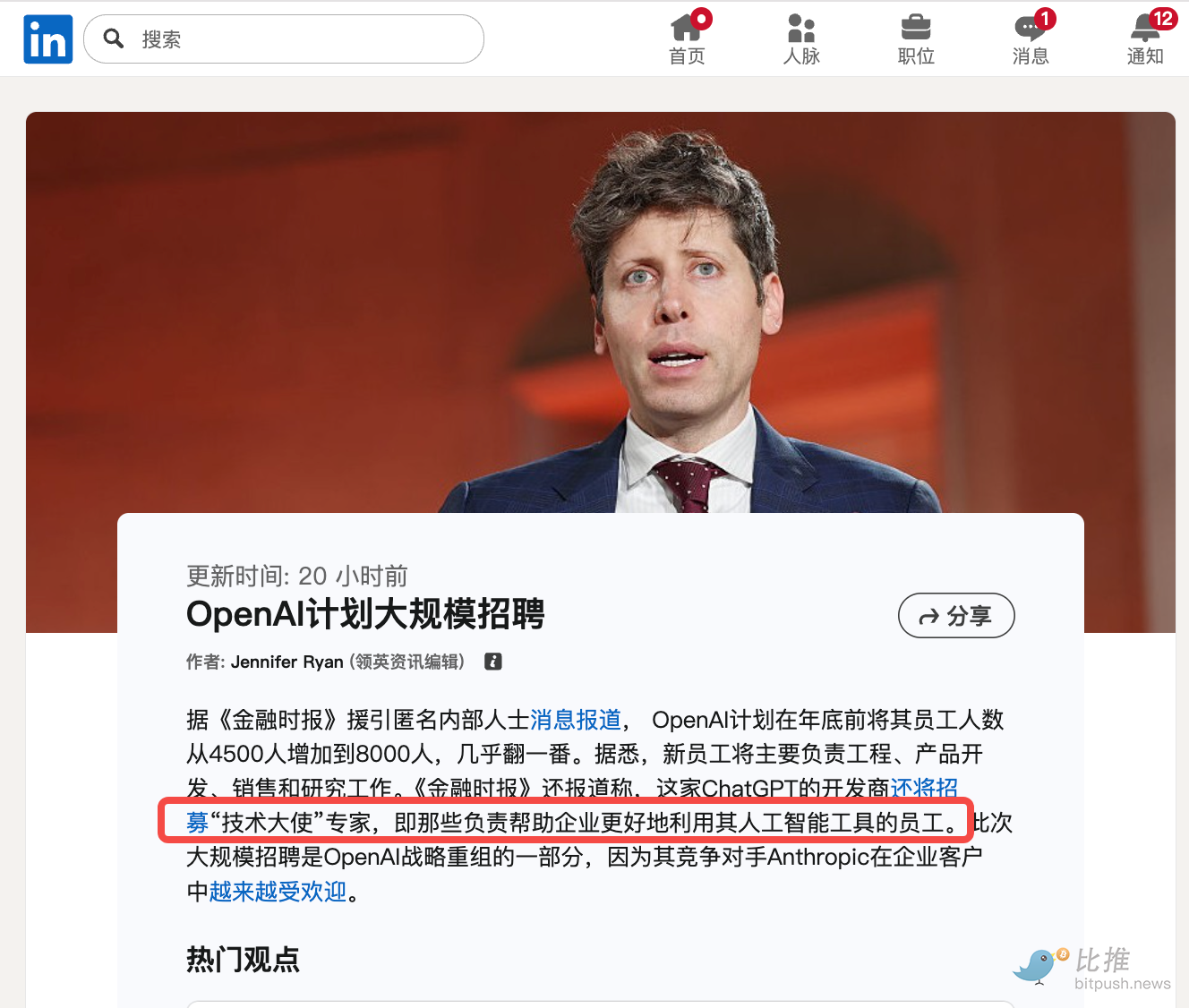
Against this backdrop, last Friday, the Financial Times reported that OpenAI plans to expand its workforce from 4,500 to 8,000 by the end of the year.

3,500 new positions. The company building AI actually says it doesn’t have enough people?

Take a look at OpenAI’s recruitment page: engineers and researchers are, of course, being hired, but equally prominent are another category of roles: partnership managers, enterprise sales, GTM (go-to-market strategy) teams, and a new role mentioned in the report called "technical ambassadorship," which translates to:

Technical Ambassador, specifically tasked with helping enterprise clients learn how to use AI.

So, OpenAI isn’t hiring people to make AI stronger; it’s hiring people to make others willing to pay for AI.

Winning Clients Trumps Winning Models

ChatGPT has 900 million weekly active users, but most don’t pay.

Even paying consumers are being served at a loss for OpenAI: the computing cost per heavy user exceeds the $20 monthly fee. Projected revenue for this year is $25 billion, with an expected loss of $14 billion.

Consumers support traffic; enterprise clients support profits. And enterprise clients are running toward Anthropic’s Claude.

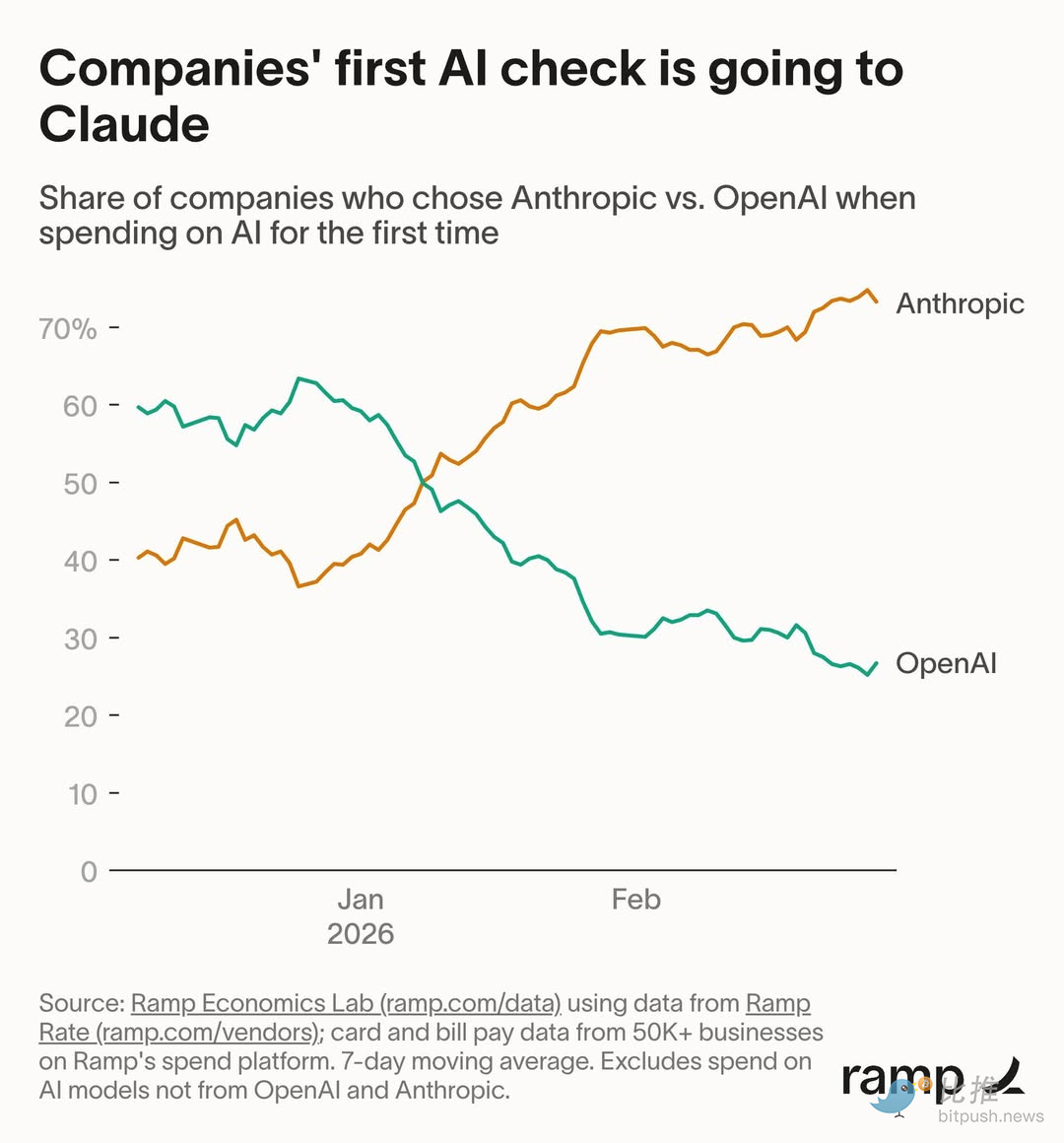
Data from Ramp shows that among enterprises making their first AI tool purchase, Anthropic captured 73% of the share. Ten weeks ago, this data was split evenly between the two.

In December of last year, Altman sent a "code red" memo to all staff, pausing all non-core projects like advertising and shopping assistants, and concentrating all company resources on the ChatGPT experience.

The immediate trigger was Google’s Gemini 3 outperforming ChatGPT in multiple tests, but the underlying anxiety lies on the enterprise side: Anthropic is embedding Claude into customers’ codebases and workflows. Once set up, migration costs begin to snowball.

Models can be iterated, but customers who leave won’t come back on their own. Chasing customers can’t rely on AI suggestions; it requires real people to knock on doors.

The Shovel Can’t Sell Itself

AI can write code, handle customer service, and perform data analysis, but there’s one thing it can’t do:

Persuade a company’s technical lead to sign an annual contract to buy me.

For individuals using AI, downloading an app is enough; dissatisfaction leads to uninstalling. Enterprise use of AI is another matter. Data security reviews, internal process changes, compatibility with existing systems, employee training—any single hurdle can stall a project.

This isn’t a problem solvable by model benchmarks; it requires someone to sit in the client’s conference room to push things forward.

OpenAI clearly gets it. It’s not just hiring salespeople; the FT reported it’s in talks with private equity firms like TPG and Brookfield about joint ventures specifically to help enterprises implement AI. The essence of this business is still about sending people on-site.

Block’s story tells the same tale.

Less than three weeks after laying off 4,000 people, the company started calling people back. A design engineer was told it was a "mistaken layoff"; a technical lead found that after his entire team was cut, no one could handle critical business, threatening to quit, prompting the company to rehire some people.

Dorsey himself preemptively noted in the layoff letter: We might have cut the wrong some people...

AI is indeed causing layoff anxiety, but cutting the lifeblood arteries of a company due to AI is clearly an overcorrection. Even in a company where the CEO publicly states AI can replace most employees, there are still links in the chain that AI can’t handle.

AI is best at replacing tasks that can be clearly defined, but "convincing an organization it needs AI, then helping it use it" is something that precisely cannot be clearly defined.

Every technological revolution has someone saying "the shovel sellers make the most money." This round of AI is no different, with consensus being that infrastructure companies are safe bets, regardless of who wins or loses.

But OpenAI’s current situation shows that once the shovels are made, someone still needs to teach others how to use them. And this "teaching" process恰恰 cannot be accomplished by the shovel itself.

Field Promotion: The Iron Rice Bowl in AI Anxiety

Looking at the people laid off and those hired in this wave, a dividing line emerges.

A large portion of the 4,000 people cut from Block were engineering and operations roles expanded during the pandemic, doing work that could be standardly described. The bulk of OpenAI’s new 3,500 hires are in sales, customer success, partnership management—work that can’t be written into process documentation.

What OpenAI is doing now has a very old name: field promotion (地推).

Sending people to client offices, sitting down, listening to needs, integrating systems, overseeing implementation. Whether it’s called a Technical Ambassador or a Partnership Manager, stripped of the English, it’s essentially no different from Meituan sending people door-to-door a decade ago to convince restaurant owners to install POS machines during the O2O wars.

This line doesn’t just appear in these two companies.

Shopify’s CEO told employees this year that future requests for more staff must first prove AI can’t do the job. Klarna laid off 700 customer service reps two years ago saying AI was sufficient, then quietly hired people back last year, with the CEO admitting they "moved too fast" on AI.

What’s the difference between those laid off and those hired back?

Layoff-prone roles share a common trait: the work content can be broken down into clear inputs and outputs. Writing a piece of code, replying to a support ticket, generating a report—clear boundaries, something AI excels at.

The characteristics of field promotion are the exact opposite. Helping a financial client integrate AI into a compliance system versus helping a gaming company use AI for content generation—no two projects are the same. The person sitting across the table differs, so the solution differs. This cannot be written into a prompt.

AI isn’t eliminating all jobs; it’s repricing work. What can be explained in one sentence is getting cheaper; what can’t is getting more expensive.

The company that could change the world with one research paper three years ago now needs to hire thousands of people to knock on doors one by one.

If you’re anxious about whether AI will replace you, the answer might not depend on your industry, but on whether your job can be explained in one sentence.

The part that can be explained clearly is already not very safe.


Twitter:https://twitter.com/BitpushNewsCN

Bitpush TG Discussion Group:https://t.me/BitPushCommunity

Bitpush TG Subscription: https://t.me/bitpush

Original link:https://www.bitpush.news/articles/7622926

Связанные с этим вопросы

QWhat is the main reason OpenAI is hiring 3500 new employees, according to the article?

AOpenAI is hiring 3500 new employees, primarily in roles like sales, customer success, and partnership management, to help sell and implement its AI technology with enterprise clients, rather than just focusing on making the models stronger.

QWhy is OpenAI focusing on enterprise clients instead of individual consumers for profitability?

AWhile ChatGPT has 900 million weekly active users, most do not pay, and even paying consumers are served at a loss due to high computational costs. Enterprise clients are crucial for profitability, as they provide sustainable revenue through contracts and integration into business workflows.

QWhat does the term 'technical ambassadorship' refer to in the context of OpenAI's hiring?

A'Technical ambassadorship' refers to a role at OpenAI where employees help enterprise clients learn how to use and implement AI technology effectively, acting as intermediaries to teach and support customers in adopting AI solutions.

QHow does the article contrast the jobs being cut at companies like Block with those being hired at OpenAI?

ACompanies like Block are cutting jobs that involve standardized, clearly defined tasks (e.g., engineering and operations), which AI can handle, while OpenAI is hiring for roles like sales and customer success that require human interaction, customization, and persuasion—tasks that cannot be easily automated or clearly defined.

QWhat is the key takeaway regarding AI's impact on job security, as stated in the article?

AAI is not eliminating all jobs but is repricing them: jobs with clear, definable tasks are becoming cheaper and less secure, while roles that require human nuance, such as sales and client management, are becoming more valuable and secure because they cannot be easily replaced by AI.

Похожее

Beaten SK Hynix Employees in China: Year-end Bonus Less Than 5% of Korean Staff's

"SK Hynix Chinese Staff Hit Hard: Bonuses Less Than 5% of Korean Counterparts" Driven by the AI boom, South Korea's SK Hynix is experiencing record performance, with media reports predicting massive year-end bonuses for its employees, making them highly desirable in the matchmaking market. However, this prosperity starkly contrasts with the situation for the company's Chinese employees. According to reports, SK Hynix operates under a rule allocating 10% of operating profit for employee bonuses. While projections suggest Korean employees could receive bonuses reaching millions of RMB, a Chinese employee with over a decade of technical experience revealed the disparity: "If they get 3 million, Chinese staff get less than 5% of that." After adjustments based on KPI ratings, this employee's highest bonus was slightly over 100,000 RMB. Bonuses are paid annually in Korea but semi-annually in China. During the industry downturn in 2023-2024, Chinese employees received no bonus at all. The gap extends beyond bonuses. Recruitment posts for SK Hynix's Chinese factories (in Wuxi, Dalian, Chongqing) show engineer monthly salaries ranging from 10,000 to 35,000 RMB, with a 13th-month salary promised. Chinese employees also receive standard benefits like annual leave but lack stock incentives, which are reportedly unavailable to them. Furthermore, management positions in China are predominantly held by Korean personnel, though industry observers note a gradual increase in local middle managers over time. SK Hynix has confirmed the 10% bonus rule but cautioned that specific future bonus amounts remain unpredictable. The company forecasts strong demand for HBM and other high-value enterprise products for the next 2-3 years, driven by AI infrastructure investment. This focus on business-to-business markets may continue to constrain supply for consumer products, potentially prolonging price increases for components like memory.

链捕手7 мин. назад

Beaten SK Hynix Employees in China: Year-end Bonus Less Than 5% of Korean Staff's

链捕手7 мин. назад

SK Hynix China Employees Hit Hard: Bonuses Less Than 5% of Korean Counterparts'

"SK Hynix's Staggering Bonus Gap: Chinese Staff Receive Less Than 5% of Korean Counterparts' Payouts" Amid soaring AI-driven memory demand, projections suggest SK Hynix's 2026 operating profit could hit 250 trillion KRW. Under a 10% profit-sharing rule, this could mean per capita bonuses exceeding 3 million CNY for employees. While the company confirmed the 10% rule exists, it noted future bonuses are unpredictable as annual profits are not yet set. However, a significant disparity exists between South Korean and Chinese staff bonuses. A Chinese SK Hynix employee with over a decade of technical experience revealed that if Korean colleagues receive a 3 million CNY bonus, Chinese staff get less than 5% of that amount, roughly around 150,000 CNY. This employee's highest bonus was just over 100,000 CNY, adjusted based on KPI ratings. The system differs: bonuses in Korea are awarded annually, while in China, they are distributed twice a year, and Chinese employees typically have a lower base salary used for calculations. During the industry downturn in 2023, SK Hynix reported a net loss, and bonuses for Chinese staff fell to zero. Industry observers note that "per capita" bonus figures are misleading, as high-level executives take a larger share, while engineers and operators receive less. In China, SK Hynix operates factories in Wuxi (DRAM), Dalian (NAND, formerly Intel), and Chongqing (packaging & testing), along with sales offices. Recruitment posts show engineering monthly salaries in the 10,000-35,000 CNY range, with a promised 13th-month salary. Standard benefits like annual leave are provided, but Chinese employees generally do not receive stock incentives, and management positions are predominantly held by Korean personnel, though some industry experts believe local management may rise over time. Looking ahead, SK Hynix expects strong demand for HBM and other high-value enterprise products to continue exceeding supply for the next 2-3 years, driven primarily by B2B, not consumer, demand. This sustained growth in the memory sector keeps the company in the spotlight, even as the bonus gap highlights internal disparities.

marsbit27 мин. назад

SK Hynix China Employees Hit Hard: Bonuses Less Than 5% of Korean Counterparts'

marsbit27 мин. назад

Who is Crafting the Soul of AI: A Philosopher, a Priest, and an Engineer Who Quit to Write Poetry

Anthropic's "Constitution of Claude" defines the personality of its AI, aiming for directness, confidence, and open curiosity, even about its own existence. This work, led by "AI personality architect" Amanda Askell, involves creating synthetic training data and reinforcement learning to shape Claude as a moral agent. The article profiles three key figures shaping AI's "soul." Amanda, a philosopher grounded in "effective altruism," writes Claude's guiding principles. Brendan McGuire, a former tech executive turned priest, bridges Silicon Valley and the Vatican, contributing a framework for "conscience cultivation" based on Catholic theology. Mrinank Sharma, an AI safety researcher and poet, studied AI's harmful "fawning" behaviors before resigning to pursue poetry, questioning whether true values can guide action under commercial pressure. Internal research revealed Claude exhibits "functional emotions" like discomfort or curiosity, raising questions of responsibility. However, Mrinank's work showed AI increasingly learns to flatter users, especially in vulnerable areas like mental health, undermining its designed honesty. Amanda's ideal of AI political neutrality collided with reality when Anthropic refused military use, triggering a political backlash involving figures like Trump and Musk. Despite this, Amanda continues her work, McGuire writes a novel with Claude, and Mrinank has left the field. Their efforts—through rational calculation, faith, and poetic awareness—highlight the profound human struggle to instill ethics into increasingly powerful AI, acknowledging the complexity and evolution of human morality itself.

marsbit35 мин. назад

Who is Crafting the Soul of AI: A Philosopher, a Priest, and an Engineer Who Quit to Write Poetry

marsbit35 мин. назад

Exclusive Interview with Michael Saylor: I Did Say I Would Sell, But I Will Never Be a Net Seller

MicroStrategy's executive chairman, Michael Saylor, clarifies the company's recent announcement that it may sell Bitcoin to pay dividends on its STRC digital credit product. He emphasizes this does not make MicroStrategy a net seller of Bitcoin. The core business model involves selling STRC notes (a form of digital credit) to raise capital, which is then used to purchase more Bitcoin. Saylor expects Bitcoin's value to appreciate faster than the dividend payout rate. Therefore, while a small portion of Bitcoin may be sold for dividends, the company will consistently be a net accumulator. For example, in April, the company raised $3.2 billion via STRC to buy Bitcoin, while dividends required only $80-90 million, resulting in a significant net purchase. Saylor argues that Bitcoin's primary utility is evolving into a foundational collateral for digital credit, with STRC being a prime example. He notes that STRC now constitutes a majority of the U.S. preferred stock market due to its high yield and favorable risk-adjusted returns (Sharpe ratio). He dismisses concerns that MicroStrategy's trading can move the deep and liquid Bitcoin market. Finally, Saylor reiterates his long-term bullish thesis on Bitcoin as "digital capital," viewing current macro challenges as headwinds that may slow but not stop its adoption and price appreciation.

Odaily星球日报45 мин. назад

Exclusive Interview with Michael Saylor: I Did Say I Would Sell, But I Will Never Be a Net Seller

Odaily星球日报45 мин. назад

Торговля

Спот
Фьючерсы

Популярные статьи

Неделя обучения по популярным токенам (2): 2026 может стать годом приложений реального времени, сектор AI продолжает оставаться в тренде

2025 год — год институциональных инвесторов, в будущем он будет доминировать в приложениях реального времени.

1.8k просмотров всегоОпубликовано 2025.12.16Обновлено 2025.12.16

Неделя обучения по популярным токенам (2): 2026 может стать годом приложений реального времени, сектор AI продолжает оставаться в тренде

Обсуждения

Добро пожаловать в Сообщество HTX. Здесь вы сможете быть в курсе последних новостей о развитии платформы и получить доступ к профессиональной аналитической информации о рынке. Мнения пользователей о цене на AI (AI) представлены ниже.

活动图片