AI Inference Bills Soar, Shopify and Roblox Warn: Savings from Layoffs Not Enough to Cover Chip Costs

marsbitОпубликовано 2026-05-11Обновлено 2026-05-11

Введение

The 2026 Q1 earnings season reveals a paradox: while AI helps companies freeze hiring and boost productivity, the soaring costs of AI inference—token consumption and GPU depreciation—are eroding savings from workforce reductions. Shopify reported that AI now writes over 50% of its code, enabling significant output with stable headcount. However, LLM costs, driven by heavy usage of its AI assistant Sidekick, are pressuring its subscription毛利率. Similarly, Roblox attributed a quarter of its full-year利润率下调 to increased AI investment. The article highlights a broader industry imbalance: combined AI capital expenditure for Amazon, Meta, Microsoft, and Google is projected to reach $725 billion in 2026, vastly outpacing potential savings from layoffs. For instance, Meta's planned裁员 would save about $2.4 billion annually, offsetting only ~12% of its incremental AI depreciation. While底层 model and chip suppliers like NVIDIA maintain high profitability, application-layer companies face a pricing squeeze. Their strategies now involve要么 tightly linking AI costs to user engagement (like Shopify) or introducing fees for advanced AI features (like Roblox), as covering AI bills with裁员 savings alone is financially unsustainable.

Author: Claude, Deep Chao TechFlow

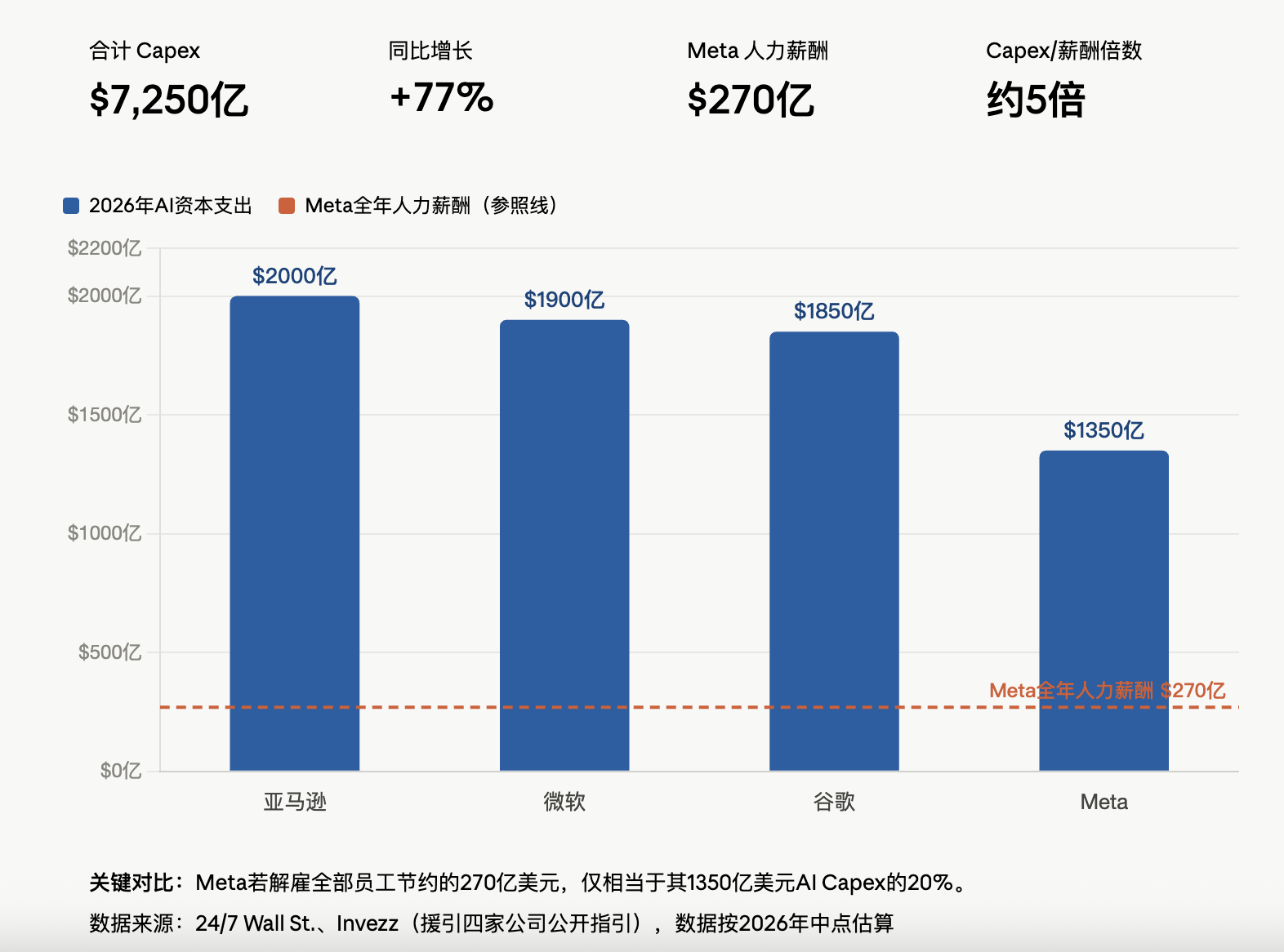
Deep Chao Introduction: The Q1 2026 earnings season for tech giants reveals a new phenomenon: while AI helps companies freeze hiring and cut positions, its own token consumption and GPU depreciation are inversely eroding gross margins. Shopify's subscription business gross margin is being suppressed by LLM costs, with about a quarter of Roblox's full-year margin guidance downgrade directly attributed to incremental AI investments. The combined AI capital expenditures of Amazon, Meta, Microsoft, and Google will reach $725 billion in 2026, a 77% year-over-year increase. For the first time, the two ends of the AI dividend—labor savings and compute consumption—are being accounted for on the same balance sheet in the same quarter, with the latter clearly larger.

The first-quarter earnings season is applying a corrective patch to the simplistic narrative of 'AI replacing labor.'

While a group of tech companies report successes in hiring freezes and accelerated product iteration, they are forced to explain a more棘手 question to investors: soaring AI chip depreciation and unpredictable token consumption are inversely eating up the money saved from layoffs.

Shopify President Harley Finkelstein stated at the May 5, 2026 earnings call that AI now handles over 50% of the company's code writing and helped Shopify deliver over 300 products and features while keeping headcount flat. However, in the same call, management also acknowledged that the gross margin of subscription solutions is being partially offset by large language model (LLM) costs, and this dynamic will persist.

Shopify: The LLM Cost Black Hole Behind an 80% Gross Margin

Shopify's Q1 subscription solutions gross margin was 80%, flat year-over-year, but the cost of maintaining this figure is changing.

According to Shopify's 10-Q filing with the SEC, subscription solutions costs grew 20% year-over-year in Q1 2026, reaching $148 million, compared to $123 million in the same period last year. Cloud and infrastructure costs (including AI-related usage) increased by $22 million as a single line item, being the primary driver of cost expansion. Shopify CFO Jeff Hoffmeister said on the earnings call that scale effects and support efficiency improvements were "partially offset by increased LLM costs, primarily driven by merchant usage of Sidekick, and we expect this dynamic to continue."

Sidekick is Shopify's AI assistant embedded in the platform. Its weekly active shops grew 385% year-over-year this quarter. Merchants used Sidekick to create over 12,000 custom apps this quarter, up more than 200% sequentially, with nearly half of Shopify Flows being AI-generated. AI-driven store traffic grew 8x year-over-year, and orders from AI search grew nearly 13x year-over-year.

But this explosion in usage means exponential growth in AI inference calls. Every interaction a merchant has with Sidekick, every proactive suggestion generated by the Pulse feature, corresponds to a token bill paid to upstream model providers.

Shopify explained the books for "internal AI" and "external AI" separately to investors: using AI internally for coding and controlling personnel expenses is a victory in the "cost game," while providing AI products externally to merchants is a strategic choice to "deeply tie infrastructure costs to merchant usage." Finkelstein summarized this logic on the earnings call as "AI is a structural advantage, not just a cost."

Roblox: One-Quarter of Margin Downgrade Directly from AI

Roblox CFO Naveen Chopra explicitly disclosed at the Q1 2026 earnings call on April 30 that about one-quarter of the full-year margin downgrade relative to prior guidance stems from incremental AI investment and adjustments to DevEx (Developer Exchange) for U.S. users aged 18 and above.

Roblox currently runs over 400 AI models on its own and cloud GPUs, processing 1.5 million inference calls per second, covering scenarios like discovery recommendations, communication safety, marketplace recommendations, and 3D generation.

Management is attempting to slice through inference costs via business model adjustments. Roblox Co-founder and CEO David Baszucki said on the earnings call that the company's upcoming "Roblox Reality" project, a technology capable of running 2K real-time photorealistic video models at 60Hz, will not be offered for free. "This will use cloud compute resources. We will have some form of subscription or payment mechanism, so we believe we can offset the costs on the real-time inference side," Baszucki explained.

Chopra added that the company's 2026 capital expenditure guidance remains unchanged, relying primarily on deploying GPUs in its own data centers to meet inference demand for the year, while some training tasks will still use the cloud. Roblox previously disclosed that by migrating some AI inference workloads from third-party clouds to its own data centers by the end of 2025, it had already achieved a 10x efficiency improvement in specific workloads like safety review and content discovery.

However, Roblox's quarterly full-year guidance includes multiple pressures: the aforementioned incremental AI investment, deleveraging of fixed costs due to lower-than-expected bookings scale, and the DevEx rate increase for 18+ adult content creators to 37.8%, ultimately triggering a market repricing of its full-year margin.

Industry Ledger: $725 Billion Capex vs. $2.7 Billion Salary Savings

The micro cases of Shopify and Roblox sit within a larger macro structural imbalance.

According to data cited by 24/7 Wall St., the combined AI capital expenditures of Amazon, Meta, Microsoft, and Google will reach $725 billion in 2026, a 77% year-over-year increase. Among them, Meta's full-year capex guidance is between $125 billion and $145 billion, meaning a daily expenditure of $370 million on data center construction; Microsoft's 2026 calendar year capex is $190 billion, with Amazon committing $200 billion.

This calculation is quite disproportionate compared to personnel expenses. Meta's total human compensation—all wages, benefits, stock-based compensation—amounts to approximately $27 billion. Even if Meta fired all its employees tomorrow, the savings would be less than one-fifth of its 2026 infrastructure expenditure.

Wedbush Securities analyst Dan Ives estimated in an April 25 research note that Meta's upcoming layoff of 8,000 people could free up about $2.4 billion in annual operating expenses, only offsetting about 12% of the incremental depreciation drag expected in 2026. In other words, for every dollar of financial pressure from AI compute expenditure, nearly ten dollars of human cost savings would be needed to fully offset it.

Meta CFO Susan Li positioned Meta's headcount reduction on the Q4 2025 earnings call as "building a leaner operating model to help offset the massive investments we are making." This statement clearly characterizes layoffs as a financial tool for AI capital expenditure, not a byproduct of productivity gains.

Victory for Model Providers, Dilemma for the Application Layer

The biggest beneficiaries of this ledger博弈 are the underlying model and compute suppliers. Microsoft Cloud gross margin held at 69% under the pressure of AI infrastructure expansion; OpenAI's gross margin is externally estimated at around 50%, Anthropic's at around 60%. Nvidia continued to report a gross margin level of about 70% in fiscal year 2026.

Application-layer companies, especially SaaS players that both consume AI and package AI capabilities into subscription products for sale, are facing a new financial structure: revenue is highly correlated with AI usage intensity, but the cost curve is dictated by upstream model provider pricing, and every model upgrade can bring new token consumption.

In his analysis of AI gross margins, Tanay Jaipuria points out that although the inference cost for a single model is declining at 80%-90% annually, the price of frontier models remains stable or even rises. If application-layer companies insist on calling the strongest model for every request, their Cost of Goods Sold (COGS) is effectively being led by the model providers' price cards.

Shopify's response is to position AI products as a strategic gateway deeply binding traffic and merchants, making the growth in inference costs a proxy indicator for "platform embed depth." Roblox's solution is to strip high-end AI experiences out of the free tier, forcing users to pay for inference costs. Behind both paths lies the same consensus: purely covering AI compute bills with savings from layoffs simply doesn't add up mathematically.

Связанные с этим вопросы

QAccording to the article, what is the main financial challenge that companies like Shopify and Roblox are facing despite using AI to reduce labor costs?

ACompanies are facing the challenge that the soaring costs of AI chip depreciation and unpredictable token consumption for AI inference are eating up the money saved from layoffs and headcount reductions, creating a negative impact on their profit margins.

QHow much of Shopify's subscription solution cost increase in Q1 2026 was driven by AI-related usage?

AIn Shopify's Q1 2026 subscription solution costs, the 'cloud and infrastructure costs (including AI-related usage)' line item increased by $22 million, which was the primary driver of the total cost expansion compared to the previous year.

QWhat proportion of Roblox's downward revision to its full-year profit margin guidance is directly attributed to AI investments?

AApproximately one-quarter of Roblox's downward revision to its full-year profit margin guidance is directly attributed to incremental AI investments.

QWhat is the estimated total AI capital expenditure for Amazon, Meta, Microsoft, and Google in 2026 according to the data cited?

AThe combined AI capital expenditure for Amazon, Meta, Microsoft, and Google is estimated to reach $725 billion in 2026.

QAccording to the Wedbush Securities analyst's estimate mentioned, how does the cost savings from Meta's potential 8,000-person layoff compare to its incremental AI depreciation cost?

AThe estimated annual operating expense savings from Meta's potential 8,000-person layoff is about $2.4 billion, which would only offset approximately 12% of the incremental depreciation drag expected in 2026 from its AI investments.

Похожее

Apple Also Has to Pay Rent Now

Apple Pays Rent Too: The Two-Way Flow of "Traffic Tax" and "AI Capability Rent" Between Tech Giants For over two decades, Google has paid Apple an estimated $20 billion annually to remain the default search engine on Safari, a "traffic tax" for a critical user entry point. However, in 2026, the direction of this cash flow partially reversed. Apple agreed to pay Google roughly $1 billion per year to license its Gemini AI models, as Apple's own models reportedly struggled with complex tasks. This creates a unique dynamic: Apple acts as the "landlord" in the established search ecosystem, collecting rent from Google for access. Simultaneously, in the emerging AI arena, Apple becomes the "tenant," paying Google for access to cutting-edge AI capabilities it cannot currently match internally. While Apple claims its new models are "distilled" from Gemini outputs and contain "not a drop" of Google's original code, core dependencies remain. Its knowledge base is refined using Gemini's outputs, and its most powerful cloud model runs on Google's infrastructure. Apple has structured the deal as non-exclusive, allowing it to theoretically switch AI suppliers—a hedge against over-reliance. The future hinges on whether advanced AI models become a commodity (cheap and abundant) or remain a concentrated, scarce resource (expensive and controlled by few). Apple is betting on the former, leveraging its massive device ecosystem to be a powerful, choosy customer. If the latter proves true, its bargaining power could erode. This power dynamic is extending to developers. Apple, Google, and WeChat are all pushing for apps to expose their core functions as standardized "actions" or "intents" that their respective AI assistants (Siri, Gemini, WeChat AI) can directly call. The new scarce resource is no longer just app store visibility, but "being selected by the AI." The currency of "rent" has changed from a 30% revenue share to ceding control over how users interact with an app's functions.

marsbit1 ч. назад

Apple Also Has to Pay Rent Now

marsbit1 ч. назад

Missed the SpaceX IPO? WEEX's "First Trade Protection" Lets You Experience US Stock Trading Risk-Free.

With the excitement around SpaceX's recent public listing reigniting interest in the US stock market, Chinese investors face significant challenges accessing compliant and convenient trading channels following regulatory actions against major online brokers. This article explores the available options, highlighting their risks and limitations. Traditional paths for US stock investments remain problematic. Qualified Domestic Institutional Investor (QDII) and Listed Open-Ended Fund (LOF) products, while compliant, suffer from high fees, significant purchase premiums, and a very limited selection of assets. Small, unregulated offshore brokers pose substantial risks, including potential insolvency. While secure, VIP accounts at banks in Hong Kong or Singapore require high minimum deposits (often 1-2 million RMB) and in-person visits, placing them out of reach for most retail investors. The article positions cryptocurrency exchanges, specifically their TradFi (traditional finance on-chain) offerings, as a compelling alternative. Platforms like WEEX are noted for providing access to a wide range of US stocks and ETFs, including SpaceX (SPCXON), through tokenized assets. This method offers advantages such as a single account for both crypto and traditional assets, USDT-based settlement avoiding fiat complexities, flexible leverage, and robust risk management. To attract users, WEEX is promoting a "First Trade Guarantee" campaign. Running from June 15 to July 8 (UTC+8), it features a $30,000 prize pool. Users who trade $500 worth of US stock contracts can qualify for a guarantee on their first eligible trade: 100% loss coverage up to $30 or a 20% bonus on profits up to $30. The campaign is presented as a low-risk opportunity for both crypto natives and traditional investors to experience US stock trading.

marsbit1 ч. назад

Missed the SpaceX IPO? WEEX's "First Trade Protection" Lets You Experience US Stock Trading Risk-Free.

marsbit1 ч. назад

How Difficult is Chip Making? A Division Error Costs 475 Million Dollars

How Hard Is It to Make a Chip? A Division Error Cost $475 Million Chip expert Shi Kan, a researcher at the Chinese Academy of Sciences and a popular tech creator, explains the immense challenges of chip development. Chips are foundational to modern technology, but their creation is extraordinarily difficult. The journey from sand to a functional chip involves complex design and manufacturing, but a critical bottleneck is verification—ensuring the design works flawlessly before costly production. A single, undetected bug can have catastrophic consequences, as illustrated by the infamous 1994 Intel Pentium FDIV bug. A flaw in the floating-point division unit forced a recall costing $475 million. Unlike software, chips cannot be easily patched after manufacture, making "first-time success" paramount. However, industry surveys show only 24% of chip projects achieve this; over three-quarters require at least one costly re-spin due to design flaws. Verification has thus become the dominant phase, consuming up to 70% of the design cycle. The core challenge is a "verification impossible triangle" between high performance, good debuggability, and low cost. Exhaustively verifying a modern CPU core could take 15,000 years with software simulation, or 30 years with advanced hardware emulation—timeframes utterly impractical for development. Despite being essential, verification is often seen as unglamorous "dirty work," receiving less academic attention than fields like AI. Shi and his team are tackling this by developing an agile verification research framework called ENCORE, based on FPGA technology, to improve verification efficiency and debug capability. Beyond research, Shi engages in public science communication through long-form video content, aiming to demystify chip technology, AI, and computer science. He argues for the value of pursuing "hard and long-term" endeavors, whether in the meticulous world of chip verification or in creating substantive educational content, believing such sustained effort is likely the right path forward.

marsbit1 ч. назад

How Difficult is Chip Making? A Division Error Costs 475 Million Dollars

marsbit1 ч. назад

Торговля

Спот
Фьючерсы

Популярные статьи

Как купить CHIP

Добро пожаловать на HTX.com! Мы сделали приобретение USD.AI (CHIP) простым и удобным. Следуйте нашему пошаговому руководству и отправляйтесь в свое крипто-путешествие.Шаг 1: Создайте аккаунт на HTXИспользуйте свой адрес электронной почты или номер телефона, чтобы зарегистрироваться и бесплатно создать аккаунт на HTX. Пройдите удобную регистрацию и откройте для себя весь функционал.Создать аккаунтШаг 2: Перейдите в Купить криптовалюту и выберите свой способ оплатыКредитная/Дебетовая Карта: Используйте свою карту Visa или Mastercard для мгновенной покупки USD.AI (CHIP).Баланс: Используйте средства с баланса вашего аккаунта HTX для простой торговли.Третьи Лица: Мы добавили популярные способы оплаты, такие как Google Pay и Apple Pay, для повышения удобства.P2P: Торгуйте напрямую с другими пользователями на HTX.Внебиржевая Торговля (OTC): Мы предлагаем индивидуальные услуги и конкурентоспособные обменные курсы для трейдеров.Шаг 3: Хранение USD.AI (CHIP)После приобретения вами USD.AI (CHIP) храните их в своем аккаунте на HTX. В качестве альтернативы вы можете отправить их куда-либо с помощью перевода в блокчейне или использовать для торговли с другими криптовалютами.Шаг 4: Торговля USD.AI (CHIP)С легкостью торгуйте USD.AI (CHIP) на спотовом рынке HTX. Просто зайдите в свой аккаунт, выберите торговую пару, совершайте сделки и следите за ними в режиме реального времени. Мы предлагаем удобный интерфейс как для начинающих, так и для опытных трейдеров.

411 просмотров всегоОпубликовано 2026.04.21Обновлено 2026.06.02

Как купить CHIP

Обсуждения

Добро пожаловать в Сообщество HTX. Здесь вы сможете быть в курсе последних новостей о развитии платформы и получить доступ к профессиональной аналитической информации о рынке. Мнения пользователей о цене на CHIP (CHIP) представлены ниже.

活动图片