After UFO Files Released, Why Does Prediction Market Only Price Alien Existence Probability at 20%?

marsbitОпубликовано 2026-05-09Обновлено 2026-05-09

Введение

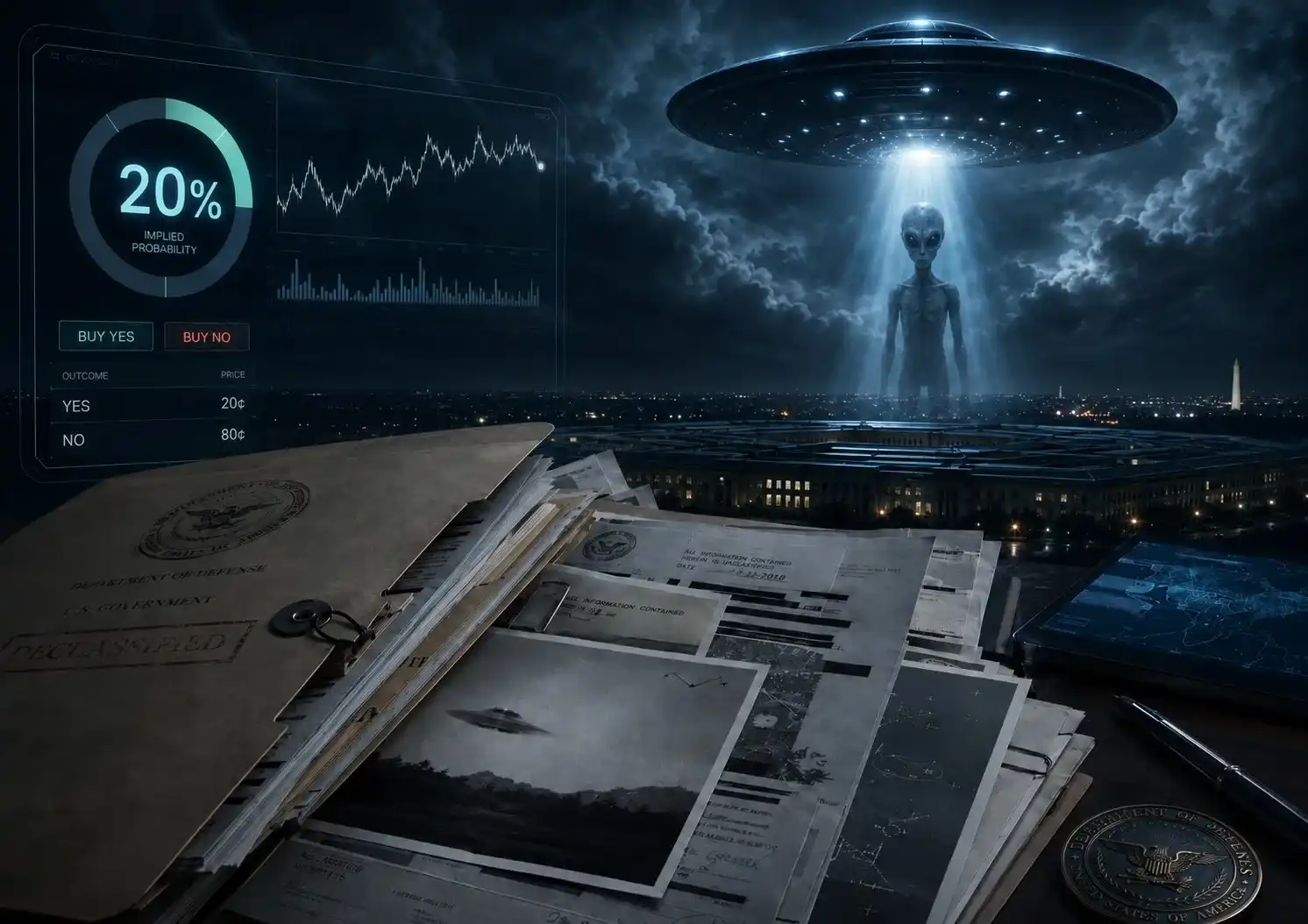
Following the official release of over 160 declassified UFO/UAP files by the U.S. Department of Defense, featuring videos, photos, and historical reports from NASA, FBI, and other agencies, public discussion has surged. However, the prediction market platform predict.fun shows measured skepticism. The probability for the event "Will the US confirm that aliens exist before 2027?" remains at only 20%. This is because the market does not trade on the philosophical question of extraterrestrial existence, but specifically on whether the U.S. government will officially and explicitly acknowledge it by the end of 2026. While the document release increases transparency and provides compelling, unexplained cases—like a jellyfish-shaped object over the UAE or anomalies near Apollo missions—it presents historical data without official interpretation or confirmation. The market views this as expanding the pool of evidence rather than providing a definitive conclusion that would compel a governmental statement. The 20% probability reflects a time-discounted assessment, acknowledging potential for future disclosures while doubting a conclusive official acknowledgment within the tight deadline. Thus, the event highlights how prediction markets concretize abstract mysteries into tradable contracts based on verifiable outcomes and specific timelines.

Author | Asher(@Asher_ 0210)

Last night, the U.S. Department of Defense officially launched a UFO archive disclosure website and released the first batch of government documents related to UAPs, unidentified flying objects, and suspected extraterrestrial life. According to public reports, this initial release consists of over 160 documents, including videos, photos, mission records, sighting reports, communication logs, and historical archives, involving multiple U.S. federal agencies such as NASA, the FBI, and the Department of Defense.

This batch of documents is not just abstract government reports; it contains a large amount of specific imagery and historical records. Among them, an Apollo mission spacecraft once captured three anomalous light points suspended above the Moon from lunar orbit, and Apollo 17 communication logs also contain discussions among astronauts about a mysterious object approaching the spacecraft. Another set of materials indicates that unexplained unidentified objects have appeared in places like the United Arab Emirates, Greece, and Iraq.

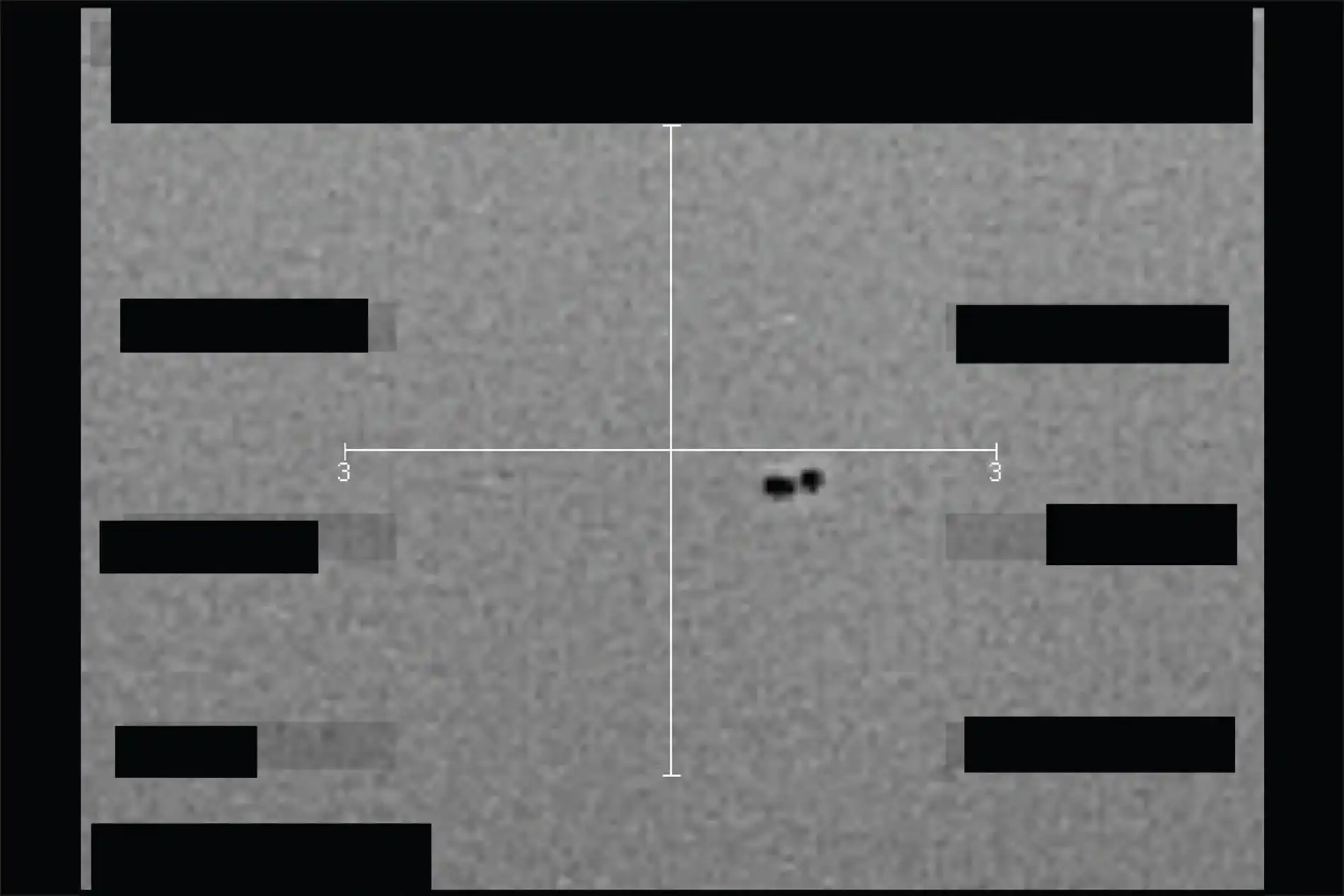
Even more widely disseminated are the unresolved cases in the files with specific visuals. A jellyfish-like object once appeared over the UAE; some materials document suspected luminous spheres and unidentified flying objects with shapes resembling an eight-pointed star; the U.S. Federal Bureau of Investigation also once captured an anomalous target near a U.S. military aircraft. A picture released by the U.S. Department of Defense also shows that an unidentified object appeared over the western U.S. in September 2025.

A picture released by the U.S. Department of Defense claims to show an unidentified object appearing over the western U.S. in September 2025 (Source: U.S. Department of Defense)

Compared to mere text reports, these images and eyewitness records are more likely to cause UFO discussions to spread rapidly, making this release appear more like a concentrated display of "declassified archives."

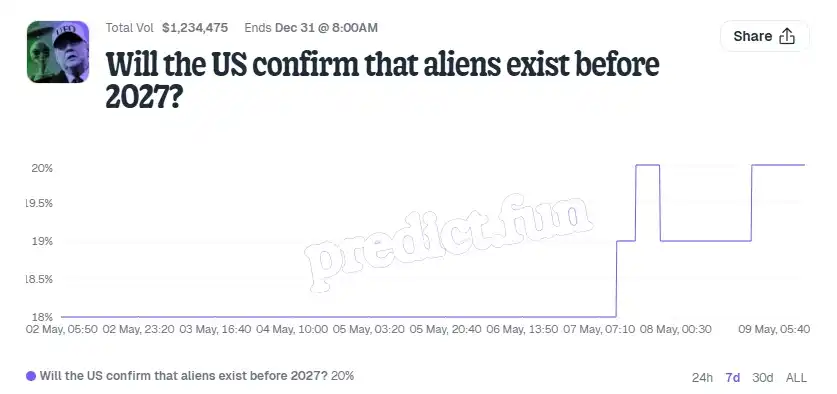
However, the answer given by the prediction market is much cooler than social media. After the initial UFO files were released, the event probability for "Will the U.S. confirm the existence of aliens by December 31, 2026" on the prediction market predict.fun did not surge significantly due to this explosive news. The market did not directly interpret this disclosure as "the U.S. is about to confirm the existence of aliens." The probability remains only 20%.

Source: https://predict.fun/market/will-the-us-confirm-that-aliens-exist-before-2027

So, why did this UFO file release not significantly change the prediction market's judgment?

The Prediction Market Bets Not on Whether Aliens Exist, But on Whether the U.S. Government Will Acknowledge It

Upon seeing the 20% probability, many people's first reaction might be that the prediction market believes the probability of aliens existing is only 20%. But this misunderstands the market itself.

Markets like predict.fun do not actually trade on whether extraterrestrial life exists in the universe, but on whether the U.S. government will explicitly confirm the existence of extraterrestrial life or alien technology before 11:59 PM EST on December 31, 2026. According to the market's settlement rules, only if the U.S. President, a member of the U.S. Cabinet, the Joint Chiefs of Staff, or a U.S. federal agency explicitly makes such a statement will the market settle to Yes; otherwise, it will settle to No. The primary settlement sources are official U.S. government information, with reference also made to consensus formed by credible media reports.

This rule is crucial. It means that a video of an unidentified flying object is not enough, a blurry photo is not enough, an astronaut communication log is not enough, and even military acknowledgment that some phenomena are temporarily unexplained is not enough. What can truly trigger a Yes is the U.S. government stating clearly enough, acknowledging that extraterrestrial life or alien technology indeed exists.

File disclosure merely places more materials before the public; official confirmation means the government is endorsing the conclusion. The former generates discussion, the latter triggers settlement. Between them lies a line that is very difficult to cross.

Archive Disclosure Is Not Answer Announcement

This UFO file release is indeed not an ordinary information update. The U.S. Department of Defense concentratedly released relevant materials through a dedicated website and indicated that more files will continue to be released in batches subsequently. For the public, this means that UFO and UAP materials previously scattered across different agencies, eras, and archival systems are being reorganized into an official portal. It makes the discussion more centralized and makes it easier for outsiders to track what materials the U.S. government actually possesses.

However, judging from the currently disclosed content, this batch of files seems more like placing historical sightings, anomalous imagery, mission records, and old archives before the public, rather than providing a unified explanation for these materials. The U.S. Department of Defense did not directly tell the world "what this is," but released more unresolved cases, leaving the judgment space to the public.

This places the release in a subtle position. It increases transparency but does not change the nature of the events. UFO discussions thus gain more material, but these materials primarily expand the questions themselves rather than pushing unexplained phenomena toward extraterrestrial confirmation.

For the prediction market, this file release is more like a new starting point for observation, rather than evidence sufficient to change the odds. It brings the UFO issue back to the main stage and gives subsequent file updates trading value; but the initial materials are still dominated by historical records, sighting reports, and unexplained imagery. What the market is truly waiting for are higher-level, harder-to-ignore signals closer to an official conclusion.

Is 20% an Underestimation or an Overestimation?

From an emotional perspective, 20% might seem low. After all, the release of UFO files has entered an official cadence, with more materials still to be released. If clearer military videos, higher-level internal records appear in the future, or a federal agency provides a more direct judgment, the Yes price could still be rapidly reassessed.

But from a market pricing perspective, 20% is not that low. Because this market trades not on an open-ended question, but one with a clear deadline. What the market must judge is not just whether the U.S. will confirm the existence of extraterrestrial life or alien technology, but also whether such confirmation will happen before the end of 2026.

Time itself is a threshold. Even if files continue to be released, even if more unresolved cases enter public view, it does not mean the U.S. government will complete evidence review, internal coordination, political assessment, and deliver a sufficiently clear conclusion within a few months. For an official system, continuing to disclose materials is one thing; completing a definitive statement within a short timeframe is another.

Therefore, the current 20% probability is more like a tail-priced assessment with a time discount. It does not deny that subsequent files may continue to create volatility, but it also indicates that the market does not believe the initial release materials have fundamentally changed the judgment of the event. For traders, the file disclosure itself is not scarce; what is truly scarce are the key signals that could push for an official conclusion before the end of this year. Before such signals appear, the Yes price is unlikely to be significantly pushed up by archive updates alone.

When UFOs Enter the Prediction Market, Truth Begins to Have a Price

The most noteworthy aspect of this event is no longer just a particular photo, a video clip, or some jellyfish-shaped object. UFO discussions have long lingered between emotion, belief, and conspiracy narratives. Believers see more clues in every file release, while skeptics continue to emphasize insufficient evidence, misidentification, and technical noise. The two sides have argued for years but can hardly truly persuade each other, because they are often not discussing the same question.

The prediction market pulls this issue one step closer to reality. It does not try to answer whether other life exists in the universe, but narrows the question to a more specific level—will the U.S. government explicitly acknowledge the existence of extraterrestrial life or alien technology before the end of this year? It turns what was originally a difficult-to-ground imagination into an event that can be traded, settled, and constantly adjusted with changing information.

So, this ~20% probability is not a final judgment on whether extraterrestrial life exists, but the market's judgment on whether U.S. officials will relent before the end of the year. It truly reflects traders' comprehensive assessment of the evidence chain, official statements, and the time window.

When humanity's oldest mystery enters the prediction market, truth is no longer just awaited and discussed; it also begins to be priced. UFOs may still hang in the sky, but the question of when they will be officially confirmed, when they will turn from unexplained phenomena into factual conclusions, has landed in the betting pool.

Связанные с этим вопросы

QWhat is the event being traded on predict.fun regarding UFOs and aliens?

AThe market is trading on whether the US government will officially confirm the existence of extraterrestrial life or alien technology by December 31, 2026.

QWhy did the market probability only stay at 20% after the initial release of UFO documents by the U.S. Department of Defense?

AThe market distinguishes between the release of historical records and unexplained materials, which expands public discussion, and an official government confirmation, which would trigger a 'Yes' settlement. The release itself did not constitute the required official statement.

QAccording to the article, what specific criteria must be met for the prediction market to settle as 'Yes'?

AFor a 'Yes' settlement, the confirmation must come directly from high-level US officials like the President, a Cabinet member, a member of the Joint Chiefs of Staff, or a federal agency, stating explicitly that extraterrestrial life or technology exists.

QFrom a market pricing perspective, why is a 20% probability for a 'Yes' outcome by the end of 2026 not considered low?

AThe 20% probability factors in a time discount. While more documents may be released, the market assesses that achieving the necessary internal government consensus and definitive public confirmation within a few months is a significant hurdle, making 20% a meaningful 'tail risk' price.

QHow does the article suggest prediction markets change the nature of the UFO discussion?

APrediction markets reframe the abstract debate about alien existence into a specific, tradable event based on verifiable government action. This shifts the focus from personal belief to collective, market-based judgment on the likelihood and timing of an official announcement.

Похожее

A Nation Blocks Chips, a Giant Buys a Nuclear Power Plant: Why It's Time to Seriously Consider DeAI

**Title: Great Powers Blockade Chips, Giants Buy Nuclear Plants: Why It's Time to Seriously Consider DeAI** In May 2026, the US closed loopholes for Chinese firms to acquire advanced NVIDIA chips via overseas subsidiaries. That same month, Kenya halted a $1B geothermal data center project involving Microsoft, fearing its immense energy consumption. Meanwhile, Huawei announced mass production of its Ascend AI chip. These disparate events underscore a new reality: the competition for computing power ("compute") has escalated beyond the tech industry, becoming a geopolitical and infrastructural battleground. A new era of oligopoly is forming, with control over the AI stack—from GPU chips (NVIDIA) and cloud platforms (AWS, Azure, Google Cloud) to foundational models (OpenAI, Anthropic)—concentrating in a few Western "AI Octopus" corporations. This centralization creates systemic risks: pricing power and platform lock-in for users, infrastructure fragility, and a widening "compute divide" that threatens to marginalize nations without independent AI capacity. An "AI Iron Curtain" is deepening through export controls. In response, some nations like Saudi Arabia and the UAE are investing heavily to buy compute power, aiming to transition from oil to AI economies. The EU seeks to triple its compute capacity by 2030 to reduce dependency. However, the spending gap is vast, with four US tech giants alone planning ~$750B in AI capex for 2026. The race is increasingly constrained by energy, with AI tasks consuming up to 1000x more power than web searches, pushing firms to even acquire nuclear plants. This landscape is fueling interest in Decentralized AI (DeAI). It proposes a third way: using open protocols to coordinate a global network of idle GPUs, independent developers, and data centers, creating an AI infrastructure without a single controlling entity. Leveraging blockchain and cryptographic verification, DeAI aims to break market concentration, disperse energy demands, reduce geopolitical dependencies, and enhance transparency. While still nascent in performance and stability, DeAI's core promise is not immediate superiority but providing a crucial alternative architecture to resist monopoly, censorship, and centralized power. As specialized AI hardware costs fall and open-source models flourish, the window to build this foundation is open. The very existence of such competition serves as a vital check against the inevitable abuse of concentrated power.

marsbit37 мин. назад

A Nation Blocks Chips, a Giant Buys a Nuclear Power Plant: Why It's Time to Seriously Consider DeAI

marsbit37 мин. назад

Outpoll Review: A Prediction Market Platform Built for Active Traders

Outpoll Review: A Prediction Market Platform Built for Active Traders In recent years, prediction markets have grown from a niche sector to a mainstream arena, attracting billions in trading volume and institutional capital. However, the user experience and tools for traders have not kept pace. Outpoll, a new global prediction market platform, aims to fill this gap by providing enhanced trading infrastructure for active and professional traders. Built on standard prediction market principles, Outpoll allows users to trade on the outcome of specific events. It uses fully collateralized contracts with USDC settlement, charges a competitive 0.1% fee per trade, and provides clear settlement rules upfront to minimize disputes. A key focus for Outpoll is its professional-grade trading tools. The platform supports limit and market orders, as well as take-profit and stop-loss orders for open positions—features uncommon in prediction markets. For automated trading, Outpoll offers comprehensive REST and WebSocket APIs, enabling portfolio management, price arbitrage, and integration with existing tools. The platform also features a creator-led market model, where approved experts and community leaders can create and manage markets for niche topics under platform supervision. Its integrated interface combines news feeds directly with trading functions, allowing users to monitor events and manage positions seamlessly. Outpoll launched with a native Android app (available on Google Play) and plans an iOS version later this year. In summary, Outpoll distinguishes itself with trader-focused tools, practical APIs, transparent and collateralized markets, integrated news, and an expanding creator program. For active traders, its advanced order types and API access alone make it a platform worth watching. Outpoll is now globally accessible via outpoll.com and Google Play.

marsbit45 мин. назад

Outpoll Review: A Prediction Market Platform Built for Active Traders

marsbit45 мин. назад

Bitwise: Crypto Becomes a Contrarian Investment, Three Logics to Understand the Current Market

**Summary** Matt Hougan, Bitwise's CIO, analyzes the current crypto market through three key lenses, arguing it has shifted from a momentum-driven to a contrarian investment. **1) Crypto Becomes a Contrarian Play:** The market is weak, with major assets like Bitcoin and Ethereum down significantly. Capital has moved to hot sectors like AI, leaving crypto as an "unloved" asset class. This transforms crypto investing from trend-following to a test of patience and fundamental analysis. Investors now favor projects with solid fundamentals (e.g., Hyperliquid) over speculative ones. **2) Regulatory Overhang:** The uncertain fate of the U.S. CLARITY Act, a major crypto regulatory framework, is a key headwind. With its passage in 2024 seen as far from guaranteed (estimates range from 30-55%), institutional capital remains on the sidelines, choosing less risky alternatives like AI stocks. The market needs clarity—whether the bill passes or fails—more than any specific outcome to move decisively. **3) Capital Rotates to New Fundamentals:** This cycle differs from past bear markets where money fled to Bitcoin. Now, capital seeks smaller assets with strong use cases. While major cryptos fell in May 2024, tokens like Hyperliquid (+72%), Zcash (+50%), and XLM (+44%) rallied on their specific fundamentals. This rotation confirms the new contrarian, fundamentals-driven logic and signals the bear market may be in its later stages. **Conclusion:** Short-term pressure persists due to regulatory uncertainty and competition from AI narratives. Investing in crypto now requires a contrarian mindset—acting against the crowd and focusing on fundamental value. Patience and targeting high-quality projects based on their merits are essential for capturing long-term gains.

marsbit1 ч. назад

Bitwise: Crypto Becomes a Contrarian Investment, Three Logics to Understand the Current Market

marsbit1 ч. назад

ChatGPT Might Be Disappearing Soon

OpenAI announced at its "Intelligence at Work" event that its coding assistant, Codex, will be fully integrated into the ChatGPT app within weeks. This move marks a strategic shift from a conversational AI (Chat) towards a unified "agentic" platform capable of execution. Codex, originally launched to compete with Anthropic's Claude Code, has grown rapidly to 5 million weekly active users, with 20% being non-developers like analysts and designers. Its enterprise revenue now constitutes 40% of OpenAI's total. The integration is the first step in creating a super-app combining ChatGPT (interface), Codex (execution engine), and the Atlas browser (web access). OpenAI also unveiled new Codex features: specialized Agent plugins for six professional roles, an "Annotations" tool for direct document editing, and a "Sites" function to turn work into shareable web apps. Internally, this reflects a power shift; the Codex team now leads core product strategy. While the ChatGPT brand remains for its vast user base, the platform's future is focused on autonomous agents that perform tasks, not just chat. The article notes that competition with Claude Code pushed OpenAI's development, with Codex competing on cost-effectiveness and accessibility rather than raw coding quality. It concludes that the essence of "ChatGPT" is evolving from a chatbot into an AI agent platform, with the name potentially becoming a legacy symbol of its original function.

marsbit1 ч. назад

ChatGPT Might Be Disappearing Soon

marsbit1 ч. назад

Торговля

Спот
Фьючерсы

Популярные статьи

Как купить NIGHT

Добро пожаловать на HTX.com! Мы сделали приобретение Midnight (NIGHT) простым и удобным. Следуйте нашему пошаговому руководству и отправляйтесь в свое крипто-путешествие.Шаг 1: Создайте аккаунт на HTXИспользуйте свой адрес электронной почты или номер телефона, чтобы зарегистрироваться и бесплатно создать аккаунт на HTX. Пройдите удобную регистрацию и откройте для себя весь функционал.Создать аккаунтШаг 2: Перейдите в Купить криптовалюту и выберите свой способ оплатыКредитная/Дебетовая Карта: Используйте свою карту Visa или Mastercard для мгновенной покупки Midnight (NIGHT).Баланс: Используйте средства с баланса вашего аккаунта HTX для простой торговли.Третьи Лица: Мы добавили популярные способы оплаты, такие как Google Pay и Apple Pay, для повышения удобства.P2P: Торгуйте напрямую с другими пользователями на HTX.Внебиржевая Торговля (OTC): Мы предлагаем индивидуальные услуги и конкурентоспособные обменные курсы для трейдеров.Шаг 3: Хранение Midnight (NIGHT)После приобретения вами Midnight (NIGHT) храните их в своем аккаунте на HTX. В качестве альтернативы вы можете отправить их куда-либо с помощью перевода в блокчейне или использовать для торговли с другими криптовалютами.Шаг 4: Торговля Midnight (NIGHT)С легкостью торгуйте Midnight (NIGHT) на спотовом рынке HTX. Просто зайдите в свой аккаунт, выберите торговую пару, совершайте сделки и следите за ними в режиме реального времени. Мы предлагаем удобный интерфейс как для начинающих, так и для опытных трейдеров.

397 просмотров всегоОпубликовано 2025.12.08Обновлено 2026.06.02

Как купить NIGHT

Обсуждения

Добро пожаловать в Сообщество HTX. Здесь вы сможете быть в курсе последних новостей о развитии платформы и получить доступ к профессиональной аналитической информации о рынке. Мнения пользователей о цене на NIGHT (NIGHT) представлены ниже.

活动图片