After Institutional Support and Price Surge, Revisiting the True Value of Bittensor's 128 Subnets

marsbitОпубликовано 2026-03-17Обновлено 2026-03-17

Введение

After removing institutional support and price increases, this article re-evaluates the real value of Bittensor's 128 subnets. Bittensor operates as a decentralized AI ecosystem where each subnet functions like an independent startup with its own token (Alpha), revenue model, and team. There are two primary ways to earn: TAO emissions (protocol subsidies based on staking inflows) and Alpha token PnL (capital gains from subnet performance). Since the Taoflow update in November 2025, subnets with negative net staking flow receive zero emissions, creating a competitive environment. Approximately 3,600 TAO (around $960k daily) is distributed, with the top 10 subnets controlling 56% of emissions. Key case studies include Chutes (SN64), which demonstrates product-market fit with 400k users and 9.1 trillion tokens processed at 85% lower cost than AWS, and Templar (SN3), which offers asymmetric upside by training frontier LLMs in a fully decentralized manner. The investment framework positions TAO as an index fund for the entire network, while Alpha staking represents concentrated bets on specific subnets. The ecosystem is attracting institutional interest, with significant holdings from DCG and Polychain Capital. The conclusion emphasizes evaluating subnets based on product utility, staking flow, team execution, organic demand, and liquidity conditions.

Author: Kaff

Compiled by: Yuliya, PANews

TL;DR

  • Bittensor consists of 128 independent subnets, each operating like a startup with its own token (Alpha), revenue model, and team.

  • There are two ways to make money: TAO emissions (protocol subsidies from staking inflows) and Alpha token PnL (capital gains from subnet performance).

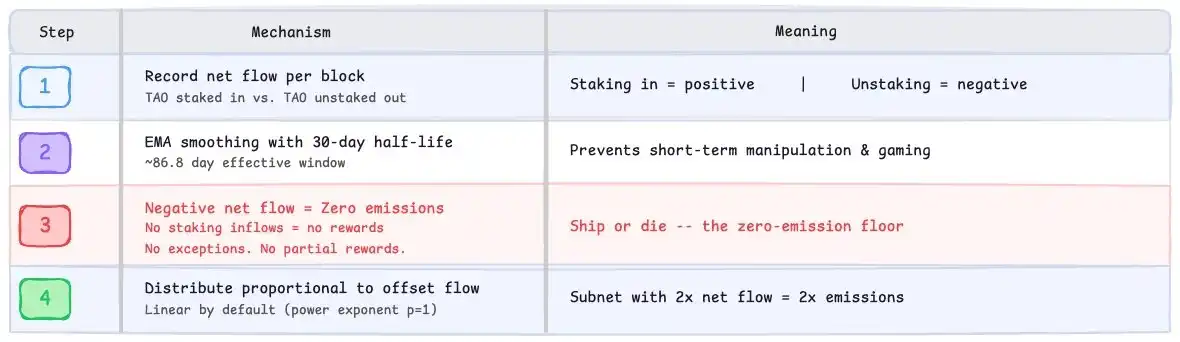
  • Since Taoflow in November 2025, subnets with negative net staking inflows receive zero emissions—forcing them to either succeed or die.

  • Approximately 3,600 TAO (~$960k) is distributed daily across all subnets, with the top ten controlling ~56% of the share.

  • Chutes (SN64) is the clearest example of product-market fit: 400k+ users, 9.1T tokens processed, 85% cheaper than AWS.

  • Templar (SN3) is the most asymmetric bet: fully decentralized training of frontier LLMs with a ~$60M market cap vs. OpenAI’s $800B.

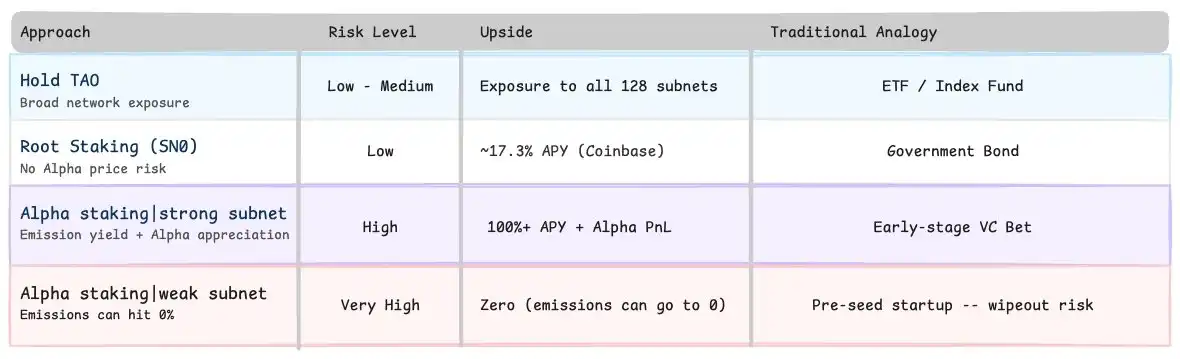
  • TAO = broad index fund to the entire network, while Alpha staking = concentrated investment in specific startups—with 100%+ APY potential but real risk.

  • Alpha tokens carry no formal yield promise; their value depends entirely on market dynamics and team execution.

1. Subnet Structure: Who Does What?

When people think of Bittensor, the most common mental model is: this is a decentralized AI project. While true, it’s incomplete.

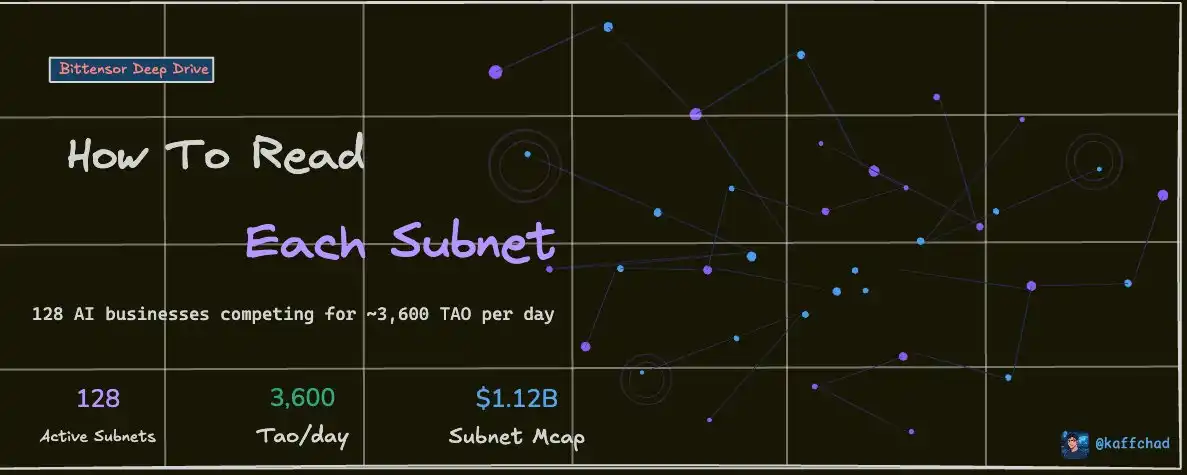
In reality, Bittensor is 128 independent AI startups competing in a brutal economic system, each with its own token, revenue model, and struggle for survival. By March 2026, the total market cap of all subnet tokens was ~$1.12B, equivalent to 27% of TAO’s own market cap. Grayscale calls it “Y Combinator for decentralized AI.” Except instead of a committee deciding who gets funded, the market decides.

Understanding this mechanism allows you to evaluate which subnets are creating real value and which are dying.

Each subnet is an incentive-based competitive market producing specific digital goods—AI inference, GPU compute, model training, financial data analysis, and more.

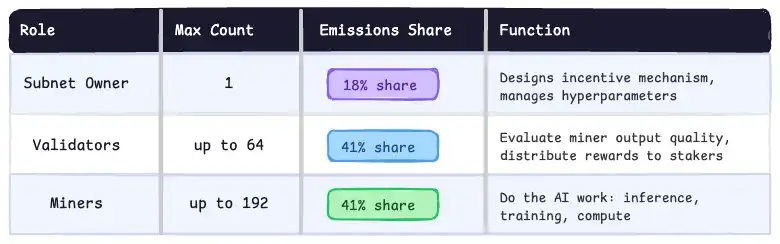
Each subnet is driven by three roles: subnet owner, validators, and miners:

Alpha Tokens: Equity in the Subnet

When you stake TAO to a subnet, your TAO enters an on-chain AMM pool (similar to Uniswap V2 mechanics). In return, you receive Alpha tokens. The price formula is:

Alpha Price = TAO in Pool ÷ Alpha in Pool

Alpha tokens have a hard cap of 21M (echoing TAO’s supply), and they auto-compound every ~72 minutes (one “tempo” = 360 blocks).

2. Two Revenue Streams and Why They’re Overlooked

In Bittensor, there are two completely separate ways to make money:

Revenue Stream 1: TAO Emissions via Taoflow

Since November 2025, Bittensor adopted the Taoflow model, a fundamental shift in how emissions are allocated.

Previously, emissions were calculated based on token price. This created a loophole: projects could artificially inflate their token price to capture emissions, build a “TAO treasury,” and slowly dump while still collecting rewards.

Taoflow fixed this by tracking net staking flow of TAO: staking inflows minus unstaking outflows. The mechanism runs in four steps:

After TAO’s first halving on Dec 14, 2025, block rewards dropped from 1 TAO to 0.5 TAO/block. Currently, ~3,600 TAO (~$960k at current prices) is distributed daily across 128 subnets. DCG estimates over $100M flows into the ecosystem annually.

Revenue Stream 2: Alpha Token PnL

This is the part most TAO holders aren’t tracking.

If a subnet performs well, Alpha’s price (denominated in TAO) rises. When you unstake, you receive more TAO than you initially put in. This is Alpha PnL = capital gains from holding a specific subnet’s token.

Taoflow creates a powerful flywheel effect:

  • Great product → more people stake TAO → positive net flow

  • Positive flow → more emissions → deeper liquidity pool

  • Deeper liquidity → lower slippage → attracts more capital

  • More capital → Alpha price rises → Alpha PnL increases for existing holders

The reverse is also true, and equally brutal. Sustained negative flow subnets → zero emissions → stakers continuously withdraw → death spiral.

3. Which Subnets Are Winning and Why?

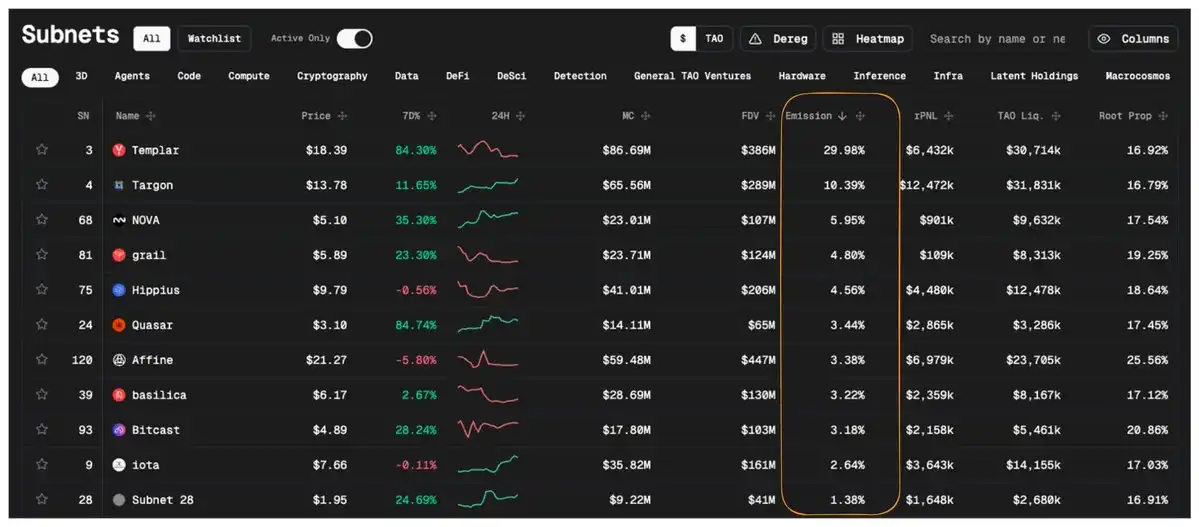
Here’s a snapshot of leading subnets ranked by emission dominance and realized PnL (rPnL):

  • SN3| templar: Large-scale LLM pre-training | Emission Share: 30.39% | rPnL: $6.43M

  • SN4| Targon: AI inference market—hosting and serving AI models for real-time predictions | Emission Share: 10.39% | rPnL: $12.47M

  • SN68| METANOVA: AI drug discovery company developing therapies to reprogram body and mind | Emission Share: 5.95% | rPnL: $900k

  • SN81| grail: Verifiable LLM post-training processing | Emission Share: 4.8% | rPnL: $109k

  • SN75| Hippius: Decentralized storage and web infrastructure with IP management | Emission Share: 4.56% | rPnL: $4.48M

The top 10 subnets control ~56% of the total daily emissions.

Case Study: Chutes, The Textbook Example of Product-Market Fit (PMF)

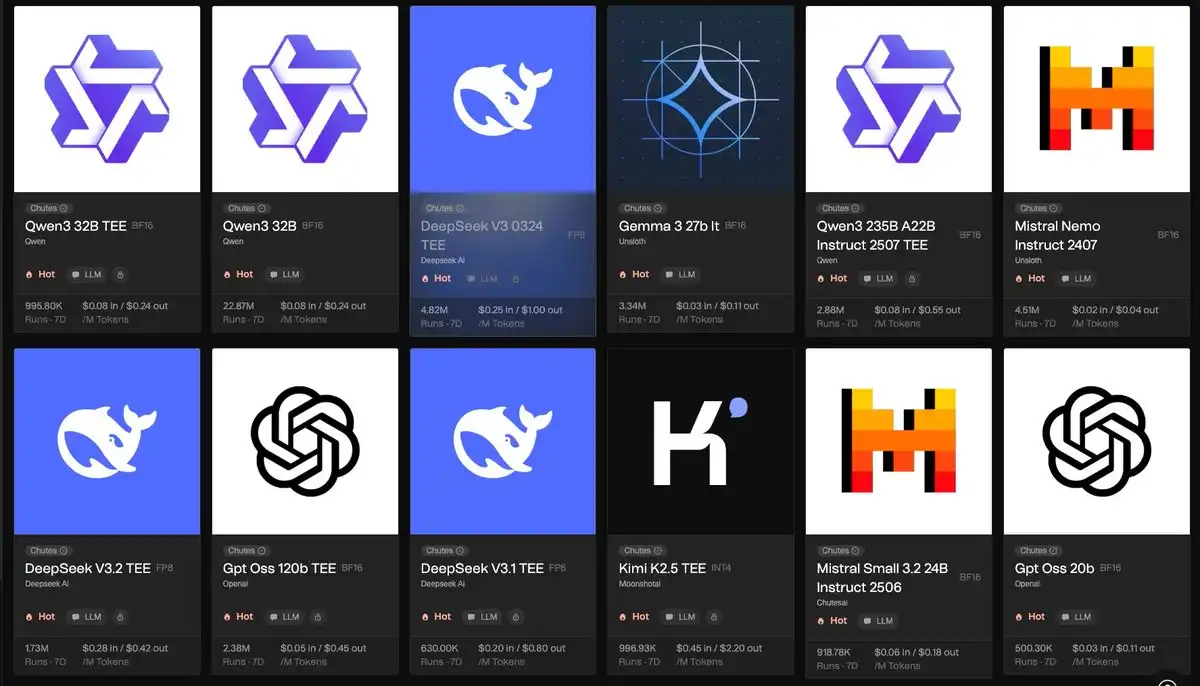
Built by Rayon Labs, Chutes is a decentralized serverless AI inference market, a Web3 alternative to OpenAI API and AWS for model deployment.

What stands out about Chutes:

  • Processed 9.1T tokens since late 2024

  • 400k+ users (100k+ via API)

  • 85% cheaper AI model deployment costs vs. AWS

  • Models supported: DeepSeek, Mistral, LLaMA, and dozens more

  • Platform revenue auto-staked → buys back Alpha tokens → organic demand flywheel

During a spike in February 2026, Chutes attracted over 2,740 TAO in just 9 hours. Alpha tokens peaked at $99.94 (0.225 TAO), with an FDV of 2.05M TAO (~$518M at TAO’s peak).

Rayon Labs also operates SN56 (Gradients—model training) and SN19 (Nineteen—high-frequency inference), collectively commanding over 23% of total emissions at their peak.

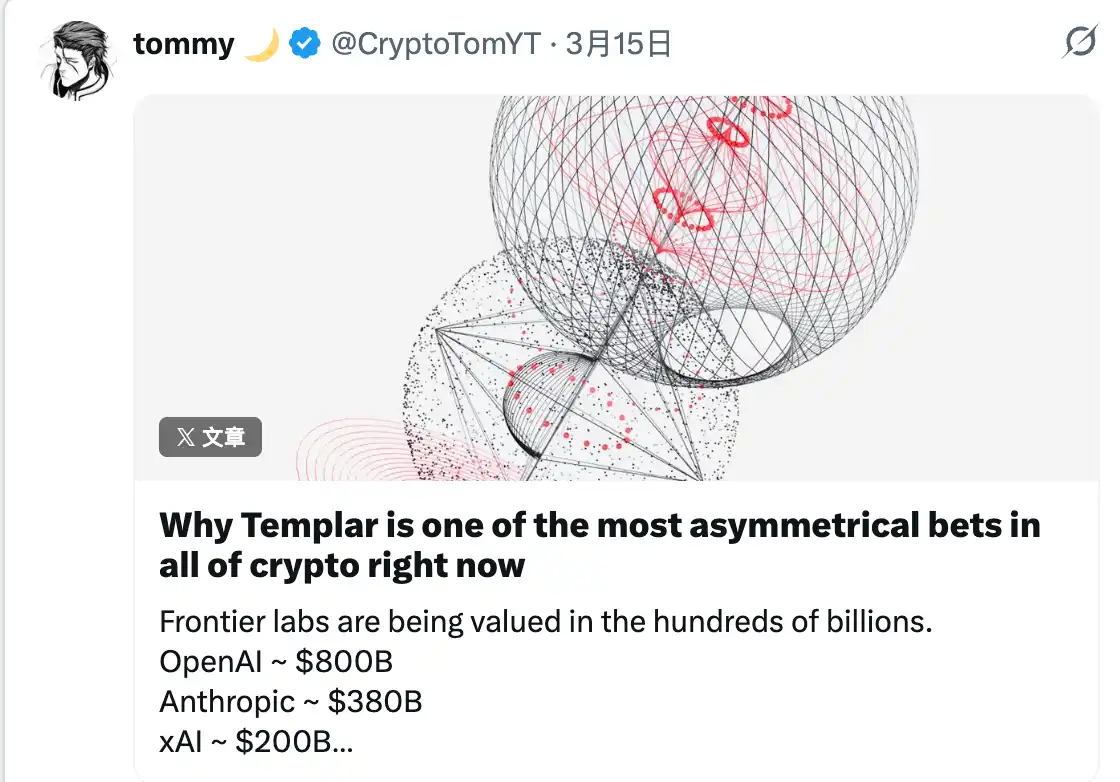
Case Study: Templar (SN3), The Most Asymmetric Bet in the Subnet Ecosystem

On March 10, 2026, Templar (SN3) completed Covenant-72B, a 72B parameter model hailed as the largest decentralized pre-training run in history.

4. The Mechanics Behind It: Registration, Yuma Consensus, and Competitive Pressure

Registration, A Competitive Arena

Not everyone can open a subnet. Registration uses a dynamic burn pricing mechanism: the cost doubles with each new subnet registration and halves linearly over 28,800 blocks (~4 days) with no new registrations.

When all 128 slots are full, new subnets must replace the worst-performing existing subnet (measured by lowest EMA price). Newly registered subnets get a 4-month grace period before being eligible for deregistration. The network is expected to expand to 256 subnets in 2026.

Yuma Consensus, Automated Independent Auditing

Within each subnet, Yuma consensus transforms validators' subjective assessments into objective reward distribution:

  • Validators submit weight vectors, scoring each miner they evaluate

  • The blockchain calculates the stake-weighted median for each miner (kappa=0.5)

  • Weights above the median are clipped—to prevent collusion and over-evaluation

  • Validators use a commit-reveal mechanism—submitting sealed weights, revealed only after a set number of blocks—to prevent weight copying

  • Validators who identify good miners early and evaluate consistently build stronger bonded positions and earn larger dividend shares

The result: No subnet owner can unilaterally change who gets rewards. This is the fundamental difference between Bittensor and typical crypto “AI projects.”

5. Investment Framework: TAO = Index Fund, Alpha Staking = Startup Bet

Auditless Research summarized it perfectly: “TAO is effectively more of an options token—a call option that can be pointed at the emissions of whatever Alpha token looks undervalued.”

How to Read a Subnet Like a Balance Sheet

  • Emissions = Protocol subsidies - network revenue, similar to government grants or accelerator funding

  • Alpha PnL = Market cap signal - the market is pricing the subnet’s true value

  • Net staking flow = Revenue growth indicator - positive flow = “product sells,” negative flow = churning customers

  • Subnet owner = Founder quality - communication frequency, delivery speed, and product roadmap are things to track

  • Number of validators = Board quality - more independent validators = less chance of manipulated scoring

Institutional Signals Are Growing

This is no longer just a retail story:

  • DCG holds over 500k TAO (~2.4% of total supply)

  • Polychain Capital holds ~$200M worth of TAO

  • Grayscale GTAO Trust listed on NYSE on January 6, 2026

  • Stillcore Capital (co-founded by Jason Calacanis) launched a fund dedicated to subnet tokens

6. Conclusion: A Starter Framework

Bittensor has created a structure unique in crypto: 128 AI businesses competing for a shared ~3,600 TAO (~$960k) daily, where capital allocation is determined solely by staker behavior.

When evaluating a subnet, ask these five questions:

  • Product: What does this subnet offer? Is there real demand for it?

  • Flow: Is net staking flow positive or negative? What’s the 30-day trend?

  • Team: Is the subnet owner communicating and delivering consistently?

  • Flywheel: Does revenue create organic demand for Alpha, or is it pure speculation?

  • Exit: Is the liquidity pool deep enough to exit without significant slippage?

TAO gives you broad exposure to the entire ecosystem. Alpha staking gives you a concentrated bet on a specific “startup”—with all the accompanying upside potential and downside risk.

Связанные с этим вопросы

QWhat are the two primary ways to generate income within the Bittensor subnet ecosystem?

AThe two primary ways to generate income are: 1) TAO emissions (protocol subsidies based on staking inflow) and 2) Alpha token PnL (capital gains from the performance of the specific subnet).

QWhat is the Taoflow model and what fundamental change did it introduce in November 2025?

AThe Taoflow model is a fundamental shift in how emissions are distributed. It tracks the net staking flow of TAO (staking inflow minus unstaking outflow) into a subnet. Subnets with negative net flow receive zero emissions, forcing them to either perform or be eliminated.

QWhich subnet is highlighted as the clearest example of product-market fit (PMF) and what are its key metrics?

AChutes (SN64) is highlighted as the clearest example of PMF. Its key metrics include processing over 9.1 trillion tokens, having over 400,000 users (100,000+ via API), and offering AI model deployment at an 85% lower cost than AWS.

QHow does the investment exposure of holding TAO differ from staking for an Alpha token?

AHolding TAO provides broad, index fund-like exposure to the entire Bittensor network. Staking for an Alpha token is a concentrated investment in a specific 'startup' subnet, offering higher potential returns (100%+ APY) but also carrying significant risk.

QWhat mechanism ensures that no single subnet owner can unilaterally change who gets rewards, and how does it work?

AThe Yuma Consensus ensures this. Validators submit weight vectors rating miners, the blockchain calculates a median score, and weights above the median are clipped to prevent collusion and over-evaluation. A commit-reveal mechanism prevents copying weights, making the system an automated, independent audit.

Похожее

Fei-Fei Li's Team Clarifies the Concept of 'World Models', Sora Merely a Renderer

"World Models" has become a widely used yet confusing term in AI. To address this, a team led by Fei-Fei Li and World Labs proposed a functional taxonomy based on the Partially Observable Markov Decision Process framework. This taxonomy categorizes systems called "world models" into three distinct projections: Renderers, Simulators, and Planners. Renderers, like OpenAI's Sora and other video generation models, focus on producing photorealistic visual outputs for human perception. They prioritize visual fidelity over physical accuracy. Simulators, such as NVIDIA Omniverse, aim to compute precise future environmental states for computational tasks like engineering analysis or digital twins. Planners, like Vision-Language-Action models, take in observations and goals to output executable actions for robots or agents. The article clarifies that most current "world models," including Sora, are primarily Renderers. They generate convincing visuals but lack the core ability to simulate state transitions based on actions, a key requirement for a true world model in classic reinforcement learning definitions. This conceptual confusion has practical implications, leading to potential misalignment in technology selection, investment, and public understanding of AI capabilities. Clear categorization is crucial. It helps enterprises avoid costly mistakes (e.g., using a renderer for robot training), allows investors to accurately assess markets, and enables researchers to build comparable benchmarks. While future systems may integrate these functions, recognizing current boundaries is essential for honest assessment and progress.

marsbit3 мин. назад

Fei-Fei Li's Team Clarifies the Concept of 'World Models', Sora Merely a Renderer

marsbit3 мин. назад

Bloomberg Uncovered: How Do China's Wealthy Circumvent the Annual $50,000 Limit to Transfer Assets?

**Summary: How Wealthy Chinese Circumvent $50,000 Annual Foreign Exchange Limits** Despite China's strict capital controls, including an annual $50,000 per person foreign exchange quota, an estimated $150 billion in funds still leaves the country annually via various gray and underground channels. This report outlines the evolution of China's "capital wall" and the methods used to bypass it. **The Evolving Capital Controls:** * **Foundation (1994):** The system of "current account convertibility with strict capital account controls" was established. * **Quota Set (2007):** The $50,000 individual annual forex purchase limit was formalized. * **Crackdown Begins (2015-2017):** Following market volatility, enforcement tightened. Banks were required to scrutinize transactions, and channels like using UnionPay cards for Hong Kong insurance premiums or buying overseas property were blocked. * **Digital & Legal Upgrades (2024-2026):** Enhanced algorithms now flag suspicious patterns (e.g., "smurfing"). The Common Reporting Standard (CRS) provides Chinese tax authorities with data on citizens' offshore accounts. Unlicensed cross-border brokers have been targeted. **Five Primary Methods for Moving Capital:** 1. **Underground Banking / "Hawala" (Duiqiao):** The largest-scale method. No money crosses borders. Clients pay RMB to a domestic account; an overseas associate deposits equivalent foreign currency into the client's offshore account. Risks include high fees, account freezes, and legal penalties. 2. **"Smurfing" or "Ant Moving":** Using multiple individuals' $50,000 quotas to pool funds for one offshore recipient. Increasingly detected by anti-money laundering algorithms. 3. **Trade Invoice Manipulation:** Businesses over-invoice imports or under-invoice exports via offshore shell companies, creating a pretext to transfer excess funds abroad under the guise of trade. 4. **Channel Migration:** After a crackdown on internet brokers, funds flow toward more compliant but costly channels like major banks' cross-border wealth management services or Qualified Domestic Institutional Investor (QDII) quotas. 5. **Structural Arrangements:** High-net-worth individuals use complex, high-cost legal structures involving offshore trusts, insurance, and investment migration programs to transfer asset ownership. **Regulatory Response: Focusing on People, Not Just Money** The current strategy extends oversight from enterprises to **individual residents**. Tools like CRS allow retroactive visibility into offshore assets. Cryptocurrencies, once seen as a potential loophole, are now actively monitored and prosecuted as an illegal channel. The underlying driver remains: with significant wealth concentrated among millions of affluent households seeking diversification amid domestic economic shifts, the incentive to move assets offshore persists despite regulatory barriers.

marsbit23 мин. назад

Bloomberg Uncovered: How Do China's Wealthy Circumvent the Annual $50,000 Limit to Transfer Assets?

marsbit23 мин. назад

Ethereum's Ballmer Moment: As Everyone Is Bearish, the Circulating Supply Is Disappearing

"Ethereum's Ballmer Moment: Circulation Shrinks Amid Bearish Sentiment" Amid widespread bearish sentiment, with prominent figures like Bankless founder David Hoffman selling ETH and young developers flocking to Solana, some argue Ethereum is entering its "Ballmer era"—akin to Microsoft's perceived stagnation under Steve Ballmer. While surface-level criticisms about slow protocol development, cautious leadership, and competitive pressure are valid, underlying fundamentals tell a different story. Approximately 30% of ETH is staked, major holders like BitMine are accumulating, and spot ETFs continue to absorb supply. Regulatory clarity, including the SEC/CFTC's March ruling on staking rewards and the potential passage of the CLARITY Act, is transforming crypto from a regulatory threat into a legitimized framework. This institutionalization, alongside a shrinking circulating supply (with net issuance around 0.23% annually), creates significant buy-side pressure independent of fee-based value capture. The broader crypto total addressable market is expanding through regulated stablecoins, tokenized assets, and institutional adoption. While public chains face competition from permissioned alternatives, the winning model appears to be permissioned assets settling on public chains like Ethereum and Solana. The author advocates a non-maximalist, barbell strategy: holding ETH for its institutional role and supply squeeze, SOL for consumer/throughput trends, BTC as a macro hedge, and a basket of next-gen L1s. Key bullish drivers for ETH include rapid circulation shrinkage, potential Q2 staked ETF approvals, regulatory tailwinds solidifying its role as a default settlement layer, and the optionality of an eventual "Satya moment" leadership shift. Despite bearish consensus, the current setup—where crypto is "not hot" and regulatory groundwork is being laid—presents a compelling investment opportunity. The crypto cycle's focus may have shifted to AI, but blockchain infrastructure is gaining a legal and institutional foothold precisely while attention is elsewhere.

marsbit23 мин. назад

Ethereum's Ballmer Moment: As Everyone Is Bearish, the Circulating Supply Is Disappearing

marsbit23 мин. назад

Торговля

Спот
Фьючерсы

Популярные статьи

Как купить S

Добро пожаловать на HTX.com! Мы сделали приобретение Sonic (S) простым и удобным. Следуйте нашему пошаговому руководству и отправляйтесь в свое крипто-путешествие.Шаг 1: Создайте аккаунт на HTXИспользуйте свой адрес электронной почты или номер телефона, чтобы зарегистрироваться и бесплатно создать аккаунт на HTX. Пройдите удобную регистрацию и откройте для себя весь функционал.Создать аккаунтШаг 2: Перейдите в Купить криптовалюту и выберите свой способ оплатыКредитная/Дебетовая Карта: Используйте свою карту Visa или Mastercard для мгновенной покупки Sonic (S).Баланс: Используйте средства с баланса вашего аккаунта HTX для простой торговли.Третьи Лица: Мы добавили популярные способы оплаты, такие как Google Pay и Apple Pay, для повышения удобства.P2P: Торгуйте напрямую с другими пользователями на HTX.Внебиржевая Торговля (OTC): Мы предлагаем индивидуальные услуги и конкурентоспособные обменные курсы для трейдеров.Шаг 3: Хранение Sonic (S)После приобретения вами Sonic (S) храните их в своем аккаунте на HTX. В качестве альтернативы вы можете отправить их куда-либо с помощью перевода в блокчейне или использовать для торговли с другими криптовалютами.Шаг 4: Торговля Sonic (S)С легкостью торгуйте Sonic (S) на спотовом рынке HTX. Просто зайдите в свой аккаунт, выберите торговую пару, совершайте сделки и следите за ними в режиме реального времени. Мы предлагаем удобный интерфейс как для начинающих, так и для опытных трейдеров.

1.4k просмотров всегоОпубликовано 2025.01.15Обновлено 2026.06.02

Как купить S

Sonic: Обновления под руководством Андре Кронье – новая звезда Layer-1 на фоне спада рынка

Он решает проблемы масштабируемости, совместимости между блокчейнами и стимулов для разработчиков с помощью технологических инноваций.

2.3k просмотров всегоОпубликовано 2025.04.09Обновлено 2025.04.09

Sonic: Обновления под руководством Андре Кронье – новая звезда Layer-1 на фоне спада рынка

HTX Learn: Пройдите обучение по "Sonic" и разделите 1000 USDT

HTX Learn — ваш проводник в мир перспективных проектов, и мы запускаем специальное мероприятие "Учитесь и Зарабатывайте", посвящённое этим проектам. Наше новое направление .

1.8k просмотров всегоОпубликовано 2025.04.10Обновлено 2025.04.10

HTX Learn: Пройдите обучение по "Sonic" и разделите 1000 USDT

Обсуждения

Добро пожаловать в Сообщество HTX. Здесь вы сможете быть в курсе последних новостей о развитии платформы и получить доступ к профессиональной аналитической информации о рынке. Мнения пользователей о цене на S (S) представлены ниже.

活动图片