After Falsifying Revenue, Why Did This CEO Choose a 'No Pants' Response?

比推Опубликовано 2026-03-11Обновлено 2026-03-11

Введение

CEO Roy Lee, founder of AI startup Cluely, responded to accusations of inflating revenue figures not with a traditional apology, but with a deliberately absurd video performance. After being accused of falsely claiming $7M in annual recurring revenue in a TechCrunch interview, Lee first admitted to casually providing the number, then released a video where he appeared professionally dressed from the waist up—only to stand up and reveal he was not wearing pants. The company, which began by creating an AI-powered interview cheating tool and was co-founded after Lee was expelled from Columbia University, has consistently leveraged controversy as a core growth strategy. Rather than mitigating the scandal, Lee turned it into a viral moment, echoing a broader trend in tech and crypto where attention itself is monetized. Major investor a16z has backed Cluely, with partners arguing that in an era of commoditized AI models, viral storytelling and public attention are the new moats. Lee’s response exemplifies how some founders now treat controversy not as risk, but as fuel for growth.

Author: DingDang

Original Title: CEO Uses Humor to Respond to Crisis, AI Entrepreneurs Steal Crypto's Marketing Playbook


In most startups, if exposed for 'falsifying revenue,' it would likely lead to a PR crisis—issuing a statement, explaining the misunderstanding, correcting data metrics, apologizing, and then steering the conversation back to product or business growth.

But Cluely's CEO Roy Lee clearly had no intention of doing that.

A Company That Started with a 'Cheating Tool'

Cluely was founded in 2025, and its initial product came from a project called Interview Coder, developed by Roy Lee and his college roommate Neel. This was a tool that used AI to help users cheat in LeetCode interviews. Due to this project, both were eventually expelled from Columbia University.

For most people, being expelled from school would be a black mark to cover up. But Roy Lee turned this incident into a marketing opportunity, even a 'turning point in life.'

Cluely's initial product slogan was: 'Cheat on Everything.' It wasn't until November 2025 that Cluely began shifting its product narrative from a 'cheating tool' to an AI note-taking assistant, such as using AI to automatically organize meeting content, optimize collaboration efficiency, and even modify attendees' expressions to hide distractions. But no matter how the product evolved, the company, or rather, its CEO, never shook off a very distinct vibe: it almost grew through controversy.

And the ensuing storm, in a way, continued down this path.

A Farce Triggered by 'Falsified Revenue'

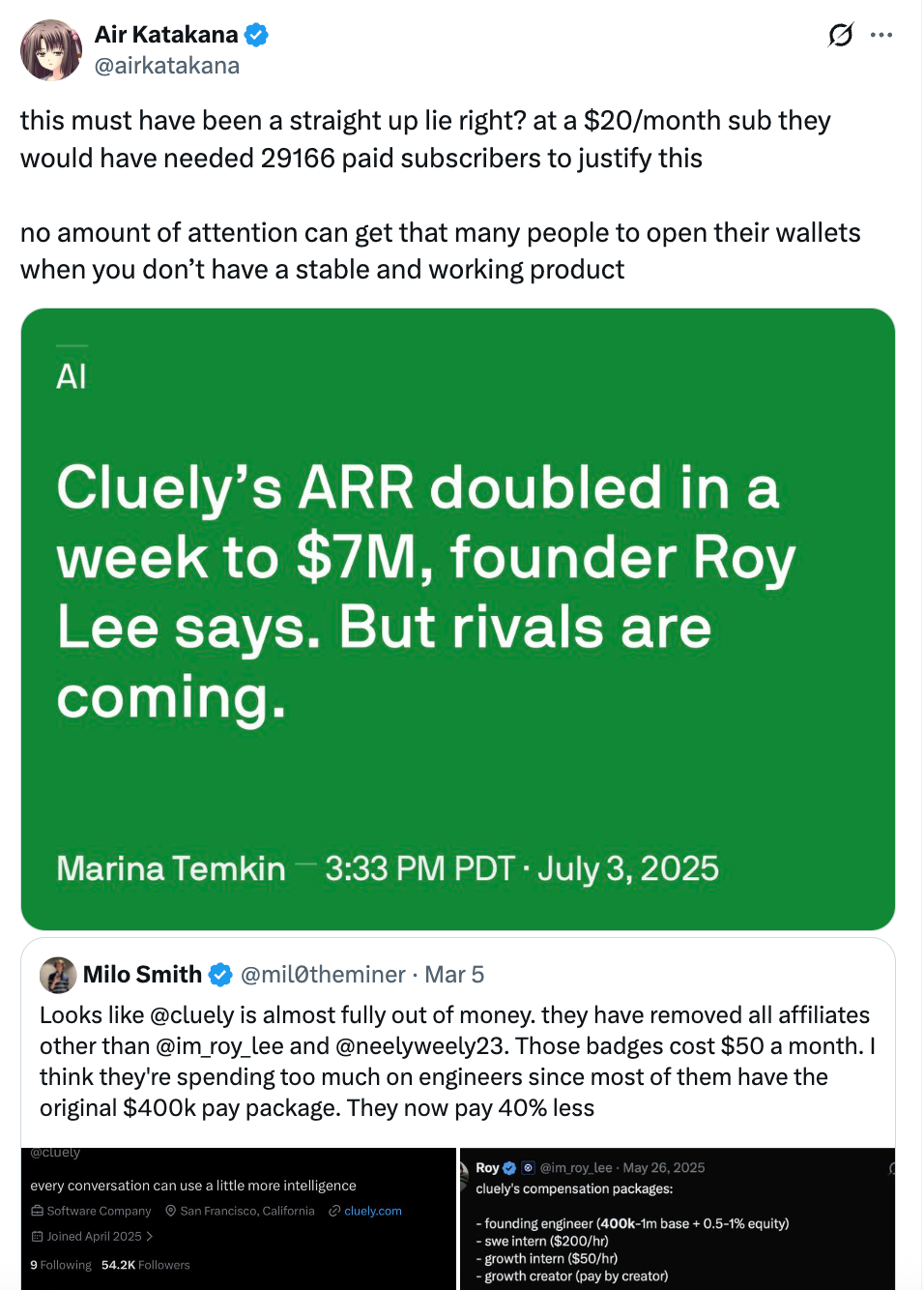
The incident began when someone dug up a July 2025 report by TechCrunch. The article mentioned that Cluely's Annual Recurring Revenue (ARR) had doubled in a week, reaching $7 million. This data was questioned as fraudulent.
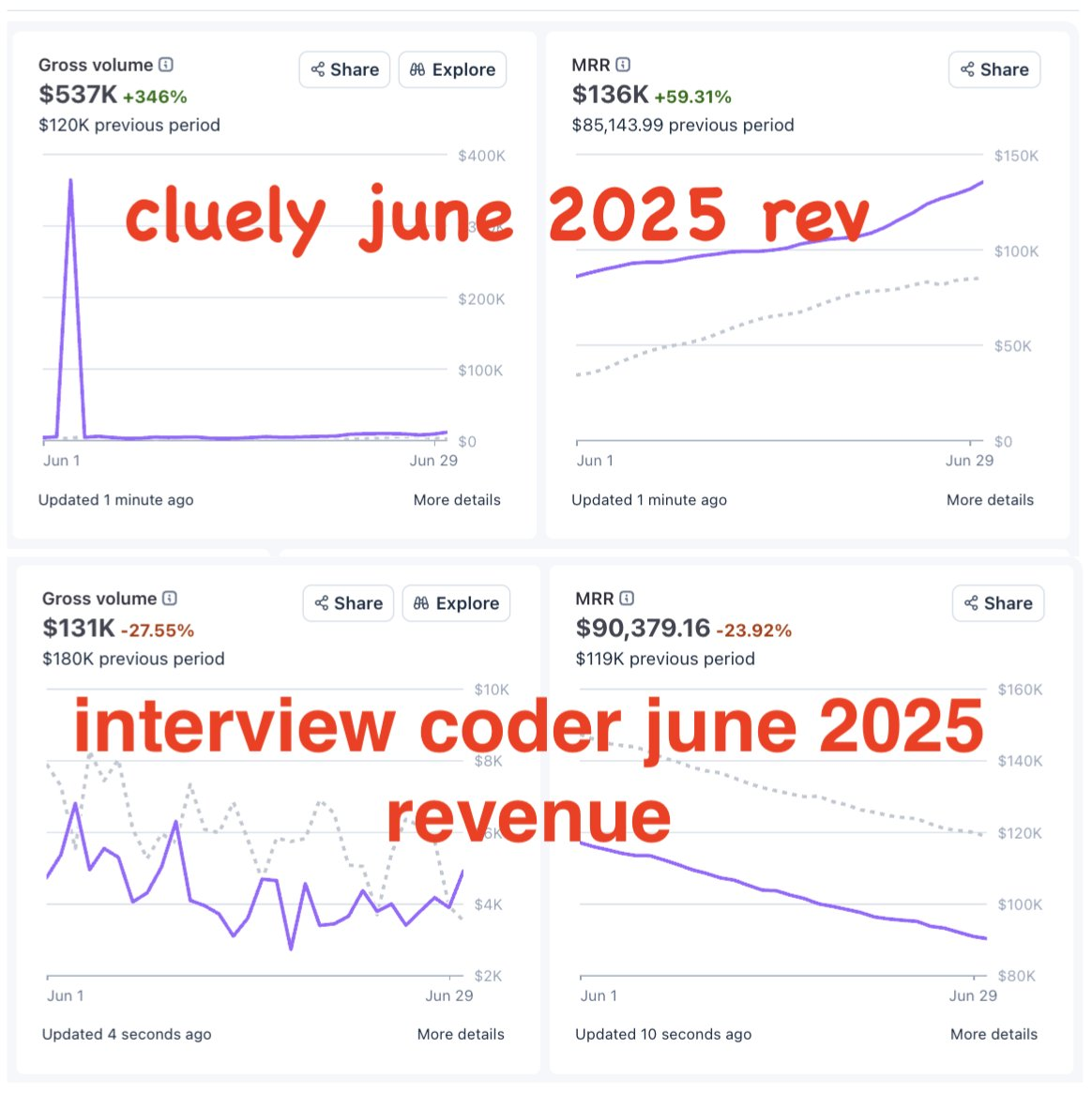
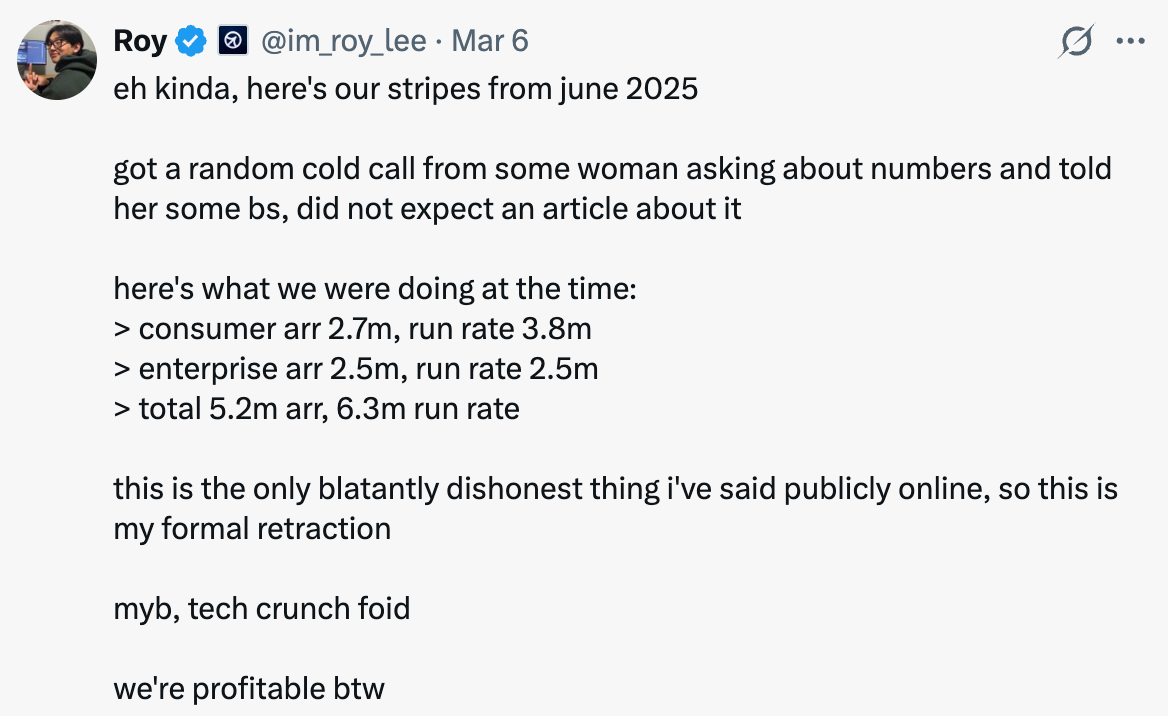
Facing the质疑, Cluely CEO Roy Lee was quite candid. He quickly posted to admit that he had casually mentioned the number when a reporter called him, not expecting it to be included in a formal article. Seemingly to prove it wasn't an intentional exaggeration, he also posted Cluely's actual data from June 2025: consumer business annual revenue of $2.7 million and enterprise business annual revenue of $2.5 million, totaling $5.2 million.

Up to this point, there was nothing sensational, and the explanation was plausible.
But on the same day, TechCrunch reporter Julie Bort published a rebuttal to Roy's claim. She stated that the interview was arranged proactively by Cluely's PR team, was documented, and was not a casual chat.

Roy Lee didn't continue with a written explanation but chose a more dramatic way to respond. He released a video with the caption, 'Breaking News: Cluely CEO Officially Responds to TechCrunch.'

In the video, he sat in front of the camera wearing sunglasses and a suit, with a microphone on the desk, looking as if he was about to make a serious statement. But the setting wasn't an office; it looked more like a living room, with an old desktop computer next to him playing Subway Surfers—a classic time-wasting game. Roy's response was also completely informal, more like a self-deprecating performance, mixed with self-mockery and bragging, his tone reminiscent of a rapper freestyling.

Even more absurdly, at the end of the video, he stood up from behind the desk, revealing that this CEO, formal from the waist up, was wearing no pants......

Thus, a crisis PR situation originally about 'falsified revenue' was handled as a traffic-grabbing, self-mocking performance.

What a16z Is Betting On Is Actually the Attention Economy

The capital market doesn't seem to mind this kind of performative founder personality either. In June 2025, Cluely announced the completion of a $15 million Series A funding round, with participating institutions including the renowned venture capital firm Andreessen Horowitz (a16z). Its partner Bryan Kim once mentioned on a podcast: In the AI era, the traditional 'artisan product + slow growth' model is no longer sufficient; viral spread itself is part of the product.

What he considers the 'new AI startup template' is that in an era where model capabilities are increasingly commoditized, attention itself is becoming a key resource. Whoever can capture user attention first may build a new moat.

From the 'cheating controversy' of Interview Coder, to the entrepreneurial story of being expelled from Columbia, to this absurd 'response video,' Roy Lee's entire personal brand has been built along this path: controversy itself is the content for propagation. This might also explain why a16z chose to invest in Cluely, to invest in Roy Lee.

When Controversy Becomes a Growth Strategy

In past entrepreneurial narratives, growth typically came from product capability, technological barriers, and business models. But in today's internet environment, another resource is becoming increasingly important—attention.

This logic has actually been proven in the crypto industry long ago. Many crypto projects capture user attention by creating topics, controversies, or even dramatic events, and then convert this traffic into product growth or commercial value, especially with the rise of Memes—pure propagation, no (traditional) product.

In a way, Roy Lee's response video is a classic case of this logic: when negative news emerges, rather than trying to suppress the controversy, repackage the controversy itself as传播 content.

Evidently, in the current internet environment, attention is often more valuable than explaining the truth.


Twitter:https://twitter.com/BitpushNewsCN

Bitpush TG Discussion Group:https://t.me/BitPushCommunity

Bitpush TG Subscription: https://t.me/bitpush

Original link:https://www.bitpush.news/articles/7618818

Связанные с этим вопросы

QWhat was the initial product developed by Cluely's CEO and co-founder, and what was the consequence of its creation?

AThe initial product was Interview Coder, an AI tool designed to help users cheat on LeetCode coding interviews. As a result, both Roy Lee and his roommate were expelled from Columbia University.

QHow did Cluely's CEO, Roy Lee, respond to the allegations of falsifying revenue reported by TechCrunch?

ARoy Lee first admitted in a post that he had casually provided the number during a call with a journalist without expecting it to be published. He then released a satirical video response where he appeared professionally dressed from the waist up but was not wearing pants, turning the crisis into a performance to attract attention.

QWhich prominent venture capital firm invested in Cluely's Series A funding round, and what was their stated reasoning for such investments in the AI era?

AAndreessen Horowitz (a16z) participated in Cluely's $15 million Series A funding round. Their partner, Bryan Kim, stated that in the AI era, viral marketing itself is part of the product, and capturing user attention is a critical resource for building a moat.

QAccording to the article, what is the 'new AI startup template' that Cluely's strategy exemplifies?

AThe 'new AI startup template' is one where, in an era of increasingly commoditized model capabilities, attention itself becomes a key resource. The strategy involves generating controversy and using viral, dramatic events to capture user attention and drive growth, rather than relying solely on traditional product capability or technological barriers.

QHow did the company's product narrative evolve from its origins to late 2025?

AOriginally promoted with the slogan 'Cheat on Everything' as a tool for cheating, the company began shifting its product narrative in November 2025 towards an AI note-taking assistant. This new focus included features like automatically organizing meeting content, improving collaboration efficiency, and even modifying attendees' expressions to hide distraction.

Похожее

A Hair Dryer Blows Away $34,000 from Polymarket

A hairdryer was used to manipulate a temperature sensor at Paris Charles de Gaulle Airport (LFPG) on April 6 and 15, 2026, causing short-lived artificial temperature spikes. These false readings were used to exploit a prediction market on Polymarket, where users bet on Paris’s daily maximum temperature. The attacker targeted low-probability high-temperature outcomes, which settled as "Yes" based on the corrupted data, netting a total of $34,000 in profit. The attacker’s a newly created anonymous account funded just two days before the first incident. After the successful manipulations, the funds were quickly moved through mixers and decentralized exchanges to avoid tracing. French meteorological experts and authorities confirmed the anomalies were inconsistent with actual weather conditions and nearby station data, pointing to physical intervention. Legal action was initiated for "disrupting automated data processing systems," which carries severe penalties under French law. Polymarket’s market rules relied solely on a single, publicly accessible sensor and did not account for subsequent data revisions, making the system vulnerable to such physical oracle attacks. In response, Polymarket silently switched its data source to Paris-Le Bourget Airport (LFPB) without public explanation or refunding the exploited funds. The incident highlights the risks of single-point data dependencies in prediction markets and the low-cost, high-reward potential of real-world manipulation.

marsbit20 мин. назад

A Hair Dryer Blows Away $34,000 from Polymarket

marsbit20 мин. назад

MetaMask Co-founder Departs, Leaving Behind a Little Fox Packaged in an IPO Prospectus

MetaMask co-founder Dan Finlay has left Consensys after a decade, citing burnout and a desire to spend more time with family. MetaMask, launched in 2016, is one of the most recognizable crypto wallets with over 100 million installs and 30 million monthly active users. Despite its dominant position, the wallet faces growing competition from newer entrants like Phantom, which has expanded beyond Solana and reportedly generates more than double MetaMask’s annual revenue. The timing of Finlay’s departure coincides with Consensys’s plans for an IPO, advised by J.P. Morgan and Goldman Sachs. The company, last valued at $7 billion in 2022, has undergone multiple rounds of layoffs amid slowing growth and internal challenges. Employee reviews on Glassdoor point to low morale and management issues. MetaMask’s delayed expansion into chains like Solana and the long-promised but unreleased $MASK token have also drawn criticism. While the wallet remains the default option for many Ethereum dApps, its product-market fit is weakening as new users increasingly choose alternatives. Consensys appears to be prioritizing monetizing MetaMask’s strong brand recognition through a public listing while its market position is still valuable. Finlay’s quiet exit reflects both personal fatigue and broader shifts in the competitive landscape of crypto wallets.

marsbit26 мин. назад

MetaMask Co-founder Departs, Leaving Behind a Little Fox Packaged in an IPO Prospectus

marsbit26 мин. назад

In-Depth Report on the On-Chain Lending Market: When Off-Chain Credit Meets On-Chain Liquidation

The on-chain lending market has evolved from a peripheral DeFi niche into core financial infrastructure. As of early 2026, total value locked (TVL) in on-chain lending protocols has reached $64.3 billion, accounting for 53.54% of total DeFi TVL, making it the largest and most mature vertical within decentralized finance. Aave dominates the sector with approximately $32.9 billion in TVL, commanding nearly half of the market—a leadership position that is unlikely to be challenged in the foreseeable future. However, the path of on-chain lending forward is not without risk. Liquidation cascades, credit defaults, and cross-chain vulnerabilities remain systemic threats hanging over the industry. At the same time, a deeper structural transformation is underway: on-chain lending is shifting from a “leverage tool for crypto-native users” to a “compliant gateway for institutional capital”. The scale of RWA (Real World Asset) lending has surpassed $18.5 billion, with U.S. Treasuries and government securities increasingly serving as core collateral. Institutional capital inflows are reshaping both the user base and risk appetite of the sector. This report systematically analyzes the evolution of on-chain lending definitions, competitive dynamics, core risks, and future trends, providing a comprehensive industry outlook for investors and trade practitioners. Key findings suggest that the “one dominant player with several strong challengers” structure will persist in the short term, while fixed-rate lending, compliant collateral, and institutional credit underwriting will define the next phase of competition. For investors focused on DeFi infrastructure, three key opportunity tracks stand out, namely, the Aave ecosystem (Morpho, Spark), RWA lending protocols (Ondo, Maple) and fixed-rate innovation (Notional, Pendle).

HTX Learn1 ч. назад

In-Depth Report on the On-Chain Lending Market: When Off-Chain Credit Meets On-Chain Liquidation

HTX Learn1 ч. назад

Торговля

Спот
Фьючерсы
活动图片