After Analyzing 231 Prediction Markets, We Uncovered the Harsh Truth About ICOs

比推Опубликовано 2026-01-29Обновлено 2026-01-29

Введение

Analyzing 231 prediction markets on Polymarket for 29 token launches reveals that these markets are not reliable predictive tools but rather contrarian indicators of market sentiment. Despite claims of near-perfect accuracy, the true predictive accuracy one week before market close is only 66.7%, with systematic over-optimism bias. Markets consistently overestimated fundraising amounts and valuations, with FDV predictions averaging a +35% overestimation. High trading volume on Polymarket (>$50M) is a strong bearish signal, often correlating with significant post-ICO price declines. In contrast, conservative predictions and lower trading volume (<$5M) are relatively bullish signals, though most tokens still underperform. Overall, 75% of tokens fell in the first 24 hours, and the average return since ICO is -32.2%, indicating that extreme optimism in prediction markets often precedes poor performance.

Source: LEGION (@legiondotcc)

Original Title: What prediction markets reveal about ICOs

Compiled and Edited by: BitpushNews


Prediction Markets in the Token World

Polymarket's token launch prediction markets have cumulatively processed nearly $2.5 billion in trading volume, with the platform claiming an astonishing prediction accuracy rate—100% for fundraising size predictions and over 90% for valuation predictions. However, in-depth analysis reveals that these figures are severely misleading: the true market signal lies not in "what was predicted correctly" but in "how much was predicted incorrectly."

By analyzing data from 231 prediction markets across 29 token launch events and comparing it with actual token performance from CoinGecko, we found that these markets are not reliable prediction tools but rather contrarian indicators reflecting market sentiment.

Key Findings:

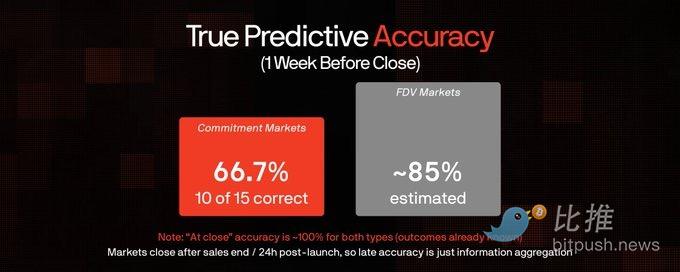
One week before the prediction markets closed, the true prediction accuracy rate was only 66.7%. At critical moments, the crowd was wrong one out of every three times, and the errors systematically showed excessive optimism.

24-Hour Volatility Issue: Using CoinGecko's hourly data, we found that PM's "FDV exceeding X 24 hours after listing" markets were betting on extreme volatility.

Average 24-hour change: ±23% | Best Case: Monad +54.8% | Worst Case: Trove -38.7%.

75% of tokens saw their prices drop within the first 24 hours of listing. PM's 24-hour FDV prediction accuracy rate: only 62.5%.

The Fallacy of Accuracy

When we track how market probabilities change over time, rather than just looking at the final outcome, a different picture emerges. The promise markets appear "100% accurate" because the final data leaks as the sale progresses. Insiders and observers update prices accordingly; this is merely price discovery after the fact.

Key Finding:

Both promise markets and FDV markets tend to approach ~100% accuracy at closing because they settle after the outcome is known. Promise markets close after the sale ends; FDV markets close after the 24-hour post-listing period ends. The only meaningful predictive metric is the accuracy rate one week before closing, when genuine uncertainty still exists. The 66.7% promise accuracy rate indicates that, at critical moments, the market was wrong one-third of the time.

Where User Judgment Went Wrong

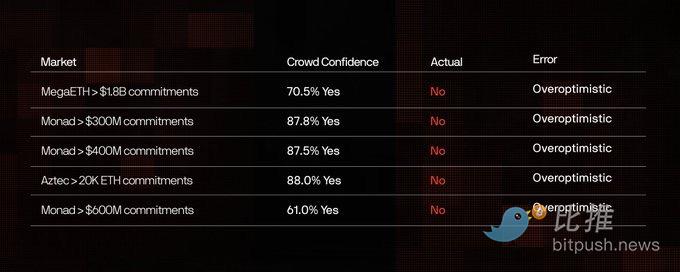
We examined every market where users had over 60% confidence in an unrealized outcome. In every case, the error was consistently in the same direction: excessive optimism. The crowd consistently believed the fundraising size would be larger and the valuation higher than they actually were.

This systematic bias suggests that the participants in these markets are optimistic speculators who are drawn there precisely because they are bullish on the token sales.

Excessive Optimism vs. Token Performance (Since ICO)

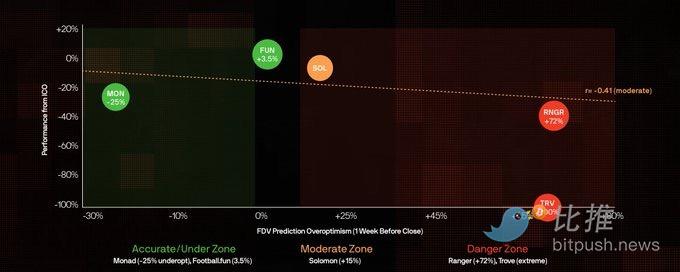
Methodology: This analysis only includes markets that had a public ICO and have issued tokens, using PM odds from one week before closing. Degree of Excessive Optimism = (PM Predicted FDV – Actual 24h FDV) / Actual 24h FDV. The Y-axis shows performance (return) since the ICO.

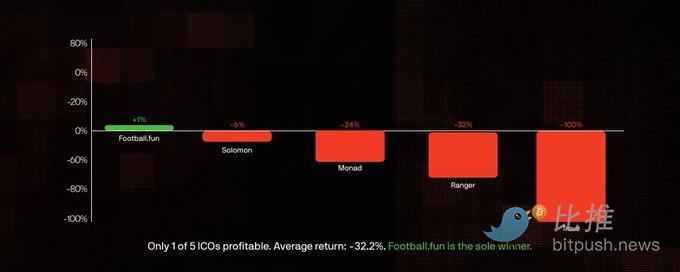
The data shows a moderate negative correlation (r=-0.41) between the degree of excessive optimism and ICO returns. Monad was undervalued (-25%) but has still fallen -24% since its ICO. Ranger was the most over-optimistically predicted (+72%) and has fallen -32% since its ICO. Only Football.fun remains above its ICO price (+1%).

Token Performance Ranking

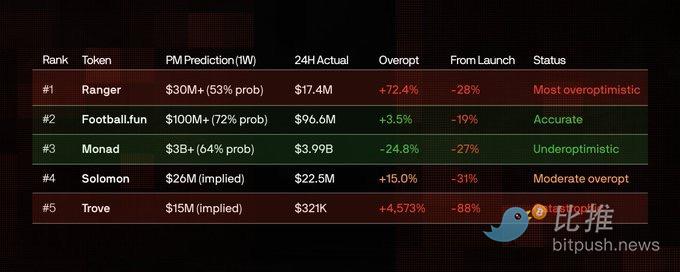
The table below uses historical PM odds from one week before closing, revealing the true prediction accuracy.

The pattern is clear: extreme excessive optimism foretells disaster, and high PM trading volume is a contrarian indicator even when its predictions are accurate.

ICO FDV vs. Listing Performance

Key Finding: Among tokens with ICO data, 40% listed at a price below their ICO valuation. Average return since ICO: -32.2%. Only Football.fun is trading above its ICO price.

The pattern is starkly clear: Even tokens that listed above their ICO valuation (Monad, Solomon) eventually fell below the ICO price. Among the 5 ICO tokens in this dataset, only Football.fun is currently trading above its ICO price (+1%), making it the sole winner.

Key Conclusions

After analyzing 231 markets, $241.5 million in trading volume, and 8 listed tokens with verified 24-hour FDV data, several conclusions clearly emerge:

1. "100% accuracy" is meaningless. Markets close after the outcome is known (promise markets after the sale, FDV markets after 24 hours), so late-stage accuracy is trivially close to ~100%. One week before closing, the true prediction accuracy of promise markets was only 66.7%. At critical moments, the crowd was wrong one-third of the time.

2. Systematic excessive optimism. Among the top 15 markets, 5 markets showed over 60% confidence in thresholds that were not met. Average FDV overestimation: +35%.

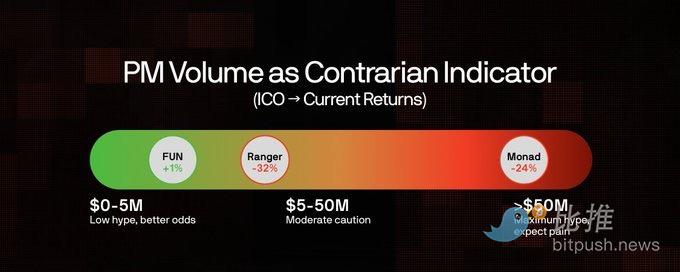
3. High PM trading volume is a contrarian indicator. Monad ($89M) and MegaETH ($67M) had the highest degrees of excessive optimism. The more money the crowd pours in, the more confident they become, and the more wrong they tend to be.

4. Conservative predictions = Better outcomes. Tokens where PM predictions were accurate (Monad, Football.fun) fell less. Low hype and accurate predictions appear to be bullish signals.

Trading Signals

Based on the analysis, we can extract actionable signals for evaluating future token sales. These are not absolutely precise, but they represent patterns that appeared repeatedly in our dataset.

Bearish Signals

  • PM Trading Volume > $50 Million

  • FDV Excessive Optimism > 50%

  • All FDV thresholds likely won't be met

  • Promise Amount Excessive Optimism > 30%

Bullish Signals (Relatively)

  • PM Trading Volume < $5 Million

  • FDV Prediction Error within 20%

  • Multiple FDV thresholds will be met

  • Crowd expectations are conservative

This asymmetry is crucial. Bearish signals are strong indicators of poor outcomes, while bullish signals are relatively weaker—only suggesting that a token might "fall less" than its hyped counterparts. In a market where token prices have generally fallen from their highs, "falling less" is already the best-case scenario.

Ultimately: Polymarket's token sale markets are essentially hype gauges. The true signal lies not in the prediction itself, but in the deviation between the predicted outcome and the actual performance. When public money floods in, betting that valuations will continue to climb, it is wise to be cautious.

History repeatedly proves: when market consensus peaks, it is often the moment when investors experience the most pain.

Data sources in the article: Polymarket CLOB API, CoinGecko, CMC (cross-verified), price data as of January 27, 2026.


Twitter:https://twitter.com/BitpushNewsCN

Bitpush TG Discussion Group:https://t.me/BitPushCommunity

Bitpush TG Subscription: https://t.me/bitpush

Original article link:https://www.bitpush.news/articles/7607105

Связанные с этим вопросы

QWhat is the main finding regarding the accuracy of prediction markets for ICOs one week before closing?

AThe true prediction accuracy of commitment markets one week before closing is only 66.7%, meaning the crowd was wrong one out of every three times during critical periods of uncertainty.

QWhat systematic bias did the analysis discover in the prediction markets?

AThe analysis found a systematic bias of excessive optimism, where participants consistently predicted higher fundraising amounts and higher valuations than what actually occurred.

QAccording to the article, what does high trading volume on Polymarket indicate for an ICO?

AHigh Polymarket trading volume (e.g., over $50 million) is a bearish signal and acts as a reverse indicator, suggesting that the more money the crowd invests, the more confidently wrong they tend to be.

QWhat percentage of tokens in the dataset traded below their ICO valuation at listing?

A40% of the tokens with ICO data in the dataset listed at a price below their ICO valuation.

QWhat is the key takeaway about the relationship between prediction market forecasts and actual ICO performance?

AThe key takeaway is that prediction markets are not reliable forecasting tools but rather gauges of hype. The true signal lies not in the predictions themselves, but in the deviation between those predictions and actual performance.

Похожее

You Bet on the News, the Pros Read the Rules: The True Cognitive Gap in Losing Money on Polymarket

The article explains that the key to profiting on Polymarket, a prediction market platform, lies not just predicting real-world events correctly, but in meticulously understanding the specific rules that govern how each market will be resolved. It illustrates this with examples, such as a market on Venezuela's 2026 leader, where the official rules defining "officially holds" the office overruled the intuitive answer of who was in practical control. Other examples include debates over the definition of a "token" or what constitutes an "agreement." The core argument is that a "reality vs. rules" gap creates pricing discrepancies that savvy traders ("车头" or "whales") exploit. The platform has a formal dispute resolution process managed by UMA token holders to settle ambiguous outcomes. This process involves proposal submission, a challenge window, a discussion period, and a final vote. However, the article highlights a critical flaw in this system compared to a traditional court: the lack of separation between the arbiters (UMA voters) and the interested parties (traders with financial stakes in the outcome). This conflict of interest undermines the discussion phase, leads to herd mentality, and results in opaque final decisions without explanatory rulings. Consequently, the system lacks a body of precedent, making it difficult for users to learn from past disputes. The ultimate takeaway is that success on Polymarket requires a lawyer-like scrutiny of the rules to identify and capitalize on the cognitive gap between how events appear and how they are contractually defined for settlement.

marsbit7 мин. назад

You Bet on the News, the Pros Read the Rules: The True Cognitive Gap in Losing Money on Polymarket

marsbit7 мин. назад

Will the Fed Still Cut Interest Rates? Tonight's Data Is Crucial

The core debate surrounding the Federal Reserve's potential interest rate cuts is intensifying amid geopolitical conflict and rebounding inflation. The key question is whether high energy prices will cause persistent inflation or weaken consumer demand enough to force the Fed to cut rates. Citigroup presents a bullish case for cuts, arguing that oil supply disruptions from the Strait of Hormuz are temporary and will not lead to lasting inflationary pressure. They point to receding bond yields and oil prices as evidence the market is pricing in a short-lived shock. Citi's data also shows tightening financial conditions, a stabilizing labor market, and healthy tax returns, supporting their view that the path to lower rates remains open. Conversely, Deutsche Bank offers a starkly contrasting, more hawkish outlook. They argue the Fed's current policy is already neutral and expect rates to remain unchanged indefinitely. Their view is based on stalled disinflation progress and a shift toward more hawkish rhetoric from key Fed officials like Waller, who cited risks from prolonged Middle East conflict and tariffs. Other officials, including Williams and Hammack, signaled rates would likely stay on hold for a "considerable time." The market pricing has shifted dramatically, now forecasting zero cuts in 2026. The imminent release of the March retail sales "control group" data is highlighted as a critical test. This metric, which excludes gas station sales, will reveal if high gasoline prices are eroding consumer spending in other areas. A weak reading could support the case for imminent rate cuts, while a strong one would bolster the argument for the Fed to hold steady. This data is pivotal for determining the near-term policy path.

marsbit27 мин. назад

Will the Fed Still Cut Interest Rates? Tonight's Data Is Crucial

marsbit27 мин. назад

The Second Half of Macro Influencer Fu Peng's Career

Fu Peng, a prominent Chinese macroeconomist and former chief economist of Northeast Securities, has joined Hong Kong-based digital asset management firm Bitfire Group (formerly New Huo Group) as its chief economist. This move, announced in April 2026, triggered an 11% surge in Bitfire's stock price. Fu, known for his accessible macroeconomic commentary and large social media following, will focus on integrating digital assets into global asset allocation frameworks, particularly combining FICC (fixed income, currencies, and commodities) with cryptocurrencies for institutional clients. His career includes roles at Lehman Brothers and Solomon International, with significant influence gained through public communication. However, in late 2024, Fu faced temporary social media bans after a controversial private speech at HSBC on China's economic challenges, though he denied regulatory sanctions. He later left Northeast Securities citing health reasons. Bitfire, a licensed virtual asset manager serving high-net-worth clients, seeks to build trust and attract traditional capital through Fu’s expertise and credibility. The partnership represents a strategic shift for both: Fu enters the crypto sector after a traditional finance peak, while Bitfire aims to leverage his macro framework for institutional adoption. Outcomes remain uncertain regarding capital inflows and compatibility within corporate structure.

marsbit1 ч. назад

The Second Half of Macro Influencer Fu Peng's Career

marsbit1 ч. назад

Торговля

Спот
Фьючерсы
活动图片