After AAVE Was Hit, What Did Spark Do Right to Attract $1.3 Billion Against the Trend?

marsbitОпубликовано 2026-04-22Обновлено 2026-04-22

Введение

Amid a $15.1 billion liquidity crisis at Aave triggered by a cross-chain vulnerability involving rsETH, which led to $200 million in bad debt, Spark Protocol emerged as a safe haven, attracting $1.3 billion in inflows. Spark’s TVL surged to $4.74 billion, with ETH deposit rates spiking to 130% due to high demand and scarce liquidity. Spark’s resilience stemmed from its conservative governance and multi-layered risk framework. Unlike Aave, which aggressively listed rsETH to boost capital efficiency, Spark had proactively delisted the asset months earlier, avoiding exposure. The protocol employs strict rate-limited caps, higher interest rate buffers, and a modular isolation architecture to mitigate risks. These measures prevent over-concentration, ensure liquidity during stress, and attract arbitrage capital during high utilization. The shift from Aave to Spark signals a market preference for security over yield, underscoring the importance of disciplined risk management in DeFi.

Author: Jae, PANews

When Aave faced a massive withdrawal of hundreds of billions of dollars, Spark caught the overflowing liquidity.

The on-chain disaster triggered by cross-chain vulnerabilities in Kelp DAO and LayzerZero split the DeFi lending market into two distinct worlds.

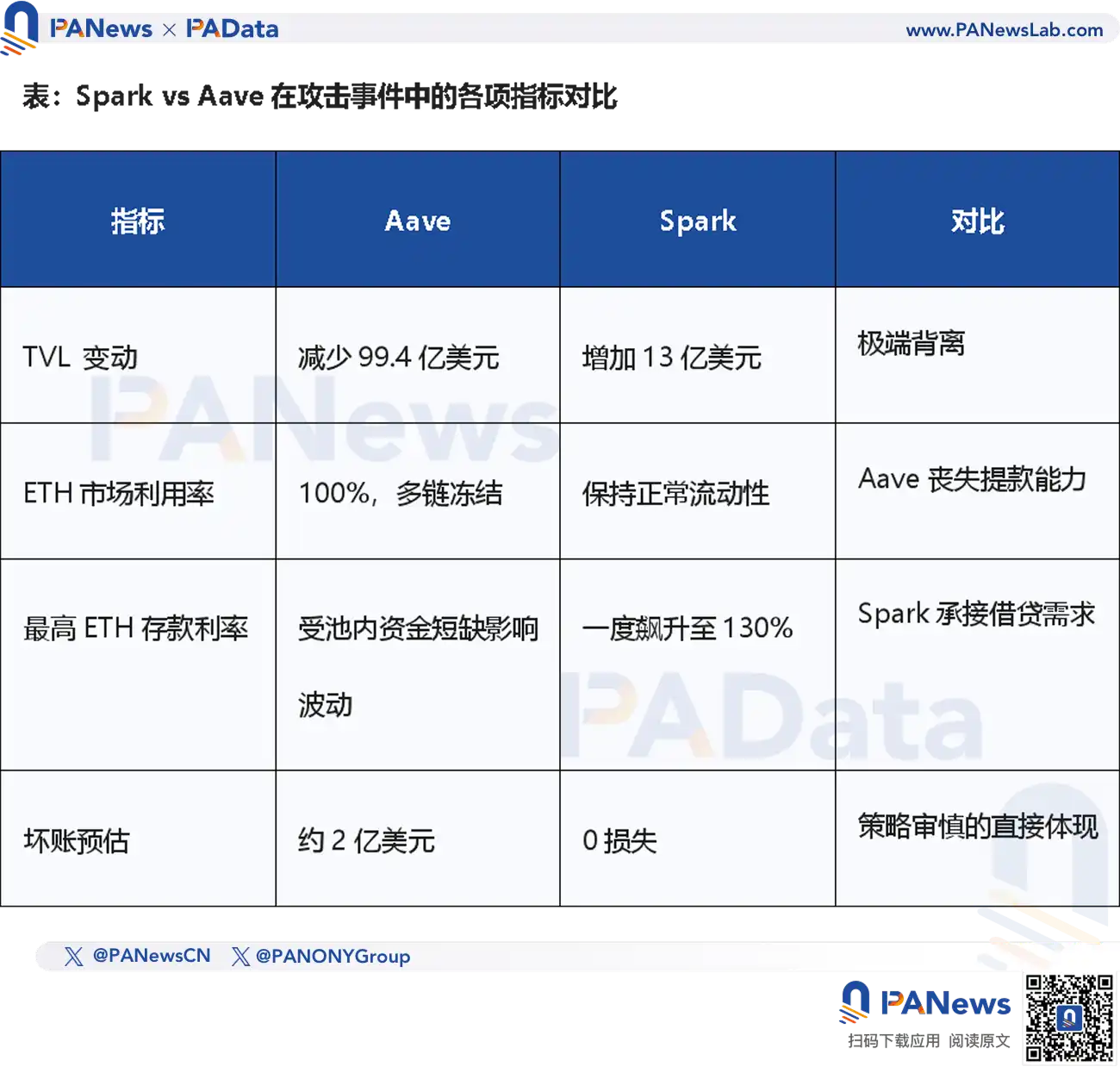
The influx of "toxic" asset rsETH into Aave resulted in approximately $200 million in bad debt, causing a complete liquidity drain and a panicked exodus of hundreds of billions in funds.

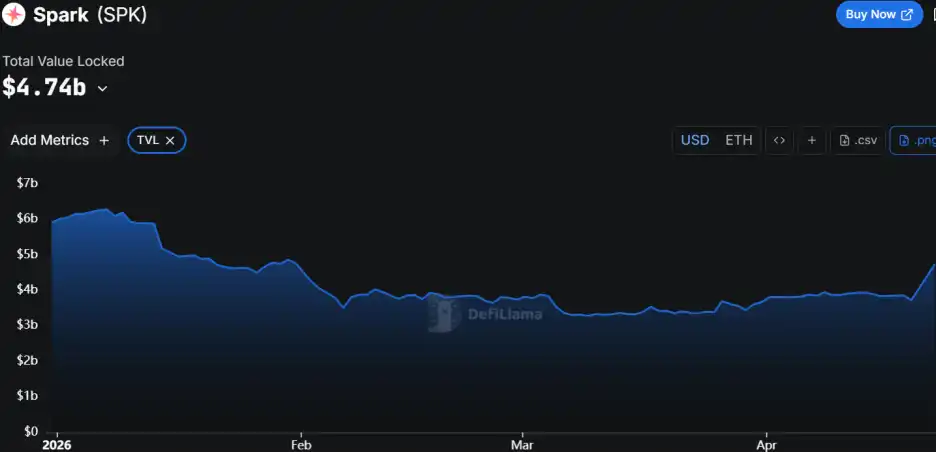
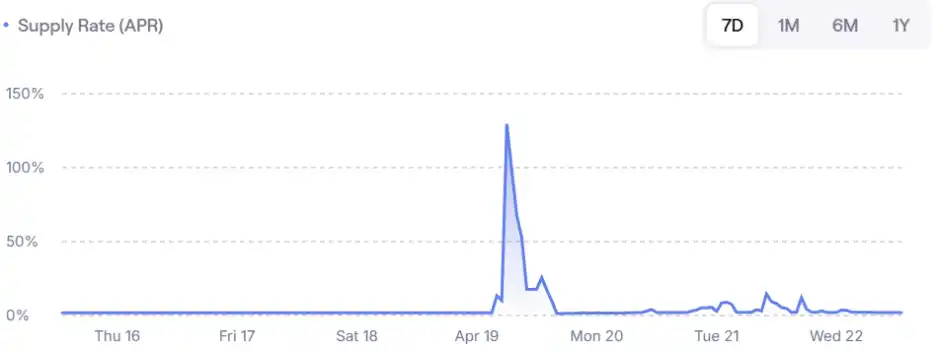
However, amid the widespread fear, another lending protocol giant, Spark, had its moment of glory. Its TVL (Total Value Locked) rapidly increased by $1.3 billion, and the ETH deposit rate once surged to 130%, making it the safe harbor of choice for whales transferring assets.

A black swan event has revalidated the true ruler of the DeFi iron throne.

Aave's Bloodbath of a Bank Run, Spark Seizes the Opportunity to Attract $1.3 Billion

The breach of rsETH's cross-chain bridge effectively pressed the pause button on Aave's entire lending market.

Hackers used fraudulently minted rsETH as collateral on Aave to borrow large amounts of WETH, draining the pool of clean assets and leaving behind a pool of bad debt.

Related reading: KelpDAO Cross-Chain Explosion, AAVE Becomes the "Patsy," Industry Calls for Risk Repricing

Panic spread like a virus: Over the past three and a half days, $151 billion has fled Aave, with total deposits dropping from $485 billion to $307 billion—about one-third of the funds have exited; WETH utilization rates on multiple chains hit 100% directly; depositors couldn't withdraw, and liquidators had no funds to borrow.

The most notable move came from Justin Sun, who quickly withdrew 65,584 ETH from Aave, worth approximately $154 million.

This "withdraw first" behavior created a herd effect in the market. For investors, no annualized yield could offset the panic of being unable to withdraw their principal.

Just as Aave became the hackers' liquidity exit, Spark became the users' escape route.

Spark's TVL反而 increased by $1.3 billion, with its total scale reaching $4.74 billion. This money is a vote of confidence cast by the market with real capital.

Due to the massive influx of borrowing demand into Spark, coupled with highly scarce liquidity, Spark's ETH deposit rate experienced a spectacular surge, once reaching an annualized level of 130%. This directly reflects the extremely high premium for safe assets.

Spark's ability to meet this demand is thanks to its unique ecosystem structure. Unlike Aave, it is the lending engine of the Sky ecosystem, backed by the vast USDS reserves. As Sky's liquidity outpost, Spark not only relies on external deposits but can also directly obtain stablecoin supplies through Sky's credit lines.

This "central bank-level" liquidity backing allows it to keep withdrawal channels open even during market turmoil.

Abandoning TVL Vanity, Spark Defies Trend to Delist rsETH

Spark avoided the rsETH pitfall due to a counter-trend decision made three months ago.

Same day, different fate. On January 29th, the two major lending platforms took opposite approaches in handling Liquid Restaking Tokens (LRTs).

Aave went full throttle. The protocol officially launched rsETH E-Mode, allowing users to conduct leveraged borrowing with a high collateral ratio (LTV) of 93%. Aave's goal was to attract an anticipated $1 billion inflow of rsETH, restore WETH utilization, and boost TVL and revenue.

Spark prudently retreated. The protocol passed a governance Spell to completely halt new supply of rsETH and gradually remove it from the asset list.

This move by Spark caused strong dissatisfaction among ETH循环杠杆 users, who often use repeated抵押 of stETH or rsETH and similar staking assets to arbitrage interest rate differentials. Spark's delisting forced them to migrate their positions, with most flowing to Aave, which had more lenient policies and lower interest rates.

At the time, the community questioned Spark's team for being "too conservative" or "abandoning growth." No one expected that this step might have saved the entire protocol later.

After the fact, Spark's Strategy Lead, monetsupply.eth, pointed out in a review that the decision to delist rsETH was based on a security-oriented tightening mechanism.

  1. Marginal Cost vs. Marginal Benefit: If the cost of maintaining a certain asset exceeds its risk-adjusted return to the protocol, such assets will be purged;
  2. Risk Exposure: rsETH had extremely low utilization on Spark, almost monopolized by the same wallet address, making risk difficult to disperse;
  3. User Preference Research: The sole whale user of rsETH expressed a willingness to actively migrate to more mature collateral like wstETH or weETH, providing an opportunity for the protocol to smoothly clean up the asset.

It was this decision-making discipline and transparency, which "does not blindly pursue TVL," that allowed Spark to avoid all potential losses that could have been caused by hackers exploiting rsETH.

Multi-Layered Risk Control System: Rate Limits + Interest Rate Buffer + Isolated Architecture

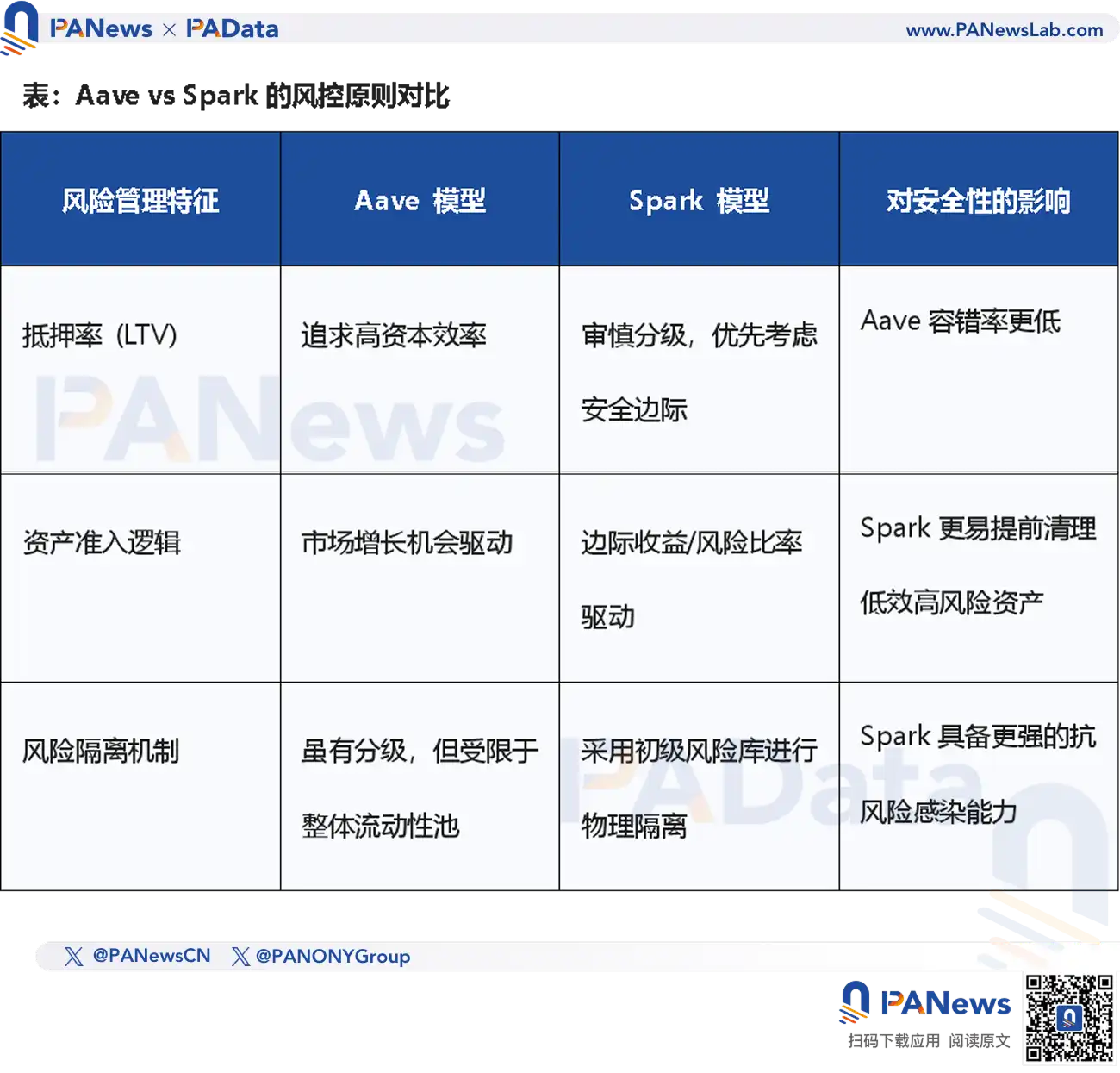
PANews believes that even if rsETH had not been delisted, Spark's architecture would have been sufficient to withstand such risks. Compared to Aave's pursuit of capital efficiency at the expense of safety redundancy, Spark has established a multi-tiered, in-depth defense system.

Spark implements strict deposit and borrowing rate limits (Rate-Limited Caps), meaning the amount of funds that can be deposited and borrowed within a fixed time increases gradually. Even if rsETH were still listed, an attacker could not deposit $290 million in collateral all at once as they did on Aave. This design forcibly limits the maximum risk exposure scale of a single event, hard-capping losses within an acceptable range.

Spark has long maintained relatively high interest rate ceilings. Under stable market conditions, higher borrowing rates, while deterring over-borrowing (if it's expensive to borrow, people borrow less), on the other hand attract more people to deposit (depositors earn more). The result is that the pool always retains liquidity, avoiding a situation where funds are "all borrowed out," preventing people from being unable to withdraw their money. Especially during market crashes, it avoids bank runs due to liquidity枯竭.

When pool utilization rises, Spark's interest rate curve slope becomes steeper than Aave's, which has two significant consequences:

  • Forced Deleveraging: High interest costs force borrowers to actively seek liquidity to repay loans.

  • Attracting Supplementary Liquidity: High deposit APY quickly attracts external arbitrage capital, thus resolving the deadlock of 100% utilization.

Spark's modular isolated architecture offers strong controllability in risk management. When handling high-risk synthetic assets like USDe, Spark has also adopted a prudent approach, isolating them in specific primary risk pools. This ensures that even if a specific asset encounters problems, it will not affect the main lending pools on the platform.

The great liquidity migration from Aave to Spark signifies a shift in risk preference from yield chasing to safety and stability.

Aave's hundred-billion-dollar outflow is a wake-up call for all protocols pursuing high capital efficiency. When safety margins are sacrificed, any minor external关联 risk can evolve into a global crisis for the protocol.

Spark's rise proves that in an uncertain market environment, prudent risk governance decisions and the implementation of a "risk-first" strategy are the moats with greater long-term value.

Связанные с этим вопросы

QWhat was the main reason behind Spark's significant increase in TVL (Total Value Locked) during the Aave crisis?

ASpark's TVL increased by $1.3 billion because it was perceived as a safe haven for users fleeing the rsETH-related instability on Aave. Its unique ecosystem, backed by the substantial USDS reserves of the Sky ecosystem, provided a reliable liquidity backstop, ensuring withdrawal channels remained open during the market turmoil.

QHow did Spark's decision regarding rsETH months before the incident contribute to its stability?

AThree months prior to the incident, Spark made a proactive governance decision to halt new supplies of rsETH and gradually remove it from its asset list. This risk-averse move, based on a cost-benefit analysis, low utilization, and concentrated risk exposure, prevented Spark protocol from being exposed to the rsETH exploit that caused significant bad debt on Aave.

QWhat are the key risk management features of its protocol that the article highlights as reasons for Spark's resilience?

AThe article highlights Spark's multi-layered risk management system, which includes strict Rate-Limited Caps to restrict large, sudden deposits/borrows, a higher interest rate curve that discourages over-leverage and attracts liquidity during stress, and a modular, isolated architecture that contains problems from risky assets in separate silos to protect the main lending pools.

QWhat specific event triggered the massive withdrawal of funds from Aave and the subsequent liquidity crisis?

AThe specific event was a cross-chain bridge exploit involving Kelp DAO's rsETH. A hacker used fraudulently minted rsETH as collateral on Aave to borrow a large amount of WETH, draining the pool of 'clean' assets and leaving behind approximately $200 million in bad debt, which triggered panic and a bank run.

QWhat does the shift of liquidity from Aave to Spark signify in terms of market risk preference according to the article?

AThe shift signifies a change in market risk preference from pursuing high capital efficiency to prioritizing safety and stability. It served as a warning to protocols that sacrifice security margins for efficiency, demonstrating that prudent risk governance and a 'risk-first' strategy are more valuable long-term moats in an uncertain market environment.

Похожее

WeChat Agent Issues a 'Heroic Summons,' Half of the Internet Responds

WeChat AI Agent is on the horizon. The WeChat Open Platform has issued a guide for developers, offering them ways to integrate into the WeChat AI ecosystem. This will enable mini-programs to be discovered and invoked by the AI. Meituan has already announced its integration, allowing users to access services like food delivery through WeChat AI. Other platforms like Ctrip and Tongcheng have followed suit. Furthermore, WeChat is collaborating with major smartphone manufacturers to enable their native AI assistants to perform actions within WeChat, such as initiating calls or sending messages, through a controlled protocol called Agent-to-Agent (A2A). Reports indicate the WeChat AI Agent will be accessible by swiping right on the main interface. It aims to understand user intent within the rich context of chats, groups, and past interactions, then automatically call upon relevant mini-programs to complete tasks like ordering coffee or booking restaurants. This positions it as a potential "super app" with direct access to WeChat's vast ecosystem of services, social connections, and payment systems. Technically, this is a complex endeavor. It requires advanced natural language understanding, a "world model" to predict interactions within mini-programs (UI-Oceanus), multi-model orchestration for cost efficiency, and careful coordination with millions of third-party service providers. Tencent's development follows a "Co-Design" approach, where product teams and the Hunyuan model team collaborate closely, allowing capabilities honed in other AI products (like Yuanbao for chat, ima for search, WorkBuddy for office tasks) to be transferred to the WeChat Agent. Tencent is strategically opting for the A2A protocol over GUI-based automation (which it has blocked in the past), maintaining control over its ecosystem. To manage the immense scale and cost of serving 1.4 billion monthly active users, Tencent is deepening its ties with DeepSeek, known for its cost-effective training, to secure a low-cost inference backbone. The ultimate goal is to solve practical, everyday problems for users within the WeChat ecosystem, moving beyond technical benchmarks to deliver real utility, which Tencent sees as the key to winning in the long-term AI game.

marsbit32 мин. назад

WeChat Agent Issues a 'Heroic Summons,' Half of the Internet Responds

marsbit32 мин. назад

Humanity Loses $31 Million in Attack, Token Price Plummets 90% Due to a Single Private Key

On June 9th, the digital identity project Humanity Protocol suffered a major security breach resulting in over $31 million in losses. According to on-chain analyst Specter, hundreds of wallets holding the project's H token were drained. The attack was confirmed by founder Terence Kwok to be caused by the compromise of a foundation member's private key. As a precaution, users are advised to avoid interacting with Humanity's cross-chain bridge or liquidity pools. The incident caused the H token price to crash over 90%, from around $0.70 to a low of $0.052, wiping its market cap from $2 billion to approximately $35.7 million. The attacker allegedly minted 100 million new H tokens and is selling them for BNB. This breach adds to existing controversies surrounding Humanity Protocol. Founded in 2024, it aimed to verify human users via palm-print biometrics and zero-knowledge proofs. However, a leaked conversation in 2025 revealed that only about 1 million of its 9 million claimed Human IDs had completed biometric verification, suggesting 88% might be bots. Furthermore, the project has faced allegations of being a repackaged product from a Chinese access control vendor, raising privacy and authenticity concerns. Founder Terence Kwok's previous venture, Tink Labs, a hotel smartphone startup that raised $170 million, failed and entered bankruptcy in 2020 after burning through its funding. The current attack highlights the persistent critical issue of private key management in crypto. Unlike smart contract exploits, a private key compromise bypasses all on-chain security mechanisms. With no user compensation plan announced yet, this $31 million breach may be a final blow to the project's credibility, already weakened by previous controversies and a heavily depreciated token.

marsbit1 ч. назад

Humanity Loses $31 Million in Attack, Token Price Plummets 90% Due to a Single Private Key

marsbit1 ч. назад

MicroStrategy Will Not Die in This Downturn: Reflexivity, STRC Anchoring Back to Par, and the Self-Rescue Logic of "Sell Stock, Not Bitcoin"

This article analyzes the recent sharp decline in Bitcoin and MicroStrategy (MSTR), framing it as a targeted "reflexivity" attack. The trigger was MSTR using its cash reserves to buy back convertible notes, raising market concerns about a liquidity crisis. The playbook follows George Soros's principle: market expectations can shape reality. Fears that MSTR might be forced to sell BTC caused panic selling, lowering BTC's price and worsening MSTR's financial ratios, thus reinforcing the negative narrative. The author argues that MSTR's Structured Convertible (STRC), while falling in price, is a floating-rate security that will eventually return to par value (100). The price drop reflects the market demanding a higher yield due to perceived risk, but as a floating-rate instrument, its coupon can adjust, naturally pulling the price back to par over time. This is crucial for MSTR's continued ability to raise funds. The core thesis is that MSTR's best move to counter the attack is to **issue new equity (sell shares)**, not sell its Bitcoin holdings. While selling BTC would solve the immediate cash crunch, it would destroy the company's core investment thesis and premium. It would dilute the BTC per share, likely erase the market premium over its net asset value (mNAV > 1), and worsen its debt-to-asset ratio. Issuing shares while mNAV is high (e.g., 1.25x) allows MSTR to raise cash for reserves without harming shareholder value or the "perpetual accumulation" narrative. It improves the debt ratio and reassures STRC holders, breaking the negative reflexivity cycle. In conclusion, while MSTR could survive this episode even by selling BTC, doing so would fundamentally alter its investment proposition and weaken it for future cycles. The optimal, value-preserving strategy is to sell equity to rebuild reserves and maintain the long-term growth flywheel.

marsbit1 ч. назад

MicroStrategy Will Not Die in This Downturn: Reflexivity, STRC Anchoring Back to Par, and the Self-Rescue Logic of "Sell Stock, Not Bitcoin"

marsbit1 ч. назад

Торговля

Спот
Фьючерсы

Популярные статьи

Как купить AAVE

Добро пожаловать на HTX.com! Мы сделали приобретение Aave Protocol (AAVE) простым и удобным. Следуйте нашему пошаговому руководству и отправляйтесь в свое крипто-путешествие.Шаг 1: Создайте аккаунт на HTXИспользуйте свой адрес электронной почты или номер телефона, чтобы зарегистрироваться и бесплатно создать аккаунт на HTX. Пройдите удобную регистрацию и откройте для себя весь функционал.Создать аккаунтШаг 2: Перейдите в Купить криптовалюту и выберите свой способ оплатыКредитная/Дебетовая Карта: Используйте свою карту Visa или Mastercard для мгновенной покупки Aave Protocol (AAVE).Баланс: Используйте средства с баланса вашего аккаунта HTX для простой торговли.Третьи Лица: Мы добавили популярные способы оплаты, такие как Google Pay и Apple Pay, для повышения удобства.P2P: Торгуйте напрямую с другими пользователями на HTX.Внебиржевая Торговля (OTC): Мы предлагаем индивидуальные услуги и конкурентоспособные обменные курсы для трейдеров.Шаг 3: Хранение Aave Protocol (AAVE)После приобретения вами Aave Protocol (AAVE) храните их в своем аккаунте на HTX. В качестве альтернативы вы можете отправить их куда-либо с помощью перевода в блокчейне или использовать для торговли с другими криптовалютами.Шаг 4: Торговля Aave Protocol (AAVE)С легкостью торгуйте Aave Protocol (AAVE) на спотовом рынке HTX. Просто зайдите в свой аккаунт, выберите торговую пару, совершайте сделки и следите за ними в режиме реального времени. Мы предлагаем удобный интерфейс как для начинающих, так и для опытных трейдеров.

958 просмотров всегоОпубликовано 2024.04.12Обновлено 2026.06.02

Как купить AAVE

Обсуждения

Добро пожаловать в Сообщество HTX. Здесь вы сможете быть в курсе последних новостей о развитии платформы и получить доступ к профессиональной аналитической информации о рынке. Мнения пользователей о цене на AAVE (AAVE) представлены ниже.

活动图片