Aave founder under scrutiny for $10M token purchase amid governance drama

cointelegraphОпубликовано 2025-12-24Обновлено 2025-12-24

Введение

Aave founder Stani Kulechov faces criticism for purchasing $10 million worth of AAVE tokens, with allegations that the move was intended to increase his voting power in a key governance proposal. Critics, including DeFi strategist Robert Mullins, claim the purchase could be used to vote against token holders' interests, highlighting concerns about governance attacks and the concentration of voting power. The controversy arises amid a heated vote on reclaiming control of Aave's brand assets through a DAO structure. Critics argue the proposal was rushed and note that a small group of large holders controls over 58% of the voting power, raising questions about the fairness of token-based governance.

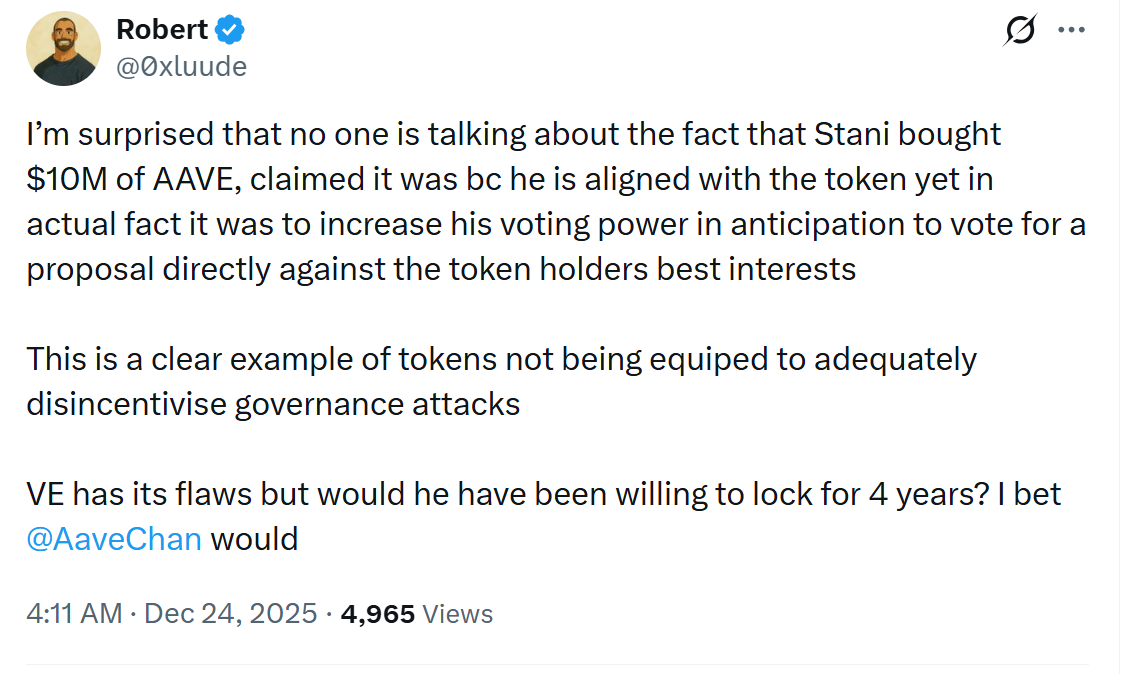
Aave founder Stani Kulechov is facing scrutiny over his recent $10 million purchase of AAVE tokens, with some in the crypto community claiming it was used to boost his voting power in a key governance proposal.

In a Wednesday post on X, Robert Mullins, a decentralized finance (DeFi) strategist and liquidity specialist, argued that the purchase was meant to increase Kulechov’s “voting power in anticipation to vote for a proposal directly against the token holders best interests.”

He added: “This is a clear example of tokens not being equipped to adequately disincentivize governance attacks.”

Prominent crypto user Sisyphus echoed those concerns, claiming that Kulechov might have sold “millions of dollars” worth of Aave (AAVE) tokens between 2021 and 2025, questioning the economic rationale behind the move.

The controversy comes as Aave token holders debate how governance power is exercised within one of DeFi’s largest protocols, with critics arguing that large token purchases can materially influence voting outcomes on high-stakes proposals. The dispute has reignited concerns about whether token-based governance adequately protects minority holders when founders or early insiders retain significant economic leverage.

Robert Mullins questions Kulechov’s motive behind recent purchase. Source: Robert Mullins

Aave governance vote sparks backlash

As Cointelegraph reported, Aave’s governance vote has triggered a backlash after a proposal on reclaiming control of the protocol’s brand assets was pushed to a snapshot vote despite ongoing debate.

The proposal asks whether AAVE token holders should regain ownership of domains, social accounts and intellectual property through a DAO-controlled legal structure.

Several stakeholders disputed that decision, arguing that the proposal was escalated prematurely.

Former Aave Labs CTO Ernesto Boado, listed as the proposal’s author, said the vote escalated without his consent and broke community trust.

Related: Aave founder outlines 2026 ‘master plan’ after end to SEC probe

Voting power concentration in Aave DAO

Samuel McCulloch of USD.ai pointed out the concentration of voting power. In an X post, he described the Aave vote as “silly,” adding that a small group of large holders accounted for about half of the total voting weight.

Snapshot data from the Aave DAO shows that the top three voters alone control more than 58% of the entire vote. The top voter, 0xEA0C...6B5A, holds 27.06% of the voting power (333k AAVE), while the second-largest voter, aci.eth, controls 18.53% (228k AAVE).

Cointelegraph reached out to Kulechov for comment, but did not receive a response by publication.

Magazine: Bitcoin whale Metaplanet ‘underwater’ but eyeing more BTC: Asia Express

Связанные с этим вопросы

QWhy is Aave founder Stani Kulechov facing scrutiny for his recent token purchase?

AStani Kulechov is facing scrutiny because some in the crypto community claim his $10 million purchase of AAVE tokens was used to boost his voting power in a key governance proposal, potentially acting against token holders' best interests.

QWhat specific governance proposal has caused controversy in the Aave community?

AThe controversial proposal asks whether AAVE token holders should regain ownership of the protocol's brand assets, including domains, social accounts, and intellectual property, through a DAO-controlled legal structure.

QHow concentrated is the voting power in the Aave DAO according to the article?

AVoting power in Aave DAO is highly concentrated, with the top three voters controlling more than 58% of the total voting weight, and the top single voter holding 27.06% of the voting power.

QWhat criticism did Robert Mullins raise about Kulechov's token purchase?

ARobert Mullins argued that Kulechov's purchase was meant to increase his voting power to vote for a proposal that goes against token holders' best interests, calling it a clear example of tokens not being equipped to disincentivize governance attacks.

QWhat concern has this controversy reignited about token-based governance systems?

AThe controversy has reignited concerns about whether token-based governance adequately protects minority holders when founders or early insiders retain significant economic leverage and can influence voting outcomes through large token purchases.

Похожее

Only a 50% Chance of Passing This Year, Can the CLARITY Bill Succeed Before the Midterm Elections?

The CLARITY Act, which passed the House in July 2025 with strong bipartisan support (294-134), faces a critical juncture in the Senate. The Senate Banking Committee is expected to hold a markup soon, but key issues remain unresolved, including stablecoin yield provisions, DeFi regulations, and securing full Republican committee support. Other contentious points involve the Blockchain Regulatory Certainty Act (BRCA), ethics amendments for government officials, and SEC-related matters. The legislative calendar is tight, with limited time before the midterm elections. If the committee markup is delayed beyond mid-May, the chances of passage in 2026 drop significantly. Senator Cynthia Lummis has warned that failure this year could delay comprehensive crypto market structure legislation until 2030 or later. Galaxy estimates the probability of the CLARITY Act becoming law in 2026 is only about 50%. The bill provides crucial regulatory clarity by defining jurisdictional boundaries between the SEC and CFTC, establishing a path for decentralization, and bringing digital commodity intermediaries under federal regulation. Its passage is seen as vital before potential power shifts in the next Congress, which could bring less favorable leadership to key committees. The timeline is compressed, and the bill must compete for floor time with other priorities like Iran authorization and DHS appropriations. Key hurdles include finalizing the stablecoin yield compromise text, addressing law enforcement concerns about BRCA, and navigating political dynamics around SEC nominations. The outcome of the Banking Committee markup and the level of bipartisan support will be critical indicators of its future success.

marsbit4 мин. назад

Only a 50% Chance of Passing This Year, Can the CLARITY Bill Succeed Before the Midterm Elections?

marsbit4 мин. назад

Dialogue with Xinhuo Chief Economist Fu Peng: Macro Bear Market Expected to End This Year, Prioritize Allocation to Value Assets

Fu Peng, Chief Economist at New Huo Group, discusses the integration of crypto assets into traditional finance, marking a shift from a speculative phase to institutionalization. He highlights the current era as the second major fusion of finance and technology, driven by AI, data, and computing power, with crypto assets becoming part of the FICC+C (Fixed Income, Currencies, Commodities + Crypto) framework. Regulatory clarity in the U.S., such as the GENIUS and Clarity Acts, has paved the way for institutional adoption by defining digital assets as financial instruments. Fu views RWA (Real World Assets) as a tool for asset tokenization rather than a standalone asset class, noting that financial innovation differs between Eastern and Western markets due to cultural approaches to risk and regulation. He emphasizes that stablecoins are essential for future finance, but Asian markets, including Hong Kong, will adopt them cautiously. Macro liquidity now significantly influences crypto markets, as institutional participation increases correlation with traditional assets. Fu suggests the macro-driven bear market may end by year-end, reducing the relevance of Bitcoin’s four-year cycle. For asset allocation, he recommends value-oriented AI stocks for stability, Bitcoin for moderate certainty, and Ethereum for higher volatility.

marsbit11 мин. назад

Dialogue with Xinhuo Chief Economist Fu Peng: Macro Bear Market Expected to End This Year, Prioritize Allocation to Value Assets

marsbit11 мин. назад

Only a 50% Chance of Passing This Year, Can the CLARITY Bill Succeed Before the Midterm Elections?

The CLARITY Act, which passed the U.S. House in July 2025 with strong bipartisan support (294-134), faces a critical juncture in the Senate. The Senate Banking Committee is expected to hold a markup soon, but key issues remain unresolved, including stablecoin yield provisions, DeFi regulations, and securing full Republican committee support. Additional challenges involve the Blockchain Regulatory Certainty Act (BRCA), ethics amendments for government officials, and SEC-related concerns. Galaxy estimates only a 50% chance of the bill becoming law in 2026. The tight legislative calendar, competing priorities like Iran military authorization and DHS appropriations, and the impending midterm elections create significant time pressure. If the bill is not passed before the new Congress convenes in 2027, comprehensive crypto market structure legislation could be delayed until 2030 or later, especially if leadership changes result in less favorable committee chairs. The act provides crucial regulatory clarity by defining the jurisdictional boundaries between the SEC and CFTC, establishing a path for decentralized networks to be classified as non-securities, and bringing digital commodity intermediaries under federal regulation. The outcome of ongoing Senate negotiations, particularly the release of revised text on stablecoin yields, will be a key indicator of its future prospects.

Odaily星球日报14 мин. назад

Only a 50% Chance of Passing This Year, Can the CLARITY Bill Succeed Before the Midterm Elections?

Odaily星球日报14 мин. назад

Four-Dimensional Resonance: Hong Kong Web3 Carnival Sub-Forum Co-Creates Blueprint for Global Financial New Infrastructure

The "Four-Dimensional Resonance: 2026 Global Financial New Infrastructure" forum, a core event of the Hong Kong Web3 Festival, was successfully held at the Hong Kong Convention and Exhibition Centre. Co-hosted by Web3Labs and DeShang Singularity Tech, with joint support from Bitroot, Injective, Microsoft, and Z Oracle, the event gathered policymakers, industry leaders, and investors to explore the integration and innovation of global financial infrastructure, focusing on RWA, AI, DeFi, and compliant payments. Policy speakers, including Hong Kong Legislative Council Member Mr. Wu Jiezhuang, South Korean National Assembly Member Mr. Min Byung-duk, and ACED Chairman Mr. Yun Seok-hun, emphasized the importance of cross-border regulatory collaboration and an open policy environment for fintech innovation. Web3Labs CEO Caspar and DeShang Singularity Tech CEO Chang Shuai highlighted Hong Kong’s role as a financial innovation center and the approaching "singularity moment" for global financial infrastructure. Technical insights were shared by MagnetX, Bitroot, Microsoft, and Injective on topics including AI Agent economies, the evolution of public blockchains, and AI’s transformative role in finance. Key partnerships and initiatives were launched: - GWDC 2026 Korea collaboration between Hong Kong and South Korea. - A strategic agreement between Web3Labs and Microsoft. - The launch of a public anti-fraud alliance by Z Oracle and partners. - The "Injective Rising Star" program to support AI and Web3 projects. Panel discussions delved into AI-driven smart payments, compliant cross-border transactions, and the fusion of RWA and DeFi. Participants agreed that integrating RWA with DeFi is crucial for the next stage of financial infrastructure, enabling a shift from physical to digital finance. The forum underscored Hong Kong’s pivotal role in advancing a globalized and sustainable Asian fintech ecosystem.

marsbit23 мин. назад

Four-Dimensional Resonance: Hong Kong Web3 Carnival Sub-Forum Co-Creates Blueprint for Global Financial New Infrastructure

marsbit23 мин. назад

Торговля

Спот
Фьючерсы

Популярные статьи

Как купить AAVE

Добро пожаловать на HTX.com! Мы сделали приобретение Aave Protocol (AAVE) простым и удобным. Следуйте нашему пошаговому руководству и отправляйтесь в свое крипто-путешествие.Шаг 1: Создайте аккаунт на HTXИспользуйте свой адрес электронной почты или номер телефона, чтобы зарегистрироваться и бесплатно создать аккаунт на HTX. Пройдите удобную регистрацию и откройте для себя весь функционал.Создать аккаунтШаг 2: Перейдите в Купить криптовалюту и выберите свой способ оплатыКредитная/Дебетовая Карта: Используйте свою карту Visa или Mastercard для мгновенной покупки Aave Protocol (AAVE).Баланс: Используйте средства с баланса вашего аккаунта HTX для простой торговли.Третьи Лица: Мы добавили популярные способы оплаты, такие как Google Pay и Apple Pay, для повышения удобства.P2P: Торгуйте напрямую с другими пользователями на HTX.Внебиржевая Торговля (OTC): Мы предлагаем индивидуальные услуги и конкурентоспособные обменные курсы для трейдеров.Шаг 3: Хранение Aave Protocol (AAVE)После приобретения вами Aave Protocol (AAVE) храните их в своем аккаунте на HTX. В качестве альтернативы вы можете отправить их куда-либо с помощью перевода в блокчейне или использовать для торговли с другими криптовалютами.Шаг 4: Торговля Aave Protocol (AAVE)С легкостью торгуйте Aave Protocol (AAVE) на спотовом рынке HTX. Просто зайдите в свой аккаунт, выберите торговую пару, совершайте сделки и следите за ними в режиме реального времени. Мы предлагаем удобный интерфейс как для начинающих, так и для опытных трейдеров.

863 просмотров всегоОпубликовано 2024.04.12Обновлено 2025.05.13

Как купить AAVE

Обсуждения

Добро пожаловать в Сообщество HTX. Здесь вы сможете быть в курсе последних новостей о развитии платформы и получить доступ к профессиональной аналитической информации о рынке. Мнения пользователей о цене на AAVE (AAVE) представлены ниже.

活动图片