A Quick Look at the Latest Moves of the 24-Year-Old 'AI Stock God': Sixty Percent of the Portfolio Hedging Against Semiconductor Downturn

marsbitОпубликовано 2026-05-18Обновлено 2026-05-18

Введение

24-year-old AI investing prodigy Leopold Aschenbrenner's fund, Situational Awareness LP, has disclosed its Q1 2026 13F holdings. The fund's total portfolio nominal value surged 148% to $13.7 billion, driven by both investment gains and significant new capital inflows. The most striking move was the establishment of massive short-term hedges against potential volatility in the AI semiconductor sector. Over 60% of the fund's nominal exposure is now in put options (bets on declines) targeting major AI hardware stocks like NVIDIA (NVDA), VanEck Semiconductor ETF (SMH), Broadcom (AVGO), and AMD. Notably, the fund also holds call options (bets on rises) on some names like Micron (MU) and TSMC, indicating it expects extreme price swings in these stocks. Alongside these hedges, the fund remains a long-term bull on AI infrastructure. It significantly increased its equity stakes in companies like GPU cloud provider CoreWeave (CRWV) and added to positions in power/energy infrastructure firms like Bloom Energy (BE), albeit after taking substantial profits on the latter. The fund also exited positions in optical communication hardware (LITE, COHR) and reduced leverage by clearing out large call option positions on Intel and CoreWeave. In essence, the portfolio reflects a dual strategy: cautious on near-term semiconductor valuations and potential over-extension, while maintaining a conviction that the true long-term bottlenecks and value will be in the underlying infrastructure powering...

Original | Odaily Planet Daily (@OdailyChina)

Author | Azuma (@azuma_eth)

No Confidential Treatment Requested! No Complete Sell-Off! The 13F filing for Situational Awareness LP, the fund run by the new "AI Stock God" Leopold Aschenbrenner, was officially published this evening.

  • Odaily Note: For details about Leopold Aschenbrenner's personal story, see 'SBF's Junior, Turned $225 Million into $5.5 Billion in One Year'.

This means the first assumption in our morning article 'Fastest Reveal Expected Today, the Entire Internet Awaits the 24-Year-Old 'AI Stock God's' Version of the Answer' was accurate. Situational Awareness LP indeed submitted its filing quite late on the May 15th deadline, causing the SEC to be unable to publish the document on its website that day. The market had to wait through another weekend until the SEC resumed work on Monday to see the fund's holdings disclosure.

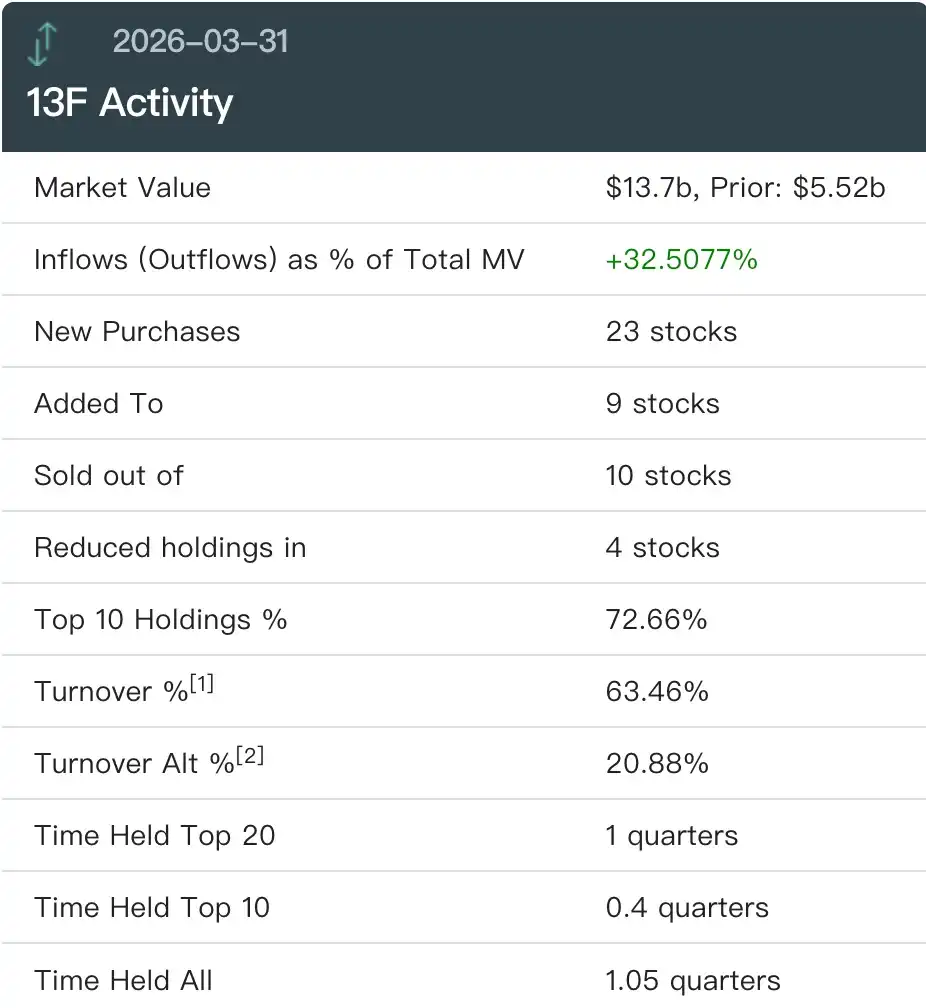
According to this latest 13F filing, as of March 31, 2026, the nominal total value of Situational Awareness LP's holdings has increased to $13.7 billion, more than doubling (up 148%) from $5.52 billion as of December 31 last year.

  • Odaily Note: It's important to note that in the statistical methodology of US stock 13F filings, the market value of option assets is typically shown as the "Notional Value" of the underlying stock, not the actual premium cost paid by the fund. This means that although the fund has built a semiconductor hedge wall with hundreds of billions in nominal asset value, its actual cash cost consumed (maximum potential loss) is much smaller, representing a typical high-leverage macro hedge.

Additionally, this quarter, net inflows accounted for 32.51% of the fund's total holdings value. This indicates the fund's explosive growth isn't solely due to portfolio appreciation but also includes very substantial external new capital subscriptions (i.e., new capital injection).

Frenetic Portfolio Adjustment

The filing also shows that Situational Awareness LP executed drastic portfolio adjustments in Q1.

  • New Purchases: 23 stocks (including options);
  • Added To: 9 stocks;
  • Sold Out Of: 10 stocks (including options);
  • Reduced Holdings In: 4 stocks (including options).

New Purchases: Sixty Percent of Portfolio Hedging Semiconductor Downturn

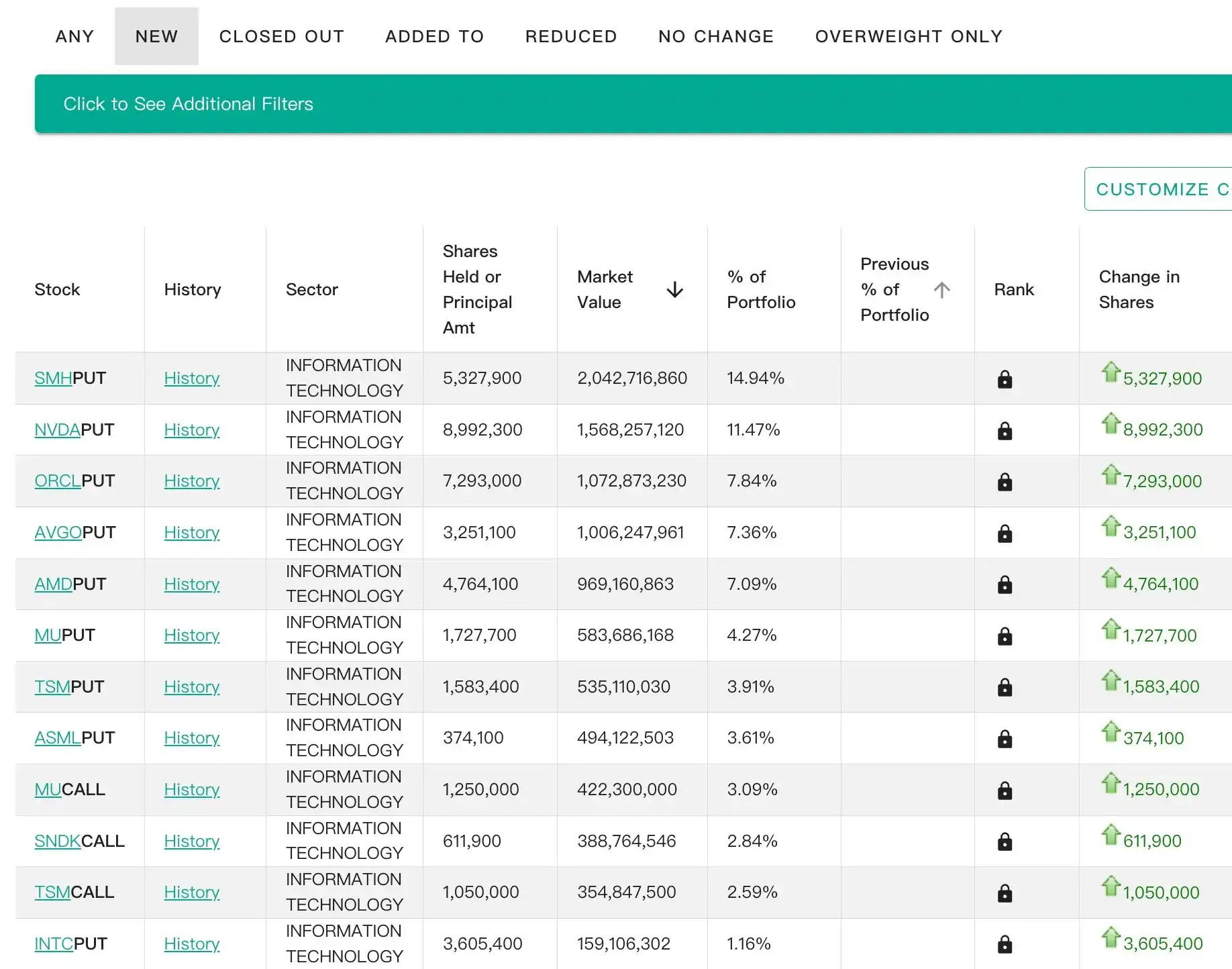
  • Odaily Note: The chart above only covers new stock purchases valued over $100 million. For all 23 new stock purchases, click the "portal" to view.

First, let's look at the new purchase activity, which is the most shocking piece of information in Situational Awareness LP's entire 13F report — in Q1, the fund conducted systematic risk hedging on the AI semiconductor and computing hardware sector through large-scale Put option positions.

Let's look at the data directly:

  • SMH PUT (VanEck Semiconductor Core ETF Put Option): 14.94% weighting (market value $2.04 billion) — Largest new position;
  • NVDA PUT (NVIDIA Put Option): 11.47% weighting (market value $1.56 billion) — Second largest new position;
  • ORCL PUT (Oracle Put Option): 7.84% weighting;
  • AVGO PUT (Broadcom Put Option): 7.36% weighting;
  • AMD PUT (AMD Put Option): 7.09% weighting;

Just the above top five Put option holdings account for 48.7% of Situational Awareness LP's $13.7 billion nominal total holdings value. Adding the subsequent Put options on Micron (MU), TSMC (TSM), ASML (ASML), and Intel (INTC), over 60% of the fund's nominal portfolio is betting on or hedging against a decline or severe volatility in core AI hardware stocks.

It's also noteworthy that Situational Awareness LP simultaneously bought both Call and Put options on the same stock. For example, while buying Micron Puts (MU PUT, 4.27%), it also bought MU CALLs (3.09%); while buying TSMC Puts (TSM PUT, 3.91%), it also bought TSM CALLs (2.59%).

This is a two-way bet strategy commonly used by hedge funds. It suggests the fund believes Micron (memory chips) and TSMC (foundry) may experience stock price movements far exceeding market expectations in upcoming 2026 earnings reports or industry cycles due to geopolitics or extreme supply-demand imbalances — significant one-way volatility large enough can generate profits on both sides.

Added To: Still Favors SanDisk, CRWV in Common Stock

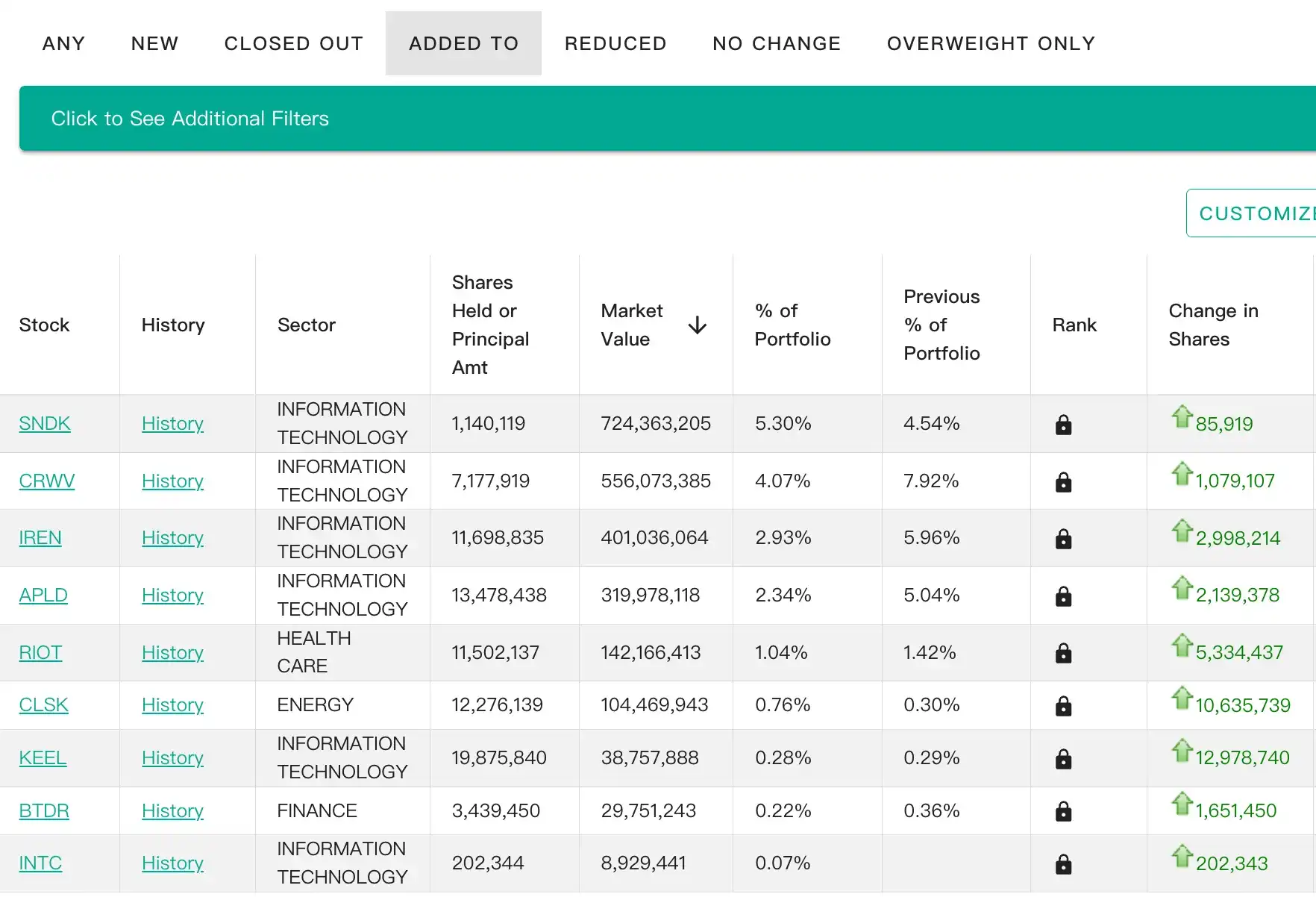
Regarding additions, Situational Awareness LP opted for common stock rather than options, increasing holdings in 9 stocks.

In Q1, Situational Awareness LP added a small amount of 85,000 shares of SanDisk (SNDK), bringing total holdings to 1.14 million shares, with a holding value as high as $724 million, accounting for 5.30% of the entire investment portfolio. This is one of the very few super-heavyweight positions in Situational Awareness LP's portfolio held entirely in common stock form.

Another noteworthy action is that Situational Awareness LP significantly increased its holdings by over 1.07 million shares of CoreWeave (CRWV) in Q1, pushing the holding value to $556 million, a 4.07% weighting. CoreWeave is one of the most closely watched AI GPU cloud service infrastructure companies currently, and an important partner in NVIDIA's ecosystem. After its IPO, Situational Awareness LP swiftly incorporated it into its core portfolio and aggressively increased its position. This indicates that while the fund is shorting NVIDIA's short-term valuation (via PUTs), it remains extremely bullish on cloud giants that directly convert GPUs into computing power for renting to various models.

Furthermore, Situational Awareness LP also added to positions in KEEL, IREN, APLD, RIOT, CLSK, BTDR, and other computing or power infrastructure companies, continuing the logic championed by Leopold Aschenbrenner that "electricity is the new oil."

Sold Out Of: Unwinding Intel Call Leverage, Exiting Optical Communications

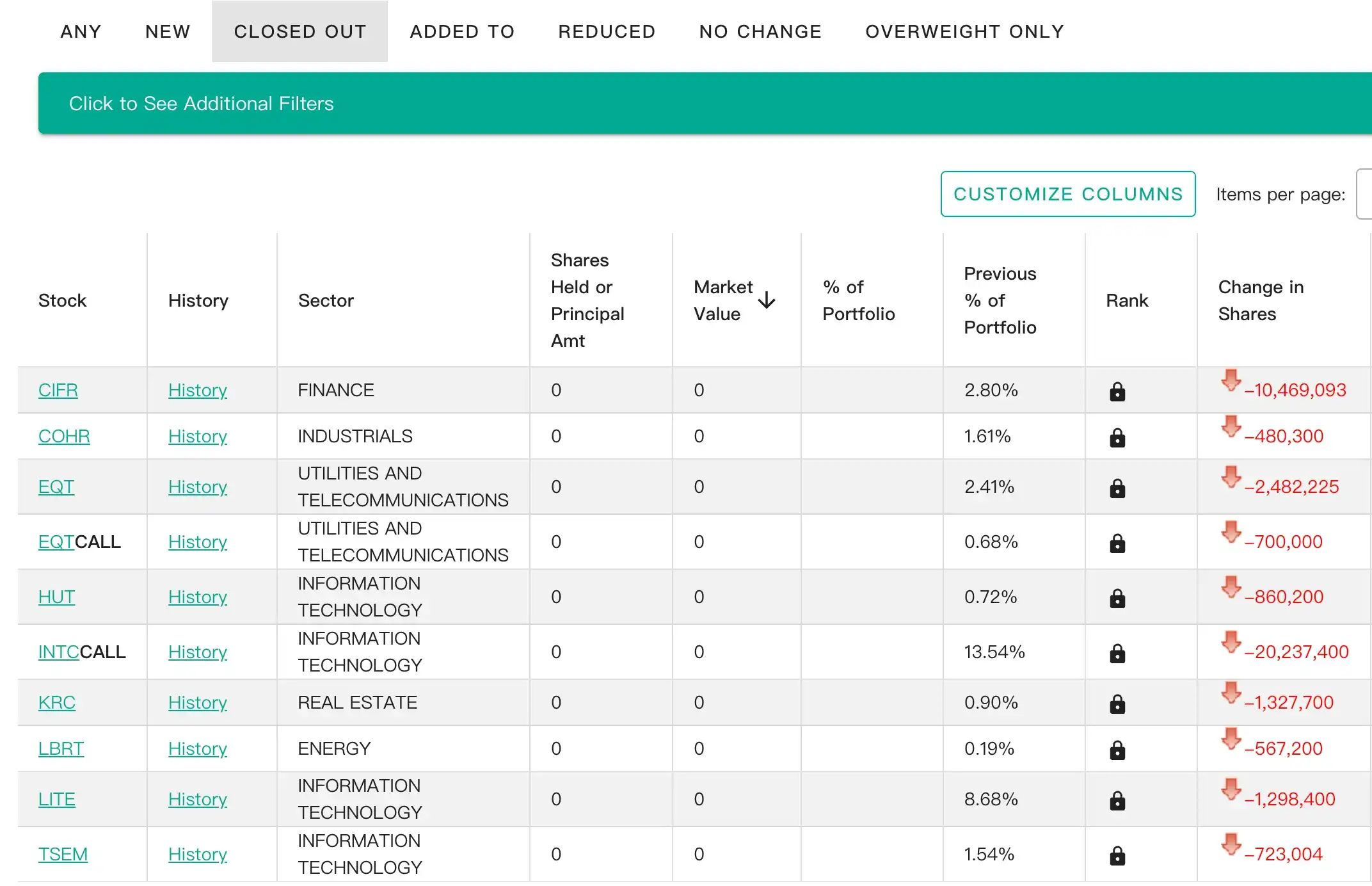
Regarding complete sell-offs, Situational Awareness LP's biggest move was completely unwinding its leverage from Intel Call options (INTC CALL). In the previous disclosure period, Situational Awareness LP had bet over 13% of its portfolio on Intel Call options (a staggering 20.23 million option contracts), a highly leveraged directional bet. This quarter, it completely sold out, shifting to holding a small common stock position (0.07% weighting).

Additionally, Situational Awareness LP completely exited LITE (8.68% weighting last period) and COHR (1.61% weighting last quarter) in Q1. LITE and COHR are both global top-tier optical communication chip and optical module (Optical Transceivers) giants. This exit indicates Situational Awareness LP is withdrawing from the AI optical module/network hardware sector.

Situational Awareness LP also sold out of CIFR (2.80% weighting last period) and HUT (0.72% weighting last period) in Q1. Both are cryptocurrency mining companies (including CORZ, which was reduced in the next section). Considering the additions to similar companies like RIOT, CLSK, BTDR, this is likely routine portfolio adjustment.

Reduced Holdings: Substantial Profit-Taking on BE

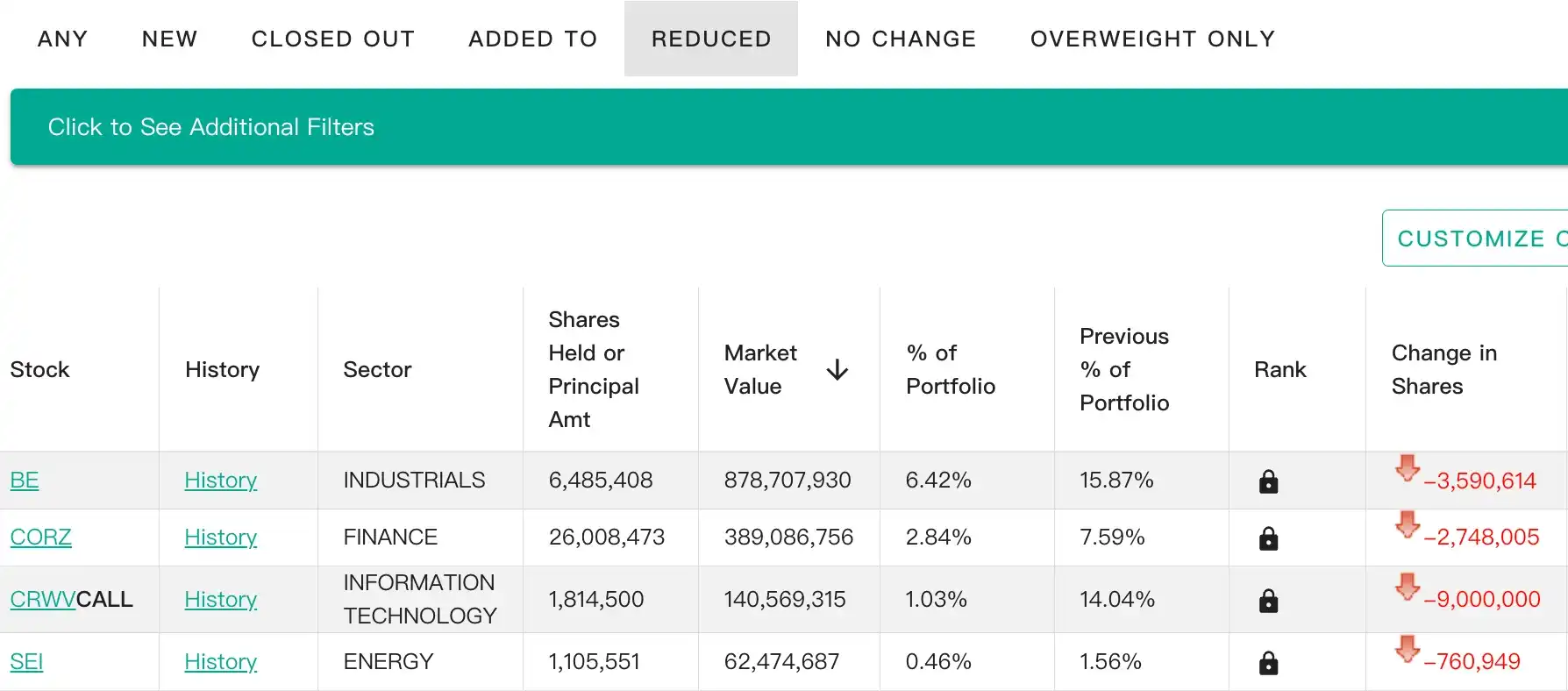
Finally, looking at the reductions, Bloom Energy (BE) was the largest holding disclosed in Situational Awareness LP's previous 13F filing. In Q1, the fund reduced its position by 3.59 million shares, causing its weighting to plummet from 15.87% last quarter to 6.42%.

Bloom Energy focuses on solid oxide fuel cell technology and is a core target for data center "on-site power" that bypasses traditional grids. Considering the remaining position is still significant, the reduction likely doesn't mean Situational Awareness LP is no longer bullish on the company, but more likely routine profit-taking.

CoreWeave Call options (CRWV CALL) were Situational Awareness LP's second-largest reduction (weighting plummeted from 14.04% to 1.03%). As mentioned earlier, the fund has shifted to holding CRWV in common stock form, so this is more about reducing leverage.

Situational Awareness LP also reduced its holdings in Core Scientific (CORZ) by 2.74 million shares, lowering its weighting from 7.59% to 2.84%. CORZ is a leading Bitcoin miner transitioning to AI computing power hosting. However, considering Situational Awareness LP added other miners still in transition with potentially more attractive valuations this quarter, reducing CORZ seems more like partial profit-taking.

What Is the 'AI Stock God' Really Thinking?

If looking only at the surface data of this 13F, many might draw a simple, crude conclusion — Leopold Aschenbrenner, who once proclaimed "AGI by 2027," has turned bearish on AI.

But the reality is clearly not that simple. In Situational Awareness LP's portfolio structure, there are actually two seemingly contradictory, yet highly unified, main themes.

  • On one side, there is extreme vigilance towards short-term valuation bubbles in the 'chip sector.' Situational Awareness LP has used Put option positions of staggering nominal size to essentially "buy crash insurance" for almost the entire AI semiconductor industry chain, including NVIDIA and Broadcom;
  • On the other side, there is a near-fanatical optimism about long-term AI infrastructure demand. Whether it's CoreWeave, Bloom Energy, or a series of power, transformer, and data center-related companies, they all essentially point to the same deterministic logic — AI's computing power war has entered the deep end.

This is perhaps Situational Awareness LP's core judgment at present. What will truly be scarce in the future may not be GPU chips themselves, but the energy, power systems, and data center infrastructure supporting these GPUs' continuous operation. GPU production can keep expanding, and advanced processes will eventually ramp up, but megawatt-level power supply capacity, transformers, transmission systems, and large-scale data center construction cycles are difficult to replicate simultaneously in a short time. Compared to the 'selling picks and shovels' logic already fully priced by the market, Leopold Aschenbrenner seems more focused on where the real bottlenecks might emerge in the next phase of the AI industry.

This also explains why Situational Awareness LP is simultaneously buying massive semiconductor Put options to hedge against severe volatility risks in the AI hardware sector, while continuing to heavily invest in GPU cloud services, power, and computing infrastructure assets.

In a sense, this 13F is less a simple holdings disclosure and more like Leopold Aschenbrenner's roadmap judgment for the next phase of evolution in the AI industry chain.

When a genius investor who rose to fame rapidly by All-in on AI starts deploying billions in nominal positions to buy insurance for the AI sector, it at least indicates one thing — even the most steadfast AI bulls of this era have begun to take volatility seriously.

Связанные с этим вопросы

QAccording to the article, what is the most significant new position taken by Situational Awareness LP in Q1 2026, and what does it represent?

AThe most significant new position is a $2.04 billion notional value in SMH (VanEck Semiconductor ETF) put options, accounting for 14.94% of the fund's portfolio. It represents a large-scale hedge against a potential downturn or high volatility in the AI semiconductor and hardware sector.

QWhy did Situational Awareness LP simultaneously buy both call and put options for stocks like Micron (MU) and TSMC (TSM)?

AThe fund used a dual-option strategy (straddle/strangle) for these stocks, indicating a belief that their prices could experience extreme volatility in either direction due to factors like geopolitical tensions or severe supply-demand imbalances. This strategy profits if the stock price makes a large move up or down, regardless of the direction.

QWhat is the apparent contradiction in Situational Awareness LP's investment strategy as described in the article, and how is it explained?

AThe apparent contradiction is the fund's massive bearish bets (put options) on AI semiconductor stocks alongside substantial bullish investments in AI infrastructure companies like CoreWeave and Bloom Energy. This is explained by the fund's core thesis: it is hedging against short-term valuation bubbles in the 'chip makers' while remaining bullish on the long-term, structurally scarce necessities for AI—specifically, the energy, power, and data center infrastructure needed to run the chips.

QWhat major sector did Situational Awareness LP exit in Q1 2026, as indicated by its sell-outs?

AThe fund exited the AI optical modules/network hardware sector by completely selling out its positions in LITE and COHR, which are leading companies in optical communication chips and transceivers.

QWhat was the primary reason suggested for the fund's large reduction in its Bloom Energy (BE) position?

AThe primary reason suggested for the large reduction in the Bloom Energy position was likely routine profit-taking. The fund still maintains a significant holding (6.42%), indicating it likely remains positive on the company's long-term prospects related to on-site power generation for data centers.

Похожее

SpaceX, OpenAI, Anthropic: The Three AI Giants Racing for IPO, Which One Is Worth Betting On?

SpaceX, OpenAI, and Anthropic are poised for historic IPOs within weeks, potentially raising a combined $180 billion—a sum exceeding the entire internet bubble's fundraising. The hosts of the Limitless Podcast argue this isn't just individual company financing but an unprecedented capital concentration for AI infrastructure, driven by an insatiable need for compute, data centers, power, and chips. SpaceX's IPO is notable for reportedly changing market index rules to allow faster inclusion, potentially funneling trillions in passive retirement funds into its stock, despite its unproven space-based data center business model. In contrast, Anthropic demonstrates explosive growth, with ARR reportedly hitting $45 billion and approaching profitability, fueled by strong enterprise adoption of products like Claude Code. Google's separate $80 billion raise highlights the immense capital pressure, even for giants. The discussion acknowledges bubble risks but leans optimistic. The hosts contend the massive spending is building essential physical infrastructure for the next technological era. A key bottleneck isn't capital but the real-world limits of chip manufacturing and construction speed. As long as demand for AI compute outstrips supply, this investment cycle represents a foundational build-out rather than a purely financial bubble. All three companies are seen as foundational bets on the future, with Anthropic often cited as the most immediately compelling due to its proven revenue trajectory.

marsbit38 мин. назад

SpaceX, OpenAI, Anthropic: The Three AI Giants Racing for IPO, Which One Is Worth Betting On?

marsbit38 мин. назад

From 'Old Guys' to 'New Favorites': How AI Is Revaluing Old Infrastructure from Dell to Nokia?

From "Vintage Tech" to "New AI Darlings": How AI Revalues Old Infrastructure One year ago, tech giants like Dell, Nokia, Cisco, and Western Data were seen as slow-growth, low-valuation stories, far from the AI spotlight dominated by players like Nvidia. Now, these legacy tech stocks are gaining market attention, sparking debate on whether this is genuine industry revaluation or a temporary narrative. As AI moves from model parameters to real-world data centers, the market is recognizing companies with proven delivery and infrastructure capabilities. This shift marks a change in the AI investment thesis: from pure model and GPU focus to the complex systems engineering required for deployment. Companies like Dell, HPE, and Corning are being revalued not for being "sexy" AI innovators, but for their decades of accumulated expertise in supply chains, enterprise delivery, and infrastructure—assets that have become critical in the AI buildout phase. The revaluation is unfolding across three key infrastructure lines: 1. **Servers & System Integration:** Dell and HPE are emerging as crucial system integrators or "general contractors" for AI data centers, translating GPU orders into complete, deployable server racks integrated with power, cooling, and networking. 2. **Networking & Connectivity:** AI's scale demands robust high-speed connections. Corning (fiber optics), Nokia (AI-RAN, 6G), and Cisco (data center switches) are gaining importance for enabling efficient data transfer within and between AI clusters. 3. **Storage:** Beyond high-speed memory (HBM/DRAM), the AI data explosion is driving demand for high-capacity hard drives (HDDs) from companies like Western Digital and Seagate to handle training data, logs, and cold storage cost-effectively. For this revaluation to be substantive and not just a narrative, three criteria are key: 1) Concrete AI-related order and revenue growth (e.g., Dell's AI server sales), 2) Upward revisions to company financial guidance, and 3) Sustainable improvements in profit quality, not just top-line revenue spikes. In essence, AI's transition to a real construction phase is re-pricing "old assets" against "new demand." The opportunity, however, is selective. Only those legacy firms that are demonstrably integrated into the capital expenditure chains of data center and enterprise AI deployment are likely to experience a true "logic re-rating" rather than just a temporary valuation bounce.

marsbit44 мин. назад

From 'Old Guys' to 'New Favorites': How AI Is Revaluing Old Infrastructure from Dell to Nokia?

marsbit44 мин. назад

The Merger of Codex and ChatGPT Marks the Beginning of a Major Reshuffle in Programming Tools

OpenAI is shifting its strategic focus from ChatGPT to Codex, merging them along with the browser tool Atlas into a unified desktop super-app. This move signals an internal belief that Codex, originally a programming tool, represents the next evolution of AI more than conversational models like ChatGPT. Over the past year, Codex's weekly active users have surged past 5 million. The key distinction is that while ChatGPT answers questions, Codex executes tasks. Enterprises increasingly value this ability to get work done over simply receiving advice. Consequently, Codex is attracting professionals beyond developers, including analysts, bankers, marketers, and product managers. OpenAI's reorganization and increased investment in Codex stem from recognizing that the future of AI competition lies in execution capabilities, not just conversation. The company is launching role-specific plugins (e.g., for data analysis, sales, design) to transform Codex into a broad knowledge work platform that automates and redefines white-collar workflows. Beyond being a tool, Codex reflects OpenAI's ambition to redefine software. New features like "Sites"—which generates interactive websites from documents—and collaborative "Annotations" aim to create a paradigm where the AI understands the goal and handles the tools and steps, functioning more like a digital colleague than traditional software. The ultimate goal is a unified experience where the user cares only about the completed task.

marsbit53 мин. назад

The Merger of Codex and ChatGPT Marks the Beginning of a Major Reshuffle in Programming Tools

marsbit53 мин. назад

Interpreting Investment Opportunities in the Age of Great Navigation, Invesco Great Wall Fund Releases '2026 Report on Chinese Enterprises Going Global'

Invesco Great Wall Fund has released its "2026 China Corporate Globalization Report," titled "The 'Great Navigation Era' of Chinese Enterprises." The report analyzes the new trends and investment opportunities as Chinese companies expand globally, moving from simple product exports to comprehensive overseas operations involving services, branding, and local production. Driven by factors like trade friction, the pursuit of higher profit margins abroad, and policy support, globalization is becoming essential for Chinese companies. The report outlines an evolution: from early product export ("Globalization 1.0") to the current "Globalization 2.0," characterized by overseas capacity, capital goods investment, consumer brand expansion, and service exports. Chinese firms' competitive advantages are highlighted, including a vast engineer talent pool, low-cost and robust infrastructure, and complete industrial clusters. Specific sectors with significant出海 potential are identified: * **Capital Goods** (e.g., engineering machinery, power equipment): Benefiting from global demand, especially in Belt & Road markets and the AI-driven power grid upgrade cycle. * **Consumer Brands**: Transitioning from cost to brand advantage, leveraging供应链 efficiency. * **Technology & Innovation**: Including AI applications, optical modules within global tech supply chains, and new energy vehicles focusing on local production. * **Pharmaceuticals**: Chinese biotech firms are becoming preferred partners for global pharma, with potential for breakthrough drugs in areas like oncology and weight loss. The report concludes that corporate globalization represents a sustained, core theme for China's capital markets, though companies must navigate challenges like geopolitics and localization.

marsbit1 ч. назад

Interpreting Investment Opportunities in the Age of Great Navigation, Invesco Great Wall Fund Releases '2026 Report on Chinese Enterprises Going Global'

marsbit1 ч. назад

Торговля

Спот
Фьючерсы

Популярные статьи

Неделя обучения по популярным токенам (2): 2026 может стать годом приложений реального времени, сектор AI продолжает оставаться в тренде

2025 год — год институциональных инвесторов, в будущем он будет доминировать в приложениях реального времени.

1.8k просмотров всегоОпубликовано 2025.12.16Обновлено 2025.12.16

Неделя обучения по популярным токенам (2): 2026 может стать годом приложений реального времени, сектор AI продолжает оставаться в тренде

Обсуждения

Добро пожаловать в Сообщество HTX. Здесь вы сможете быть в курсе последних новостей о развитии платформы и получить доступ к профессиональной аналитической информации о рынке. Мнения пользователей о цене на AI (AI) представлены ниже.

活动图片