A Less 'Hawkish' 'Hawkish Rate Cut' and Balance Sheet Expansion Buying Bonds That 'Is Not QE'

深潮Опубликовано 2025-12-11Обновлено 2025-12-11

Введение

The Federal Reserve cut interest rates by 25 basis points for the third consecutive time in 2024, lowering the target range to 3.50%-3.75%. The decision revealed the largest internal dissent in six years, with three officials opposing the move. The updated dot plot continues to project only one more rate cut in 2025, signaling a significant slowdown in the pace of easing. Chair Jerome Powell emphasized that the current policy stance allows the Fed to be patient and data-dependent, noting that no one is assuming the next move will be a hike. Simultaneously, the Fed announced it would begin purchasing short-term Treasury bills to maintain ample reserves in the banking system, with an initial $40 billion in purchases planned for the next month. Powell stressed that these operations are for reserve management purposes and do not represent a change in monetary policy stance. The economic projections were slightly revised, with upgrades to GDP growth and minor downgrades to inflation expectations. The labor market is showing signs of cooling, with the unemployment rate rising and job growth slowing.

Source: Wall Street Journal

The Federal Reserve cut interest rates again at the conventional pace as the market expected, but it exposed the largest divergence among voting policymakers in six years, signaling a slowdown in the pace of action next year and a potential pause in the near term. The Fed also, as expected by Wall Street, initiated reserve management operations, deciding to buy short-term Treasury bonds by year-end to address pressures in the money markets.

On Wednesday, December 10, Eastern Time, the Federal Reserve announced after its FOMC monetary policy meeting that the target range for the federal funds rate was lowered from 3.75%-4.00% to 3.50%-3.75%. This marks the third 25-basis-point rate cut this year, bringing the total reduction for the year to 75 basis points. Since September of last year, this easing cycle has cumulatively cut rates by 175 basis points.

It is worth noting that the Fed's interest rate decision faced three dissenting votes for the first time since 2019. Governor Milan, appointed by Trump, continued to advocate for a 50-basis-point cut, while two regional Fed presidents and four non-voting members supported holding rates steady. In effect, seven officials opposed the decision, reportedly the largest divergence in 37 years.

The dot plot released after the meeting showed that the interest rate path forecast by Fed policymakers remained consistent with the one published three months ago, still projecting one 25-basis-point rate cut next year. This implies that the pace of rate cuts next year will slow significantly compared to this year.

As of Tuesday's close, CME Group's FedWatch Tool showed that the futures market priced in an approximately 88% probability of a 25-basis-point cut this week, while the probability of at least another 25-basis-point cut did not reach 71% until next June. The probabilities for such a cut at the January, March, and April meetings next year all remained below 50%.

The predictions reflected by the CME tool can be summarized by the recently popular term "hawkish cut." It refers to the Fed cutting rates this time while simultaneously signaling a potential pause in action, with no further cuts in the near term.

Nick Timiraos, a veteran Fed reporter known as the "new Fed whisperer," stated bluntly after the meeting that the Fed "signaled it may pause on rate cuts for now" due to "rare" internal disagreements over whether to worry more about inflation or the job market.

Timiraos pointed out that three officials dissented from the 25-basis-point cut at this meeting, and the stalled decline in inflation and cooling labor market made this meeting the most divisive in recent years.

Powell emphasized at the post-meeting press conference that he did not believe "a rate hike at the next meeting" was anyone's base case. The current level of rates allows the Fed to be patient and observe how the economy evolves. He also stated that the available data so far does not indicate a change in the economic outlook, and the scale of Treasury purchases may remain high in the coming months.

01 Fed Cuts Rates by 25 Basis Points as Expected, Still Projects One Cut Next Year, Initiates RMP Buying $40B in Short-Term Bonds

On Wednesday, December 10, Eastern Time, the Federal Reserve announced after its FOMC monetary policy meeting that the target range for the federal funds rate was lowered from 3.75%-4.00% to 3.50%-3.75%. This marks the third consecutive FOMC meeting with a rate cut, each by 25 basis points, bringing the total reduction for the year to 75 basis points. Since September last year, this easing cycle has cumulatively cut rates by 175 basis points.

It is worth noting that the Fed's interest rate decision faced three dissenting votes for the first time since 2019. Trump-appointed Governor Milan continued to advocate for a 50-basis-point cut, while two regional Fed presidents and four non-voting members supported holding rates steady. In effect, seven officials opposed the decision, reportedly the largest divergence in 37 years.

A key change in this meeting's statement compared to the previous one was in the interest rate guidance. Although the decision was to cut rates, the statement no longer broadly said that, when considering further rate cuts, the FOMC would assess incoming data, the evolving outlook, and the balance of risks. Instead, it more explicitly referred to considering the "extent and timing" of future adjustments. The statement now reads:

"In considering the extent and timing of any adjustments to the target range for the federal funds rate, the Committee will carefully assess incoming data, the evolving outlook, and the balance of risks."

The meeting statement reiterated that inflation remains somewhat elevated and that the downside risks to employment have increased in recent months. It removed the phrase "remains low" regarding the unemployment rate, noting it had risen slightly to 4.4% as of September.

The addition of "extent and timing" regarding further rate cuts is seen as signaling a higher bar for future cuts.

Another important change in this meeting's statement compared to the last was the addition of a new paragraph specifically noting the intention to purchase short-term bonds to maintain ample reserve balances in the banking system. The statement wrote:

"The Committee views reserve balances as having declined to ample levels and will begin purchases of Treasury bills, as needed, to maintain ample reserve balances over time."

This amounts to announcing the start of so-called reserve management operations, rebuilding liquidity buffers in the money markets. Year-end often sees market disruptions as banks typically reduce activity in the repo market to support their balance sheets for regulatory and tax settlements.

The statement said reserves have declined to ample levels and, to maintain ample reserves, will begin buying short-term bills this Friday. The New York Fed plans to buy $40 billion in short-term bills over the next 30 days and expects Reserve Management Purchases (RMP) of short-term bills to remain high in the first quarter of next year.

The median projection of Fed officials' interest rate forecasts released after Wednesday's meeting showed that their expectations this time were exactly the same as the previous ones published in September.

Fed officials currently also project that, after three rate cuts this year, there will likely be one 25-basis-point cut each in the next two years.
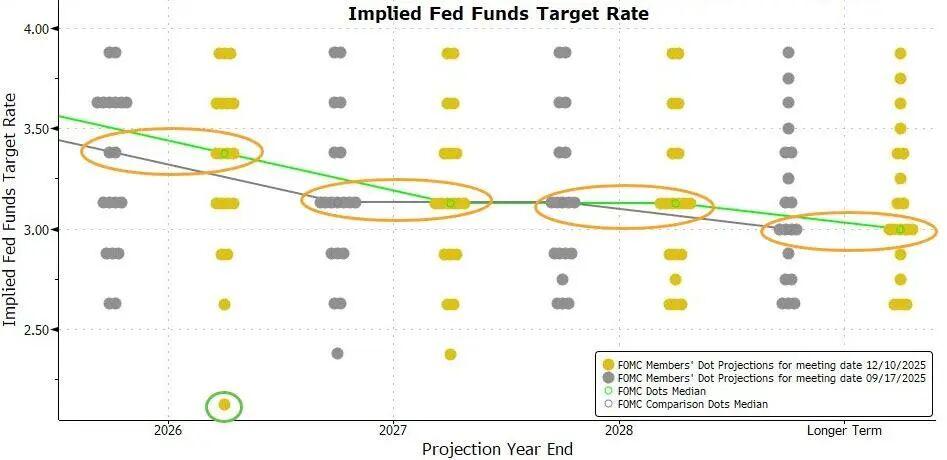
Many had expected that the dot plot reflecting future interest rate movements would show Fed policymakers leaning more hawkish. This dot plot did not show such a tendency; instead, it was slightly more dovish compared to the previous one.

Among the 19 Fed officials providing forecasts, seven now project the interest rate next year to be between 3.5% and 4.0%, compared to eight who projected this last time. This means that the number of officials expecting no rate cuts next year decreased by one.

The economic projections released after the meeting showed that Fed officials raised their GDP growth forecasts for this year and the subsequent three years, and slightly lowered the unemployment rate forecast for 2027, i.e., the year after next, by 0.1 percentage point, while leaving the forecasts for other years unchanged. This adjustment indicates that the Fed views the labor market as more resilient.

Simultaneously, Fed officials slightly lowered their forecasts for PCE inflation and core PCE inflation for this year and next year by 0.1 percentage point each. This reflects a slightly stronger confidence in inflation slowing over the coming period.

02 Powell: Current Rates Allow for Patience, Does Not Believe 'Next Move is a Hike' is Anyone's Base Case

With today's cut, the Fed has lowered the policy rate by a total of 75 basis points over the past three meetings. Powell said this will help gradually return inflation to 2% after the effects of tariffs fade.

He said the adjustments made to the policy stance since September have brought the policy rate into the range of various estimates of "neutral interest rates." The median projection of FOMC members shows the appropriate level for the federal funds rate at the end of 2026 is 3.4% and 3.1% at the end of 2027, unchanged from September.

Powell stated that currently, inflation risks are tilted to the upside, while employment risks are tilted to the downside, presenting a challenging situation.

A reasonable baseline is that the impact of tariffs on inflation will be relatively short-lived, essentially a one-time shift in the price level. Our job is to ensure this one-time price increase does not evolve into a persistent inflation problem. But at the same time, downside risks to employment have increased in recent months, and the overall balance of risks has changed. Our policy framework requires balance between the two aspects of our dual mandate. Therefore, we believe a 25-basis-point cut at this meeting was appropriate.

Given the stalled progress in bringing inflation down, Fed officials had hinted before this week's decision that further cuts might require evidence of labor market weakness. Powell said at the press conference:

"Where we are right now allows us to be patient and watch how the economy evolves."

In the Q&A session, regarding the question of whether the next policy adjustment is necessarily downward now that rates are closer to neutral, or if policy risks have truly turned two-way, Powell responded that no one has rate hikes as their base case currently, and he hasn't heard such views. There are differing views within the Committee: some members believe the current policy stance is appropriate and advocate maintaining the status quo for further observation; others believe another cut may be needed this year or next, perhaps even more than one.

When members write down their judgments on the policy path and appropriate interest rate levels, expectations are mainly concentrated on a few scenarios: either maintaining the current level, implementing a small cut, or a slightly larger cut. Powell emphasized that the current mainstream expectations do not include a rate hike scenario.

Powell stated that as a separate decision, the Fed also decided to initiate purchases of short-term U.S. Treasury bills, with the sole purpose of maintaining ample reserve supplies over time, thereby ensuring the Fed can control the policy rate effectively. He stressed that these issues are separate from the monetary policy stance itself and do not represent a change in policy orientation.

He said the scale of short-term bill purchases may remain high in the coming months, and the Fed isn't strictly "worried" about money market tensions, just that this situation came a bit sooner than expected.

Powell also stated that, according to the New York Fed's announcement, the initial scale of asset purchases will reach $40 billion in the first month and may remain high in the following months to alleviate anticipated short-term money market pressures. Afterwards, the scale of purchases is expected to decline, with the specific pace depending on market conditions.

Regarding the labor market, Powell said that although official October and November employment data are not yet available, existing evidence suggests that both layoffs and hiring remain at low levels. Simultaneously, households' perceptions of job availability and businesses' sense of hiring difficulty continue to decline. The unemployment rate continues to rise slightly, reaching 4.4%, and employment growth has slowed noticeably compared to earlier this year. The Fed also removed the phrase "the unemployment rate has remained low" from the statement.

Powell said in the subsequent Q&A that after adjusting for overestimation in the employment data, job growth may have turned slightly negative since April.


Связанные с этим вопросы

QWhat was the outcome of the December 10th FOMC meeting regarding the federal funds rate?

AThe Federal Reserve lowered the target range for the federal funds rate from 3.75%-4.00% to 3.50%-3.75%, marking the third 25 basis point cut of the year.

QWhat does the term 'hawkish cut' refer to in the context of this article?

AA 'hawkish cut' refers to the Fed's decision to cut interest rates while simultaneously signaling that it may pause and not cut rates again in the near future.

QWhat new policy did the Fed announce alongside the rate cut to address money market pressures?

AThe Fed announced it would begin purchasing short-term Treasury bills to maintain an ample supply of reserves in the banking system, starting with a plan to buy $40 billion over the next 30 days.

QAccording to the dot plot, how many rate cuts do Fed officials project for the year 2025?

AFed officials' median projection, as shown in the dot plot, indicates one 25 basis point rate cut for the year 2025.

QWhat was Chairman Powell's stance on the possibility of the next policy move being a rate increase?

AChairman Powell stated that he does not believe a rate hike is anyone's base case assumption for the next policy move and that the mainstream expectations were for either holding rates steady or for small cuts.

Похожее

Ten-Thousand-Word Analysis: From $10 to $290, MRVL Wins the Entire AI Era by 'Not Making GPUs'

Marvell Technology's stock price surged from under $10 in 2016 to a record $290 in June 2026, fueled not by making GPUs, but by dominating AI infrastructure connectivity. This analysis argues the market misvalues MRVL as merely a smaller Broadcom in custom AI chips, overlooking its true, unique position. Marvell's core strength lies in enabling high-speed data flow for AI clusters through three interconnected businesses. First, it holds a commanding ~70% market share in high-speed optical DSPs (essential for data center light modules), a deep-moat business with accelerating growth. Second, its custom AI chip design business serves hyperscalers like AWS, Microsoft, and Google, with a significant revenue pipeline despite lower margins. Third, stable cash flows come from Ethernet switch chips and enterprise storage controllers. Together, they form a full-stack "AI data movement" platform. CEO Matt Murphy's transformative leadership since 2016, involving strategic divestments, key acquisitions (like Inphi for optical DSPs), and securing long-term agreements with major cloud providers, repositioned the company. A pivotal $2 billion strategic investment from NVIDIA in 2026 underscored Marvell's critical role in the AI ecosystem, particularly through collaborations like NVLink Fusion. While Marvell faces risks—including client concentration (losing the Amazon Trainium3 design), lower-margin business mix, competitive threats, insider selling, and complex supply chains—its fundamentals remain strong. The optical interconnect moat is widening with the acquisition of Celestial AI (photonics fabric), and financial metrics show accelerating revenue growth and operating leverage. With a PEG ratio suggesting undervaluation relative to its growth, the thesis is that the market undervalues Marvell's monopolistic position in AI "plumbing" while overemphasizing its competitive custom chip segment. The story transcends investing, symbolizing how in any complex system—from the internet to AI—the value of "connection" ultimately surpasses that of individual "nodes."

marsbit16 мин. назад

Ten-Thousand-Word Analysis: From $10 to $290, MRVL Wins the Entire AI Era by 'Not Making GPUs'

marsbit16 мин. назад

AI Relay Stations Spark Heated Debate on Zhihu: Behind Cheap Tokens, What Are Users Really Worried About?

A discussion on Zhihu about "AI relay stations" shifted the niche developer topic of "cheap tokens" into broader user awareness. Users moved beyond simply questioning the legitimacy of these services to focus on practical concerns: Where do cheap tokens truly come from? Is the model being accessed the real one? Can relay stations see prompts, code, and API keys? For occasional users, are the risks worth it? The core debate centered less on price and more on trust. A primary worry is model authenticity—the risk of "model swapping," where users paying for a premium model might be routed to a cheaper one, creating an information asymmetry. Others argued that cost comparisons matter; while cheaper than official pay-as-you-go APIs, relay stations may not be the lowest-cost option versus subscriptions, domestic models, or free tiers, making user needs assessment crucial. Speculation about token sources ranged from legitimate bulk discounts to gray-area methods like account sharing or exploiting regional pricing. This opacity makes risk assessment difficult for users. Data security emerged as a critical concern, especially for enterprise use. When processing sensitive information like code, contracts, or client data, the inability to verify a relay station's data handling, retention, or access policies poses significant compliance and confidentiality risks. The evolving consensus suggests relay stations can be used cautiously for low-sensitivity, disposable tasks (e.g., summarizing public info, simple translation). However, they should not be the default for sensitive, professional, or production workflows involving proprietary data, Agents, or automated systems. Recommendations include avoiding large prepayments, not relying on a single service, using test prompts to monitor quality, anonymizing data where possible, and keeping official channels as backups. Ultimately, the discussion framed tokens not just as a billing unit but as a measure of real cost encompassing price, model integrity, data security, and service stability. The popularity of relay stations highlights user demand for affordable access, but the debate underscores a key trade-off: the savings from cheap tokens may come at the price of trust, transparency, and control over one's data and AI experience.

marsbit46 мин. назад

AI Relay Stations Spark Heated Debate on Zhihu: Behind Cheap Tokens, What Are Users Really Worried About?

marsbit46 мин. назад

In-Depth Research Report on TradFi: The Convergence Wave of Crypto and Traditional Finance

In 2026, the crypto industry is undergoing a profound infrastructure-level transformation—TradFi assets are migrating on-chain at an unprecedented pace. According to CoinGecko's Q1 2026 report, the total value locked (TVL) of tokenized real-world assets (RWA) has surpassed $31 billion, a nearly 4x increase from $7.8 billion at the beginning of 2025, with the sector’s aggregate market capitalization reaching $19.3 billion. Among these, the market cap of tokenized stocks surged from $2 million to $486 million, with Q1 spot trading volume reaching $15.1 billion—a single quarter already surpassing the entire second half of 2025. RWA perpetual contract Q1 trading volume reached a staggering $524.8 billion, far exceeding the $313 billion for all of 2025. Meanwhile, BlackRock's BUIDL fund has reached $2.3 billion in scale and has filed for two new tokenized funds, signaling that the world's largest asset manager's tokenization strategy is evolving from pilot to product suite expansion. HTX, as a core participant in the crypto exchange sector, officially launched TradFi perpetual futures products including NVDA, AAPL, MSFT, META, and SPY in 2026, enabling crypto users to gain 24/7 trading access to core U.S. equities. Boston Consulting Group predicts that global tokenized asset scale could reach $16 trillion by 2030, while McKinsey offers a conservative estimate of approximately $2 trillion. The on-chain migration of TradFi assets is no longer a "future narrative" but a structural transformation unfolding in real time, as crypto exchanges evolve from single crypto asset trading platforms toward "multi-asset-class trading infrastructure."

HTX Learn49 мин. назад

In-Depth Research Report on TradFi: The Convergence Wave of Crypto and Traditional Finance

HTX Learn49 мин. назад

Торговля

Спот
Фьючерсы

Популярные статьи

Что такое ZEST

I. Введение в проект1. Что такое Zest Protocol?Zest Protocol — это кредитный протокол, основанный на Bitcoin, построенный на Stacks Layer 2, который позволяет пользователям зарабатывать доход с помощью BTC или занимать активы, закладывая BTC. Умные контракты протокола написаны на языке Clarity, полностью работают в цепочке и являются открытым исходным кодом, с дизайном, вдохновленным Aave v3. Zest в настоящее время является крупнейшим DeFi-протоколом на Stacks, с более чем 800 BTC, внесенными в депозит, и пиковым TVL, превышающим 100 миллионов долларов. В мае 2026 года протокол дополнительно представил Bitcoin Collateral Vaults, расширив кредитные возможности с Stacks на основную сеть Bitcoin. Это позволяет пользователям занимать стейблкоины, не перемещая BTC с сети Bitcoin, что обеспечивает кредитование с самоуправлением.2. Как работает Zest Protocol?Zest Protocol состоит из двух рынков. Рынок Stacks построен на Aave v3, позволяя пользователям вносить такие активы, как sBTC, STX и USDC, чтобы зарабатывать доход или брать кредиты с избыточным обеспечением. Максимальное LTV по умолчанию составляет 50% (70% для sBTC). Рынок Bitcoin работает через недавно запущенные Bitcoin Collateral Vaults. Пользователи занимают стейблкоины, блокируя BTC в самоуправляемых хранилищах на цепочке Bitcoin. Обеспечение остается на основной сети Bitcoin на протяжении всего процесса, и пользователи сохраняют право собственности, если позиция не ликвидирована.3. Кто основал Zest Protocol?Tycho Onnasch (Соучредитель): Выпускник Оксфордского университета. Участвовал в исследованиях и грантах для Фонда открытого интернета Stacks. Бывший менеджер в Trust Machines и основатель Deedmob. Профиль LinkedIn: https://www.linkedin.com/in/tychokoonnasch/.Fernando Foy (Соучредитель): Ранее работал в IT-консалтинге в Objectif Emploi. Профиль LinkedIn: https://www.linkedin.com/in/fernando-foy/.Emil E. (Соучредитель): Имеет степень магистра физики из Университета Уорика. Бывший инженерный партнер в Trust Machines, Full-Stack разработчик для проектов Web3 и дата-ученый в HSBC. Профиль LinkedIn: https://www.linkedin.com/in/emil-e-49771a145/.Детали финансирования: В мае 2024 года Zest Protocol объявил о завершении раунда начального финансирования в размере 3,5 миллиона долларов, возглавляемого Тимом Дрейпером, с участием Binance Labs, Flow Traders, Trust Machines и других.4. Токеномика $ZEST$ZEST — это нативный токен Zest Protocol с фиксированным общим предложением в 1 миллиард токенов и без инфляционного механизма.Сообщество (27,83%): Используется для аирдропов и стимулов для пользователей;Развитие экосистемы (24,82%): Используется для ликвидности, партнерств, маркетинга, листинга на биржах и т. д.;Инвесторы (22,35%): Поддержка инвестиционных сторон, которые поддержали раннее развитие Zest Protocol;Команда (25%): Выделено для основных участников.График вестинга: Токены команды и инвесторов подлежат 1-летнему периоду блокировки, за которым следует 3 года линейного разблокирования.5. Хронология ключевых этапов2022: Официальное основание Zest Protocol.Март 2024: Завершен аудит безопасности и запущен рынок кредитования Stacks на основной сети.В феврале 2026 года запускается Stacks Market V2, вводящий группы риска.В мае 2026 года были представлены Bitcoin Collateral Vaults, и теперь доступен рабочий прототип основной сети. Это позволяет пользователям использовать самоуправляемый BTC на Bitcoin L1 в качестве обеспечения для займа стейблкоинов на EVM-цепочках, заканчивая мосты, обертки и стороннее хранение. Этот запуск разделен на два этапа. Этап 1: Использует заранее подписанные транзакции для ограничения движения BTC; Этап 2: Использует BitVM для проверки. II. Информация о токенеНазвание токена: ZEST (Zest Protocol)III. Связанные ссылкиВебсайт: https://www.zestprotocol.com/Эксплореры: https://bscscan.com/token/0x5506599c722389a60580b5213ea1da60d64754a1Твиттер: https://twitter.com/ZestProtocolПримечание: Введение в проект основано на материалах, опубликованных или предоставленных официальной командой проекта, и предназначено только для справки и не является инвестиционным советом. HTX не несет ответственности за любые прямые или косвенные убытки, возникшие в результате.

245 просмотров всегоОпубликовано 2026.05.19Обновлено 2026.06.02

Что такое ZEST

Как купить ZEST

Добро пожаловать на HTX.com! Мы сделали приобретение Zest Protocol (ZEST) простым и удобным. Следуйте нашему пошаговому руководству и отправляйтесь в свое крипто-путешествие.Шаг 1: Создайте аккаунт на HTXИспользуйте свой адрес электронной почты или номер телефона, чтобы зарегистрироваться и бесплатно создать аккаунт на HTX. Пройдите удобную регистрацию и откройте для себя весь функционал.Создать аккаунтШаг 2: Перейдите в Купить криптовалюту и выберите свой способ оплатыКредитная/Дебетовая Карта: Используйте свою карту Visa или Mastercard для мгновенной покупки Zest Protocol (ZEST).Баланс: Используйте средства с баланса вашего аккаунта HTX для простой торговли.Третьи Лица: Мы добавили популярные способы оплаты, такие как Google Pay и Apple Pay, для повышения удобства.P2P: Торгуйте напрямую с другими пользователями на HTX.Внебиржевая Торговля (OTC): Мы предлагаем индивидуальные услуги и конкурентоспособные обменные курсы для трейдеров.Шаг 3: Хранение Zest Protocol (ZEST)После приобретения вами Zest Protocol (ZEST) храните их в своем аккаунте на HTX. В качестве альтернативы вы можете отправить их куда-либо с помощью перевода в блокчейне или использовать для торговли с другими криптовалютами.Шаг 4: Торговля Zest Protocol (ZEST)С легкостью торгуйте Zest Protocol (ZEST) на спотовом рынке HTX. Просто зайдите в свой аккаунт, выберите торговую пару, совершайте сделки и следите за ними в режиме реального времени. Мы предлагаем удобный интерфейс как для начинающих, так и для опытных трейдеров.

240 просмотров всегоОпубликовано 2026.05.19Обновлено 2026.06.02

Как купить ZEST

Обсуждения

Добро пожаловать в Сообщество HTX. Здесь вы сможете быть в курсе последних новостей о развитии платформы и получить доступ к профессиональной аналитической информации о рынке. Мнения пользователей о цене на A (A) представлены ниже.

活动图片