A Company 'Destined to Be Killed' – How Did Its Returns Outperform Solana, the S&P, and Nasdaq?

marsbitОпубликовано 2026-03-30Обновлено 2026-03-30

Введение

The article argues that the biggest beneficiaries of stablecoin technology are not the startups building it, but established companies with existing distribution channels. The author uses Western Union (WU) as a prime example. Initially believing stablecoins would disrupt WU's business, the author instead found a valuable, cash-generating company whose stock was priced for imminent failure (trading at a P/E of 3-6x). The market had given WU zero credit for its powerful, trusted brand and massive global distribution network. The core "Inversion" thesis is that the market structurally overvalues tech innovators and undervalues old-economy companies, pricing their potential adoption of new technology at zero. This creates a significant margin of safety and asymmetric upside. The author's bet on WU over Solana paid off, as WU's management began embracing stablecoins, launching USDPT on Solana to reduce costs. The author contends that mature companies with distribution are best positioned to capture the efficiency gains from technologies like stablecoins and AI, leveraging their existing customer trust and reach to expand margins while startups commoditize the infrastructure.

Author: Santiago Roel Santos

Compiled by: Deep Tide TechFlow

Deep Tide's Introduction: The core argument of this article is a counterintuitive judgment: the biggest beneficiaries of stablecoins are not the startups building them, but the established institutions that own the distribution channels.

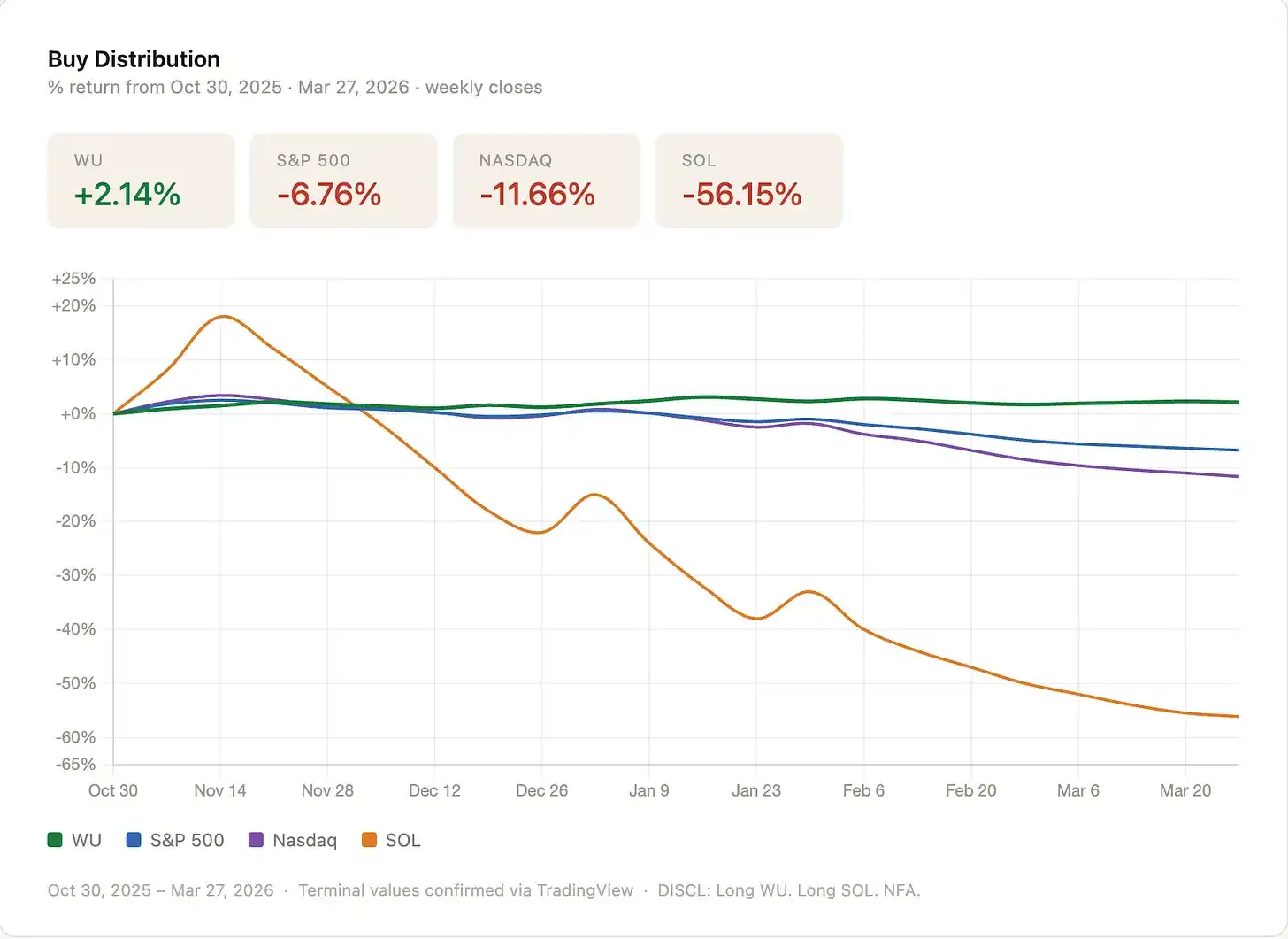
The author bet in November 2025 that Western Union would outperform Solana, and it paid off, also incidentally outperforming the S&P and Nasdaq.

What's worth reading is not just the conclusion, but the framework he uses to find opportunities: "the disruption narrative depresses valuations, distribution channels are priced at zero."

Full text as follows:

I started researching Western Union because I thought stablecoins would disrupt its business. Why pay WU fees when you can use stablecoins to send money anywhere in the world at extremely low cost? Later I realized: WU's business is much stronger than this framework suggests, and it is better positioned than almost anyone to embrace stablecoins itself. It has the brand and the distribution channels. The key risk is whether management will act.

They hadn't acted before. Until recently, they were dismissive. When I placed my bet in November 2025, I was willing to bet that they would eventually act, or someone would force them to act. I'm not an activist investor, but I felt the pressure building.

This week I also spoke at the Digital Asset Summit, and WU's CEO was on stage. I saw a completely different CEO, one who clearly articulated how stablecoins will compress the cost of global money movement.

I took on the risk of this happening, but I liked my odds. At the time, WU's P/E ratio was 3x, and it was experiencing declining growth. Many companies trade at these valuation levels and then go bankrupt. Betting on troubled companies is tempting; some will transform, some will go to zero.

What I saw in WU, and still see, is the distribution channel. A market leader with a brand, trust, and deep insight into consumer behavior—understanding both consumer resistance to new financial primitives like stablecoins and their reliance on the familiar. People will always pay for convenience. They trust WU. It's embedded in small grocery stores, convenience stores, and retail service points where less tech-savvy consumers withdraw cash. This won't disappear overnight.

I've read *The Innovator's Dilemma*, and I've invested in the very technology that claims to replace WU. But I've come to recognize that distribution channels are incredibly hard to build, and trust is even harder—especially in financial services.

All this is to say: Since I bet on WU to outperform Solana, it has indeed outperformed, and by a significant margin, also incidentally beating the S&P and Nasdaq. A classic mean reversion.

Starting from the assumption that the market is right

I always assume the market is right, then work backwards to understand why.

For WU, I kept arriving at the same answer: the market was pricing it as a melting ice cube. A business heading towards its end, slowly being eroded by Remitly, Wise, and some stablecoin-native remittance startup that just got seed funding last week. If management does nothing, maybe it's right. But price is the most important variable, and at this valuation level, there was a significant margin of safety.

WU's market cap is $2.8 billion. When I first researched it last year, the P/E ratio was nearly 3x; today it's 6x. $4.1 billion in revenue, $923 million EBITDA, $500 million net profit, 12% net margin. This isn't a dying business; it's a cash machine the market has given up on.

The gap in valuation multiples is real, and the reasons behind it are real.

WU's business is larger than both (referring to Remitly and Wise), covers over 200 countries, and generates nearly $1 billion in EBITDA annually. A 6x P/E ratio means you're not paying for any recovery, any technology adoption, any optionality. The market is pricing future upside at zero. The margin of safety is here.

Core Thesis

This is the core thesis that prompted me to found Inversion.

The market will treat certain businesses as dead men walking, assume disruption is imminent, and give zero credit for the brand and distribution channels these companies built over decades. Layer on the optionality of technology adoption, and the asymmetry becomes interesting.

The market is structurally long tech and short anything that looks old. The pace of innovation is accelerating, and it feels like AI will replace everything. This isn't a discussion about whether creative destruction will happen—it always does. It's a discussion about price, and what you're paying for it.

WU is acting, and faster than expected.

Western Union CEO Devin McGranahan has recently changed his stance. He clearly articulated this week at the New York Digital Asset Summit how stablecoins will compress the cost of global money movement—turning negative float into positive float, turning a cost center into a revenue source. WU has now announced the launch of its own stablecoin, USDPT, on Solana, ironically issued through Anchorage Digital. This shift was catalyzed by the GENIUS Act.

This is not a small signal. A 175-year-old money transfer company going from skeptical to launching its own stablecoin on Solana in less than a year is a major shift in management posture. The bear case was always that they wouldn't act, and they are now acting. That alone warrants a repricing.

Execution risk remains, it always will. Everything gets disrupted eventually. The key is understanding what price you are paying for the future to happen. The downside risk is a 20% to 30% drawdown if revenue decline accelerates, buffered by a 10% dividend yield and $500 million in annual net profit. The upside, as noted above, is 4x to 5x if they regain any growth credibility.

In contrast, most high-multiple tech companies are priced for perfect execution, and when something is priced for perfection, it only takes a small deviation to upend the thesis. When something is seen as dead, it only takes a small sign of life. WU is showing signs of life.

The product vision I keep coming back to

As much as I believe in technology, its deployment and persuading customers to use it takes a long time. The more you understand technology, the more you realize it's brilliant at what it does, but certain core human behaviors don't change. This is especially true when it comes to money. Most people won't try something new when the existing thing works fine. Consumers will always pay for convenience.

A user would rather click on WU than download and learn a digital wallet. This isn't ignorance; it's a lifetime of accumulated inertia, trust, and familiarity. This inertia has real economic value. That's why WU still processes nearly 300 million transactions annually, and why you can buy it at 6x P/E and collect a 10% dividend while you wait.

My core thesis and position is this: the biggest beneficiary of cost-reducing technology is not the startup building it, but the mature enterprise that adopts it and owns the distribution channel. Whether it's stablecoins compressing money movement costs or AI compressing operational costs, incumbent distribution channels are the leverage point. Startups commoditize infrastructure, incumbents capture profits.

WU can use stablecoin rails to reduce costs while maintaining its trait of being known for convenience. If they're smart, they'll launch a digital wallet to lower payout commissions. Global users could choose to receive and hold dollars in a WU wallet, then spend with a Visa card. If users don't withdraw cash, WU doesn't need to raise liquidity in the destination market, further compressing costs. The distribution channel remains the same, the infrastructure gets cheaper, margins expand. Cost reduction is something you can control, inherently less risky than underwriting revenue growth.

This is the optionality the market prices at zero.

WU is just one example

I've long accepted that I will never get the timing right. My predictions about the future are no better than the next person's. What I believe is that, with the right positioning, I can get better returns.

That positioning always comes back to the same thesis: buying durable businesses with distribution channels at the right price. These businesses have massive embedded optionality. Not all will act in time; some will die. But those that do will massively outperform, and those gains will far outweigh the losses.

You see General Catalyst, Thrive, and Bezos now moving into traditional businesses to inject AI. The opportunity with stablecoin and blockchain rails is the same.

Inversion's thesis is simple: buy assets with distribution channels at the best possible price, with the optionality of reshaping the business with technology. The disruption narrative depresses valuation multiples; that's the entry point.

Invert, always invert. The question isn't whether WU will be disrupted, but whether you are sufficiently compensated for taking that risk at ~$923M EBITDA and ~6x P/E. I think yes, and generously so.

Disclosure: Long WU. Long SOL. This is not investment advice.

Связанные с этим вопросы

QWhat is the core argument of the article regarding the primary beneficiaries of stablecoin technology?

AThe core argument is that the biggest beneficiaries of stablecoin technology are not the startups building it, but the established, incumbent companies that have existing distribution channels and brand trust.

QWhat was the author's investment thesis for Western Union (WU) and what key risk did it involve?

AThe author's investment thesis was that WU, with its strong brand, trust, and massive distribution network, was severely undervalued because the market priced its future upside at zero. The key risk was whether its management would act to embrace new technologies like stablecoins.

QAccording to the author, why is the valuation multiple of Western Union considered to have a significant 'margin of safety'?

AThe margin of safety comes from its low valuation (e.g., a P/E ratio of 6x) combined with its strong fundamentals ($5B net profit, 12% net margin). The market priced it as a dying business, offering a high dividend yield and a large potential upside if the company showed any signs of adapting, with limited downside risk.

QWhat specific change in management's stance does the author point to as a major signal for Western Union?

AThe author points to CEO Devin McGranahan's changed stance, from being dismissive to clearly articulating how stablecoins would reduce global money movement costs and subsequently launching their own stablecoin, USDPT, on the Solana blockchain.

QWhat is the 'Inversion' thesis described in the article?

AThe 'Inversion' thesis is to invest in durable businesses with strong distribution channels that are undervalued because of a 'disruption narrative.' The goal is to buy them at a low price, capturing the embedded optionality value if they successfully adopt new technologies to reshape their business.

Похожее

Raising Interest Rates Is Not a Tech Killer, EPS Is: A Strategy for Discarding the Weak and Retaining the Strong After the AI Theme's Sharp Decline

**Summary: Rising Interest Rates Are Not the Killer of Tech; EPS Is: The "Keep the Strong, Ditch the Weak" Strategy After the AI Theme Plunge** The author argues that the sharp sell-off in tech and AI-related stocks, triggered by a strong US jobs report that heightened Fed rate hike fears, represents a "pullback to pick up passengers" rather than a "car crash." The true end of a tech bull market is not determined by an extra 25 basis point hike, but by industry overcapacity and the disproval of earnings per share (EPS) expectations. Historical analysis shows that during past rate hike cycles, the Nasdaq-100 often outperformed, provided EPS growth remained strong. The current phase is seen as a shift from a "broad narrative-driven rally" to a "focused verification stage" for AI. The investment strategy should be to "keep the strong, ditch the weak." * **Retain exposure** to high-conviction AI infrastructure leaders with clear order visibility, stable margins, strong cash flow, and upward EPS revisions (e.g., AI servers, advanced packaging, optical modules, key cloud suppliers). * **Reduce exposure** to high-beta, narrative-driven stocks with unclear profit paths (e.g., some quantum computing, space, or speculative chip stocks), especially on rebounds. Valuation concerns should focus on whether earnings can catch up to high multiples, not on high P/E alone. Crowded positioning signals a concentration into quality assets, not necessarily a market top. The upcoming Q2 earnings season will be a key validation point. The core principle is to hold stocks with proven EPS, while using macro events (CPI data, central bank meetings) to manage timing and risk.

marsbit32 мин. назад

Raising Interest Rates Is Not a Tech Killer, EPS Is: A Strategy for Discarding the Weak and Retaining the Strong After the AI Theme's Sharp Decline

marsbit32 мин. назад

The Largest IPO in History Ignites Heated Debate: Is SpaceX Worth $1.77 Trillion?

SpaceX's potential IPO is priced at $135 per share, aiming to raise $75 billion and valuing the company at approximately $1.77 trillion, which would make it the largest IPO in history. This valuation has sparked intense debate among investors. Bullish analysts, including major underwriters Goldman Sachs and Morgan Stanley, argue the valuation is justified by SpaceX's long-term potential. They see it not just as a rocket company but as a future leader in space infrastructure, with key growth drivers being Starlink satellite internet, low-cost rocket launches, and future AI-related ventures. They project revenues reaching hundreds of billions to trillions of dollars by 2030-2040. ARK Invest's model suggests a 2030 enterprise value could reach $2.5 trillion. Bearish analysts from independent research firms like Morningstar, PitchBook, and New Constructs contend the IPO price is excessively high, already pricing in unrealistic future growth. Using DCF and sum-of-the-parts models, they estimate fair value between $780 billion and $1.7 trillion, significantly below the IPO target. They highlight risks such as the speculative nature of AI projections, over-dependence on Elon Musk, high growth expectations, and corporate governance concerns. Trefis set a target price of just $79 per share. While both sides acknowledge SpaceX's unique position in commercial space, the core disagreement centers on whether the $135 share price offers a reasonable margin of safety or is overly optimistic. Despite the valuation controversy, reported strong demand for the IPO indicates significant market interest.

marsbit2 ч. назад

The Largest IPO in History Ignites Heated Debate: Is SpaceX Worth $1.77 Trillion?

marsbit2 ч. назад

After the Passage of the GENIUS Act and the CLARITY Act, What Is the Correct Architecture for On-Chain Yield?

The article discusses the evolution of on-chain credit, distinguishing three markets: overcollateralized crypto lending, unsecured lending (largely unsuccessful), and asset-backed credit (ABC). ABC, backed by identifiable real-world collateral with legal recourse, is identified as the fastest-growing category and the only one credibly addressing adverse selection—the core problem in credit where the riskiest borrowers self-select. Current growth in on-chain Real World Assets (RWAs), particularly tokenized private credit funds (e.g., Maple Finance, Centrifuge), is substantial but often merely "wraps" existing fund structures, inheriting their risks rather than solving adverse selection at the protocol level. The regulatory landscape is a key driver, with the US GENIUS Act (prohibiting stablecoin issuers from paying yield) and the proposed CLARITY Act (closing loopholes on indirect yield) set to redefine permissible yield-bearing products. This makes vaults (like ERC-4626) the critical architecture—they become the primary compliant vehicle for delivering yield, functioning as issuance, disclosure, distribution, and recovery mechanisms. The author's thesis is that the correct post-GENIUS/CLARITY architecture involves building ABC solutions where credit assessment, structure, and recovery are encoded directly into the smart contract vault layer, moving beyond mere tokenized fund wrappers to solve adverse selection fundamentally and ensure regulatory compliance.

Foresight News2 ч. назад

After the Passage of the GENIUS Act and the CLARITY Act, What Is the Correct Architecture for On-Chain Yield?

Foresight News2 ч. назад

Торговля

Спот
Фьючерсы

Популярные статьи

Как купить S

Добро пожаловать на HTX.com! Мы сделали приобретение Sonic (S) простым и удобным. Следуйте нашему пошаговому руководству и отправляйтесь в свое крипто-путешествие.Шаг 1: Создайте аккаунт на HTXИспользуйте свой адрес электронной почты или номер телефона, чтобы зарегистрироваться и бесплатно создать аккаунт на HTX. Пройдите удобную регистрацию и откройте для себя весь функционал.Создать аккаунтШаг 2: Перейдите в Купить криптовалюту и выберите свой способ оплатыКредитная/Дебетовая Карта: Используйте свою карту Visa или Mastercard для мгновенной покупки Sonic (S).Баланс: Используйте средства с баланса вашего аккаунта HTX для простой торговли.Третьи Лица: Мы добавили популярные способы оплаты, такие как Google Pay и Apple Pay, для повышения удобства.P2P: Торгуйте напрямую с другими пользователями на HTX.Внебиржевая Торговля (OTC): Мы предлагаем индивидуальные услуги и конкурентоспособные обменные курсы для трейдеров.Шаг 3: Хранение Sonic (S)После приобретения вами Sonic (S) храните их в своем аккаунте на HTX. В качестве альтернативы вы можете отправить их куда-либо с помощью перевода в блокчейне или использовать для торговли с другими криптовалютами.Шаг 4: Торговля Sonic (S)С легкостью торгуйте Sonic (S) на спотовом рынке HTX. Просто зайдите в свой аккаунт, выберите торговую пару, совершайте сделки и следите за ними в режиме реального времени. Мы предлагаем удобный интерфейс как для начинающих, так и для опытных трейдеров.

1.4k просмотров всегоОпубликовано 2025.01.15Обновлено 2026.06.02

Как купить S

Sonic: Обновления под руководством Андре Кронье – новая звезда Layer-1 на фоне спада рынка

Он решает проблемы масштабируемости, совместимости между блокчейнами и стимулов для разработчиков с помощью технологических инноваций.

2.3k просмотров всегоОпубликовано 2025.04.09Обновлено 2025.04.09

Sonic: Обновления под руководством Андре Кронье – новая звезда Layer-1 на фоне спада рынка

HTX Learn: Пройдите обучение по "Sonic" и разделите 1000 USDT

HTX Learn — ваш проводник в мир перспективных проектов, и мы запускаем специальное мероприятие "Учитесь и Зарабатывайте", посвящённое этим проектам. Наше новое направление .

1.8k просмотров всегоОпубликовано 2025.04.10Обновлено 2025.04.10

HTX Learn: Пройдите обучение по "Sonic" и разделите 1000 USDT

Обсуждения

Добро пожаловать в Сообщество HTX. Здесь вы сможете быть в курсе последних новостей о развитии платформы и получить доступ к профессиональной аналитической информации о рынке. Мнения пользователей о цене на S (S) представлены ниже.

活动图片