Your Backtest Is Lying: Why You Must Use Point-in-Time Data

insights.glassnodeОпубликовано 2026-03-13Обновлено 2026-03-13

Введение

The article warns that backtests using revised historical data are misleading due to look-ahead bias. It illustrates this with a hypothetical trading strategy based on Bitcoin exchange outflows from Binance: entering the market when the 5-day moving average of BTC balance falls below the 14-day average, and exiting on the reverse. Initial backtest results using current data appeared reasonably successful, even comparable to buy-and-hold at times. However, the author argues this is deceptive because metrics like exchange balances are often revised retroactively as new data arrives, meaning a backtest uses information that wasn't available in real-time. Re-running the identical strategy using Point-in-Time (PiT) data—which is immutable and reflects only what was known when the data was first published—yielded significantly worse performance. The PiT-based strategy failed to capture key market upswings as effectively, resulting in meaningfully lower cumulative returns. The key takeaway is that only immutable, Point-in-Time data ensures a backtest accurately replays history without look-ahead bias, and that using revised data will produce lying backtests.

Let's build a simple, hypothetical trading strategy. The premise is straightforward and rooted in a widely discussed narrative: when coins leave exchanges, it tends to be bullish. The reasoning is intuitive: coins moving off exchanges typically signal that holders are withdrawing to self-custody, reducing the available supply for selling. Conversely, coins flowing onto exchanges may indicate that holders are preparing to sell.

A single day of outflows, however, is just noise. To identify a genuine trend, we would apply a moving average crossover on the exchange balance. When the short-term average falls below the long-term average, it confirms that coins have been leaving exchanges consistently, as a sustained pattern, rather than isolated events.

Using Glassnode's exchange balance for Binance, we define the following:

  • Enter the market when the 5-day moving average of Binance's BTC balance falls below its 14-day moving average, signaling a sustained outflow trend.
  • Exit the market when the 5-day average rises back above the 14-day average, signaling that the outflow trend has reversed and coins are returning to the exchange.

We then benchmark this strategy against simply holding BTC over the same period, starting January 1, 2024 through March 9, 2026, with an initial capital of $1,000 and 0.1% trading fees applied to each trade.
This is a simplified trading strategy, designed primarily for illustrative purposes. It is not investment advice, nor is it meant to suggest that exchange balances are a robust foundation for a trading system.
Access live chart

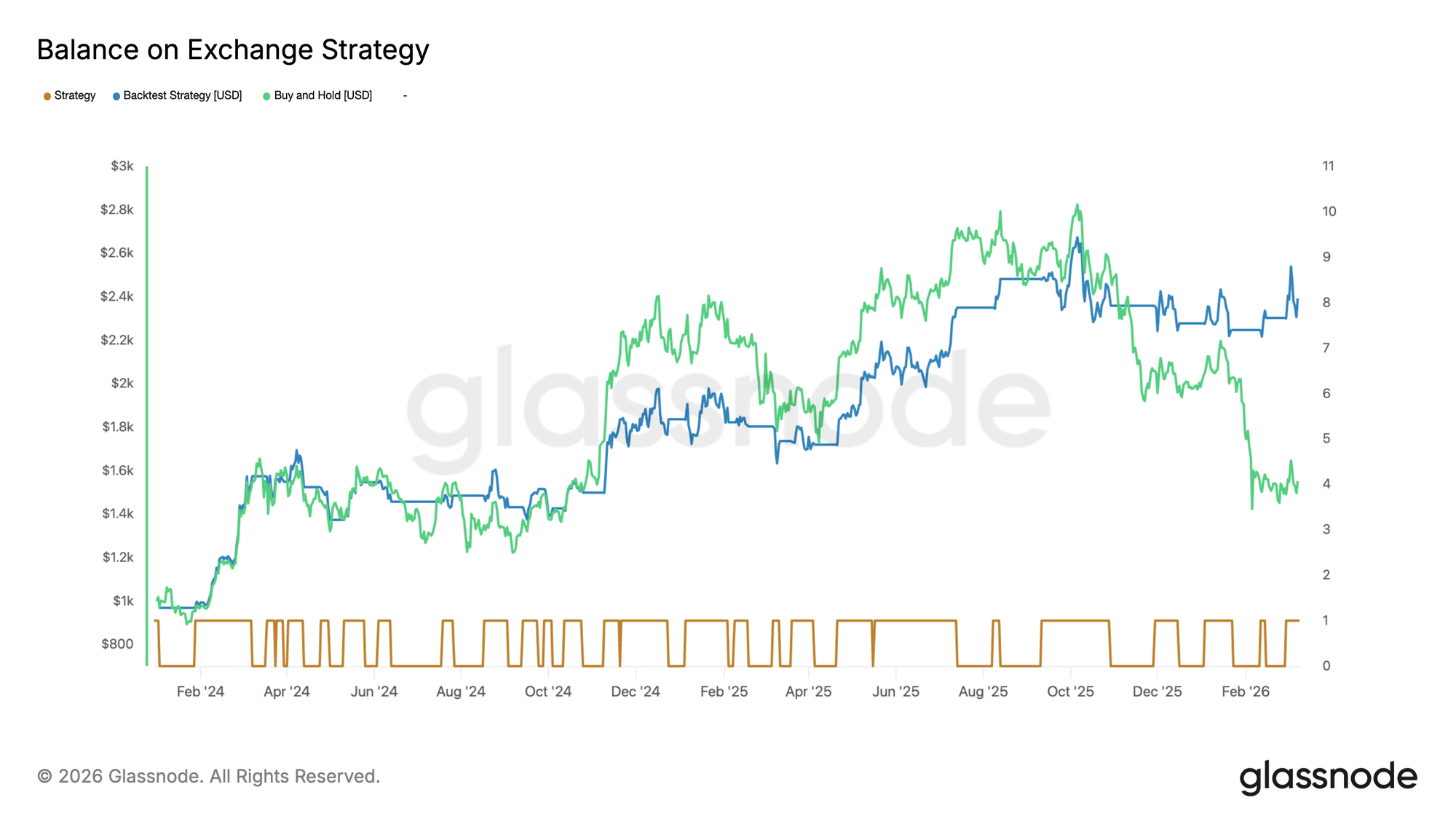
Here's how to read this chart:

🟫 The brown line at the bottom is the binary trading signal, toggling between in the market (1) and out of the market (0).

🟦 The blue line tracks the strategy's portfolio value over time.

🟩 The green line is the buy-and-hold portfolio benchmark.

We can observe that the exchange balance strategy performed reasonably well, although at times the buy-and-hold strategy outperformed it. In the final days of the research period, however, the exchange balance strategy caught up. While some investors may find the combination of reduced volatility and an ultimately comparable performance to buy-and-hold appealing, the final numbers are misleading – and here’s why.

The Problem: Data Mutation and Look-Ahead Bias

Metrics are not static. Many are retroactively revised as new information becomes available. This is particularly true for metrics that depend on address clustering or entity labeling, such as on-chain exchange balances. However, it is also the case for metrics such as trading volume or price, as individual exchanges can occasionally submit their data with slight delays.

This means that a value you see today for, say, January 15, 2024, may not be the same value that was published on January 15, 2024. The data has been revised with hindsight. When you backtest a strategy on this revised data, you are implicitly using information that was not available at the time the trading decisions would have been made. This introduces a look-ahead bias.

The Honest Backtest: Using Point-in-Time Data

Let's therefore repeat the exact same backtest – same signal logic, same parameters, same dates, same fees – but this time using the Point-in-Time (PiT) variant of the Exchange Balance metric, available in Glassnode Studio.

PiT metrics are strictly append-only and immutable. Each historical data point reflects only the information that was known at the time it was first computed. No retroactive revisions, no look-ahead bias.

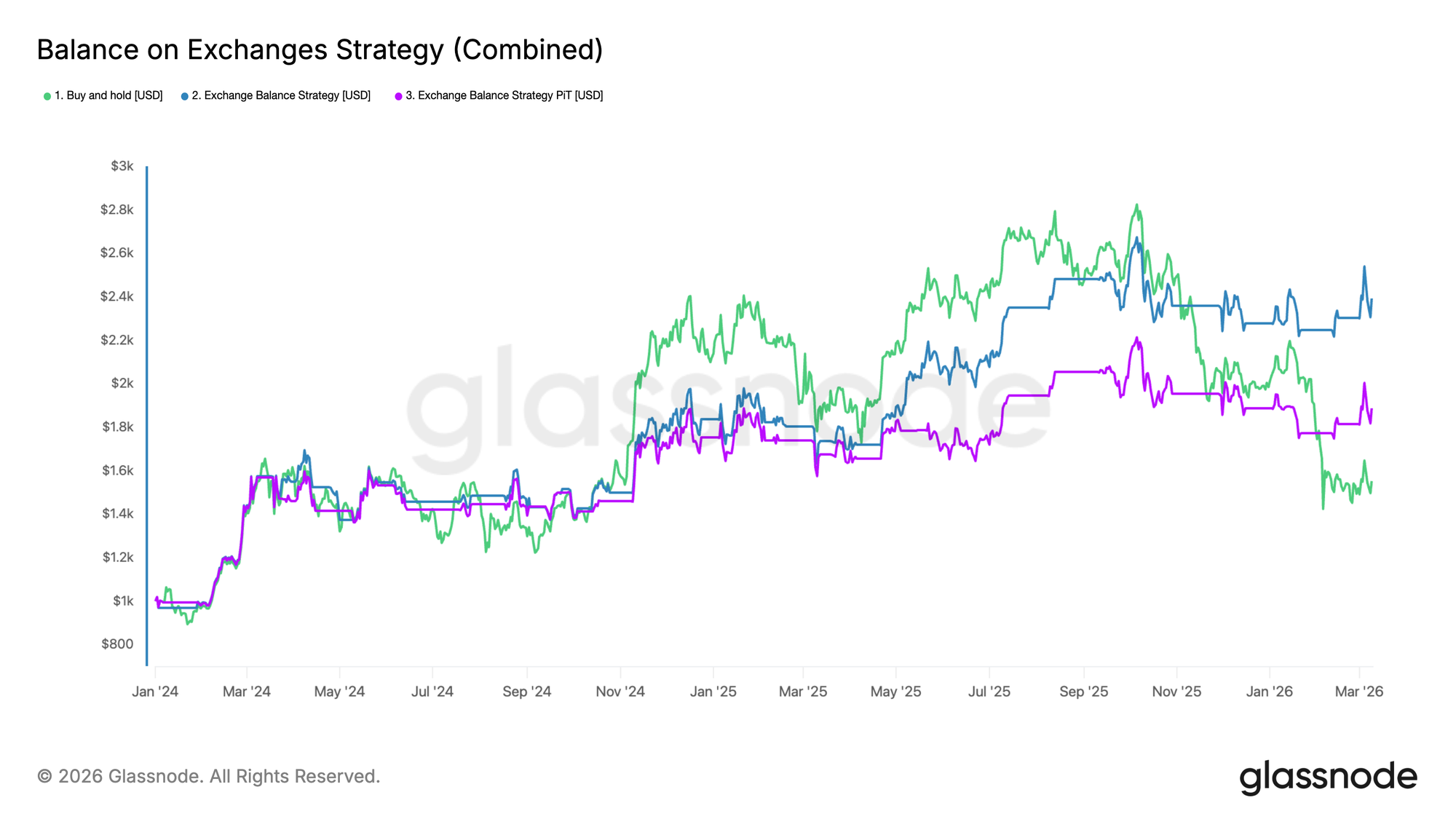
While we are using the same metric, the strategy now produces significantly different results, as illustrated by the purple line in the new chart below. The overall performance is notably worse.

Although both strategies behave similarly for much of 2024, we observe that the PiT-based version fails to capture the strong upticks in November 2024 and March 2025 as effectively. As a result, the cumulative performance diverges meaningfully and ends up considerably lower.
Access live chart

Key Takeaway

In this example, the purple strategy, which only has access to information as it was available at the time, performs noticeably worse. ► Backtests will lie if fed with wrong or revised data. Only immutable, Point-in-Time metrics ensure you’re replaying history as it actually happened.


Связанные с этим вопросы

QWhat is the main premise of the hypothetical trading strategy described in the article?

AThe strategy is based on the narrative that when coins leave exchanges, it is a bullish signal, as it indicates holders are moving to self-custody and reducing available supply. It enters the market when the 5-day moving average of Binance's BTC balance falls below its 14-day average and exits when it rises back above.

QWhat is the primary problem identified with using standard historical data for backtesting?

AThe primary problem is data mutation and look-ahead bias. Many metrics are retroactively revised as new information becomes available, meaning a backtest uses data that was not known at the time of the original trading decision, leading to inaccurate and overly optimistic results.

QWhat is Point-in-Time (PiT) data and how does it differ from standard data?

APoint-in-Time data is strictly append-only and immutable. Each historical data point reflects only the information that was known and published at that specific time, with no retroactive revisions. This prevents look-ahead bias in backtesting.

QHow did the performance of the strategy change when backtested with Point-in-Time data?

AThe performance was significantly worse. The PiT-based strategy failed to capture strong market upticks as effectively, leading to a meaningfully lower cumulative performance compared to the backtest using revised data.

QWhat is the key takeaway from the article regarding backtesting and data?

AThe key takeaway is that backtests will produce misleading results if they use revised data. Only immutable, Point-in-Time metrics ensure an accurate historical replay of what was actually knowable at the time, preventing look-ahead bias.

Похожее

Deconstructing the Capital Game of Public Chain Pharos: A $950 Million Valuation Propped Up by Photovoltaic and Other Assets, A Shell Transaction Under Layers of Betting?

The article investigates the recent $247.3 million investment by Hong Kong-listed GCL New Energy into the Layer 1 blockchain project Pharos at a $950 million valuation. It reveals the deal is not a straightforward investment but a complex, multi-stage transaction bound by stringent performance milestones. The core of the agreement is a set of mutual, conditional investments. Pharos must first purchase up to $1.5 billion HKD worth of GCL shares. However, GCL's reciprocal investment in Pharos tokens is contingent upon a series of strict, performance-based vesting conditions. The entire deal is split into five tranches, each unlocking only if the Pharos token lists on an exchange without falling below its issue price and maintains a high fully diluted valuation (FDV) over successive three-month periods. If any condition fails, the entire agreement can be terminated. The article questions the legitimacy of the $950 million valuation, which was calculated based on a purported $250 million in Total Value Locked (TVL). Notably, over half of this TVL is claimed to be from real-world assets (RWA), specifically photovoltaic and power station assets linked to GCL—a highly unconventional method for valuing a Layer 1 blockchain. Furthermore, the mainnet is not yet live, and the TVL figure is unverified by independent data platforms. The author suggests the deal is a "capital game" designed to boost GCL's stock price, which saw suspicious pre-announcement surges, and to create hype for the upcoming Pharos token launch, ultimately passing the risk onto the market and future investors.

marsbit1 ч. назад

Deconstructing the Capital Game of Public Chain Pharos: A $950 Million Valuation Propped Up by Photovoltaic and Other Assets, A Shell Transaction Under Layers of Betting?

marsbit1 ч. назад

Comprehensive Analysis of Canton Network: Wall Street's Blockchain Ambition

Canton Network is positioned at the convergence of key crypto trends, including real-world asset tokenization, institutional blockchain adoption, privacy infrastructure, and stablecoin settlements. It has attracted major financial institutions like DTCC, Nasdaq, and Broadridge, which are deploying real workflows such as treasury tokenization, repo financing, and collateral management. The network is designed for regulated entities, offering granular transaction privacy and validator-level control while maintaining interoperability. Its architecture separates execution from coordination, using validator nodes operated by participants and synchronizers for atomic settlement. Key adoptions include DTCC tokenizing U.S. Treasuries, Broadridge processing trillions in repo transactions, and Nasdaq integrating its Calypso platform. Tokenomics are usage-driven, with weekly CC burns increasing by 216% since TGE, and the burn-to-mint ratio rising to 0.90, nearing a deflationary state. Despite generating the highest revenue among L1s in February, Canton trades at a discount to peers, possibly due to high emissions and its perception as financial infrastructure. Catalysts include regulatory clarity from the Clarity Act and DTCC’s broader tokenization platform launch in late 2026. Risks include token concentration, with 54% of CC held by a few entities, though these are largely operational holdings. Canton aims to become a core coordination layer for tokenized financial markets.

marsbit1 ч. назад

Comprehensive Analysis of Canton Network: Wall Street's Blockchain Ambition

marsbit1 ч. назад

Which Areas Still Have Moats in the AI Era?

In the AI era, certain moats remain despite rapid technological advancement. The author, a former hedge fund manager, argues that the true inflection point occurred when AI models like ChatGPT’s o1 began generating functional code—even with imperfections—enabling recursive self-optimization and fundamentally altering software development. Key short-term moats identified include: 1. **Proprietary Data**: Firms with unique, inaccessible data (e.g., multi-strategy hedge funds) can fine-tune models, creating defensible advantages. 2. **Regulatory Friction**: Industries requiring human approval (e.g., traditional finance) face slower disruption due to compliance and legal barriers. 3. **Authority-as-a-Service**: Human trust in institutional authority (e.g., legal or audit services) persists even if AI outperforms humans technically. 4. **Physical World Lag**: Hardware-dependent sectors evolve slower, delaying full AI integration. However, these moats only delay, not prevent, disruption. The author emphasizes acting on signals rather than waiting for certainty: identify directional trends, place asymmetric bets (limited downside, high upside), and iterate through action. As AI accelerates, windows of opportunity close quickly. To remain relevant, humans must excel in long-term strategy, complex system-level thinking, and collaboration—areas where AI still lags. The time to act is now, before markets price in the obvious.

marsbit1 ч. назад

Which Areas Still Have Moats in the AI Era?

marsbit1 ч. назад

Actually, ETH Scaling is a Major Boon for L2s

Vitalik Buterin's recent comments on Ethereum scaling have been misinterpreted. He did not declare Layer 2s (L2s) a failure but rather signaled a strategic shift: Ethereum is moving from a "rollup-centric" scaling model, where L2s were seen as simple replicas of the base layer, to one where the L1 itself undergoes aggressive scaling. L2s remain crucial, but their primary value proposition has evolved to be customization, not just cheap transactions. Two key developments drove this change. First, Ethereum's base layer is scaling faster than anticipated. After years of cautious progress to preserve decentralization, an ambitious new roadmap aims to drastically increase L1 throughput through a series of upgrades, including a higher gas limit, faster block times, parallel transaction processing, and a fundamental transition to a native zero-knowledge (zkEVM) architecture. This allows Ethereum to scale while maintaining its superior decentralization. Second, L2s have found product-market fit with institutions. Companies like Robinhood, Coinbase, and Kraken are building their own L2s because they need Ethereum's security and access to its liquidity, but also require control for regulatory compliance, custom fee structures, and operational flexibility. This creates a spectrum of L2s, from highly decentralized ones to more controlled, institutionally-focused chains—a reality Vitalik acknowledges is valid as long as marketing is honest. Crucially, scaling the L1 does not compete with L2s; it makes them better. A more powerful L1 means cheaper data availability and settlement costs for L2s, faster withdrawals, and quicker finality. The main unresolved challenge is liquidity fragmentation between L2s, which the Ethereum Foundation is prioritizing with new interoperability solutions for 2026. The narrative that Ethereum is abandoning L2s is incorrect. The ecosystem is maturing into a system with a radically scaling L1 at its core, surrounded by a flourishing ecosystem of specialized L2s.

marsbit3 ч. назад

Actually, ETH Scaling is a Major Boon for L2s

marsbit3 ч. назад

Торговля

Спот
Фьючерсы
活动图片