Helius CEO Says Crypto’s ‘Straw Houses’ Face Collapse As AI Raises The Stakes

bitcoinistОпубликовано 2026-06-11Обновлено 2026-06-11

Введение

Helius Labs CEO Mert Mumtaz warns that cryptocurrency is entering a critical security phase, demanding spaceflight-level rigor. He argues crypto's promise of irreversible execution can no longer tolerate the "sloppy" software standards of traditional web apps, where bugs can be patched. Instead, immutable financial code must be provably correct, akin to launching a spaceship. Mumtaz connects this to the historical "software crisis" and the need for formal verification. He criticizes the industry's "facade of decentralization"—reliance on admin keys and emergency interventions—which masks underlying fragility. AI is a dual catalyst: while it empowers attackers to find exploits faster, it also makes rigorous practices like formal verification, audits, and invariant checking more accessible at scale. This will trigger a "trial by fire" and "aggressive natural selection," separating robust "serious infrastructure teams" from fragile "straw house" protocols that may collapse. The ultimate goal is a crypto industry where demonstrable correctness and security are paramount, making it safer and more robust than centralized finance. Mumtaz's warning comes as AI models like Claude advance, compressing the time for both offensive and defensive security research in DeFi.

Helius Labs CEO Mert Mumtaz has warned that crypto is entering a new security era in which AI, formal verification and higher software standards could separate serious infrastructure teams from fragile protocols. In a widely viewed post on X, he argued that crypto is “about to enter the space age,” with immutable financial code increasingly demanding the rigor of aerospace, chip manufacturing and other failure-intolerant industries.

Mumtaz’s central argument is that most software has historically tolerated a level of sloppiness that crypto can no longer afford. In conventional internet businesses, a bug may cause downtime, lost revenue or an embarrassing outage, but centralized operators can usually intervene, patch the system, roll back changes or compensate users. Crypto, he wrote, is structurally different because its core promise depends on irreversible execution in adversarial environments.

“Immutable financial code is akin to a spaceship leaving Earth that you have no further control over. It must work, or there will be catastrophe,” Mumtaz said. “This crisis has come up before. In the late 1960s, a NATO conference declared a ‘software crisis,’ as the software industry was getting increasingly sloppy and no one could really reason about these systems at scale.”

Crypto Must Reach Spaceflight-Level Security

He connected that earlier software crisis to the intellectual roots of formal verification, citing Edsger Dijkstra and the long-standing argument that testing can show the presence of bugs, but not their absence. For systems where correctness matters, Mumtaz said, software has to be treated less like an iterative consumer product and more like a mathematical object that can be reasoned about and proven.

That framing is especially relevant to crypto because blockchain systems handle billions of dollars in assets through code that is public, immutable and constantly probed by attackers. Mumtaz argued that the industry has often adopted the risk profile of aviation or spaceflight while retaining the development culture of web applications. In his words, crypto falls into the category of low-margin-of-error software industries, yet “most of the industry has been built using the sloppy standards of the former, human-intervenable systems.”

The Helius Labs CEO also took aim at what he described as the “facade of decentralization” that has softened the perceived urgency of the problem. Admin keys, controlled validator sets, social coordination and emergency interventions, he argued, have created a short-term sense of comfort. But those mechanisms also blur the distinction between genuinely autonomous systems and systems that can still be rescued by human operators when something breaks.

Mumtaz expects that distinction to become harder to ignore as AI improves. Rather than viewing AI only as a threat vector, he framed it as a force that will make rigorous software practices more accessible. Specification writing, proof assistance, symbolic reasoning, fuzzing, audits, invariant checking and formal verification workflows, he said, could become dramatically easier to use at scale.

“The silver lining is that AI will greatly streamline the process of formal verification and making programs more rigorous. What was once extremely manual and expensive will now become tractable at scale: specification writing, proof assistance, symbolic reasoning, fuzzing, audits, invariant checking, and formal verification workflows will all get dramatically more accessible,” he wrote. “This set of circumstances will lead to crypto reaching its ultimate potential, but I suspect only through trial by fire.”

That “trial by fire” is the crux of his warning. Mumtaz said an “aggressive natural selection mechanism” has already begun and may continue for several years. Strong teams, in his view, will emerge with more resilient systems, while weaker architectures will fail under higher security expectations and increasingly capable adversarial tooling.

He was careful not to frame those failures purely as malicious or negligent. “The serious teams will emerge stronger than ever, while straw houses will collapse,” Mumtaz wrote, adding that the latter should not necessarily be read as an insult because these systems are genuinely hard to build.

The broader implication is that crypto’s next competitive cycle may not be defined only by throughput, liquidity incentives or distribution, but by demonstrable correctness. Mumtaz’s end state is an industry where security, rigor and privacy become first-class concerns again, allowing crypto to become “demonstrably safer, more robust, and more Lindy than any centralized financial system.” His closing line was blunt: “I am long math and I am long crypto.”

The timing of Mert’s post is notable because it came just after Anthropic’s June 9 release of Claude Fable 5 and Claude Mythos 5, a rollout that underscored how quickly AI is moving into offensive and defensive security research. Anthropic said Fable 5 is its most capable generally available model, but added safeguards around cybersecurity queries because the same capabilities could be misused; Mythos 5, the less-restricted version, is being limited at first to selected cyberdefenders and infrastructure providers through Project Glasswing in collaboration with the US government.

For DeFi, that is the uncomfortable part of the story. If models can increasingly reason through large codebases, identify subtle logic flaws and help turn vulnerabilities into working exploits, then public smart contracts become a natural target for AI-assisted bug hunting. Mumtaz’ “straw houses” warning is therefore not abstract: AI may sharply compress the time it takes both auditors and attackers to find the next broken invariant, unsafe assumption or exploitable edge case in crypto’s financial code.

At press time, the total crypto market cap stood at $2.12 trillion.
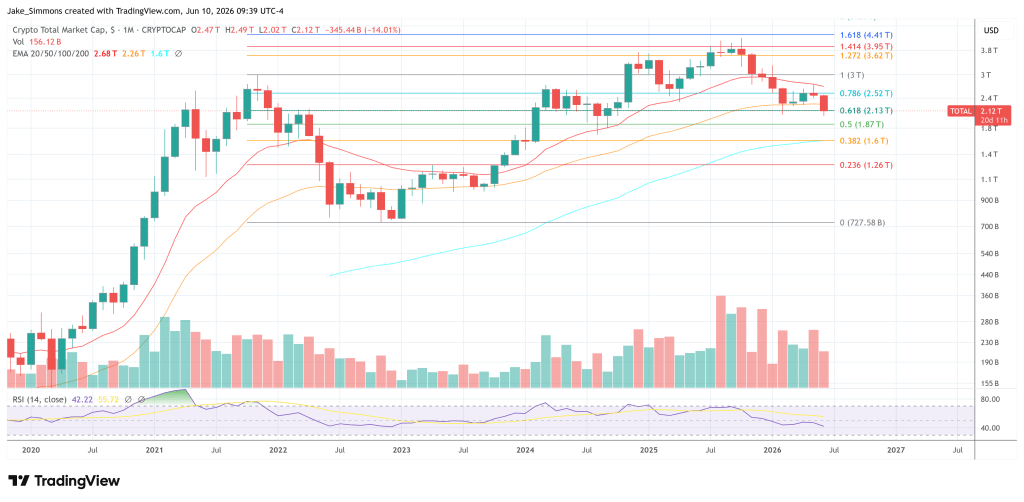
Total crypto market cap must stay above the 0.618 Fib, 1-month chart | Source: TOTAL on TradingView.com

Связанные с этим вопросы

QWhat is the main warning issued by Helius Labs CEO Mert Mumtaz regarding the future of crypto?

AMert Mumtaz warns that crypto is entering a new security era where AI, formal verification, and higher software standards will separate robust infrastructure from fragile 'straw house' protocols. He argues that crypto's immutable financial code demands aerospace-level rigor, and systems that cannot meet these heightened security expectations will collapse under pressure from more capable adversarial tools, including AI.

QAccording to the article, why does crypto software require a higher standard of correctness than conventional internet businesses?

ACrypto software requires a higher standard of correctness because its core promise depends on irreversible execution in adversarial environments. Unlike conventional businesses where centralized operators can intervene, patch systems, or roll back changes, crypto's immutable code, like a spaceship leaving Earth, has no further control. A failure can lead to catastrophic, irreversible financial loss.

QHow does Mert Mumtaz view the role of AI in the future of crypto security?

AMumtaz views AI as a dual-purpose force. While it is a threat vector that can help attackers find vulnerabilities faster, it is also a tool that will make rigorous software practices like formal verification, specification writing, proof assistance, and audits dramatically more accessible and scalable, ultimately helping strong teams build more resilient systems.

QWhat does the article suggest is the 'uncomfortable part of the story' for DeFi regarding AI advancements?

AThe uncomfortable part for DeFi is that AI models are becoming increasingly capable of reasoning through large codebases, identifying subtle logic flaws, and helping turn vulnerabilities into working exploits. This makes public smart contracts a natural target for AI-assisted bug hunting, sharply compressing the time for both auditors and attackers to find the next critical flaw.

QWhat broader shift does Mumtaz predict will define crypto's next competitive cycle?

AMumtaz predicts that crypto's next competitive cycle will be defined not just by throughput, liquidity incentives, or distribution, but by demonstrable correctness. He envisions an industry where security, rigor, and privacy become first-class concerns, allowing crypto to become demonstrably safer and more robust than any centralized financial system.

Похожее

Raising Interest Rates Is Not a Tech Killer, EPS Is: A Strategy for Discarding the Weak and Retaining the Strong After the AI Theme's Sharp Decline

**Summary: Rising Interest Rates Are Not the Killer of Tech; EPS Is: The "Keep the Strong, Ditch the Weak" Strategy After the AI Theme Plunge** The author argues that the sharp sell-off in tech and AI-related stocks, triggered by a strong US jobs report that heightened Fed rate hike fears, represents a "pullback to pick up passengers" rather than a "car crash." The true end of a tech bull market is not determined by an extra 25 basis point hike, but by industry overcapacity and the disproval of earnings per share (EPS) expectations. Historical analysis shows that during past rate hike cycles, the Nasdaq-100 often outperformed, provided EPS growth remained strong. The current phase is seen as a shift from a "broad narrative-driven rally" to a "focused verification stage" for AI. The investment strategy should be to "keep the strong, ditch the weak." * **Retain exposure** to high-conviction AI infrastructure leaders with clear order visibility, stable margins, strong cash flow, and upward EPS revisions (e.g., AI servers, advanced packaging, optical modules, key cloud suppliers). * **Reduce exposure** to high-beta, narrative-driven stocks with unclear profit paths (e.g., some quantum computing, space, or speculative chip stocks), especially on rebounds. Valuation concerns should focus on whether earnings can catch up to high multiples, not on high P/E alone. Crowded positioning signals a concentration into quality assets, not necessarily a market top. The upcoming Q2 earnings season will be a key validation point. The core principle is to hold stocks with proven EPS, while using macro events (CPI data, central bank meetings) to manage timing and risk.

marsbit1 ч. назад

Raising Interest Rates Is Not a Tech Killer, EPS Is: A Strategy for Discarding the Weak and Retaining the Strong After the AI Theme's Sharp Decline

marsbit1 ч. назад

Торговля

Спот
Фьючерсы

Популярные статьи

Как купить S

Добро пожаловать на HTX.com! Мы сделали приобретение Sonic (S) простым и удобным. Следуйте нашему пошаговому руководству и отправляйтесь в свое крипто-путешествие.Шаг 1: Создайте аккаунт на HTXИспользуйте свой адрес электронной почты или номер телефона, чтобы зарегистрироваться и бесплатно создать аккаунт на HTX. Пройдите удобную регистрацию и откройте для себя весь функционал.Создать аккаунтШаг 2: Перейдите в Купить криптовалюту и выберите свой способ оплатыКредитная/Дебетовая Карта: Используйте свою карту Visa или Mastercard для мгновенной покупки Sonic (S).Баланс: Используйте средства с баланса вашего аккаунта HTX для простой торговли.Третьи Лица: Мы добавили популярные способы оплаты, такие как Google Pay и Apple Pay, для повышения удобства.P2P: Торгуйте напрямую с другими пользователями на HTX.Внебиржевая Торговля (OTC): Мы предлагаем индивидуальные услуги и конкурентоспособные обменные курсы для трейдеров.Шаг 3: Хранение Sonic (S)После приобретения вами Sonic (S) храните их в своем аккаунте на HTX. В качестве альтернативы вы можете отправить их куда-либо с помощью перевода в блокчейне или использовать для торговли с другими криптовалютами.Шаг 4: Торговля Sonic (S)С легкостью торгуйте Sonic (S) на спотовом рынке HTX. Просто зайдите в свой аккаунт, выберите торговую пару, совершайте сделки и следите за ними в режиме реального времени. Мы предлагаем удобный интерфейс как для начинающих, так и для опытных трейдеров.

1.4k просмотров всегоОпубликовано 2025.01.15Обновлено 2026.06.02

Как купить S

Sonic: Обновления под руководством Андре Кронье – новая звезда Layer-1 на фоне спада рынка

Он решает проблемы масштабируемости, совместимости между блокчейнами и стимулов для разработчиков с помощью технологических инноваций.

2.3k просмотров всегоОпубликовано 2025.04.09Обновлено 2025.04.09

Sonic: Обновления под руководством Андре Кронье – новая звезда Layer-1 на фоне спада рынка

HTX Learn: Пройдите обучение по "Sonic" и разделите 1000 USDT

HTX Learn — ваш проводник в мир перспективных проектов, и мы запускаем специальное мероприятие "Учитесь и Зарабатывайте", посвящённое этим проектам. Наше новое направление .

1.8k просмотров всегоОпубликовано 2025.04.10Обновлено 2025.04.10

HTX Learn: Пройдите обучение по "Sonic" и разделите 1000 USDT

Обсуждения

Добро пожаловать в Сообщество HTX. Здесь вы сможете быть в курсе последних новостей о развитии платформы и получить доступ к профессиональной аналитической информации о рынке. Мнения пользователей о цене на S (S) представлены ниже.

活动图片