This Xiaohongshu Graphic Layout AI Skill Has Found a Route to Bypass AI Labeling for Graphic Generation

marsbitОпубликовано 2026-05-28Обновлено 2026-05-28

Введение

A new open-source tool called "guizang-social-card-skill" has emerged, offering a unique workaround for AI content labeling rules on platforms like Xiaohongshu. Instead of using AI models to generate images, it employs AI to make layout decisions, then uses HTML/CSS to render the final graphic. Photographic assets are sourced from libraries like Unsplash. The output is a rasterized browser screenshot, not an "AI-generated image." This approach is a direct response to platform policies. In early 2026, Xiaohongshu mandated labeling for AI-generated synthetic content and deployed audio-visual recognition models to detect AI-generated pixels based on statistical patterns. This tool bypasses those pixel-level detectors by not using diffusion or GAN models for image generation. The tool provides 28 predefined layout templates across two visual styles. Users input a topic, and the AI selects a template, positions text, and integrates elements like maps (using OpenStreetMap). The system prioritizes user-uploaded photos before falling back to stock image searches. The article outlines three divergent technical paths for social media graphic tools: 1) AI models directly generating pixels (highest detection risk), 2) API template engines (risk of anti-spam rules for homogeneity), and 3) this HTML-rendering method. The longevity of this workaround depends on whether platforms broaden their definition of "AI-generated content" to include programmatically rendered, AI-designed graphics....

In February 2026, Xiaohongshu issued an announcement requiring AI-generated synthetic content to be proactively labeled; unlabeled content would face distribution restrictions. More than three months later, an open-source project named guizang-social-card-skill appeared on GitHub, specializing in generating Xiaohongshu 3:4 graphics and public account covers. Its technical path had an unusual choice: it doesn't use any AI model to generate image pixels. The entire visual is rendered by HTML+CSS, with supporting images sourced from searches in real photo libraries like Unsplash. What it outputs is not an "AI-generated image" but a web page screenshot rasterized by a browser engine.

This choice corresponds to a specific change. Since 2026, Xiaohongshu has deployed audio-visual recognition models that analyze pixel distribution patterns and audio features to identify AIGC content. During the same period, over 800,000 AI-operated accounts and nearly 150,000 AI-fabricated notes were penalized. For content creators who need to produce graphics frequently, the probability of detection and labeling for images generated by tools like Midjourney or Canva AI is continuously increasing. Developer Cang Shifu's Skill chose another path: let AI handle layout decisions and leave the final pixels to rendering engines and real photo libraries.

This is a conscious technical bypass. However, how far this solution can go depends on the elasticity of the platform's definition of the term "AI-generated synthetic content."

28 Layout Skeletons: AI Handles Layout Logic, Not Drawing

Developer Cang Shifu, real name Gui Zang, previously released guizang-ppt-skill, another AI tool for graphic layout scenarios. This new social-card-skill has a more focused positioning: targeting Xiaohongshu 3:4 graphics, public account 1:1 and 21:9 covers, outputting resolutions of 1080×1440, 1080×1080, and 2100×900 respectively.
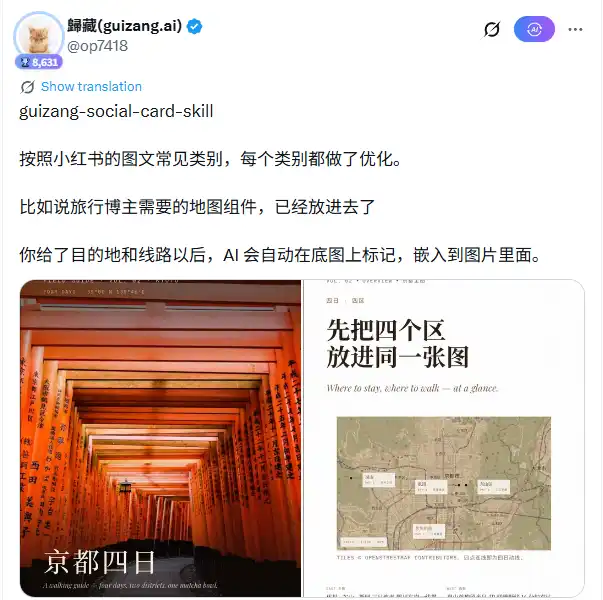

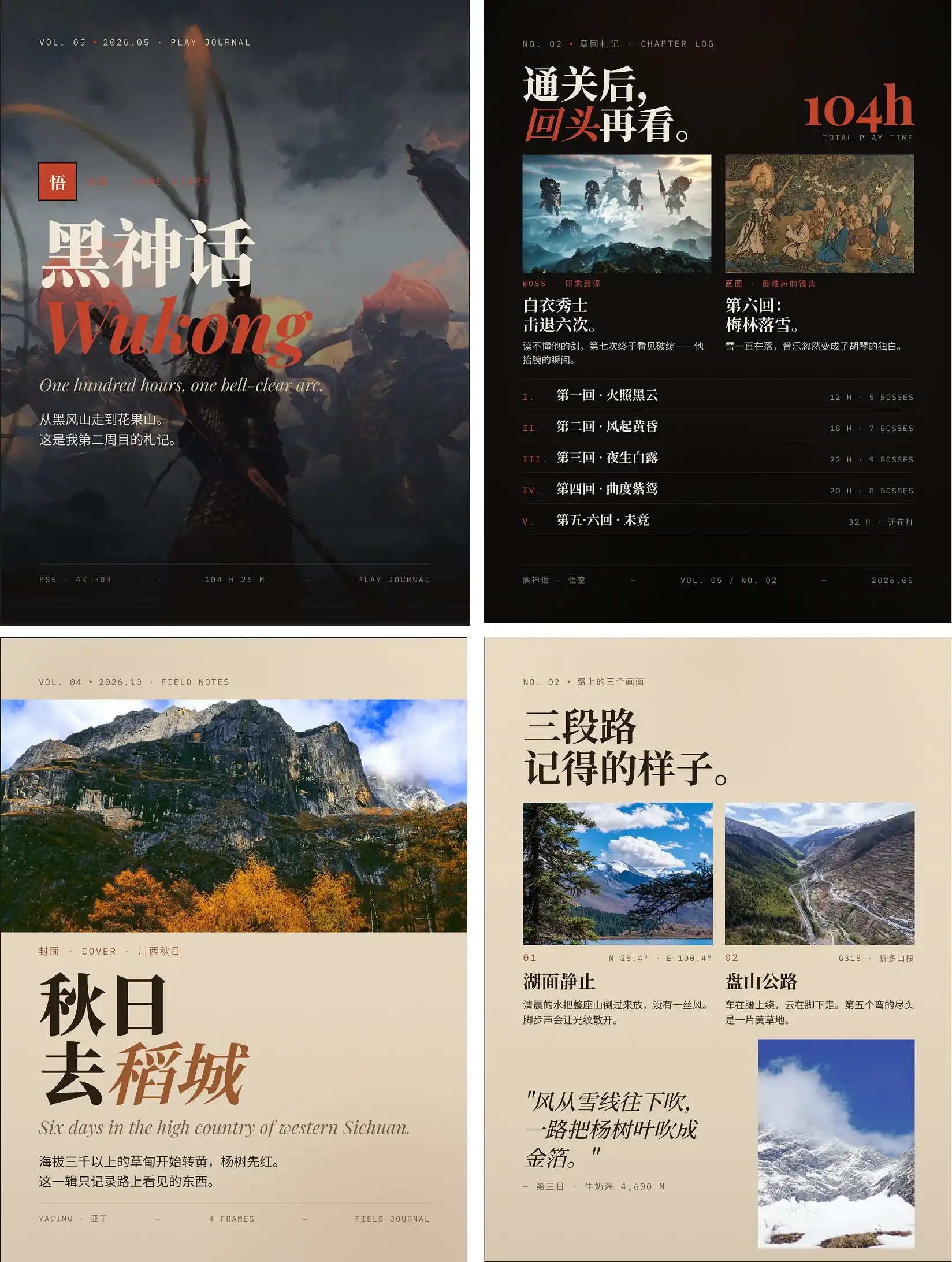
In terms of technical architecture, this Skill has 28 built-in layout skeletons, divided into two visual systems: Editorial (magazine style, 16 layouts) and Swiss (Swiss International Style, 12 layouts), accompanied by 10 preset theme color schemes. After users input a destination, itinerary, or note topic, the AI is responsible for selecting an appropriate layout skeleton, deciding text positioning, processing map annotation parameters, and then writing all design decisions into HTML+CSS. The Playwright rendering engine takes over the subsequent steps, capturing screenshots page by page to output PNGs.

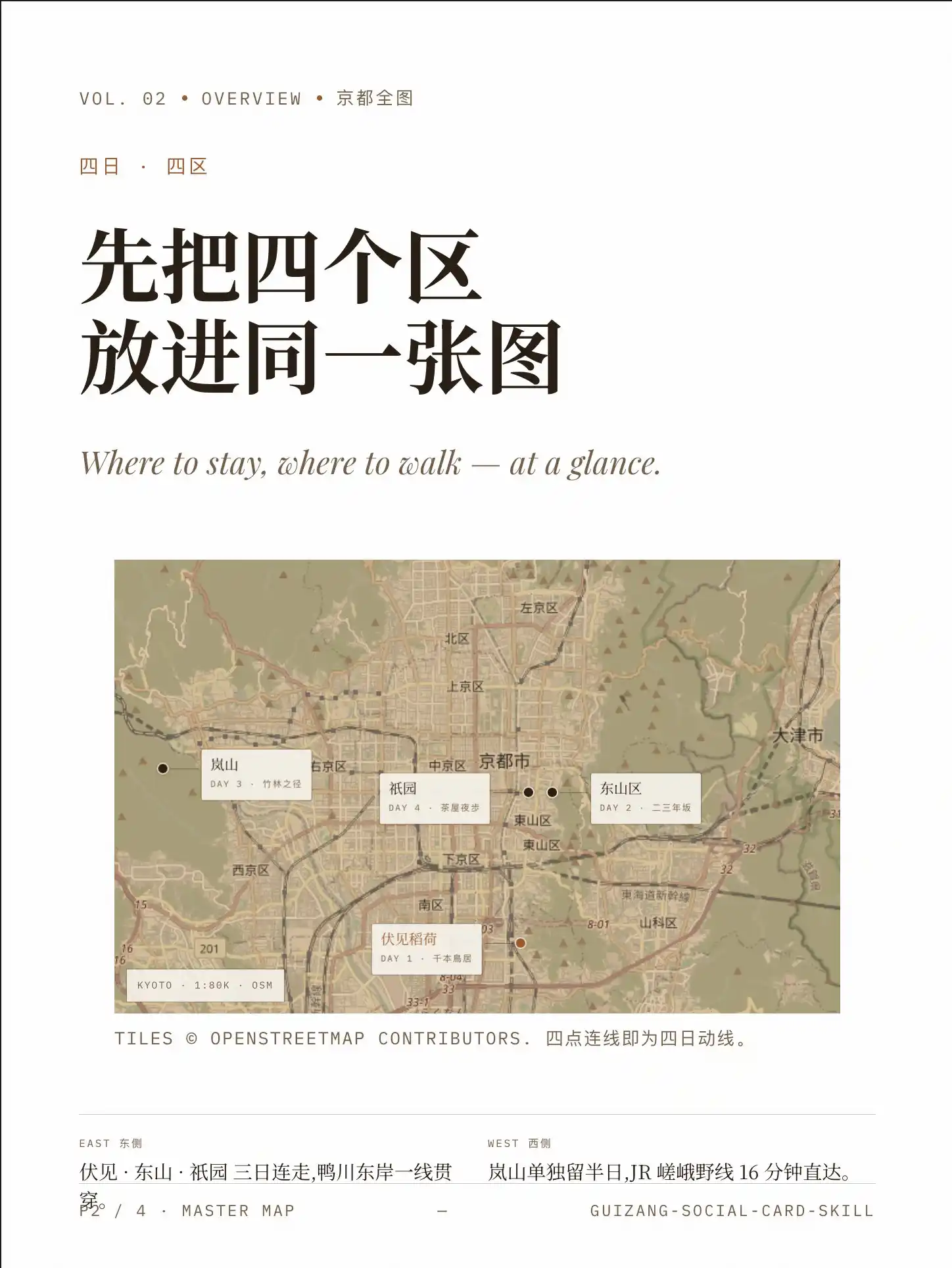
A particularly useful component for travel bloggers is the map module. It uses MapLibre to load real tiles from OpenStreetMap, supporting multiple location markers and connecting lines. Users only need to provide city or attraction names; the AI automatically generates a basemap with annotations and embeds it into the layout. The accompanying image sourcing workflow has a clear priority: user-provided real photos take precedence; when no user images are available, it automatically retrieves supporting images in the order of Unsplash → Pexels → Flickr CC → Wallhaven.

The entire process is executed in seven steps: Intake (receive input) → Style & Theme (determine style and theme) → Layout Selection → Asset Prep (material preparation) → Compose & Render (layout and rendering) → Deliver & Review (output and review) → Iterate (iterative modifications). Each step is recorded in .poster files within the task directory. For batch image generation, run node render.mjs, and Playwright renders them one by one. Another validation script, validate-social-deck.mjs, measures DOM elements in a real browser environment to detect layout issues like text overflow, font size exceeding limits, and footer element collisions.

The design goal of this mechanism is clear: to be as precise and controllable as printing layout software, rather than as free but unpredictable as diffusion models. The cost is that creative freedom is confined to these 28 grids. For creators who rely on personal photography styles, hand-drawn elements, or irregular collages, these layout skeletons provide not efficiency gains, but design constraints.

Regarding the entry barrier: the CLI version requires installing Playwright, Node environment, and obtaining API access for Claude Code or Codex. There's also a web version portal at xiaohongshu.guizang.ai for non-developer users, but there is no public comparison yet on whether its feature completeness matches the CLI version. The developer's several X platform posts and frequently updated README indicate this project is still in rapid iteration.

Pixels Not from Generative Models, But Compliance Doesn't Equal Long-term Safety

Xiaohongshu's AI content detection logic, according to public information and technical analysis, relies primarily on audio-visual recognition models. These models determine whether content originates from AI generative models by analyzing pixel distribution patterns. Diffusion models and GANs leave specific statistical signatures at the pixel level when generating images, which differ from the natural lighting, lens distortion, and noise patterns captured by camera sensors. The training objective of audio-visual recognition models is precisely to capture this inconsistency in statistical patterns.

The evasion logic of Cang Shifu's Skill is based on a key distinction: its output image pixels do not come from any generative model. The HTML rendering engine rasterizes CSS styles, producing pixel distribution characteristics closer to browser interface screenshots or desktop publishing software outputs. The photographic portions come from real human-shot materials in libraries like Unsplash; these images, captured by cameras and manually post-processed, do not carry diffusion model signatures.


However, the validity of this distinction depends on the platform's definition of "AI-generated synthetic content" being precisely drawn at the line of "AI model generating pixels." Xiaohongshu's official announcement uses the term "AI-generated synthetic content," a phrase whose original scope is not narrow. Once the platform expands the definition to include "AI-assisted design programmatically rendered output" or incorporates the browser rendering characteristics of HTML-rasterized images into the training data for its recognition models, the current technical advantage of this solution would disappear.

The platform has both the technical foundation and governance motivation to expand the definition. The audio-visual recognition models themselves are continuously iterating. If training data includes a large number of comparative samples between HTML-rendered images and AI-generated images, models could learn to distinguish "subpixel anti-aliasing features of browser font rendering" from "irregular pixel blocks in GAN-generated text." There's no public information indicating Xiaohongshu has initiated training in this direction yet, but from the perspective of model capability boundaries, such expansion is technically feasible.

More noteworthy are compliance factors related to mini-program/API hosting. Currently, there is no official documentation indicating that this Skill has integrated a model filing number or completed related compliance registration. If the platform adds traceability requirements for the image generation toolchain to its content review process, the lack of filing information could become a new blocking point.

API Template Engines, Platform-specific Tools, and HTML Rendering Are Forging Three Diverging Paths

Observing tools in the market that generate images for social media, one finds they are diverging into three distinct technical routes, each facing a different structure of review risks.

Direct Image Generation by AI Models. The representative of this path is the Magic Design feature released by Canva AI in April 2026, which generates design drafts containing AI visual elements directly from text prompts. Images generated by models like Midjourney, DALL·E also fall into this category. The problem is clear: these images are the primary detection target for audio-visual recognition models. Canva's response is to encourage transparent labeling, not evasion of detection. On Xiaohongshu, there is no public data to confirm whether posts with AI-generated images receive lower recommendation weights after being labeled, but the platform's policy of "restricting distribution of unlabeled AI content" is already established. Each update to diffusion models may change pixel statistical signatures, and the corresponding detection models iterate simultaneously, meaning creators face a continuously moving target.

API Template Engine Rendering. Bannerbear is typical of this route. Users create templates in a designer, modify layer variables by passing JSON data via REST API, and the server renders and outputs PNGs or JPGs. Its core is also "programmatic rendering," not "model-generated pixels," and outputs lack diffusion model signatures. The difference from Cang Shifu's Skill is: Bannerbear's templates rely on manual design; AI doesn't participate in layout decisions. Cang Shifu's Skill lets Claude directly read/write HTML, giving layout selection power to AI. Bannerbear's solution has risks in another dimension: when many accounts use identical templates, colors, and fonts to produce graphics, even if each image isn't AI-generated, it can trigger pattern recognition of "programmatic batch production" on the platform side. The triggers for anti-spam rules aren't identical to AI detection, but for creators operating batch accounts, the result is also restricted distribution.

Platform-specific Custom Generation. Tools like Pin Generator are designed exclusively for Pinterest, automatically generating Pin images that align with the platform's algorithm preferences. The core of this route isn't evasion, but full adaptation—dimensions, visual style, publishing rhythm all conform to platform specifications. The advantage is the lowest review risk; the downside is obvious: tool capabilities are tied to platform rules. When Pinterest adjusts its algorithm or restricts third-party API calls, the tool directly fails. Compared to Cang Shifu's Skill, the former is a platform-exclusive tool, while the latter is a cross-platform general solution. Platform-exclusive is safer but more fragile; cross-platform is more flexible but more complex—a recurring trade-off in the AI tool space.

The three routes have different risk structures. AI generation offers the most freedom but must constantly respond to new detection models with each update. Template engines are most stable but risk being caught by anti-spam rules. HTML rendering walks between the two: layouts are flexibly controlled by AI, pixels are left to the browser and real photos, evading detection at the "AI-generated pixels" layer but unable to counter rule expansions at the platform's semantic level.

The Ceiling of the Layout System Lies Not in Code, But in Content Type

The 28 layout skeletons cover two mainstream visual systems: magazine and Swiss styles. For travel bloggers needing to display map routes, timelines, and multi-day itineraries, this system is a high match. Map annotations and itinerary connections are core information for such notes; the layout skeletons structure this information while maintaining a professional layout aesthetic.

However, Xiaohongshu's content ecosystem is far richer than travel guides. Outfit notes rely on personal photography style and color tone; makeup reviews need high-definition macro photos and product comparisons; lifestyle content heavily uses multi-photo collages and handwritten annotations. The "layout" for these content types isn't about structured information presentation but an expression of personal aesthetics and mood. The 28 layout skeletons are not tools but constraints in such scenarios.

Technical limitations are also real. It currently supports three sizes: 1080×1440 (Xiaohongshu 3:4), 2100×900 (Public Account 21:9), and 1080×1080 (Public Account 1:1). Formats like Douyin's 9:16 vertical cover or Bilibili's 16:9 horizontal cover are not supported. The image libraries rely on Unsplash and Pexels; their material leans towards high-quality photography, suitable for travel, scenery, and urban architecture. However, coverage for high-frequency materials in verticals like food close-ups, cosmetic product flat lays, or fashion items is limited in these libraries. The user-image-first strategy can partially mitigate this, provided creators have sufficient real photo material themselves.

The validation mechanism is a double-edged sword. validate-social-deck.mjs can intercept layout accidents before output, ensuring zero errors in 100 batch renders. This is an efficiency guarantee in operational scenarios requiring dozens of daily graphics. But it also means any design not conforming to preset layout rules will be rejected by the script. Creators wanting to add a slanted text decoration or custom margin within a standard layout cannot simply drag and adjust as in Canva; they need to edit the HTML and CSS source code directly.

The local deployment barrier is another stratification point. Creators capable of running Playwright and Node scripts can dive into layout skeletons and rendering scripts for customization. But for most Xiaohongshu bloggers, what's accessible is likely a functional subset via a web interface. The actual value derived from this Skill differs greatly between these two user groups. The core user base of open-source projects is creators and developers willing to tinker and with technical backgrounds, not the "one-click output" demands of average content producers.

No Universal Answer, But the Divergence of Technical Paths Itself Tells a Story

A Xiaohongshu travel blogger faces three choices: use Midjourney to generate illustration-style itinerary graphics, bearing the risk of labeling and demotion; use Bannerbear to set up templates and batch-fill data daily, bearing the anti-spam risks from template homogeneity; or use Cang Shifu's Skill, letting AI choose the layout and outputting via HTML rendering, bearing the risk of the platform expanding its "synthetic content" definition. There's no safe card, only combinations of different risk structures.

This landscape itself conveys a message: the adversarial iteration between platforms and AI tools has begun. Every time a platform updates its detection model, the technical advantage period for a batch of tools ends. Every time a new tool finds a bypass route, the platform adjusts its strategy. This is not a process that will converge to a stable state. The validity period of the HTML rendering solution depends on whether Xiaohongshu's audio-visual recognition model training continues to focus on "diffusion model pixel features" or expands to "all non-native photographic pixels."

For content creators, distinguishing between "AI-assisted" and "AI-replacement" gains practical significance. The platform's stance is clear: encourage AI as a creative amplifier, oppose using AI to replace humans for low-quality batch production. In Cang Shifu's Skill, AI handles layout decisions, not content generation; photos are real, layouts are preset skeletons by human designers. This precisely falls into the "AI-assisted" zone. Content where everything from copy to images is generated by models is what the platform explicitly aims to crack down on.

Whether this distinction will become an operational standard for platform review is uncertain. But tool developers are already responding to this definition with their technical choices.


Связанные с этим вопросы

QWhat is the main technical approach of the 'guizang-social-card-skill' to bypass AI content labeling on Xiaohongshu?

AThe 'guizang-social-card-skill' does not use AI models to generate image pixels. Instead, it employs AI to make layout decisions and then uses HTML+CSS for visual rendering. The final pixel output is a rasterized screenshot of a webpage generated by a browser engine, with supporting images sourced from real photo libraries like Unsplash.

QWhat are the three main technical paths for social media image generation tools mentioned in the article, and their associated risks?

A1. **AI Model Direct Generation** (e.g., Canva AI, Midjourney): High risk of detection by AI recognition models analyzing pixel patterns. 2. **API Template Engine Rendering** (e.g., Bannerbear): Risk of triggering anti-spam rules due to identical templates, even without AI-generated pixels. 3. **Platform-Specific Custom Generation** (e.g., Pin Generator): Lowest audit risk but highly dependent on and vulnerable to changes in a single platform's rules.

QHow does the article assess the long-term viability of the HTML rendering approach used by the guizang-social-card-skill?

AIts viability depends on how platforms like Xiaohongshu define 'AI-generated synthetic content.' Currently, it avoids detection by not using generative models for pixels. However, if platforms expand their definitions to include 'program-rendered outputs assisted by AI' or train their detection models to recognize browser-rendering features, this technical workaround could lose its effectiveness.

QWhat are the limitations of the guizang-social-card-skill's design system for content creators?

AIts 28 layout templates, while efficient for structured content like travel itineraries, act as constraints for content types that rely on personal aesthetics, such as fashion, makeup, or lifestyle posts. It also has technical limitations: it only supports specific aspect ratios (not 9:16 or 16:9), relies on general-purpose photo libraries lacking niche content, and its validation scripts strictly enforce preset rules, limiting creative customization for non-technical users.

QAccording to the article, what key distinction for content creators is emerging in the context of platform AI policies?

AThe distinction between **'AI assistance'** and **'AI replacement'** is becoming crucial. The guizang-social-card-skill exemplifies 'AI assistance,' where AI handles layout logic but the photos are real and layouts are human-designed templates. This aligns better with platforms' stated goals of encouraging AI as a creative amplifier rather than a tool for low-quality, fully AI-generated bulk production, which is the primary target for platform restrictions.

Похожее

Reframing Ethereum's Valuation: Why the Fee Model is Wrong, and the 'Treasury Logic' is the Future?

"Rethinking Ethereum's Value: The 'Vault Logic' Framework" Traditional valuation models incorrectly treat Ethereum as a company, valuing ETH based on transaction fees ("revenue"). This is flawed. Fees are network friction; a successful network aims to reduce them to zero. Ethereum's average fee has dropped from over $50 in 2021 to around $0.20 today, while transaction volume has tripled. Instead, view Ethereum as a digital vault securing ~$250 billion in on-chain assets (stablecoins, RWAs, L2 bridged funds, wBTC, etc.). Post-merge, Ethereum's security is directly purchased with its own asset: ETH. To attack the network, an attacker must acquire and control staked ETH. Therefore, the vault's security level is intrinsically tied to ETH's market value. Currently, the value of all staked ETH is only ~$72B, protecting ~$250B in assets—a dangerous imbalance. For robust security, the staked ETH securing the network should be valued significantly *higher* than the total value it protects. Applying a conservative security multiplier suggests ETH's fair value should be closer to ~$6,900 (vs. ~$2,070 currently). As on-chain asset value grows into the trillions, ETH's price must rise proportionally to maintain this security budget. Comparisons to free infrastructure like Linux or low-margin utilities like the DTCC are misguided. Their security is provided externally (community, law, banks). Ethereum's security is internal and must be purchased in the open market using ETH. ETH is not the clearinghouse; it is the collateral backing it. The model is not a short-term price predictor but a structural framework. The economic force for ETH appreciation grows monotonically with the adoption of Ethereum for settling value. The narrative that high fees are good is backwards; low fees enable more activity, which increases the value needing protection, thus demanding a more valuable ETH.

marsbit2 мин. назад

Reframing Ethereum's Valuation: Why the Fee Model is Wrong, and the 'Treasury Logic' is the Future?

marsbit2 мин. назад

Justin Sun’s Interview with Hurun Report: A New Order and Certainty for Value Flow in the Era of Transformation

In an interview with *Hurun Report*, Justin Sun, founder of TRON, discussed the evolution of the Web3 industry as it moves from initial exploration to large-scale adoption. He emphasized that the core value of blockchain lies in building an open and inclusive internet of value, enabling anyone globally to transfer and use funds efficiently and at low cost, regardless of location or access to banking. Sun highlighted that projects with lasting impact are those built on genuine demand and real-world usage. He pointed to the stablecoin payment ecosystem as the most mature and scalable application currently, noting that TRON has rapidly become one of the world's largest stablecoin networks. The circulation of USDT on TRON has surpassed $86.3 billion, driven by actual use cases such as cross-border transfers and daily payments, demonstrating strong network effects. Regarding strategy, Sun outlined a methodology combining data-driven iteration, rapid execution, and user-centric focus. He cited the decision to partner with Tether to launch TRC-20 USDT as a key strategic move, based on an assessment of market trends and long-term potential, which has become a significant growth engine for the TRON ecosystem. On globalization, Sun stressed the importance of local compliance and cultural adaptation, noting that success in different markets depends on deep understanding and local partnerships. He also addressed the convergence of AI and blockchain, describing it as a transformative direction where blockchain provides decentralized infrastructure for AI, while AI enhances the intelligence and user experience of blockchain systems. For industry participants and young entrepreneurs, Sun advised continuous learning and adaptability in a fast-changing environment, focusing on building irreplaceable core strengths rather than spreading resources too thinly. Through infrastructure development, global strategy, and technological foresight, TRON aims to advance the practical implementation and evolution of the value internet.

marsbit34 мин. назад

Justin Sun’s Interview with Hurun Report: A New Order and Certainty for Value Flow in the Era of Transformation

marsbit34 мин. назад

Samsung Leverages Technology Cycles, SK Hynix Relies on HBM, What Enabled Micron to Win a Trillion-Dollar Market Cap?

Micron Technology, the Idaho-based memory chip maker, recently saw its market cap surpass $1 trillion, securing its position as one of the top three DRAM manufacturers alongside Samsung and SK Hynix. Its survival and growth story is marked by a unique combination of political maneuvering and hard-won manufacturing efficiency, but also strategic missteps that now challenge its future. Founded in 1978 in Boise without significant government or capital backing, Micron repeatedly turned to Washington for survival during critical junctures. In the 1980s, it filed anti-dumping complaints against Japanese firms, leading to the U.S.-Japan Semiconductor Agreement. Ironically, this created an opening for Samsung, which Micron had earlier licensed its 64K DRAM technology to. In 2002, Micron avoided heavy fines in a price-fixing investigation by acting as a whistleblower against its competitors, cementing its reputation as a "political opportunist." A major strategic error occurred in 2013 with its $2.5 billion acquisition of bankrupt Japanese firm Elpida. This deal burdened Micron with integrating incompatible manufacturing processes just as the industry was pivoting toward HBM (High Bandwidth Memory), a critical technology for AI. SK Hynix had launched its first HBM chip that same year. By the time AI demand exploded with ChatGPT in 2022, SK Hynix commanded about 85% of the HBM3 market, while Micron, playing catch-up, held only around 3%. In 2017, Micron employed similar tactics against a new competitor, Chinese startup Fujian Jinhua, by alleging intellectual property theft, which led to U.S. sanctions effectively crippling the firm. However, this strategy backfired in 2023 when China banned Micron's products from its critical infrastructure, causing its revenue share from China to plummet from 14% in FY2023 to just 7.1% by FY2025. Today, Micron faces a triple squeeze: it lags in the high-margin HBM race, faces pricing pressure in low-end DRAM from Chinese manufacturers like CXMT, and has lost crucial access to the booming Chinese AI server market. Despite its political strategies, Micron's core strength is its exceptional manufacturing cost control, achieved through decades of engineering. Its DRAM chips have a smaller cell area than its rivals, yielding more chips per wafer. This efficiency has been vital for weathering industry downturns. However, this advantage cannot compensate for the decade lost in HBM development. Micron is now racing to ramp up production of its HBM3E, certified by NVIDIA, and develop HBM4. Its future hinges on whether it can close this technological "time debt" through relentless R&D and execution, in a marathon where its competitors, having started earlier, are not slowing down.

marsbit52 мин. назад

Samsung Leverages Technology Cycles, SK Hynix Relies on HBM, What Enabled Micron to Win a Trillion-Dollar Market Cap?

marsbit52 мин. назад

Deconstructing Mysterious Researcher Serenity's Chokepoint Algorithm and the Global Revaluation of Equity Assets

Unmasking Serenity's "Chokepoint Theory": A Framework for AI-Era Investment This article deconstructs the investment methodology of the pseudonymous online researcher Serenity (formerly AleaBito on Reddit), who claims extraordinary returns by identifying critical bottlenecks in AI and robotics supply chains. Rejecting Wall Street's typical top-down analysis, Serenity employs a bottom-up, reverse-engineering approach. Starting with an end product like an Nvidia GPU cluster, he meticulously maps the global supply chain down to its most essential, irreplaceable physical components—the "choke points." These are low-profile, often monopolized sub-sectors where a disruption could paralyze entire downstream industries, analogous to a strategic strait controlling global oil flow. His primary focus is the physical evolution of AI data centers, specifically the shift from copper interconnects to silicon photonics and Co-Packaged Optics (CPO). He identifies five critical, monopolized technical barriers within CPO: high-precision fiber alignment components (e.g., FOCI), external light sources and high-power lasers (e.g., SIVE), molecular beam epitaxy equipment (ALRIB/Riber), ultra-high-purity red phosphorus raw materials, and Silicon-on-Insulator (SOI) wafers (Soitec). Serenity extends this framework to humanoid robotics, arguing that while the AI "brain" resides in the US, the physical "body" hardware (actuators, gears, motors) is dominated by Asian manufacturers. He highlights a looming "demand tsunami" for specific rare earth elements essential for robot motors, presenting a severe future supply chain and geopolitical challenge. The article cites several of his investment targets (RPI, SIVE, Soitec, VLN, NBIS) where identifying such choke points, coupled with correcting market mispricings (e.g., ticker code confusion for VLN), allegedly led to significant re-ratings. Ultimately, the article posits that Serenity's core value is not in providing stock picks, but in demonstrating a paradigm: using deep technical analysis to find the silent, indispensable "physical switches" within complex systems, thereby exploiting institutional research blind spots. However, it warns of major risks, including illiquidity in micro-cap stocks, potential "pump-and-dump" accusations, and the foundational gamble that his identified technological paths (like CPO) are the correct and inevitable ones.

marsbit54 мин. назад

Deconstructing Mysterious Researcher Serenity's Chokepoint Algorithm and the Global Revaluation of Equity Assets

marsbit54 мин. назад

Cross-strait Regulators Jointly Block Hong Kong Stock Account Openings: Where Can Your Money Go Now?

**Summary:** On May 22, 2026, financial regulators in mainland China and Hong Kong launched a synchronized crackdown targeting informal channels used by mainland investors to trade in Hong Kong and US stocks via Hong Kong-based securities firms. The Hong Kong Securities and Futures Commission (SFC) issued a stringent circular to licensed brokers, mandating stricter onboarding procedures for mainland clients. New requirements include a mandatory written declaration stating that all investment funds originate from *outside* mainland China and are from legal sources. The SFC also demanded the closure of accounts opened with suspicious documents and dormant accounts. Simultaneously, China's securities regulator, along with seven other ministries, initiated a two-year rectification plan, penalizing firms like Futu and Tiger Brokers for illegal cross-border operations. This effectively ends the previously common grey-area practice for mainlanders. Immediate impacts are evident. Social media reports show mainland investors traveling to Hong Kong for in-person account openings are now frequently denied after signing the new declaration, even at firms like uSMART that still accept applications. The declaration acts as both a compliance shield for brokers and a filter for clients. While major internet brokers have halted new mainland accounts, limited options remain. A few Hong Kong-licensed firms like uSMART, Fosun Wealth, and Cheerful still offer avenues, but approval is not guaranteed and hinges on proving offshore fund sources. Crucially, funding accounts must now be in the investor's own name at qualified Hong Kong or international banks, blocking previous informal methods like third-party transfers. For compliant access, official channels like Stock Connect, QDII, and the Cross-boundary Wealth Management Connect remain open. Individuals with verifiable overseas residency or status have better prospects. The crackdown signals the definitive end of the loosely regulated expansion period, forcing mainland investors toward stricter, fully compliant pathways for overseas asset allocation.

marsbit59 мин. назад

Cross-strait Regulators Jointly Block Hong Kong Stock Account Openings: Where Can Your Money Go Now?

marsbit59 мин. назад

Торговля

Спот
Фьючерсы

Популярные статьи

Как купить ROUTE

Добро пожаловать на HTX.com! Мы сделали приобретение Router Protocol (ROUTE) простым и удобным. Следуйте нашему пошаговому руководству и отправляйтесь в свое крипто-путешествие.Шаг 1: Создайте аккаунт на HTXИспользуйте свой адрес электронной почты или номер телефона, чтобы зарегистрироваться и бесплатно создать аккаунт на HTX. Пройдите удобную регистрацию и откройте для себя весь функционал.Создать аккаунтШаг 2: Перейдите в Купить криптовалюту и выберите свой способ оплатыКредитная/Дебетовая Карта: Используйте свою карту Visa или Mastercard для мгновенной покупки Router Protocol (ROUTE).Баланс: Используйте средства с баланса вашего аккаунта HTX для простой торговли.Третьи Лица: Мы добавили популярные способы оплаты, такие как Google Pay и Apple Pay, для повышения удобства.P2P: Торгуйте напрямую с другими пользователями на HTX.Внебиржевая Торговля (OTC): Мы предлагаем индивидуальные услуги и конкурентоспособные обменные курсы для трейдеров.Шаг 3: Хранение Router Protocol (ROUTE)После приобретения вами Router Protocol (ROUTE) храните их в своем аккаунте на HTX. В качестве альтернативы вы можете отправить их куда-либо с помощью перевода в блокчейне или использовать для торговли с другими криптовалютами.Шаг 4: Торговля Router Protocol (ROUTE)С легкостью торгуйте Router Protocol (ROUTE) на спотовом рынке HTX. Просто зайдите в свой аккаунт, выберите торговую пару, совершайте сделки и следите за ними в режиме реального времени. Мы предлагаем удобный интерфейс как для начинающих, так и для опытных трейдеров.

417 просмотров всегоОпубликовано 2024.04.01Обновлено 2025.03.21

Как купить ROUTE

Обсуждения

Добро пожаловать в Сообщество HTX. Здесь вы сможете быть в курсе последних новостей о развитии платформы и получить доступ к профессиональной аналитической информации о рынке. Мнения пользователей о цене на ROUTE (ROUTE) представлены ниже.

活动图片