From 'Old Dogs' to 'New Darlings': How AI is Revaluing Old Infrastructure, from Dell to Nokia

marsbitОпубликовано 2026-06-05Обновлено 2026-06-05

Введение

"Old Dogs" Become AI's New Darlings: Revaluing Legacy Infrastructure The AI investment narrative is shifting. Beyond the spotlight on core chipmakers like Nvidia, a new wave of interest is rising for legacy tech companies—Dell, HPE, Nokia, Cisco, Corning, Western Digital—once labeled as slow-growth, outdated stories. This resurgence stems from AI's evolution from model development to real-world deployment, creating massive demand for physical infrastructure. As AI moves into data center construction and enterprise adoption, the focus turns to who can actually build and deliver complex systems. These established players hold decades of experience in supply chains, integration, networking, and enterprise delivery—assets now critical for scaling AI. The revaluation can be grouped into three key infrastructure areas: 1. **Servers & Integration (e.g., Dell, HPE):** They are becoming essential system integrators, transforming GPUs into full-scale AI servers with networking, power, and cooling, then delivering them to clients. Strong recent earnings and AI-specific revenue/order growth for Dell and HPE underscore this shift. 2. **Networking & Connectivity (e.g., Corning, Nokia, Cisco):** As AI clusters grow, high-speed data transfer becomes paramount. Corning benefits from fiber demand for data center links, Nokia is exploring AI-integrated wireless networks (AI-RAN), and Cisco sees surging orders for data center switches—all critical for efficient AI operations. 3. **Storag...

By Jim, MSX Maitong

A year ago, if someone told you that Dell, Nokia, Cisco, Corning, Western Digital, etc., would once again become hot stocks in the AI trade, you'd probably think they were out of touch...

After all, for a very long time, the market's first reaction when talking about AI was typically NVIDIA, memory, optical modules, power, and data centers. They were either close enough to GPUs or directly in the hottest part of the computing power expansion. In contrast, old-guard tech companies like Dell, HPE, Nokia, Cisco, Corning, and Seagate were more often labeled as 'slow growth,' 'old story,' and 'no valuation elasticity.'

Yet, this very group of old-guard tech stocks, which previously seemed less sexy, has recently performed quite brightly, leading the market to start re-discussing them.

The market quickly and adaptively found the appropriate angle of interpretation: As AI moves from model parameters to real data centers, the market naturally begins to re-evaluate companies with proven delivery and infrastructure capabilities. This is why Dell, HPE, Nokia, etc., are being seen anew.

So, is this a genuine industry revaluation, or just a new narrative temporarily slapped onto these old tech stocks by the market?
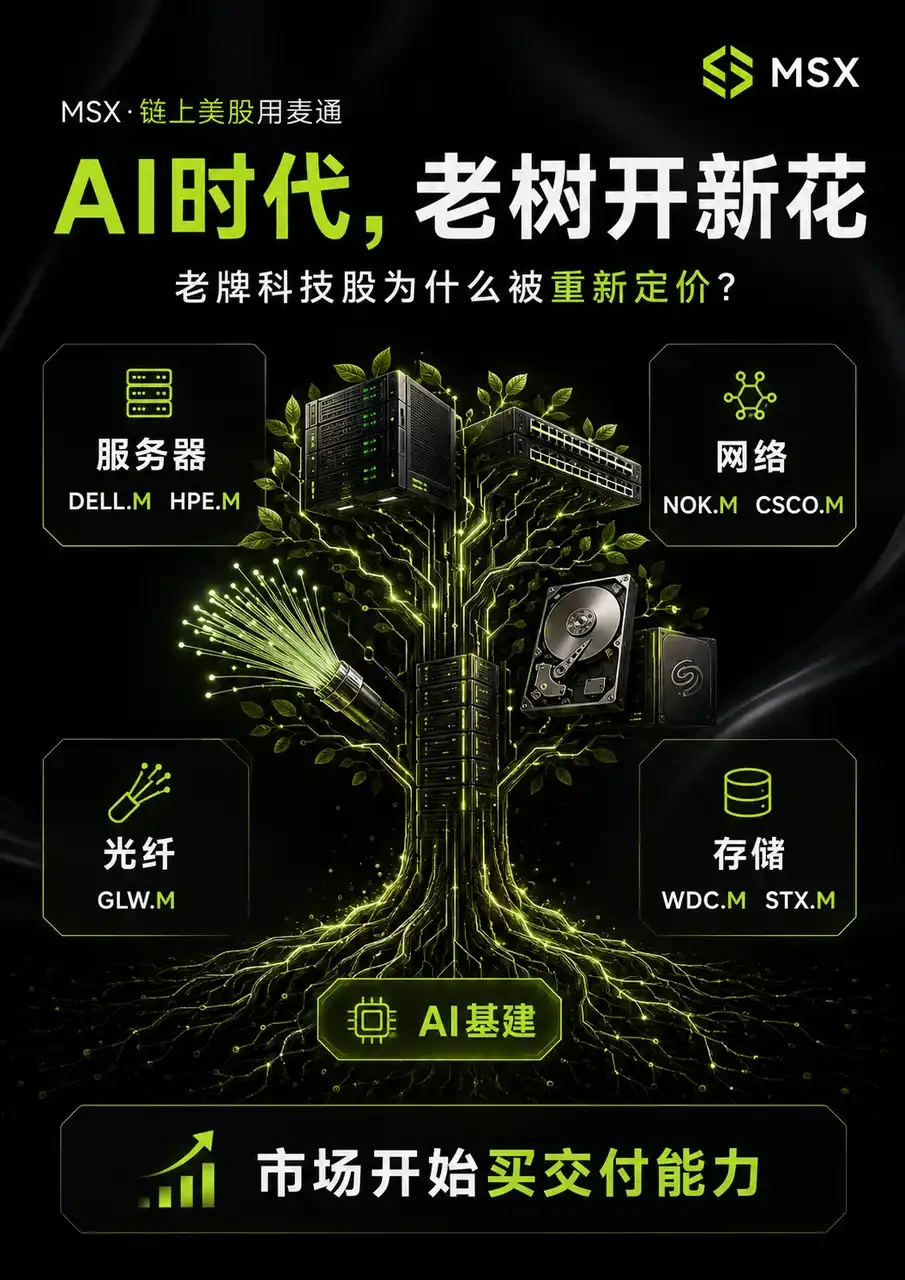
I. The AI Rally Shifts Gears: Why Revalue Old-Guard Tech Stocks?

Over the past few years, the core thread of the AI trade has been very clear: first look at the models, then look at the computing power.

This is easy to understand. Those with the strongest models or access to the most GPUs received the most direct market premium. In this phase, investors were most willing to buy AI imagination, the computing power supply gap, and core beneficiaries like NVIDIA.

However, the issue is that AI cannot remain solely in press conferences and model parameters. After all, models need data centers to be trained; inference needs servers, networks, storage, and power to be deployed at scale; and for enterprises to truly use AI, they need complete IT architectures and delivery capabilities.

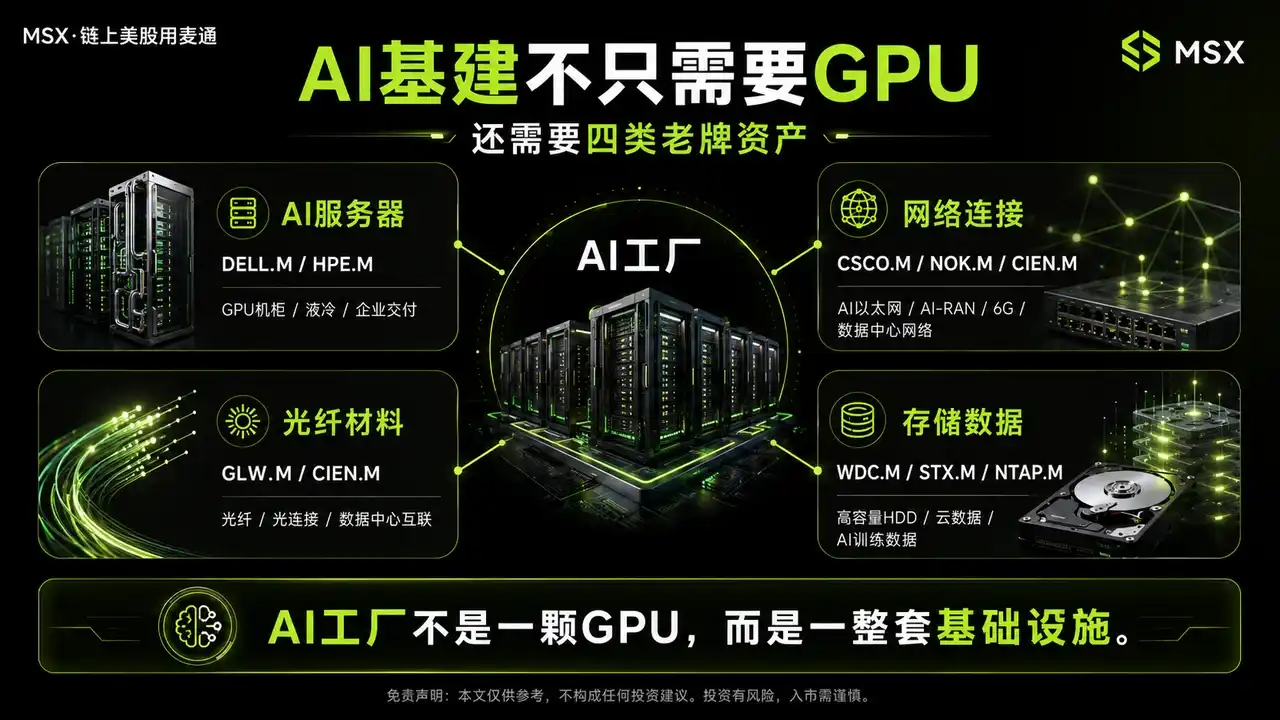
In other words, AI isn't a problem solved by a single GPU; it's an entire complex systems engineering challenge. This is also the starting point for the re-pricing of old-guard tech companies.

Previously, the market might have seen Dell and thought of PCs and traditional servers; seen HPE and thought of enterprise hardware; seen Nokia and thought of the old 5G equipment story; seen Cisco and thought of traditional networking gear; seen Corning and thought of glass and fiber materials; seen Western Digital and Seagate and thought of the hard drive cycle.

These labels aren't wrong, but in the AI infrastructure build-out cycle, their roles have changed. Building AI data centers requires rack-scale servers, liquid cooling, storage, network switches, fiber connectivity, data management, power infrastructure, and enterprise-grade delivery capabilities. The larger the AI cluster, the higher the demands on system integration, network transmission, storage capacity, and operational capabilities.

Therefore, the essence of this revaluation isn't a sudden wave of market nostalgia, nor old companies collectively jumping on the AI bandwagon. Instead, as AI moves into the order, revenue, and delivery phase, the market is starting to re-evaluate 'who can actually build the AI infrastructure.'

These companies may not be the sexiest, but they share a common advantage: their decades of accumulated customers, channels, supply chains, delivery experience, and infrastructure capabilities are becoming valuable again during the large-scale AI deployment phase.

In other words, AI is placing a batch of 'old assets' into a 'new demand' context for re-pricing.

II. From Servers, Networks to Storage: Old-Guard Tech Stocks Are Being Placed in the AI Infrastructure Chain

Overall, this round of AI-driven revaluation of old-guard tech stocks can roughly be divided into three lines: Servers & System Integration, Networking & Connectivity, and Storage & Data Management.

The first line is servers and system integration.

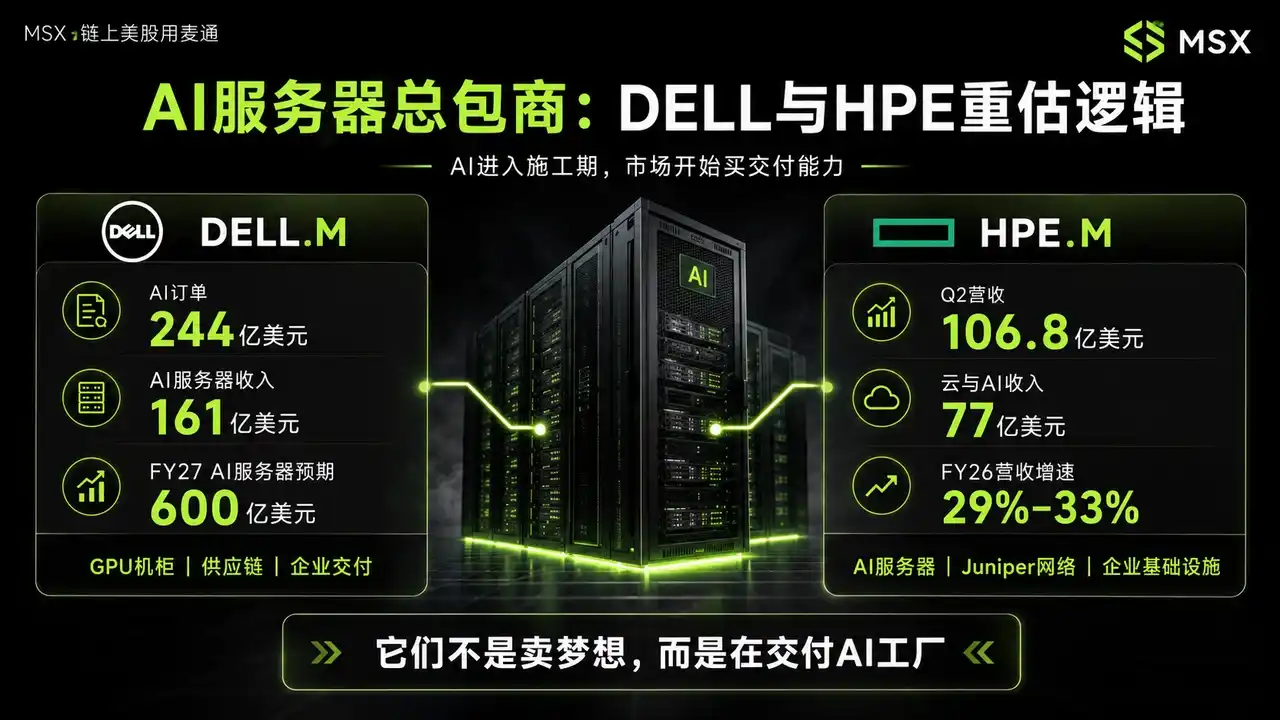
Dell is the most typical example. In its latest quarterly earnings, Dell delivered very strong numbers: Q1 FY27 revenue reached $43.8 billion, AI orders reached $24.4 billion, and it recognized $16.1 billion in AI server revenue. The company also raised its full-year FY27 AI server revenue expectation to $60 billion and raised its full-year revenue guidance midpoint to $167 billion.

These numbers are significant because they change how the market views Dell. Previously, investors looked at Dell mostly through the lens of the PC cycle, traditional servers, and enterprise hardware demand. But now, the market is starting to see if Dell can become the general contractor in building AI factories.

Its advantage is not in making its own GPUs, but in its supply chain, delivery capability, enterprise customer base, server system design, and integration capabilities within the NVIDIA ecosystem. An AI server isn't finished when a GPU is sold; it needs to be installed into racks, connected to networks, power, and cooling systems, and then delivered to cloud providers and enterprise customers.

Dell is capturing this phase from chip to system deployment. The logic for HPE is similar.

HPE's stock surged after its latest earnings, also primarily due to strong AI infrastructure demand. The company's Q2 revenue reached $10.68 billion, up 40% year-over-year; cloud and AI-related business revenue reached $7.71 billion, and it raised its full-year FY2026 growth outlook. More importantly, HPE also benefits from the networking capabilities brought by Juniper, making it less of just a traditional server company and more like an 'AI networking + enterprise infrastructure' platform.

Therefore, the revaluation logic for Dell and HPE is not that 'they are turning into NVIDIA,' but that they are becoming crucial system integrators in the AI factory construction crew.

The second line is networking and connectivity.

One of the most easily overlooked aspects of AI infrastructure is connectivity. Computing power does not exist in isolation. Data centers require high-speed internal interconnection, data centers need fiber optic connections between them, and as AI applications move to the edge and end devices, stronger telecom networks and wireless infrastructure are needed. The larger the scale of AI training and inference, the less networking and connectivity are mere supporting roles; they become the critical infrastructure determining computing efficiency.

This is also why Corning, Nokia, and Cisco are being discussed anew. Corning is a very typical example; it's not a traditional AI chip stock, but its fiber optics, optical connectivity, and optical communication materials happen to be important supporting components for AI data center expansion.

The company's Q1 2026 core sales reached $4.35 billion, up 18% year-over-year; within that, optical communications business sales reached $1.846 billion, up 36%. The company also mentioned that Gen AI product demand and new long-term agreements with large hyperscale customers were key growth drivers, indicating that AI data centers don't just need GPUs, but also the foundational materials that truly connect the computing power.

Nokia's story extends from traditional 5G equipment to AI-RAN, 6G, and AI-native wireless networks. NVIDIA previously announced it would invest $1 billion in Nokia, and the two would collaborate on advancing AI-RAN and the transition from 5G to 6G. This signal is important because AI traffic won't remain solely in data centers; it will enter end-user scenarios like phones, cars, robots, and AR/VR. As long as AI applications continue to spread to the edge and mobile networks, telecom infrastructure companies will regain narrative space.

Cisco's logic leans more toward data center networking. The company's Q3 FY2026 revenue reached $15.8 billion, up 12% year-over-year; data center switch orders grew over 40% year-over-year. It's important to remember that in AI clusters, the network is not just a simple cable but a critical component affecting data transfer efficiency, computing power utilization, and cluster stability.

The common logic for this category of companies is: the larger the scale of AI deployment, the more valuable networking and connectivity become.
The third line is storage.

This line has become widely known to the market in the past two months: AI doesn't just lack computing power, it also lacks storage. Previously, the market focused most on HBM, DRAM, and NAND. But now, high-capacity HDDs are back in the spotlight because AI model training, inference logs, video data, enterprise data, and cold data archiving all create larger storage capacity demands.

Western Digital is one representative. The company's latest quarterly revenue grew 45% year-over-year to $3.34 billion, and it provided next-quarter revenue guidance above market expectations. More importantly, the market noted that its high-capacity hard drive demand primarily comes from AI and cloud data centers. Seagate is similar, clearly benefiting from high-capacity nearline hard drives, with data center customers accounting for a growing share.

Of course, the AI era doesn't require all data to sit on the most expensive high-speed storage. Vast amounts of cold data, training data, log data, video data, and archival data still need cost-effective, high-capacity hard drives. Therefore, the revaluation logic for WDC and STX is not a sudden 'hard drive revival,' but that the AI data explosion is making storage a necessity once again.
III. What Constitutes a Genuine Revaluation?

However, the AI revaluation of old-guard tech stocks does not mean all old companies deserve blind optimism.

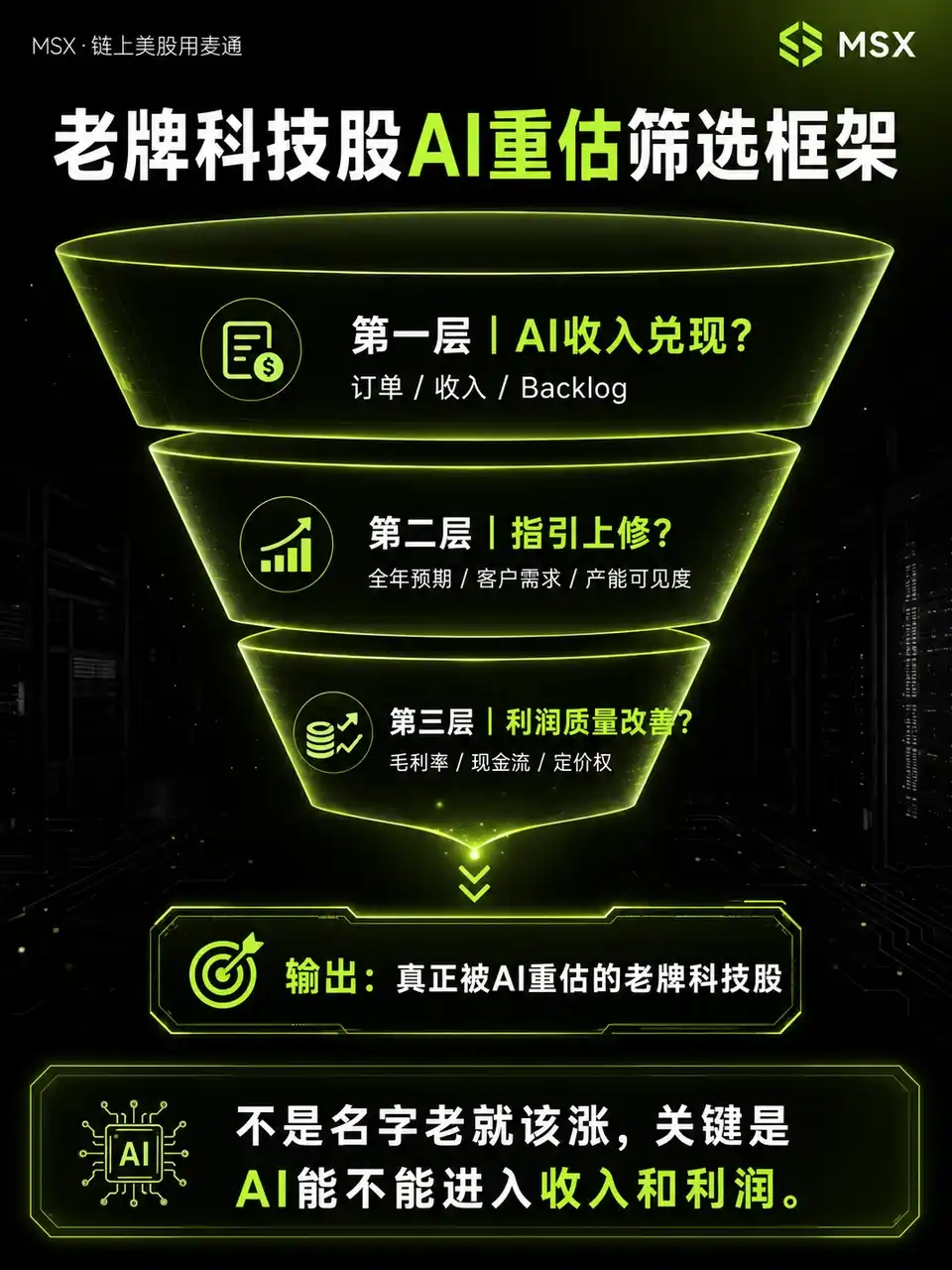
The most important distinction here is that some companies have genuinely entered the AI infrastructure chain. Therefore, judging whether such a company is truly being revalued involves at least three criteria:

  • First, Is there order and revenue realization? For example, Dell's AI orders and AI server revenue, HPE's cloud and AI-related business, Corning's optical communications revenue, Cisco's data center switch orders, WDC's high-capacity hard drive demand—these matter more than simply telling an AI story.
  • Second, Is there guidance revision upward? If AI remains only in press releases and product descriptions, stock prices can easily rise and then fall back. But if management is willing to raise full-year revenue expectations, business growth outlooks, or key product shipment forecasts, it suggests AI demand is no longer just short-term sentiment but may be altering the company's growth trajectory. This is also why the market is re-pricing companies like Dell and HPE.
  • Third, Can profit quality keep up? The biggest issue for old-guard hardware companies has always been gross margins and cyclicality. Fast growth in AI server revenue does not necessarily mean high profit elasticity; rising storage prices may also be just short-term supply-demand mismatch; increased networking equipment orders also need to translate into sustainable profits.

A truly good revaluation should see improvement in revenue growth, order visibility, and profit quality together.

If only revenue goes up but gross margins are squeezed thin, or if demand is merely a short-cycle inventory restocking, then valuation re-rating will be limited. Ultimately, the market isn't buying 'old companies telling new stories,' but whether 'old assets plus new demand can become new profits.'

This is also the most noteworthy aspect of this round of 'old trees blossoming anew': AI will not turn all traditional tech companies back into growth stocks. It will only screen out those truly positioned at key infrastructure points and capable of converting AI demand into orders, revenue, and profits.
In Conclusion

Objectively speaking, at this stage of the AI rally, it's no longer just about 'whose model is stronger' or 'who has more GPUs.' The real change is that AI is entering the actual construction phase.

As more AI data centers are built, server companies will be re-priced; as computing clusters become more complex, networking companies will be re-priced; as data centers need more fiber connectivity, materials companies will be re-priced; and as AI data continues to explode, storage companies will also be re-priced.

This is why old-guard tech stocks are being seen anew by the market: they haven't suddenly become young again; rather, the AI era once again needs the infrastructure they possess.

But this also means this round of revaluation won't be evenly distributed among all 'old dogs.'

Only by truly entering the capital expenditure chain of data center and enterprise deployment can old-guard tech companies potentially move from 'valuation repair' to 'logical revaluation.'


Связанные с этим вопросы

QWhat are the three main categories of 'old tech' stocks being re-evaluated in the context of AI infrastructure, according to the article?

AAccording to the article, the three main categories are: 1) Servers and System Integration (e.g., Dell, HPE), 2) Networking and Connectivity (e.g., Corning, Nokia, Cisco), and 3) Storage and Data Management (e.g., Western Digital, Seagate).

QWhat is the fundamental reason cited for the market's re-evaluation of legacy tech companies like Dell and Nokia?

AThe fundamental reason is that AI has moved from the model/parameter stage into a real-world construction and deployment phase. As AI data centers and infrastructure are being built at scale, the market is looking for companies with proven capabilities in delivery, system integration, and core infrastructure—strengths that these legacy companies have accumulated over decades.

QWhat are the three criteria the article proposes to determine if a legacy tech company is being genuinely revalued by the AI trend?

AThe three criteria are: 1) Evidence of AI-related orders and revenue realization (e.g., Dell's AI server revenue), 2) Upward revisions to company guidance (e.g., Dell, HPE raising full-year revenue expectations), and 3) Improvements in profit quality, not just top-line revenue growth (to ensure sustainability beyond short-term cycles).

QHow does the article describe the role of companies like Dell and HPE in the AI infrastructure build-out?

AThe article describes their role as being crucial 'system integrators' or 'general contractors' for building AI factories. Their advantage is not in making GPUs but in their supply chain, delivery capabilities, enterprise customer base, server system design, and integration with ecosystems like NVIDIA's, which are essential for turning GPU chips into fully functional, deployed systems.

QWhy are networking and connectivity companies like Corning and Cisco being re-evaluated for AI?

AThey are being re-evaluated because as AI training and inference scale, the efficiency of computing clusters depends heavily on high-speed data transfer and reliable connections. AI data centers require extensive fiber optic and network infrastructure for internal and external connectivity. Therefore, the need for robust networking and connectivity solutions is becoming a critical and valuable part of the AI infrastructure chain.

Похожее

Is the Sharp Decline Over? Let the Data Speak

**Has the Sharp Decline Ended? Let Data Speak** Bitcoin's recent significant drop has placed short sellers in a precarious position. Three concurrent pressures—sustained outflows from ETFs, miners offloading coins to exchanges, and short-term holders capitulating—pushed the price near $63k. The asset fell 13% this week and 21% this month, roughly halving from its all-time high. A critical data point is the extremely crowded short positioning, with a short-to-long ratio reaching 8:1, representing nearly $100 billion in short interest overhead. This creates conditions for a potential short squeeze if selling pressure merely pauses, similar to the event in November 2022 which triggered a 24% rally. The selling pressures are real: spot Bitcoin ETFs have seen a record $5.4 billion outflow over 20 days. Short-term holders moved 53k loss-held BTC to exchanges in a day, and miners sent 24k BTC to Binance, a six-month high. Capital is also rotating towards AI and tech stocks like SpaceX, with $400 billion invested in AI infrastructure recently. However, on-chain data shows accumulation by long-term holders, who added 200k BTC in a month, and institutions/miners have absorbed 1.24 million BTC since 2023. This indicates strong buying beneath the surface. Key levels to watch are the $67k-$70k zone (2021 high & 2024 breakout point). A swift recovery above it suggests a leverage washout; failure could test $60k-$55k. The direction also hinges on ETF flow reversal. Currently, the S&P 500 hits new highs driven by AI, while Bitcoin and DeFi (TVL down from $173b to $73.9b) lag. The most probable path is a grinding basing process between $60k-$58k with continued ETF outflows. A less likely but explosive scenario involves a sudden flow reversal, a surge above $70k triggering a short squeeze, and a rally back above $76k. The immediate trigger depends on when the relentless selling pauses. A final cautionary note questions Bitcoin's correlation: if the high-flying U.S. stock market corrects, will Bitcoin once again miss the rally but not the decline?

foresightnews_api16 мин. назад

Is the Sharp Decline Over? Let the Data Speak

foresightnews_api16 мин. назад

Single-Day Plunge of 30%, Arthur Hayes Suddenly Liquidates: Why Did ZEC Get Exploded by Security Issues?

On June 5th, Zcash founder Zooko Wilcox disclosed a critical soundness vulnerability in the project's latest Orchard privacy pool. This flaw, found in the elliptic curve multiplication constraints, could allow an attacker to create unlimited counterfeit ZEC within the shielded pool, with transactions appearing valid. The vulnerability was discovered in late May by security researcher Taylor Hornby, who utilized Anthropic's new Opus 4.8 AI model for a targeted audit. The Zcash ecosystem had already performed an emergency network upgrade to patch the issue. However, the detailed disclosure triggered severe market panic, causing ZEC's price to plummet over 30% in a single day. Notably, prominent investor Arthur Hayes announced he had sold his entire ZEC position following the news. The incident starkly challenges the "technological trust" narrative central to privacy coins. Despite years of top-tier cryptographic audits, the bug persisted until uncovered with advanced AI-assisted research. This highlights the growing gap between theoretical perfection and practical implementation in privacy technology. The event serves as a industry-wide warning: in an AI-driven security landscape, the assumption that "undiscovered equals safe" is obsolete. It underscores the urgent need for continuous, proactive security practices combining AI audits, formal verification, and rapid response mechanisms.

foresightnews_api1 ч. назад

Single-Day Plunge of 30%, Arthur Hayes Suddenly Liquidates: Why Did ZEC Get Exploded by Security Issues?

foresightnews_api1 ч. назад

Breaking the Curse of DeFi Cascading Liquidations, Vitalik Proposes a New Solution

**Vitalik Buterin Proposes New DeFi Design to Eliminate Forced Liquidations** Ethereum co-founder Vitalik Buterin has published a proposal for a new decentralized finance (DeFi) architecture aimed at removing the automatic liquidation mechanisms prevalent in current lending protocols. The core idea involves creating synthetic assets using options as building blocks, fundamentally avoiding the抵押借贷结构 that triggers forced sell-offs. The proposal responds to a recurring flaw in DeFi: during sharp market downturns, mass自动清算 of under-collateralized positions can exacerbate price declines, creating systemic selling pressure and market instability, as evidenced by recent crypto market volatility. Buterin's model would split an asset like 1 ETH into two option-like derivatives, P and N, pegged to a price index with a set strike price and expiration. At expiry, an oracle determines the settlement price to allocate the underlying ETH between P and N holders. This design eliminates the "cliff" of instant liquidation. Instead, a position's value would gradually drift from its target peg if not actively rebalanced by the user, transferring the rebalancing decision from the protocol to the user or automated tools. A key advantage is the reduced reliance on high-frequency, real-time oracle price feeds, which are vulnerable to manipulation and errors in current systems. The delayed settlement in the options model allows for more robust, fault-tolerant oracle designs. However, significant challenges remain for practical adoption. High transaction costs (slippage) from frequent rebalancing on automated market makers (AMMs) could erode user funds. The model may not be suitable for stablecoins requiring a strict 1:1 dollar peg, as it inherently allows for value drift. Success would depend on developing new liquidity provisioning models and deep markets for these synthetic assets. The proposal represents a fundamental rethinking of DeFi risk management, challenging the industry to explore alternatives to被动集中平仓 rather than merely optimizing existing liquidation processes. It remains a theoretical framework awaiting implementation and testing by development teams.

foresightnews_api1 ч. назад

Breaking the Curse of DeFi Cascading Liquidations, Vitalik Proposes a New Solution

foresightnews_api1 ч. назад

Bitcoin's Decline Marks the Transformation of Crypto

Title: The Decline of Bitcoin Marks the Transformation of Crypto While Bitcoin's price recently fell below $70,000, down approximately 45% from its peak, the broader crypto industry is not following it into decline. Instead, crypto is maturing and evolving beyond its dependence on Bitcoin's price movements. Two of Bitcoin's core functions are being usurped. First, AI has captured its role as the primary speculative asset. AI, with its tangible revenue, explosive demand, and massive capital inflows ($700-830 billion in 2024), is siphoning off the speculative "hot money" that once drove Bitcoin. It also contributes to a sustained high-interest-rate environment, further tightening liquidity for assets like Bitcoin. Second, dollar-pegged stablecoins like USDC and USDT have replaced Bitcoin as the crypto market's foundational currency and primary on/off-ramp. Most trading pairs and on-chain transactions are now settled in stablecoins, severing the historical link where all capital inflows had to pass through Bitcoin first. This decoupling allows projects to thrive based on their own fundamentals rather than Bitcoin's price. Examples include Hyperliquid, an on-chain derivatives exchange with annual revenues of $8-13 billion, and prediction market platform Polymarket, valued at $200 billion with $3.65 billion in annual fees. These projects are evaluated on traditional metrics like revenue and user growth. New opportunities are emerging, particularly around privacy. Privacy coins like Zcash (ZEC) are seeing surging demand, while infrastructure like NEAR enables private, cross-chain asset transfers without requiring users to hold a specific token—privacy becomes a universal service layer. In this new paradigm, stablecoins are the universal cash, various project tokens represent equity, and privacy-enabled cross-chain coordination layers (like NEAR) act as the critical infrastructure connecting a fragmented, multi-chain ecosystem. Bitcoin is now just one asset among many. The era where the entire crypto market moved in lockstep with Bitcoin is over. The industry's health should now be judged by project fundamentals—real revenue, active users, and tokenomics that capture value—and the development of the underlying infrastructure enabling a mature, dollar-denominated crypto economy.

foresightnews_api1 ч. назад

Bitcoin's Decline Marks the Transformation of Crypto

foresightnews_api1 ч. назад

Торговля

Спот
Фьючерсы

Популярные статьи

Неделя обучения по популярным токенам (2): 2026 может стать годом приложений реального времени, сектор AI продолжает оставаться в тренде

2025 год — год институциональных инвесторов, в будущем он будет доминировать в приложениях реального времени.

1.8k просмотров всегоОпубликовано 2025.12.16Обновлено 2025.12.16

Неделя обучения по популярным токенам (2): 2026 может стать годом приложений реального времени, сектор AI продолжает оставаться в тренде

Обсуждения

Добро пожаловать в Сообщество HTX. Здесь вы сможете быть в курсе последних новостей о развитии платформы и получить доступ к профессиональной аналитической информации о рынке. Мнения пользователей о цене на AI (AI) представлены ниже.

活动图片