Standard Chartered Bank Places a 40x 'Bet', Calls for UNI to Rise to $100

marsbitОпубликовано 2026-06-16Обновлено 2026-06-16

Введение

Standard Chartered Bank’s digital asset research head, Geoff Kendrick, initiated coverage on Uniswap with a highly bullish long-term price target of $100 for its UNI token by 2030—a roughly 40-fold increase from its ~$2.60 trading price at the time of the report. The bank’s thesis hinges on the exponential growth of tokenized real-world assets (RWA), projected to surge from ~$340 billion to $4 trillion by 2028. It expects the share of these assets deployed in DeFi to rise from 3.5% to 30%, driving total DeFi TVL to around $2.7 trillion. As the leading decentralized exchange (DEX), Uniswap is positioned to capture a significant portion of this liquidity influx. A key catalyst is Uniswap’s “fee switch,” activated in late 2024, which directs a portion of protocol fees to UNI token buybacks and burns. This transforms UNI from a pure governance token into a yield-generating, deflationary asset, narrowing its valuation gap with centralized exchanges like Coinbase. The report draws an analogy: Coinbase operates like Netflix (centralized, high-cost), while Uniswap functions like YouTube (open, user-generated, network-effect driven). Despite its dominant market share and recent institutional adoption—such as BlackRock’s BUIDL fund and Fidelity’s stablecoin using Uniswap for liquidity—the path faces challenges. Competition from Solana-based DEXs and aggregators threatens user mindshare, while regulatory delays or setbacks in RWA adoption could slow the projected growth. Furthermore,...

Author: Jae, PANews

A research report from a traditional bank has ignited the somewhat quiet DeFi sector.

On June 15, Geoff Kendrick, Global Head of Digital Assets Research at Standard Chartered Bank, released a first-time coverage report on the DEX (decentralized exchange) Uniswap, making a radical prediction that turned heads in the crypto market: the price of Uniswap's governance token UNI is expected to surge approximately 40-fold before the end of 2030, reaching the $100 milestone.

At the time, UNI was trading at only around $2.6.

Once derided as a "governance token with no substance," UNI is being repriced by Wall Street as a productive asset with network effects. Although the distant narrative of a 40x gain is tempting enough, the journey to that endpoint may not be entirely smooth.

Wall Street's 40x Growth Script for UNI: Four Numbers, One Main Theme

In Standard Chartered's deconstruction logic, Uniswap is being embedded within a valuation framework for the deep integration of traditional finance and the on-chain world.

Exponential Expansion of RWA Tokenization ($340B → $4T)

The starting point for growth is the wave of RWA (Real World Asset) tokenization. Standard Chartered predicts that the global scale of on-chain tokenized assets will experience exponential growth, soaring from the current approximately $340 billion to $4 trillion by the end of 2028. Asset management giants like Fidelity and BlackRock are batch-uploading traditional assets like stocks, government bonds, and money market funds onto blockchains, meaning the liquidity of on-chain tokenized assets will expand at a pace far exceeding industry expectations.

This is equivalent to building a much larger reservoir for the DeFi track: the asset scale must be established first, and only then can subsequent financial activities like trading, lending, and staking have sufficient underlying assets to carry them.

DeFi Penetration Rate Leap (3.5% → 30%) Drives TVL Higher (37x)

Getting assets on-chain is only the first step; stagnant water needs to become flowing water. Simply put, only when assets flow into DeFi protocols can they be converted into protocol revenue and value. Standard Chartered expects that currently only about 3.5% of tokenized assets are deployed in the DeFi ecosystem. This proportion is projected to increase to 30% by 2030.

Driven by the dual engines of native crypto asset growth and RWA migration to chains, the overall DeFi TVL (Total Value Locked) is projected to skyrocket 37-fold from current levels by 2030, reaching approximately $2.7 trillion.

Fee Switch Provides Price Support (40x)

Uniswap, as the primary hub for on-chain liquidity, will become the biggest beneficiary of this tidal wave of capital. Its token, UNI, is also expected to rise from $2.6 to $100, capturing a near 40-fold increase.

The long-term price path for UNI provided by Standard Chartered is: $6.5 by end of 2026 → $20 by end of 2027 → $40 by end of 2028 → $65 by end of 2029 → $100 by end of 2030.

In the past, UNI was once mocked by the market as an "air token" because it only conferred governance rights and had no cash flow capture capability. At the end of last year, Uniswap activated the fee switch, officially ushering UNI into a deflationary era.

The report points out that on December 28th of last year, Uniswap destroyed 100 million UNI in a single move, and additionally burned 5 million UNI, reducing the total supply from 1 billion to 895 million. The circulating supply has also dropped to 622 million. This contraction in supply will provide support for the UNI price.

Furthermore, Uniswap has also generated approximately $21 million in protocol fees. The linear relationship between fees and trading volume means that as tokenized assets flood into the protocol, the fee switch will automatically trigger more burn. This signifies that UNI is transitioning from a "pure governance tool" to a "productive asset with deflationary properties," directly narrowing the valuation multiple gap between Uniswap and listed exchanges like Coinbase.

It is worth mentioning that Geoffrey Kendrick also proposed a vivid business analogy in the report: likening Uniswap to YouTube, and Coinbase to Netflix.

  • Coinbase (Netflix model): Centralized operation, heavy asset investment, requiring high capital support. Listing assets and compliance involve multi-layered screening, with high marginal costs for expansion, making it easier to limit the variety of asset classes covered.

  • Uniswap (YouTube model): An open liquidity pool architecture where any user can be a "content creator" (liquidity provider). The platform does not incur high costs for listing assets. In scenarios like stablecoin trading, liquid staking derivatives, and niche tokens, the network effects and long-tail advantages of this open model are hard for centralized exchanges (CEXs) to match.

This two-sided effect, which grows more prosperous with use, is precisely the moat that allows Uniswap to maintain its leading position in the long run.

More importantly, Standard Chartered believes Uniswap is far from a simple "retail DEX application." Its essence is a set of integrable market infrastructure. Once RWA scales up, traditional financial institutions can directly "plug" assets into Uniswap's liquidity pools for trading. This is a functionality that traditional financial markets themselves cannot achieve.

Uniswap Becomes Preferred On-ramp for Traditional Funds, Yet Faces Pincer Attack from Emerging DEXs and Aggregators

Wall Street's distant lens is captivating enough, but returning to the reality of the crypto market, Uniswap's actual situation is not as straightforwardly linear as portrayed in the research report.

Since its founding in 2018, Uniswap's cumulative trading volume has exceeded $3.7 trillion, with cumulative fees as high as $5.6 billion. Its TVL is approximately $2.88 billion.
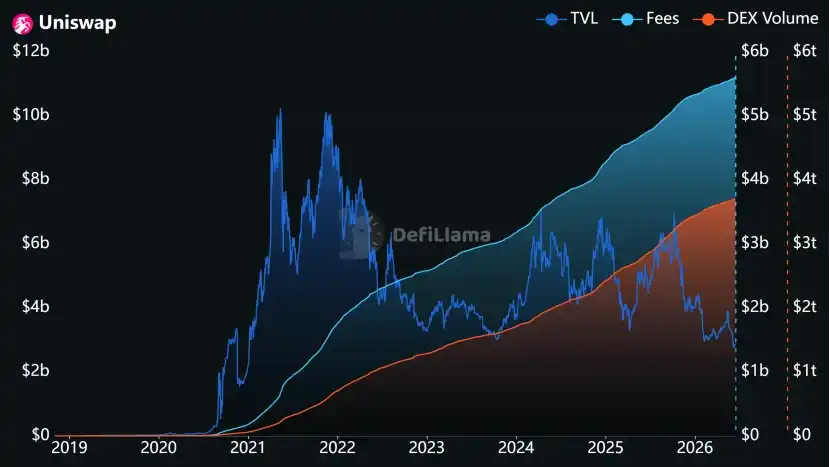
In terms of market share, Uniswap's DEX throne remains solid. Whether on the Ethereum mainnet or across major L2 ecosystems, Uniswap's trading volume and liquidity depth hold a dominant position, with no competitor posing a substantive threat.

More significant signals come from the institutional side. In February this year, BlackRock's tokenized money market fund BUIDL announced it would be available for trading on UniswapX and strategically purchased UNI tokens. With the adoption of UniswapX, which introduces features like off-chain routing, gasless transactions, and MEV (Miner Extractable Value) resistance, the experience gap between DEXs and CEXs is significantly narrowed, making it the preferred on-ramp for traditional capital.

Similarly, last Friday (June 12th), Fidelity also deployed liquidity for its stablecoin, FIDD, on Uniswap. The protocol's concentrated liquidity model is currently the most efficient pricing mechanism on-chain. Once compliant RWA assets are tokenized on a large scale, Uniswap is poised to become the "New York Stock Exchange" on-chain, holding the power of asset pricing.

Wall Street's water is flowing on-chain. And Uniswap is that faucet. Wall Street institutions are treating Uniswap as the on-chain interface for compliant assets, and UNI is also moving towards a pricing logic akin to "on-chain routing infrastructure."

Although the vision of a $100 endpoint is quite enticing, two major obstacles still lie in Uniswap's path to the summit, which could significantly delay or even nullify this distant promise.

  • Traffic Hijacking by Emerging DEXs and Aggregators (Competitive Risk): Solana-based DEXs like Jupiter and Raydium, riding on Meme mania and extremely low transaction costs, have captured a massive amount of retail traffic. Meanwhile, aggregators like 1inch and CowSwap intercept users at the front-end, reducing Uniswap to a mere "backend liquidity pool" in certain ecosystems, continuously eroding its brand premium and user mindshare.

  • Delays in Tokenization Adoption (Macro Risk): Standard Chartered's valuation heavily relies on the assumption that "DeFi TVL will reach $2.7 trillion by 2030." If global legislative progress on tokenization falls short of expectations, or if large-scale security incidents or systemic risks occur, the penetration rate of RWA could slow down significantly, potentially severely postponing the realization cycle of this grand narrative.

Returning to the most intuitive price perspective, UNI is currently trading below $3, down more than 92% from its all-time high in May 2021.

The fee switch brought deflation but not a price reversal. Market apathy towards the DeFi narrative, depleted liquidity, and high macro interest rates have all put significant pressure on UNI's valuation.

However, this might be precisely the source of the "40x potential" in Standard Chartered's eyes: starting from a low base.

Standard Chartered's first-time coverage of UNI with a $100 target price carries more symbolic significance than the price itself. In reality, the accuracy of the prediction is not the most important thing; what matters is that Wall Street's perception of DeFi is evolving: shifting from the early days of "unbridled growth and speculative bubbles" towards a rational business judgment based on "capital efficiency, network effects, and cash flow value."

It should be noted that Wall Street research reports are often strong on macro logic but short on micro risks. For investors immersed in this space, the 40x endpoint is undoubtedly attractive, but the road to 2030 is also destined to be strewn with thorns.

Whether UNI can truly capture the $4 trillion tokenization红利 depends on how skillfully it performs the high-difficulty dance between the principles of decentralization and global regulatory compliance in the real world.

More challenging than a 40x gain might be the four-year wait, which tests faith even more.

Связанные с этим вопросы

QWhat is the key prediction made by Standard Chartered Bank's research report on Uniswap's UNI token?

AStandard Chartered Bank predicts that Uniswap's governance token, UNI, will surge approximately 40 times, reaching $100 by the end of 2030.

QWhat are the two main business models Geoffrey Kendrick compares Uniswap and Coinbase to in the report?

AThe report compares Coinbase to Netflix (centralized, high capital costs, curated assets) and Uniswap to YouTube (open, user-generated liquidity, low marginal costs, strong network effects).

QAccording to the report, what two major factors are critical for achieving the $100 UNI price target?

AThe $100 price target relies on: 1) The massive expansion of tokenized real-world assets (RWA) to $4 trillion, and 2) A significant increase in the proportion of these assets flowing into DeFi, from 3.5% to 30% by 2030.

QWhat recent development changed UNI's economic model from a 'pure governance tool'?

AThe activation of the 'fee switch' mechanism. It initiated token burns (reducing total supply) and allows UNI to capture protocol fees, transforming it into a deflationary, revenue-generating asset.

QWhat are the two main challenges or risks identified for Uniswap's growth path to 2030?

AThe two main challenges are: 1) Competitive pressure from emerging DEXs (like Jupiter, Raydium) and aggregators that can divert user flow. 2) The macro risk of delayed adoption of tokenized assets if regulatory progress or market conditions slow down.

Похожее

Google TPU Shipments Revised Up by 50%

Recent industry research indicates a significant upward revision in the shipments of Google's TPU (Tensor Processing Unit) chips. Previous expectations for 2027 were set at around 10 million units, but new estimates now point to 15 million units, a 50% increase. This substantial boost directly translates to higher demand across the entire supporting supply chain. Google's TPU clusters utilize a standardized all-optical interconnect architecture. Consequently, key hardware components are deeply integrated and scaled in fixed ratios with the chips. The 15 million TPU target will drive corresponding demand increases for NPO optical engines (roughly a 1:1 match), 1.6T optical modules, OCS optical switches, high-end server power supplies, fiber optics & MPO connectors, and liquid cooling solutions. Among these, liquid cooling is highlighted as the sector experiencing the most significant transformation and offering the most stable potential for excess returns. As next-generation TPU chips reach power levels where traditional air cooling is insufficient, liquid cooling becomes essential. 2026 is forecasted as the first year of substantial adoption for Google's liquid cooling solutions. This shift, coupled with delivery and capacity bottlenecks faced by incumbent overseas manufacturers, is creating a prime window for domestic Chinese suppliers to enter and secure Google's core supply chain. The market size for Google-specific liquid cooling is projected to potentially triple from a baseline of hundreds of billions to around 300 billion units by 2028. The logic for the fiber optic sector is also being rewritten. Once considered a cyclical commodity tied to telecom operator procurement, fiber is now a strategic and scarce resource for AI Data Centers (AIDC). A severe supply-demand imbalance, driven by the long lead time for preform production (18-24 months) and surging demand from cloud giants, is supporting strong performance. Chinese fiber manufacturers are well-positioned to capture a significant share of global AIDC demand, with exports potentially reaching 200-300 million core kilometers in 2026. Overall, the investment focus within the AI computing industry is shifting from pure "chip performance speculation" towards the more certain incremental growth in computing infrastructure and its supporting ecosystem. The upward revision in Google TPU shipments, along with the potential for further doubling by 2028, is seen as solidifying performance visibility for the entire supporting supply chain over the next two years.

marsbit1 ч. назад

Google TPU Shipments Revised Up by 50%

marsbit1 ч. назад

What Wall Street Really Wants After the Crypto Story Recedes

The tide of speculative crypto narratives has receded, revealing Wall Street's true objective: building a controlled, yield-generating, and compliant financial pipeline on distributed ledgers. They are migrating core functions onto blockchains, not for decentralization, but for efficiency and new revenue streams. Key developments include BlackRock's BUIDL fund, a tokenized treasury fund acting as a foundational reserve asset, and the rise of Securitize, which is going public and partnering with the NYSE to build a 24/7 digital securities trading and settlement system. This signals a major shift of securities clearing to blockchain technology. To make volatile assets like Bitcoin palatable for institutional investors, firms like BlackRock and Goldman Sachs are creating "covered call" ETFs (e.g., BITA). These products systematically sell options on Bitcoin holdings, transforming price volatility into stable monthly income, effectively repackaging crypto as a yield-bearing asset. Stablecoins are being positioned not as speculative tools but as efficient payment rails. Companies like Stripe and Mastercard are integrating them for instant, low-cost merchant settlements and cross-border card payments, respectively. Critically, new legislation like the GENIUS Act shapes them as non-interest-bearing, heavily regulated extensions of the US dollar system. In summary, Wall Street is quietly constructing a parallel, blockchain-based financial infrastructure featuring tokenized traditional assets, structured crypto yields, and programmable dollar pipelines—all under its control and fully integrated with existing regulatory and credit frameworks.

marsbit1 ч. назад

What Wall Street Really Wants After the Crypto Story Recedes

marsbit1 ч. назад

Tying Itself to SpaceX: Cursor's $60 Billion Rise

This article recounts the rapid rise of AI-powered coding startup Cursor and its 25-year-old MIT graduate CEO, Michael Truell. Launched in 2023, Cursor achieved explosive growth, reaching over 10 billion USD in revenue by late 2025. However, its journey highlights a central dilemma for AI application companies: dependence on foundational model providers. Cursor initially relied heavily on Anthropic's models but faced an existential threat when Anthropic launched its own competing coding tool, Claude Code. In response, Cursor declared an internal emergency in early 2026 and accelerated development of its own model, Composer. To secure the immense computing power needed, Truell struck a pivotal deal with Elon Musk's SpaceX in April 2026. The collaboration grants Cursor access to SpaceX's supercomputing resources for Composer, while SpaceX's Grok model benefits from Cursor's programming data. The agreement includes a potential 600 billion USD acquisition of Cursor by SpaceX later in the year, though a substantial termination fee is in place if the deal falls through. The story explores Cursor's intense, sometimes controversial hiring practices involving lengthy unpaid "work trials," its complex partnership-turned-rivalry with Anthropic, and its high-stakes gamble to ensure independence through the SpaceX alliance. The core question remains: will Cursor evolve into a defining, independent "generational" software company, or become a key piece in a tech giant's AI arsenal?

marsbit1 ч. назад

Tying Itself to SpaceX: Cursor's $60 Billion Rise

marsbit1 ч. назад

Торговля

Спот
Фьючерсы

Популярные статьи

Как купить UNI

Добро пожаловать на HTX.com! Мы сделали приобретение Uniswap (UNI) простым и удобным. Следуйте нашему пошаговому руководству и отправляйтесь в свое крипто-путешествие.Шаг 1: Создайте аккаунт на HTXИспользуйте свой адрес электронной почты или номер телефона, чтобы зарегистрироваться и бесплатно создать аккаунт на HTX. Пройдите удобную регистрацию и откройте для себя весь функционал.Создать аккаунтШаг 2: Перейдите в Купить криптовалюту и выберите свой способ оплатыКредитная/Дебетовая Карта: Используйте свою карту Visa или Mastercard для мгновенной покупки Uniswap (UNI).Баланс: Используйте средства с баланса вашего аккаунта HTX для простой торговли.Третьи Лица: Мы добавили популярные способы оплаты, такие как Google Pay и Apple Pay, для повышения удобства.P2P: Торгуйте напрямую с другими пользователями на HTX.Внебиржевая Торговля (OTC): Мы предлагаем индивидуальные услуги и конкурентоспособные обменные курсы для трейдеров.Шаг 3: Хранение Uniswap (UNI)После приобретения вами Uniswap (UNI) храните их в своем аккаунте на HTX. В качестве альтернативы вы можете отправить их куда-либо с помощью перевода в блокчейне или использовать для торговли с другими криптовалютами.Шаг 4: Торговля Uniswap (UNI)С легкостью торгуйте Uniswap (UNI) на спотовом рынке HTX. Просто зайдите в свой аккаунт, выберите торговую пару, совершайте сделки и следите за ними в режиме реального времени. Мы предлагаем удобный интерфейс как для начинающих, так и для опытных трейдеров.

1.0k просмотров всегоОпубликовано 2024.03.29Обновлено 2026.06.02

Как купить UNI

Обсуждения

Добро пожаловать в Сообщество HTX. Здесь вы сможете быть в курсе последних новостей о развитии платформы и получить доступ к профессиональной аналитической информации о рынке. Мнения пользователей о цене на UNI (UNI) представлены ниже.

活动图片