Russia’s Largest Crypto Mining Firm Hit as BitRiver CEO Faces Tax Evasion Allegations

bitcoinistОпубликовано 2026-02-03Обновлено 2026-02-03

Введение

Russia's largest cryptocurrency mining company, BitRiver, faces intensified legal and financial pressure as its founder and CEO, Igor Runets, has been detained and charged with multiple counts of tax evasion. A Moscow court placed him under house arrest, restricting his movement during the investigation. This development adds to BitRiver's existing challenges, including U.S. sanctions imposed in 2022 and the loss of key international partnerships. The company, which operates data centers in Siberia, has also faced operational cutbacks, delayed salary payments, and lawsuits from regional energy providers. The case underscores growing regulatory risks for crypto mining firms in Russia and may influence future compliance and governance practices in the sector.

Russia’s biggest crypto mining company is under renewed scrutiny after authorities detained BitRiver founder and CEO Igor Runets on multiple tax evasion charges, deepening the legal and financial pressure on a firm already constrained by sanctions and operational setbacks.

Related Reading: With Bitcoin Below $80K, ARK Reframes The Narrative Around Gold

The case, which is being handled by a Moscow court, has drawn attention to the risks facing large-scale crypto miners operating at the intersection of energy, regulation, and geopolitics.

According to reports from Russian outlets RBK and Kommersant, Runets was detained late last week and formally charged with three counts of alleged tax evasion.

Court filings indicate that the Zamoskvoretsky Court of Moscow ordered him placed under house arrest, a measure that restricts his movement while investigators proceed. His legal team has a limited window to appeal the ruling before it becomes fully enforceable.
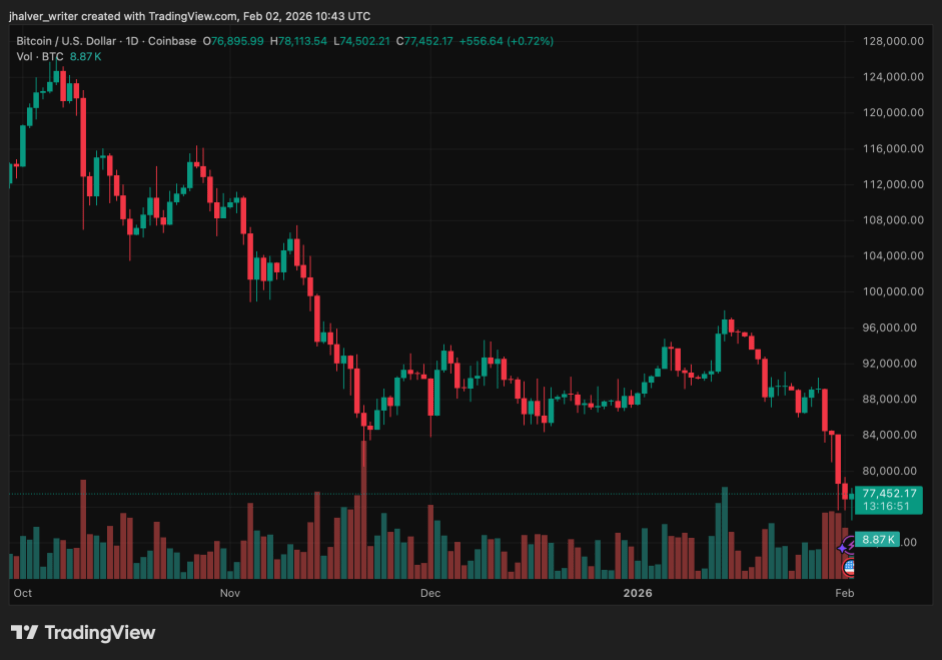
BTC's price trending downwards on the daily chart. Source: BTCUSD on Tradingview

Court Case Adds Pressure On Bitriver

Founded in 2017, BitRiver grew rapidly into Russia’s leading Bitcoin mining operator by building large data centers across Siberia.

The company used the region’s cold climate and relatively low electricity costs to support its mining operations and to provide infrastructure services to corporate clients. At its peak, BitRiver operated thousands of mining rigs across multiple sites and accounted for a significant share of Russia’s legal crypto-mining capacity.

Runets’ detention comes amid mounting challenges for BitRiver. The company was sanctioned by the US Treasury Department in mid-2022 following Russia’s invasion of Ukraine, limiting its access to Western partners and financial systems.

In 2023, Japanese financial group SBI exited its mining arrangement with BitRiver following its withdrawal from Russia, dealing a blow to the firm’s international business.

Financial Strain And Legal Disputes

Reports suggest that BitRiver began cutting costs and scaling back parts of its operations toward the end of 2024, leading to salary payment delays affecting employees.

The pressure continued into early 2025, when regional electricity provider Infrastructure of Siberia filed two lawsuits, alleging that it had paid BitRiver for equipment that was never delivered.

Despite these issues, Russia’s industrial mining sector continued to generate significant revenue in 2024, with BitRiver remaining the market leader. Bloomberg estimated Runets’ net worth at around $230 million in late 2024, largely tied to his role in the crypto mining industry.

Wider Implications for The Crypto Sector

The case against Runets highlights the growing legal and regulatory risks facing crypto executives, both in Russia and abroad. While authorities investigate the alleged tax violations, BitRiver must also manage ongoing litigation, strained partnerships, and scrutiny linked to sanctions.

Related Reading: With Bitcoin Below $80K, ARK Reframes The Narrative Around Gold

As the market awaits the verdict, the case’s outcome could shape how Russian crypto mining firms approach compliance, financing, and governance in an increasingly restrictive environment.

Cover image from ChatGPT, BTCUSD chart from Tradingview

Связанные с этим вопросы

QWhat are the main charges brought against BitRiver's CEO Igor Runets?

AIgor Runets, the founder and CEO of BitRiver, has been detained and formally charged with three counts of alleged tax evasion.

QWhat measures has the Moscow court taken regarding Igor Runets following the charges?

AThe Zamoskvoretsky Court of Moscow ordered Igor Runets to be placed under house arrest, which restricts his movement while the investigation proceeds. His legal team has a limited time to appeal this ruling.

QBesides the tax case, what other significant challenges has BitRiver faced recently?

ABitRiver has faced multiple challenges, including being sanctioned by the US Treasury Department in 2022, the exit of Japanese financial group SBI from their mining arrangement in 2023, cost-cutting measures leading to salary delays, and lawsuits from a regional electricity provider over undelivered equipment.

QHow did BitRiver become Russia's leading Bitcoin mining operator, and what advantages did it utilize?

AFounded in 2017, BitRiver grew rapidly by building large data centers across Siberia. It leveraged the region's cold climate and relatively low electricity costs to support its mining operations and provide infrastructure services to corporate clients.

QWhat broader implications does the case against Runets have for the crypto sector, according to the article?

AThe case highlights the growing legal and regulatory risks for crypto executives globally. Its outcome could influence how Russian crypto mining firms handle compliance, financing, and governance in an increasingly restrictive environment.

Похожее

Valuation of $852 Billion, CEO Holds Zero Shares, Shareholders in a Power Struggle: Who Controls OpenAI?

OpenAI, valued at $852 billion after a $122 billion funding round, is navigating immense opportunities and challenges. CEO Sam Altman holds zero equity, earning a minimal salary, which has raised governance concerns, notably during his brief 2023 ouster. Major investors include Microsoft (26.79%), OpenAI Foundation (25.8%), SoftBank (11.66%), Amazon (4.66%), and NVIDIA (3.47%). Their investments are often strategic, aimed at securing AI infrastructure advantages rather than purely financial returns. The company recently transitioned from a non-profit to a for-profit structure, with the OpenAI Foundation retaining significant control. However, oversight concerns persist as board members overlap between the two entities. Internally, tensions exist between Altman, who pushes for a potential IPO as early as Q4 2025, and the CFO, who cautions against rushing due to operational and financial risks. Financially, OpenAI reports $20 billion in monthly revenue (annualized $250 billion) but expects $140 billion in losses this year and $600 billion in compute investments over five years. Its high valuation—34x sales—reflects a bet on achieving AGI, as competition with rivals like Anthropic intensifies. The funding landscape highlights a divide: U.S. tech giants invest via corporate strategic deals, while Chinese AI firms rely on traditional VC funding, creating a significant capital gap. The ultimate question remains whether OpenAI’s vision justifies its historic valuation.

marsbit3 ч. назад

Valuation of $852 Billion, CEO Holds Zero Shares, Shareholders in a Power Struggle: Who Controls OpenAI?

marsbit3 ч. назад

Edge AI Daily Morning Report (April 12)

Edge AI Daily Brief (April 12) **Silicon Valley Front:** CoreWeave expanded partnerships with Meta and Anthropic, reflecting surging AI compute demand. Major cloud providers in China raised prices by 5%-30% due to soaring GPU costs and a 1000x increase in daily token usage since 2024. Anthropic, with annualized revenue exceeding $30B, is exploring in-house chip development to address shortages and signed a 3.5GW TPU deal with Google and Broadcom. The U.S. MATCH Act tightened semiconductor export controls, lowering technology thresholds and threatening global supply chains. ASML and Tokyo Electron saw stock declines. OpenAI addressed a third-party Axios library security issue, requiring macOS app updates. Microsoft restructured Windows Insider channels to simplify testing. Meta, Amazon, and Google invested in small modular nuclear reactors (SMRs) to power energy-intensive AI data centers. Mozilla criticized Microsoft for forcing Copilot integration in Windows 11, highlighting broader concerns about user choice and DMA compliance. Microsoft paused new carbon credit purchases due to quality concerns. **Domestic Progress:** MUJI’s Q2 revenue grew 14.8%, while Amazon launched a global smart hub in Shenzhen to streamline cross-border logistics for Chinese sellers, cutting delivery times by up to 7 days. **Open Source Trends:** Meta AI and KAIST proposed "Neural Computers" (NCs), merging computation and memory into learning runtime states. Agent AI is shifting from prediction to world-state modeling, driving edge infrastructure redesign. Quantum computing demonstrated exponential advantages in classical data processing, using under 60 logical qubits to outperform classical machines. France began migrating government systems to Linux to enhance digital sovereignty and reduce U.S. tech reliance. (Source: Edge AI Daily, Guangjiao Guancha)

marsbit3 ч. назад

Edge AI Daily Morning Report (April 12)

marsbit3 ч. назад

Торговля

Спот
Фьючерсы

Популярные статьи

Как купить S

Добро пожаловать на HTX.com! Мы сделали приобретение Sonic (S) простым и удобным. Следуйте нашему пошаговому руководству и отправляйтесь в свое крипто-путешествие.Шаг 1: Создайте аккаунт на HTXИспользуйте свой адрес электронной почты или номер телефона, чтобы зарегистрироваться и бесплатно создать аккаунт на HTX. Пройдите удобную регистрацию и откройте для себя весь функционал.Создать аккаунтШаг 2: Перейдите в Купить криптовалюту и выберите свой способ оплатыКредитная/Дебетовая Карта: Используйте свою карту Visa или Mastercard для мгновенной покупки Sonic (S).Баланс: Используйте средства с баланса вашего аккаунта HTX для простой торговли.Третьи Лица: Мы добавили популярные способы оплаты, такие как Google Pay и Apple Pay, для повышения удобства.P2P: Торгуйте напрямую с другими пользователями на HTX.Внебиржевая Торговля (OTC): Мы предлагаем индивидуальные услуги и конкурентоспособные обменные курсы для трейдеров.Шаг 3: Хранение Sonic (S)После приобретения вами Sonic (S) храните их в своем аккаунте на HTX. В качестве альтернативы вы можете отправить их куда-либо с помощью перевода в блокчейне или использовать для торговли с другими криптовалютами.Шаг 4: Торговля Sonic (S)С легкостью торгуйте Sonic (S) на спотовом рынке HTX. Просто зайдите в свой аккаунт, выберите торговую пару, совершайте сделки и следите за ними в режиме реального времени. Мы предлагаем удобный интерфейс как для начинающих, так и для опытных трейдеров.

1.0k просмотров всегоОпубликовано 2025.01.15Обновлено 2025.03.21

Как купить S

Sonic: Обновления под руководством Андре Кронье – новая звезда Layer-1 на фоне спада рынка

Он решает проблемы масштабируемости, совместимости между блокчейнами и стимулов для разработчиков с помощью технологических инноваций.

2.2k просмотров всегоОпубликовано 2025.04.09Обновлено 2025.04.09

Sonic: Обновления под руководством Андре Кронье – новая звезда Layer-1 на фоне спада рынка

HTX Learn: Пройдите обучение по "Sonic" и разделите 1000 USDT

HTX Learn — ваш проводник в мир перспективных проектов, и мы запускаем специальное мероприятие "Учитесь и Зарабатывайте", посвящённое этим проектам. Наше новое направление .

1.7k просмотров всегоОпубликовано 2025.04.10Обновлено 2025.04.10

HTX Learn: Пройдите обучение по "Sonic" и разделите 1000 USDT

Обсуждения

Добро пожаловать в Сообщество HTX. Здесь вы сможете быть в курсе последних новостей о развитии платформы и получить доступ к профессиональной аналитической информации о рынке. Мнения пользователей о цене на S (S) представлены ниже.

活动图片