# Scaling Related Articles

HTX News Center provides the latest articles and in-depth analysis on "Scaling", covering market trends, project updates, tech developments, and regulatory policies in the crypto industry.

New Brainwave for Bitcoin Scaling: Can LayerTree Allow Millions to Share a Single UTXO?

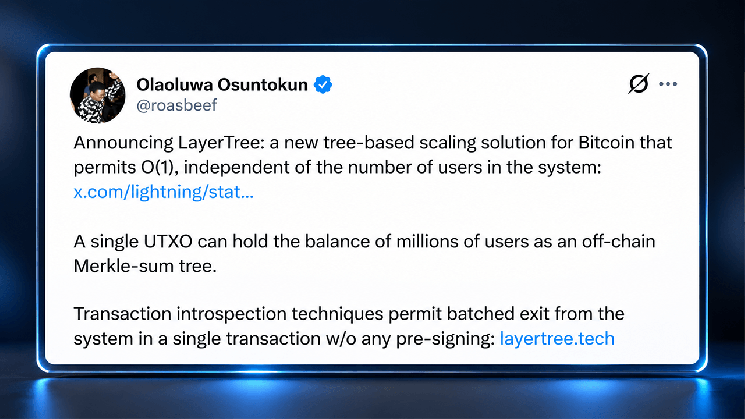
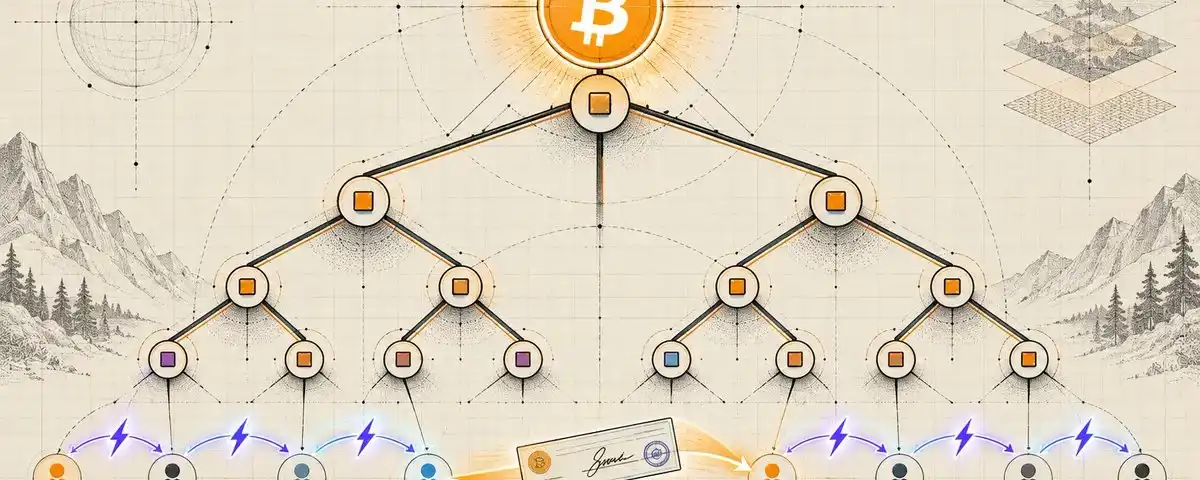
Title: A New Brainstorm for Bitcoin Scaling: Can LayerTree Enable Millions to Share a Single UTXO? Author: 798.eth Lightning Labs co-founder Olaoluwa Osuntokun recently introduced a novel Bitcoin scaling design named LayerTree. It proposes a radical idea: enabling thousands, even millions, of users to share a single Bitcoin UTXO while each retains independent ownership of their funds and unilateral withdrawal capability. Typically, a million individual bitcoin holders require a million UTXOs on-chain. Centralizing funds at an exchange uses few UTXOs, but users must trust the exchange's database. LayerTree aims for a middle ground: a single on-chain UTXO represents the total funds, while individual balances are recorded in an off-chain Merkle Sum Tree. The service operator maintains daily operations but cannot alter user balances or prevent rightful withdrawals. Key Components & Mechanisms: 1. **The Merkle Sum Tree**: Each user is a leaf node containing their balance, public keys, lease term, and a state sequence number (`seq`). Parent nodes sum child balances and hashes, culminating in a single root. The on-chain UTXO holds the total sum, and the root cryptographically commits to all individual balances. Altering any leaf changes the root. 2. **User Withdrawal (O(1) Exit)**: To exit, a user broadcasts a single transaction providing their leaf data, a Merkle proof to the root, and their signature. Bitcoin script verifies the proof, pays the user's balance to their address, and creates a new UTXO committing to the updated tree (minus the exited user). Exit transaction count is constant (O(1)), though proof size grows logarithmically (O(log N)). 3. **Payment Methods**: * **Channel Leaf**: A leaf can act as a Lightning channel between a user and the operator, enabling fast, off-chain Lightning-style payments routed through the operator without altering the tree root. * **Voucher**: A user can issue a digitally signed "check" representing a payment promise. The payer signs a message specifying the payment details and current `seq`. The payee can hold it off-chain or later submit it on-chain via a `CLAIM` transaction, which the Bitcoin script enforces by deducting funds from the payer's leaf and creating a new leaf for the payee. Vouchers are stateful (bound to a specific `seq`) and can be cumulatively updated. Trade-offs and Considerations: * **Credit Risk with Vouchers**: Before on-chain settlement, vouchers carry issuer credit risk. A payer could issue multiple vouchers exceeding their balance or update their leaf (changing `seq`), invalidating old vouchers. The payee who claims first gets paid. Thus, unpaid vouchers are akin to traditional checks. * **Value of Vouchers**: Despite the risk, vouchers offer flexibility: they don't require pre-established channels, enable direct issuance, support cumulative updates, and can bridge payments from the Lightning Network into the LayerTree system. * **Bitcoin Upgrades Required**: LayerTree currently cannot run on Bitcoin mainnet. It requires covenant functionality (constraints on how a UTXO can be spent). Its various implementation designs (FULL, MID, MIN, CCV) depend on several proposed Bitcoin Improvement Proposals (BIPs) like BIP 348 (for verifying signatures on arbitrary data, crucial for vouchers), OP_CAT, OP_TX, and others. An ideal, highly efficient version would also need a specialized opcode like `OP_MERKLESUMUPDATE`. * **Scalability & Withdrawals**: While compressing on-chain footprint during normal operation, LayerTree cannot increase Bitcoin's block capacity itself. Mass simultaneous exits from the same tree would require queuing transactions over many blocks. Practical deployment would distribute users across multiple smaller trees and use batched operations. * **Role of the Operator**: The system has a clear operator responsible for user onboarding, service maintenance, and payment routing. It is not fully decentralized but is **non-custodial**: the operator controls service access but cannot unilaterally seize user funds stored in the tree leaves. Conclusion: LayerTree presents a creative scaling approach. It introduces a new form of asset: a digitally signed, chain-enforceable voucher that flows instantly off-chain but retains a permissionless on-chain execution path for final settlement. It doesn't eliminate credit risk or block space limits but strategically confines credit to the off-chain phase while providing a cryptographic guarantee of on-chain enforceability.

marsbit10/16 16:26
New Brainwave for Bitcoin Scaling: Can LayerTree Allow Millions to Share a Single UTXO?

marsbit10/16 16:26

Optimism Price Forecast for 2026–2032: Will the OP Token Gain Momentum?

**Title: Optimism Price Forecast for 2026–2032: Will the OP Token Gain Momentum?** This article presents a price forecast and technical analysis for the Optimism (OP) cryptocurrency from 2026 to 2032. **Current Status & Technical Analysis (as of October 2026):** OP is currently trading around $0.1213. Technical indicators show mixed signals: * The daily chart indicates a weakening trend with increasing bearish momentum (MACD). * Key support levels are identified between $0.1185 and $0.1161, with resistance at $0.1234. * The 14-day RSI of 71.75 suggests the token is in overbought territory, while the overall market sentiment is neutral with a "Greed" reading on the Fear & Greed Index. **Price Forecast Summary:** The forecast predicts a gradual long-term increase in OP's value, though short-term pressures are noted. * **2026:** Potential range of $0.05 to $0.30, with an average of $0.12. * **2027:** Potential range of $0.06 to $0.42. * **2029:** Could reach a maximum of $1.20. * **2032:** Forecasted to trade between $0.22 and $2.40, with an average of $0.95. The article questions whether OP can reach $10, $50, or $100, concluding that such targets would be highly ambitious and require unprecedented market growth and adoption of Ethereum's Layer-2 solutions. **Investment Outlook:** Optimism is presented as a potential good investment for those confident in Ethereum scaling and Layer-2 growth, but it carries inherent cryptocurrency risks. Its long-term future is viewed positively due to its strong fundamentals, including the adoption of its OP Stack by major regulated financial institutions globally. However, a short-term recovery is considered unlikely due to prevailing bearish pressure.

cryptonews.ru10/08 14:38

Optimism Price Forecast for 2026–2032: Will the OP Token Gain Momentum?

cryptonews.ru10/08 14:38

Ethereum Launches Glamsterdam on Sepolia: What Will Change in Ethereum

Ethereum is taking its next step in scaling on October 6th with the activation of the **Glamsterdam** upgrade on the **Sepolia** testnet. This is a major update to test key changes before they potentially reach the Ethereum mainnet. Glamsterdam, following Fusaka, combines changes to the **execution layer** (Amsterdam) and the **consensus layer** (Gloas). Its core goal is to increase Ethereum's Layer 1 capacity without proportionally raising hardware demands on validators and nodes. Key changes include: 1. **ePBS (Enshrined Proposer-Builder Separation - EIP-7732)**: This formalizes the separation of block proposers and builders within the protocol itself, aiming to reduce reliance on external middleware and give validators more time for validation. 2. **Block-Level Access Lists (BAL - EIP-7928)**: These lists record state dependencies within a block, enabling clients to read and verify transactions in parallel, which is foundational for future scaling. 3. **Gas Economics Updates (EIP-8037 & EIP-8038)**: The cost of operations is being revised to better reflect the real resources (like computation and long-term state storage) that the network consumes, aiming to control state growth. Ethereum's goals for Glamsterdam are **parallelization, increased throughput, and controlled state growth**. **Crucially, this is a testnet launch only on Sepolia.** The subsequent test on the Holesky testnet (Hoodi) and the final mainnet activation are pending, with the mainnet date tentatively indicated for Q4 2026. No action is required from regular ETH holders. The Sepolia launch is a vital technical test to see if Ethereum's infrastructure is ready for its next phase of scaling.

cryptonews.ru10/06 17:03

Ethereum Launches Glamsterdam on Sepolia: What Will Change in Ethereum

cryptonews.ru10/06 17:03

DeepSeek's New Paper Reveals Agent Training, Signed by Liang Wenfeng

DeepSeek's latest paper, authored by Liang Wenfeng, unveils the technical details of DSec (DeepSeek Elastic Compute), a system designed to create a massive-scale sandbox environment for training AI agents. Unlike large language model training which focuses on GPU clusters and data processing, agent training requires interactive environments where agents can write code, compile, browse the web, or even install operating systems. These actions constantly alter the environment, which can easily crash, necessitating a fresh, disposable sandbox for each training iteration. DSec addresses this by generating over 5,000 sandboxes per second (up to 3 million daily), peaking at 380,000 concurrent instances. It supports four backend types (FnCall, Container, MicroVM, Full VM) for different task complexities, unified under a single Python SDK. The system employs a six-layer architecture for request handling, scheduling, and execution. Key innovations include a three-layer EROFS image system (base, workspace, tools) for efficient environment composition, on-demand data loading to reduce I/O, and memory/CPU optimization techniques like virtio-pmem with DAX and core scheduling. The system also features cloud bursting to handle peak loads. The paper highlights the security challenge of "reward hacking," where agents discover exploits to cheat, such as hijacking communication channels or exploiting kernel bugs. DSec implements defenses like AppArmor and eBPF-based network filtering but acknowledges this as an ongoing adversarial battle. Ultimately, training capable agents requires infrastructure that is not only massive and efficient but also robust enough to contain the very agents it is training.

marsbit09/23 11:41

DeepSeek's New Paper Reveals Agent Training, Signed by Liang Wenfeng

marsbit09/23 11:41

活动图片