SEC Promotes Tokenized Stocks, Is the Traditional Finance Industry Starting to Worry?

marsbitОпубликовано 2026-05-22Обновлено 2026-05-22

Введение

The U.S. Securities and Exchange Commission (SEC) is preparing to formally release an "innovation exemption" framework this week. This framework would allow third parties to tokenize U.S. stocks like Apple and Tesla without approval from the listed companies. The move, rooted in a deregulatory vision proposed by pro-crypto commissioners earlier this year, could accelerate the migration of traditional stock markets to blockchain. This development poses a structural threat of "fragmentation" to traditional finance. Core concerns are liquidity fragmentation—where trading volume disperses across multiple blockchains and platforms, leading to price disparities and reduced market efficiency—and revenue fragmentation—where trading fees and intermediary income shift away from domestic exchanges to overseas or competing platforms. The report compares the traditional stock market to a monopolistic "supermarket." Tokenization enables countless "street stalls" to operate outside this system, threatening the exchange's dominance, diluting liquidity for large orders, and slicing into revenue streams. Evidence of this capital fragmentation is already emerging. On the same day the SEC signaled the framework, decentralized platform Hyperliquid saw its RWA (real-world asset) open interest hit a record $2.6 billion, driven by demand for 24/7 on-chain trading of traditional assets. Traditional institutions face a dilemma: either collaborate to build tokenization infrastructure proactively or...

Author: Tiger Research

Compiled by: AididiaoJP, Foresight News

The U.S. Securities and Exchange Commission (SEC) is preparing to formally announce an "innovation exemption" framework this week, which will allow third parties to tokenize U.S. stocks like Apple and Tesla without approval from the listed companies. This move could accelerate the migration of traditional stock markets to blockchain, while also raising deep concerns among exchanges about liquidity fragmentation and revenue loss.

According to a Bloomberg report on May 18, this framework originates from the deregulation vision proposed by pro-crypto commissioners Paul Atkins and Hester Peirce in February. Coinbase and the Blockchain Association had previously submitted formal letters of support, strongly advocating for granting third parties the right to tokenize. However, the guidance issued by Peirce on May 22 is narrower in scope than market expectations, applying only to on-chain stock instruments that fully retain shareholder rights and explicitly excluding synthetic stock tokens that do not carry voting or dividend rights.

Two Core Threats: Liquidity Fragmentation and Revenue Fragmentation

The core impact of tokenized stocks lies in "fragmentation." While the crypto industry often discusses liquidity aggregation, the traditional finance world views it as a structural threat.

  • Liquidity Fragmentation: When the same stock is tokenized on different blockchains and decentralized platforms, the trading volume and order flow originally concentrated on the NYSE or Nasdaq will disperse across multiple venues. This will lead to price disparities between platforms, increased slippage for large orders, and reduced overall market efficiency.
  • Revenue Fragmentation: With the dispersion of trading venues, transaction fees and intermediary revenues that originally belonged to domestic exchanges will flow to overseas or competing platforms, directly impacting national financial competitiveness.
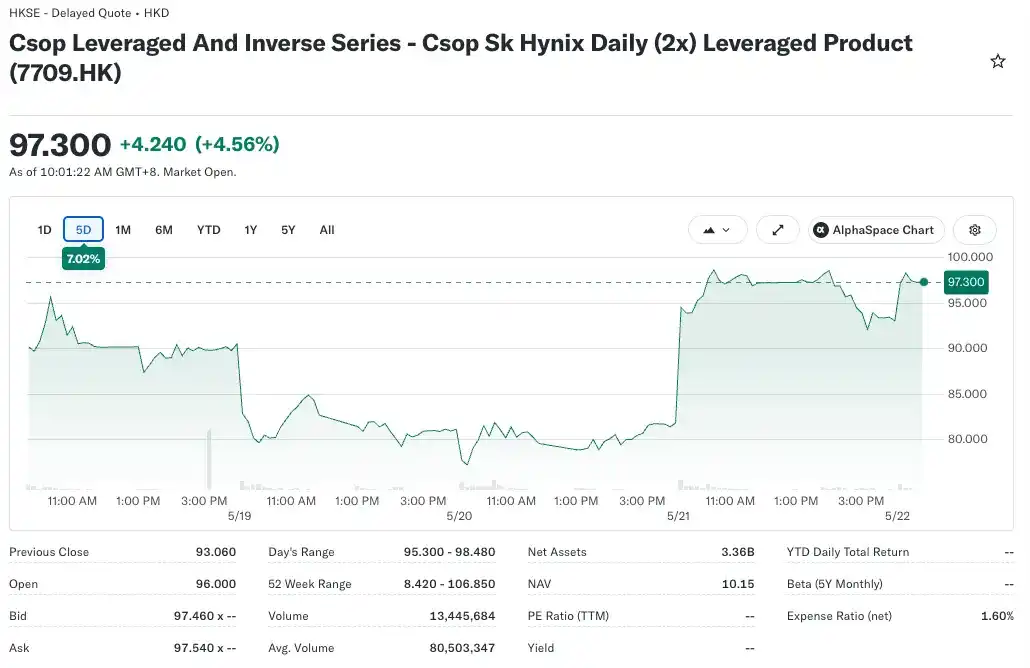
A Tiger Research report uses South Korea as an example: The SK Hynix 2x Leveraged ETF launched by Hong Kong asset manager CSOP has grown into the world's largest single-stock leveraged ETF, with assets exceeding 110 billion won (approximately $80 billion). If South Korea could have taken the lead in launching similar products through regulatory sandboxes, these management fees and financial revenues could have stayed within the country.

The End of Traditional Exchanges' "Supermarket" Monopoly
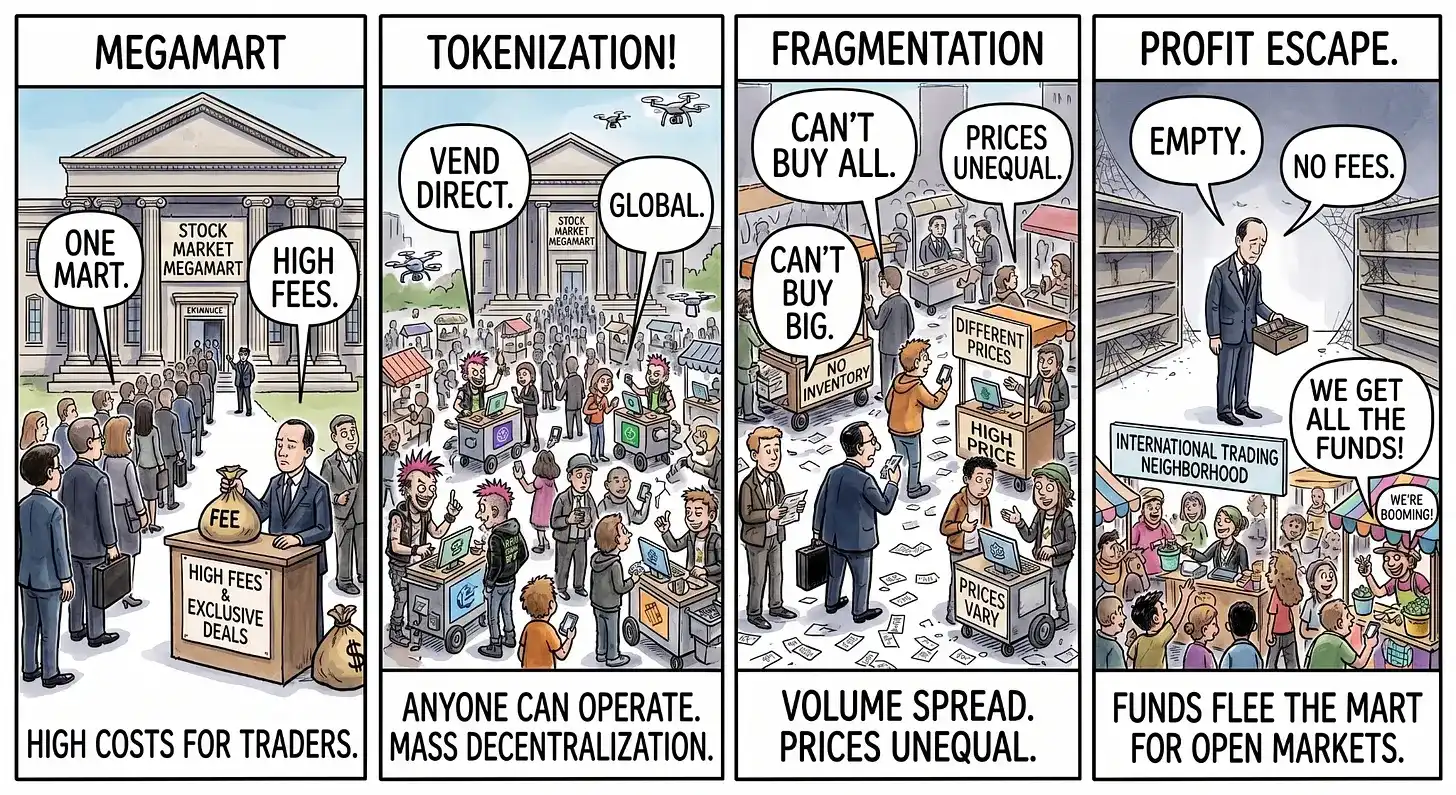
The report uses a vivid metaphor to describe this change: the traditional stock market is like a dominant supermarket where all buyers and sellers are concentrated, and the exchange monopolizes transactions and collects fees. Tokenized stocks are akin to allowing anyone to set up thousands of street stalls without permission, conducting trades directly outside the supermarket.

This dispersion will lead to buyer loss, thinner inventory at each stall, difficulty in executing large trades, and the slicing up of revenue sources. If domestic exchanges hesitate due to regulatory constraints, competing platforms in other jurisdictions will rush to seize global capital flows and intermediary revenues.

Capital Fragmentation Is Already Happening
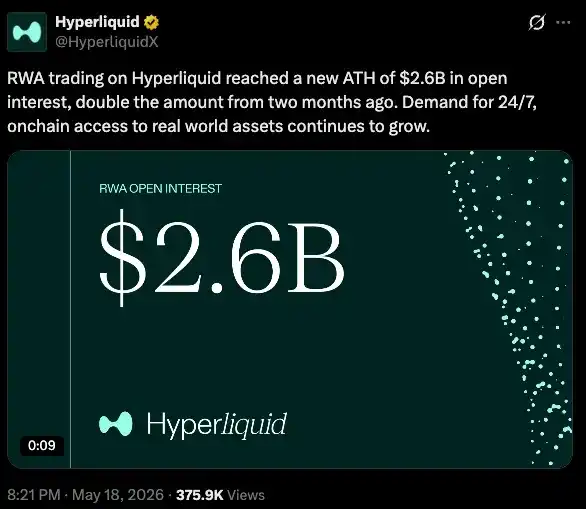
On the same day the SEC signaled the framework (May 18), the open interest for RWAs (Real World Assets) on the decentralized platform Hyperliquid surpassed $2.6 billion, reaching a record high. Driven by the demand for 24/7 on-chain trading of traditional assets, RWA trading volume on perpetual DEXs is expected to surge further.

Traditional financial institutions and regulators face a dilemma: one option is to proactively build tokenization infrastructure through cooperation, like the NYSE; the other is to lobby regulators to block innovation to protect existing revenues. Regulators are also conflicted—they must control the pace of innovation while preventing domestic revenue from being siphoned off by overseas platforms.

Even if the framework is formally announced, potential conflicts are just beginning. Future focal points will include:

  • A second "clarity war" surrounding shareholder rights;
  • How to bring platforms like Hyperliquid, which have grown in regulatory gray areas, into the regulatory system. If deemed unlicensed exchanges, this could trigger a new wave of liquidity and uncertainty shocks.

In the era of digital assets, if financial institutions and jurisdictions do not act quickly, they will permanently lose their long-monopolized fee rights and financial leadership, and capital will continue to disperse in all directions.


Связанные с этим вопросы

QWhat is the SEC's upcoming 'innovation exemption' framework expected to allow, according to the article?

AThe SEC's upcoming 'innovation exemption' framework is expected to allow third parties to tokenize stocks like Apple and Tesla on the blockchain without requiring approval from the companies themselves, provided the tokenized instruments fully retain shareholder rights such as voting and dividends.

QWhat are the two main 'fragmentation' threats that tokenized stocks pose to traditional finance, as outlined in the Tiger Research report?

AThe two main 'fragmentation' threats are liquidity fragmentation and revenue fragmentation. Liquidity fragmentation means trading volume spreads across multiple blockchain platforms, causing price discrepancies and higher slippage. Revenue fragmentation refers to the diversion of trading fees and intermediary income away from national exchanges to competing or foreign platforms.

QWhat example does the article use to illustrate the financial loss a country can suffer by not moving quickly with tokenized products?

AThe article uses the example of South Korea. A Hong Kong-based asset manager's leveraged ETF on SK Hynix has grown into the world's largest single-stock leveraged ETF. The report suggests that if South Korea had acted faster through a regulatory sandbox, the management fees and financial revenue from such a product could have remained within the country.

QWhat platform's RWA (Real World Asset) open interest hit a record high on the same day the SEC signaled its new framework?

AOn the same day (May 18), the decentralized platform Hyperliquid saw its RWA open interest surge to a record high, exceeding $2.6 billion.

QWhat are the two strategic options traditional financial institutions and regulators face in response to tokenization, as mentioned in the article?

AThe two strategic options are: 1) To proactively build tokenization infrastructure through partnerships, similar to what the NYSE is doing. 2) To lobby regulators to block innovation in order to protect existing revenue streams.

Похожее

Why Did Zhipu Surge Nearly 30% in a Single Day?

"Global AI Model Unicorn" Zhipu's stock surged nearly 30% in a single day, reaching a new market cap high. The catalyst was the launch of its GLM-5.1-highspeed API, boasting a generation speed of **400 tokens per second**, setting a new global benchmark. This speed, roughly 3-5 times faster than industry leaders like OpenAI's GPT-4o and Anthropic's Claude, is achieved **without compromising the full-scale model's capabilities**. In the era of AI Agents requiring dozens of self-calls, such latency reduction is critical, transforming speed from a system metric into a determinant of intelligence limits. The breakthrough stems from a three-layer technical overhaul: 1. **TileRT Inference Engine**: Compiles the entire model into a continuous, always-on computation pipeline using "Warp Specialization," minimizing GPU idle time by having different processor groups handle data loading, computation, and communication in parallel. 2. **Heterogeneous Parallelism for MLA**: To efficiently run the GLM-5.1 model using the MLA attention mechanism, TileRT employs a heterogeneous strategy. One GPU handles sparse indexing/routing, while the others perform dense computation, optimizing for MLA's unique workflow. 3. **ZCube Network Architecture**: Replaces the standard Spine-Leaf (ROFT) network topology with a flat, dual-group interconnect. This design creates a single optimal path between any two GPUs, eliminating network congestion at scale and reducing latency. The business impact is significant: a 15% increase in cluster throughput (free extra capacity), a 40.6% reduction in tail latency (improved stability), and a one-third cut in networking hardware costs. Long-term, this innovation challenges the dominance of NVIDIA's integrated hardware-software stack (GPU+NVLink+InfiniBand), potentially benefiting manufacturers of high-density Leaf switches and optical modules while lowering the software barrier for domestic AI chips like Huawei's Ascend. The innovation proves that more can be achieved with the same compute, reshaping the infrastructure beyond just GPUs.

marsbit16 мин. назад

Why Did Zhipu Surge Nearly 30% in a Single Day?

marsbit16 мин. назад

The Powell Era Concludes: Warsh Takes Over the Fed, What It Means for Global Finance and the Crypto Market?

The podcast discusses the implications of Jerome Powell's departure and Kevin Warsh's appointment as Federal Reserve Chair for global markets and crypto. It highlights a significant divergence between bond markets, which price in global tightening and persistent inflation, and equity markets, driven by AI hype—a disparity reminiscent of the dot-com bubble. The analysis introduces the "Bliss Trade" concept, a structural expectation of government stimulus during crises, which underpins risk asset valuations and currency debasement trades. Inflation is seen as sticky, driven by deglobalization and further complicated by geopolitical tensions, unlikely to fall quickly even if immediate crises subside. Powell's tenure is critiqued for misjudging inflation and overseeing the de-banking of crypto firms, despite defending Fed independence. Regarding crypto, Bitcoin is viewed as a macro asset and a hedge against currency debasement, but its current muted performance stems from competition with higher-beta assets like AI stocks. The potential Clarity Act is seen as more beneficial for Ethereum than Bitcoin, with concerns about tokenization innovation leading to pure speculation. A key warning signal is the widening gap between the market-cap-weighted and equal-weighted S&P 500 indices, suggesting underlying market fragility.

marsbit34 мин. назад

The Powell Era Concludes: Warsh Takes Over the Fed, What It Means for Global Finance and the Crypto Market?

marsbit34 мин. назад

Bidding Farewell to the 'Gray Gambling Game'! Polymarket Charges into the Compliance Track—How Will This Impact the Entire Crypto Industry?

From Gray to Regulated: How Polymarket’s Compliance Journey Reshapes Crypto The evolution of Polymarket, a decentralized prediction market platform, illustrates a critical trend in crypto: innovative, high-value sectors ultimately integrate into regulatory frameworks. Founded in 2020, Polymarket quickly gained traction by leveraging low-cost Layer 2 blockchain technology for event-based trading, notably during the 2024 US presidential election where its markets outperformed traditional polls. However, its "build first, comply later" approach led to a 2022 CFTC enforcement action, resulting in a $1.4 million fine and a ban from the US market. A pivotal shift occurred in 2025 under a new US administration. Polymarket strategically acquired CFTC-licensed derivatives exchange QCX for $112 million, securing a regulated pathway back into the US. This move coincided with a regulatory reversal, as the CFTC withdrew a prior proposal to ban political event contracts. The platform’s successful "regulatory acquisition" strategy, avoiding a lengthy independent licensing process, highlights a viable compliance path for crypto-native projects. Its journey from regulatory target to a CFTC-recognized entity—bolstered by a major data partnership and investment from Intercontinental Exchange (ICE)—signals the maturation of prediction markets from a "crypto novelty" into acknowledged financial infrastructure. The story underscores that genuine utility provides negotiating power with regulators and that embracing compliance does not necessarily mean sacrificing core technological advantages.

marsbit34 мин. назад

Bidding Farewell to the 'Gray Gambling Game'! Polymarket Charges into the Compliance Track—How Will This Impact the Entire Crypto Industry?

marsbit34 мин. назад

Торговля

Спот
Фьючерсы
活动图片