Market Expert Says Ripple’s Biggest Win Is Not XRP Regulation, Here’s What It Is

bitcoinistОпубликовано 2025-12-15Обновлено 2025-12-15

Введение

A crypto market expert argues that Ripple's most significant achievement is not XRP's regulatory clarity as a non-security, but rather its recent conditional approval for a national trust bank charter from the OCC. This milestone validates Ripple’s long-term strategy of engaging with regulators and building institutional partnerships, rather than focusing solely on retail adoption. The approval signals Ripple’s commitment to operating within established financial frameworks and strengthens its legitimacy in global finance. The expert, previously skeptical, now views this as evidence of Ripple’s maturity and dedication to solving foundational problems, which ultimately benefits XRP’s credibility and future.

The lawsuit between Ripple and the US Securities and Exchange Commission (SEC) had dominated headlines for years, with XRP in the spotlight over its potential classification as a security. Now that the legal dispute is over and XRP has been definitively cleared as non-security, experts argue that Ripple’s greatest success extends far beyond XRP regulation.

Ripple’s True Victory Beyond XRP Regulation

A crypto market expert operating under the name “Stellar Rippler” on X has shared a compelling report that reassesses what truly constitutes Ripple’s biggest win. The analyst highlighted that the real win for Ripple was not regulatory approval but an intellectual shift in how the project is perceived.

The expert highlighted that while he favors XRP, he has historically been skeptical of Ripple’s intentions. However, he stated that the recent approval of the crypto company’s bank charter by the Office of the Comptroller of the Currency (OCC) speaks volumes about Ripple’s long-term vision in the financial sector.

Last week, on December 12, the OCC granted conditional approval to five crypto-related firms, including Ripple, to obtain national trust bank charters. This achievement marked a significant milestone for Ripple, reinforcing its legitimacy in traditional finance despite the numerous oppositions.

In his post, the analyst compares XRP and XLM, noting that the debate between the two cryptocurrencies has often been driven by emotion. He said that discussions were frequently centered on conflicts between retail and institutions, accusations of token dumpings, and differing visions for the future.

According to the expert, XRP and XLM have always been structurally similar, both designed for fast, low-cost settlement, cross-border liquidity, interoperability, and real-world financial infrastructure. However, he notes that the primary difference between the two cryptocurrencies has always been strategy rather than values.

He explained that while Ripple prioritized tackling regulatory hurdles, banking, and building institutional partnerships first, Stellar focused on grassroots adoption and open networks. With the new OCC bank charter, the expert emphasizes that Ripple’s strategic approach is now clearly validated and undeniable.

Stellar Rippler highlighted that Ripple did not abandon its crypto principles but took on the regulatory responsibility to ensure its network could operate at scale. He stated that this milestone shows that history favors builders who solve foundational problems rather than those who focus on tribal disputes.

Stellar Expert Shifts Stance After Ripple Gains OCC Approval

In a previous post, Stellar Rippler publicly announced a significant change in perspective on Ripple following news that the company had received conditional approval for a national bank charter. He admitted he was wrong in his past views, describing the recent development as a full submission to the highest level of federal and state oversight in the United States.

The Stellar expert now believes that Ripple is firmly committed to long-term global finance, stating that a company would not take such a path if it were not building something designed to last decades. He added that this milestone represents maturity and legitimacy for Ripple and strengthens confidence in XRP.

XRP trading at $1.99 on the 1D chart | Source: XRPUSDT on Tradingview.com

Похожее

SEC Promotes Tokenized Stocks, Is the Traditional Finance Industry Starting to Worry?

The U.S. Securities and Exchange Commission (SEC) is preparing to formally release an "innovation exemption" framework this week. This framework would allow third parties to tokenize U.S. stocks like Apple and Tesla without approval from the listed companies. The move, rooted in a deregulatory vision proposed by pro-crypto commissioners earlier this year, could accelerate the migration of traditional stock markets to blockchain. This development poses a structural threat of "fragmentation" to traditional finance. Core concerns are liquidity fragmentation—where trading volume disperses across multiple blockchains and platforms, leading to price disparities and reduced market efficiency—and revenue fragmentation—where trading fees and intermediary income shift away from domestic exchanges to overseas or competing platforms. The report compares the traditional stock market to a monopolistic "supermarket." Tokenization enables countless "street stalls" to operate outside this system, threatening the exchange's dominance, diluting liquidity for large orders, and slicing into revenue streams. Evidence of this capital fragmentation is already emerging. On the same day the SEC signaled the framework, decentralized platform Hyperliquid saw its RWA (real-world asset) open interest hit a record $2.6 billion, driven by demand for 24/7 on-chain trading of traditional assets. Traditional institutions face a dilemma: either collaborate to build tokenization infrastructure proactively or lobby regulators to block innovation. Regulators must balance controlling the pace of innovation with preventing domestic revenue from being captured by offshore platforms. Key future battles will revolve around defining shareholder rights for tokenized assets and regulating platforms that have grown in regulatory gray areas. In the digital asset era, inaction risks the permanent loss of long-held fee monopolies and financial leadership as capital continues to disperse.

marsbit12 мин. назад

SEC Promotes Tokenized Stocks, Is the Traditional Finance Industry Starting to Worry?

marsbit12 мин. назад

A Comprehensive Analysis of On-Chain Pre-IPO: Why is the Pricing Power of SpaceX and OpenAI Moving On-Chain?

This podcast episode explores the rise of on-chain pre-IPO price discovery and trading, focusing on companies like SpaceX, OpenAI, and Anthropic. Key trends include the recent launch of a SpaceX pre-IPO perpetual contract on Hyperliquid, the secondary market trading of AI company shares, and a new partnership between Nasdaq Private Market and Polymarket. Dio Casares explains why AI companies like OpenAI and Anthropic actively deny the legitimacy of secondary trades. Primary reasons are to protect their primary funding rounds (as secondary trades don't provide cash to the company) and to avoid complex legal and administrative responsibilities associated with settling these transactions. He argues that on-chain **derivatives** (like perpetuals) are a more viable solution than **tokenized spot markets**, as they better navigate U.S. regulatory holding period requirements, provide effective hedging, and avoid antagonizing the companies themselves by competing with their primary raises. The discussion covers the risks and methods of gaining pre-IPO exposure, from direct investments and SPVs to riskier, layered structures that can lead to legal complications and settlement issues. Casares also maps the landscape of key players, differentiating between traditional secondary brokers (like Forge, Hiive, and Setter) and on-chain derivatives protocols (like Trade.xyz/Ventuals on Hyperliquid) and tokenization platforms (often on Solana). He positions Patagon as a facilitator for access to private market deals but clarifies it avoids on-chain tokenization to maintain good relations with portfolio companies. Looking ahead, the convergence of a historic IPO pipeline (with potential trillion-dollar valuations), the 24/7 nature of crypto markets, and the strategic use of pre-market perpetuals as a "loss leader" suggest continued growth and competition in the on-chain pre-IPO space.

marsbit29 мин. назад

A Comprehensive Analysis of On-Chain Pre-IPO: Why is the Pricing Power of SpaceX and OpenAI Moving On-Chain?

marsbit29 мин. назад

Token Packages Are Here, Are Telecom Operators in a Hurry?

Major Chinese telecom operators are launching token-based AI computing packages, sparking public debate and highlighting a strategic shift amid slowing traditional revenue growth. In May, Shanghai Telecom introduced token plans (e.g., 9.9 RMB for 10 million tokens), quickly followed by nationwide offerings from China Telecom, China Mobile, and China Unicom. While priced higher than major AI firms like DeepSeek, these packages allow users to access multiple AI models via API using their phone bills, similar to purchasing universal mobile data. The move reflects operators' anxiety as traditional voice, SMS, and data services stagnate. With revenue growth hitting multi-year lows in 2025, AI and computing power represent a critical new frontier. However, current C端 offerings, such as AI photo editing or virtual pets, are seen as non-essential and highlight operators' role as "pipes" or integrators rather than creators of compelling AI products. Beyond consumer packages, operators aim to become key infrastructure players in China’s national computing power network. They position themselves as the "power grid" delivering AI算力, leveraging their vast network of base stations to ensure low-latency, reliable coverage, especially for applications like autonomous driving. This infrastructure role, coupled with unified national调度, could make算力 a ubiquitous utility, driving new consumption scenarios even if mass adoption of token packages remains uncertain.

marsbit33 мин. назад

Token Packages Are Here, Are Telecom Operators in a Hurry?

marsbit33 мин. назад

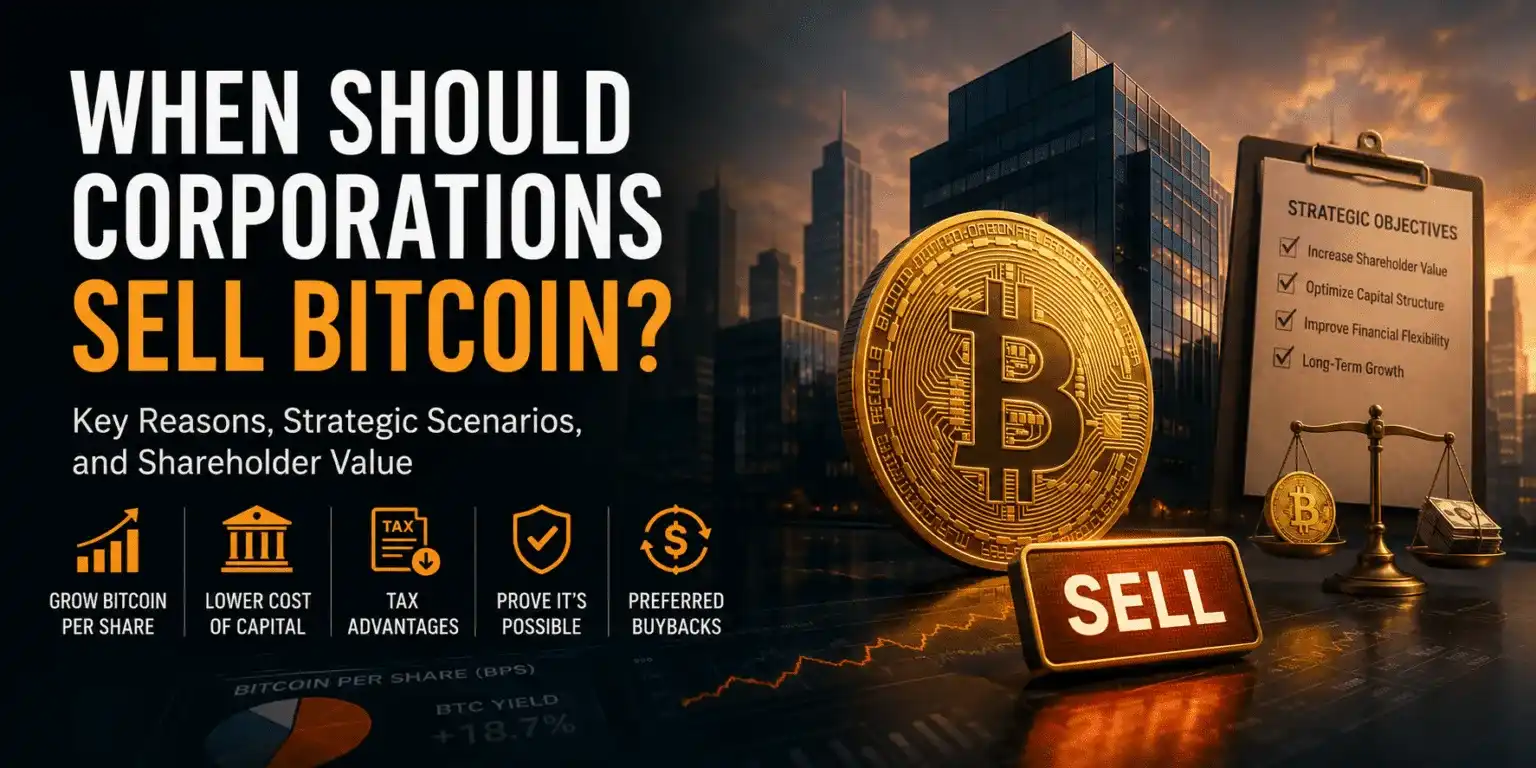
The Five Value Logics Behind Enterprises Selling Bitcoin

"Five Value Logics Behind Corporate Bitcoin Sell-offs" Recent news of Strategy company considering selling part of its bitcoin holdings to meet operational goals sparked market discussions, challenging its previous "never sell" stance. While long-term holding aligns with crypto investment philosophy, selling bitcoin can be a rational corporate decision aimed at maximizing shareholder value, unlike personal sales for life improvements. For instance, in Q1 2026, miners sold 25,376 BTC to fund a pivot into AI, deeming it a higher-return investment. For treasury-holding firms like Strategy, selling bitcoin can create value through five key logics: 1. **Increasing Bitcoin Per Share:** The core metric is bitcoin per share. If a company's stock trades below its bitcoin asset value, selling BTC to buy back shares can increase this ratio, as the reduction in shares outstanding outweighs the BTC sold. Similarly, using BTC proceeds to cover fixed costs like dividends during stock undervaluation minimizes the dilution of bitcoin per share. 2. **Optimizing Capital Structure & Lowering Financing Costs:** Credit ratings significantly influence financing costs. Rating agencies like S&P value cash reserves. By selling bitcoin to boost cash, companies can meet capital market expectations, secure better ratings, and issue debt at lower costs. Reducing debt through BTC sales also improves the appeal of preferred stock. Lower interest rates compound over time, boosting profits. 3. **Legitimate Tax Planning:** The US currently has no wash-sale rules for bitcoin. Companies can sell to realize a book loss, immediately repurchase at a lower cost basis, and use the loss to offset taxes—a strategy Strategy used in 2022's bear market. This can be combined with stock buybacks or debt repayment for multiple benefits. 4. **Dispelling Market FUD (Fear, Uncertainty, Doubt):** Negative narratives claim large corporate BTC sales could crash the market or invalidate the treasury model. A controlled sale (e.g., 50,000 BTC) without causing major market or stock price volatility could debunk such myths, helping the market accept bitcoin as a corporate asset. This reason is the most subjective of the five. 5. **Buying Back Preferred Stock at a Discount:** This lesser-known strategy involves repurchasing a company's own floating-rate preferred stock when it trades significantly below its par value. For example, if a $100-par security like STRC trades at $82, selling bitcoin to buy it back yields an $18 per-share, tax-free profit. Price drops may occur due to leveraged trading cascades, unrelated to BTC's price. Repurchasing avoids future increased dividend costs. In conclusion, corporate bitcoin sales should not be automatically viewed as bearish. In many scenarios, they protect the interests of the company and its shareholders. Bitcoin's monetary properties offer flexible capital allocation; using the asset rationally unlocks its maximum value.

marsbit33 мин. назад

The Five Value Logics Behind Enterprises Selling Bitcoin

marsbit33 мин. назад

I Tested with $10,000: Zero Wear, 8% APY, and Earn Points (Full Tutorial + Screenshots Included)

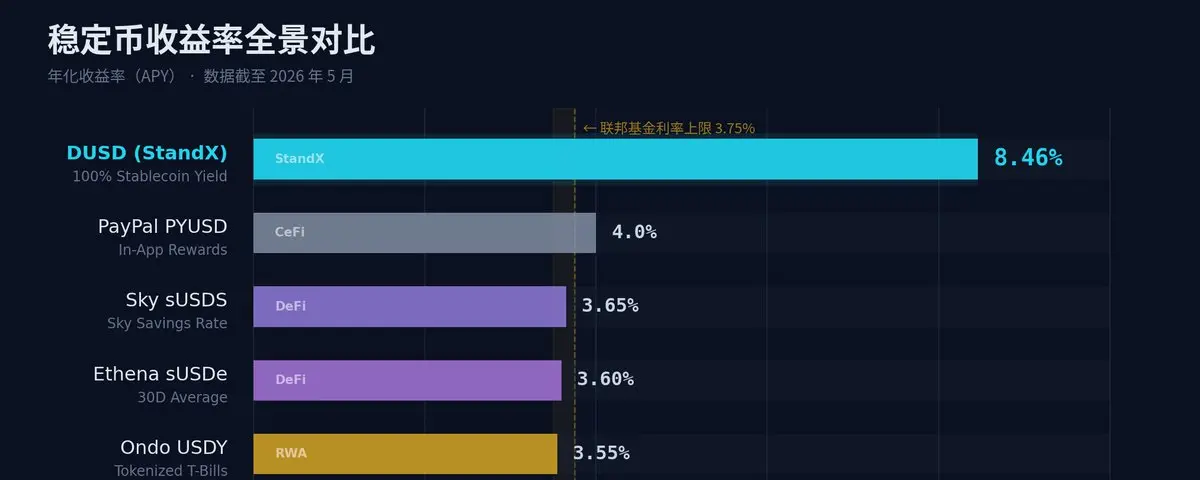
**Title:** My $10,000 Real-World Test: Zero Wear-and-Tear, ~8% APY, Plus Earning Points (Full Guide + Screenshots Included) **Summary:** This article details a personal experiment with $10,000 on the StandX platform to verify its advertised ~8% APY for its stablecoin, DUSD, while earning trading points. The author created two accounts, each depositing $5,000 worth of DUSD, and used StandX's unique "Block Trade" feature to open perfectly offsetting long and short BTC positions (2x leverage each). This neutralized directional market risk. **Key Results (Over 8 Days):** * **Total Profit:** $16.91 (~7.8% annualized). * **Zero Net Directional P&L:** BTC price movements canceled out. * **Zero Wear-and-Tear:** No losses from fees, slippage, or gas from frequent trading. * **Points Earned:** 380+ trading points. **Source of the ~8.46% APY:** The yield is composed of three layers, all paid in DUSD (real USD value, not governance tokens): 1. **DUSD Base (~1.27%):** Derived from funding rates (similar to Ethena's USDe). 2. **SIP-2 Position Boost (~2.27%):** A protocol revenue-sharing mechanism. Users providing liquidity (via open positions) earn a share of platform trading fees. Leverage acts as a multiplier on this yield. 3. **SIP-3 Universal Fee Share (~4.92%):** A portion of all platform trading fees is distributed to *every* DUSD holder, regardless of whether they trade. **Sustainability Claim:** The author argues this yield is more sustainable than pure funding-rate models (e.g., Ethena) because over 7% of it comes from transaction fees (SIP-2 + SIP-3), which are less dependent on market cycles. **Step-by-Step Strategy:** A concise 3-step guide is provided for replicating the zero-risk strategy using two wallets and StandX's Block Trade to create matched long/short positions. **Risk Disclosures:** The article notes standard DeFi risks: smart contract vulnerability and yield fluctuation (Base yield varies with funding rates; SIP-2/3 yields depend on platform trading volume). **Author's Note:** The author discloses their role in Growth at StandX. The piece is presented as personal testing and analysis, not investment advice.

链捕手1 ч. назад

I Tested with $10,000: Zero Wear, 8% APY, and Earn Points (Full Tutorial + Screenshots Included)

链捕手1 ч. назад

Торговля

Спот
Фьючерсы

Популярные статьи

Как купить S

Добро пожаловать на HTX.com! Мы сделали приобретение Sonic (S) простым и удобным. Следуйте нашему пошаговому руководству и отправляйтесь в свое крипто-путешествие.Шаг 1: Создайте аккаунт на HTXИспользуйте свой адрес электронной почты или номер телефона, чтобы зарегистрироваться и бесплатно создать аккаунт на HTX. Пройдите удобную регистрацию и откройте для себя весь функционал.Создать аккаунтШаг 2: Перейдите в Купить криптовалюту и выберите свой способ оплатыКредитная/Дебетовая Карта: Используйте свою карту Visa или Mastercard для мгновенной покупки Sonic (S).Баланс: Используйте средства с баланса вашего аккаунта HTX для простой торговли.Третьи Лица: Мы добавили популярные способы оплаты, такие как Google Pay и Apple Pay, для повышения удобства.P2P: Торгуйте напрямую с другими пользователями на HTX.Внебиржевая Торговля (OTC): Мы предлагаем индивидуальные услуги и конкурентоспособные обменные курсы для трейдеров.Шаг 3: Хранение Sonic (S)После приобретения вами Sonic (S) храните их в своем аккаунте на HTX. В качестве альтернативы вы можете отправить их куда-либо с помощью перевода в блокчейне или использовать для торговли с другими криптовалютами.Шаг 4: Торговля Sonic (S)С легкостью торгуйте Sonic (S) на спотовом рынке HTX. Просто зайдите в свой аккаунт, выберите торговую пару, совершайте сделки и следите за ними в режиме реального времени. Мы предлагаем удобный интерфейс как для начинающих, так и для опытных трейдеров.

1.3k просмотров всегоОпубликовано 2025.01.15Обновлено 2025.03.21

Как купить S

Sonic: Обновления под руководством Андре Кронье – новая звезда Layer-1 на фоне спада рынка

Он решает проблемы масштабируемости, совместимости между блокчейнами и стимулов для разработчиков с помощью технологических инноваций.

2.2k просмотров всегоОпубликовано 2025.04.09Обновлено 2025.04.09

Sonic: Обновления под руководством Андре Кронье – новая звезда Layer-1 на фоне спада рынка

HTX Learn: Пройдите обучение по "Sonic" и разделите 1000 USDT

HTX Learn — ваш проводник в мир перспективных проектов, и мы запускаем специальное мероприятие "Учитесь и Зарабатывайте", посвящённое этим проектам. Наше новое направление .

1.8k просмотров всегоОпубликовано 2025.04.10Обновлено 2025.04.10

HTX Learn: Пройдите обучение по "Sonic" и разделите 1000 USDT

Обсуждения

Добро пожаловать в Сообщество HTX. Здесь вы сможете быть в курсе последних новостей о развитии платформы и получить доступ к профессиональной аналитической информации о рынке. Мнения пользователей о цене на S (S) представлены ниже.

活动图片