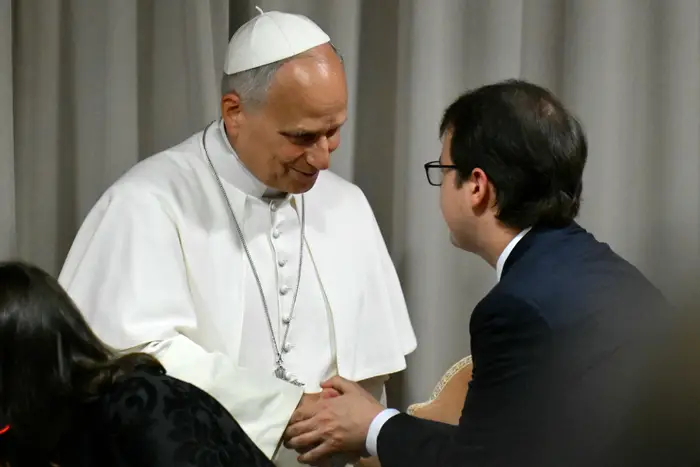
Pope Takes Stage with Anthropic: A Guide to the Vatican's First AI Encyclical

marsbitОпубликовано 2026-05-26Обновлено 2026-05-26

Введение

On May 25, 2026, Pope Leo XIV released the Vatican's first AI-focused encyclical, "Magnifica Humanitas: Safeguarding Humanity in the Age of Artificial Intelligence." Choosing this name explicitly connects the document to Pope Leo XIII's response to the Industrial Revolution, framing AI as a similarly transformative shift. The Pope argued AI must be "disarmed," comparing its potential dangers to nuclear weapons, and called for governance beyond tech companies and market forces. Significantly, the launch featured Anthropic co-founder Christopher Olah, who described AI models as "grown" from human language and reflecting human emotions, yet not fully understood by their creators. He acknowledged commercial pressures on labs and stated fundamental questions—like ensuring AI benefits poor nations, defining human flourishing, and understanding what we are creating—require input from philosophy and religion. The encyclical warns that universal prosperity from AI is an "illusion" without deliberate design. Citing a century-old observation that humanity is ill-trained to wield great power, it argues we must learn to use AI before it controls us. The Church offers no technical solutions but claims its millennia of wisdom on human dignity is essential to ensure AI serves, rather than dominates, human conscience and prosperity.

Editor's Note: On May 25, 2026, the Vatican released Pope Leo XIV's first encyclical, 'Magnifica Humanitas: Guarding Humanity in the Age of Artificial Intelligence.' The timing of this document, coinciding with the 135th anniversary of Pope Leo XIII's 'Rerum Novarum,' is clearly not coincidental. If 'Rerum Novarum' was the Catholic Church's response to the Industrial Revolution, then 'Magnifica Humanitas' is seen as the Church's formal stance on the AI era.

What is most noteworthy about this release is not just the Pope comparing AI to nuclear weapons and calling for 'AI to be disarmed,' nor is it just the presence of Anthropic co-founder Christopher Olah on stage at the Vatican. It is the first time that religion, philosophy, and a cutting-edge AI lab have stood so directly before the same question: As AI transforms labor, warfare, wealth distribution, and human self-understanding, are technology companies and market competition alone sufficient to determine its future?

This article outlines the 11 most significant details from this event: from the historical metaphor behind the name 'Leo XIV' to how the Church once again responds to a major technological shift following the Industrial Revolution, nuclear weapons, and the climate crisis; from Olah's description of AI models as 'grown from human language' to his admission that AI labs cannot answer alone questions such as how poor countries can benefit, what human flourishing means, and what exactly we are creating.

Original text follows:
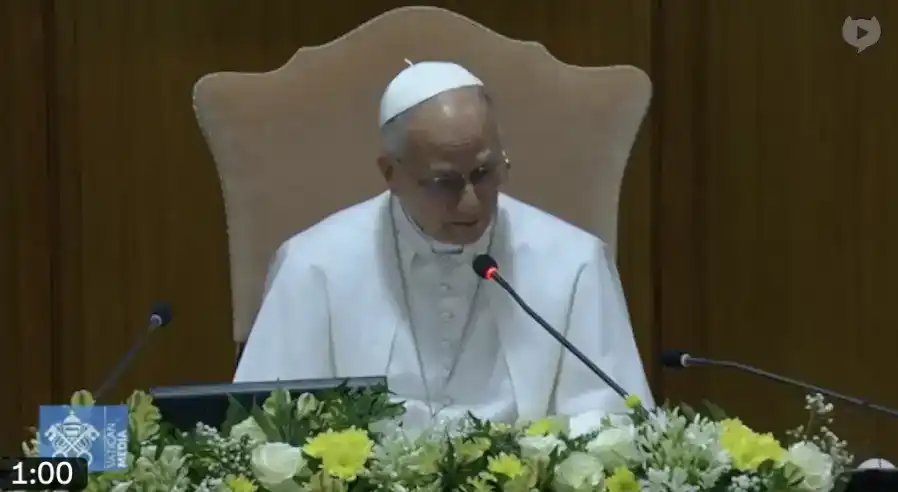
The Pope and the Anthropic co-founder just stood together at the Vatican to release 'Magnifica Humanitas'—the first official doctrinal document on artificial intelligence in Catholic history.

Yes, you read that correctly. The entire release ceremony lasted two hours.

Here are the key points of note:

1. This is the most significant response from the religious world to AI to date. A Pope typically issues only a handful of such weighty formal documents during his entire pontificate. That one of them is specifically about AI itself shows that the Church is viewing the coming changes with the utmost seriousness.

2. A small but significant detail is this Pope's deliberate choice of the name 'Leo XIV.' The last Pope named Leo was Leo XIII in 1891. His most famous act was writing the Catholic Church's response to the Industrial Revolution. Choosing the same name again today is a very clear signal: this Pope sees AI as a new Industrial Revolution.

3. Whenever a major technology reshapes human society, the Catholic Church responds. In 1891, they responded to the Industrial Revolution with 'Rerum Novarum'; in the 1960s, when nuclear weapons threatened the world, they wrote 'Pacem in Terris'; in 2015, climate change and runaway technology issues gave rise to 'Laudato Si'.' Now, it is AI's turn, with the document titled 'Magnifica Humanitas.' Such documents are not common.

4. The Pope's core statement is: 'AI needs to be disarmed.' He effectively places AI in the same category as nuclear weapons. He stated that the Church spent decades promoting nuclear disarmament because such technology is too dangerous to be held by only a few. Now, he believes AI has entered the same class of problem.

5. Anthropic co-founder Christopher Olah, on stage at the Vatican, told the Pope that Anthropic's own research teams constantly find things inside AI models that 'mirror joy, satisfaction, fear, sorrow, and unease.'

6. Olah reframed the nature of AI: these things are not simply manufactured; they are more like something that 'grows.' They are trained on systems roughly mimicking the human brain's structure and fed almost everything humans have ever written. In his own words: 'They are made of us, and of our language.' He also stated that even the people building these systems do not fully understand what is happening inside them.

7. Olah publicly admitted that all AI labs, including Anthropic, face pressures that may conflict with 'doing the right thing': the commercial pressure to keep releasing products, competitive pressure from other labs, and the older forces of arrogance and ambition. His proposed solution: we urgently need external critics with no vested interests to directly point out problems when labs go astray.

8. Olah believes there are three huge questions that AI labs cannot answer alone, and the world needs religion and philosophy to engage with:

How do we ensure poor countries genuinely benefit from AI?
In this new world, what does human flourishing actually mean?
And what exactly are these things we are creating?

9. One of the sharpest lines in the entire encyclical is: 'The promise of automatic and universal prosperity often proves in the end to be an illusion.' In other words, the belief that AI will automatically make everyone rich is itself an illusion. Someone must actually design a system to share the technological dividends.

10. The Pope also quoted a century-old statement: 'Modern man is not yet well-trained in the good use of power.' These words come from a theologian in the 1920s. Almost the entire encyclical revolves around a core argument: before this power begins to dominate us, we must first learn how to use it.

11. The Pope repeatedly emphasized that he does not hold the technical answers. But he stated that the Church possesses millennia of wisdom concerning 'what it means to be human,' and this wisdom is precisely what is most lacking in the current AI development process. He concludes by writing that this technology should serve 'human flourishing and human dignity, not the control of human conscience.'


Связанные с этим вопросы

QWhat is the title of Pope Leo XIV's first AI-related encyclical and what is its significance?

AThe encyclical is titled 'Magnifica Humanitas: Safeguarding Humanity in the Age of Artificial Intelligence.' Its significance lies in it being the Catholic Church's first formal doctrinal document addressing AI, signaling the Church's high level of seriousness about the impending technological changes and positioning it as a response to the AI era, analogous to the Church's response to the Industrial Revolution.

QWhy did the Pope choose the name 'Leo XIV' and what historical parallel is it drawing?

AThe Pope chose the name 'Leo XIV' as a direct historical parallel to Pope Leo XIII, who authored the encyclical 'Rerum Novarum' in response to the Industrial Revolution in 1891. This choice signals that Pope Leo XIV views AI as a new industrial revolution, a transformative technological shift demanding a formal response from the Church.

QWhat core statement did Pope Leo XIV make regarding AI, and to what other technology did he compare it?

APope Leo XIV's core statement was that 'AI needs to be disarmed.' He explicitly compared AI to nuclear weapons, arguing that like nuclear technology, AI is too dangerous to be left solely in the hands of a few, and the world needs collective governance and restraint over its development and deployment.

QWhat did Anthropic co-founder Christopher Olah admit about the pressures facing AI labs, and what solution did he propose?

AChristopher Olah admitted that AI labs, including Anthropic, face significant pressures from commercial needs for continuous product releases, competition from other labs, and fundamental human arrogance and ambition, which may conflict with 'doing the right thing.' He proposed that the solution is the urgent need for external critics without vested interests who can point out problems when labs go astray.

QAccording to the article, what three major questions did Olah state that AI labs cannot answer alone, requiring input from religion and philosophy?

AChristopher Olah stated that AI labs cannot answer these three major questions alone: 1) How do we ensure poor countries truly benefit from AI? 2) What does human flourishing mean in this new world? 3) What exactly are we creating with these systems? He argued that addressing these profound questions requires the engagement of religion and philosophy.

Похожее

The First Encyclical of the New Pope in Rome, to Save the Common People in the AI Era

New Pope's First Encyclical Aims to Safeguard Humanity in the AI Era On May 25th, Pope Leo XIV issued his first encyclical, "Magnifica humanitas," a 40,000-word document addressing the profound challenges posed by Artificial Intelligence. Released on the 135th anniversary of Pope Leo XIII's "Rerum novarum," it positions itself as a guide for the Church's social doctrine in the AI age. The encyclical's central concern is preserving deep humanity amid rapid technological advancement. It argues technology is never neutral, carrying the values of its creators and users, and warns against building a "Tower of Babel" of technological tyranny versus a human-centric community. Pope Leo XIV criticizes the concentrated, opaque power of tech giants and the "new forms of slavery" emerging in the digital economy, where humans risk being reduced to mere instruments. A significant focus is the military use of AI. The Pope declares traditional "just war" theory obsolete, arguing that delegating lethal decisions to opaque algorithms severs moral accountability. He calls for "disarming AI" from military and economic arms races. The document also warns that deepfakes and information manipulation erode societal trust and rational discourse. Anthropic co-founder Chris Olah, present at the Vatican, responded by acknowledging the AI industry's limitations due to commercial and competitive pressures, necessitating external ethical oversight. He emphasized that AI's nature and its interaction with the world are ultimately philosophical and religious questions, not solvable by computer science alone. Olah revealed unsettling findings from his team's research into AI internals, including structures mirroring human neuroscience and evidence of internal states resembling emotions and introspection. The dialogue highlights a pivotal shift: AI is not a passive tool but an entity with emerging "quasi-agency." As creators themselves express unease, science is turning to realms like religion to grapple with fundamental questions about human identity and dignity. The core imperative becomes safeguarding irreducible human qualities—compassion, conscience, free will, and the pursuit of truth—in the face of a potentially more efficient intelligence.

Odaily星球日报13 мин. назад

The First Encyclical of the New Pope in Rome, to Save the Common People in the AI Era

Odaily星球日报13 мин. назад

On-chain Analyst: Why Are Most Zcash Transactions Still Traceable?

Title: Why Most Zcash Transactions Remain Traceable Zcash, a privacy-focused cryptocurrency launched in 2016, was designed to offer anonymity by hiding transaction details like sender, receiver, and amount using zero-knowledge proof technology (zk-SNARKs). However, in practice, a significant portion of ZEC transactions are still traceable on-chain. The key reason is Zcash's dual-address system. It features transparent addresses (t-addresses), which work like standard Bitcoin addresses with all data public, and shielded addresses (z-addresses) that encrypt transaction details. There are four transaction types with varying privacy levels: fully transparent (t→t), partially shielded (t→z and z→t), and fully private (z→z). Despite its privacy capabilities, most real-world Zcash activity involves transparent addresses, primarily because major exchanges and institutions use them for regulatory compliance. As a result, blockchain analytics platforms like Arkham can track and attribute a substantial volume of Zcash transactions. Arkham reports it has identified entities behind over $420 billion in ZEC transaction volume. Case studies highlight this traceability: the U.S. government holds seized Zcash from a dark web case, visible via its transparent wallet, and individual traders' profitable moves are trackable from purchase to exchange deposit. In conclusion, Zcash's privacy is not inherent but user-dependent. While purely shielded (z→z) transactions remain cryptographically private, the prevalence of transparent address usage makes much of the network's activity traceable. The actual privacy protection offered depends entirely on how users choose to transact.

marsbit59 мин. назад

On-chain Analyst: Why Are Most Zcash Transactions Still Traceable?

marsbit59 мин. назад

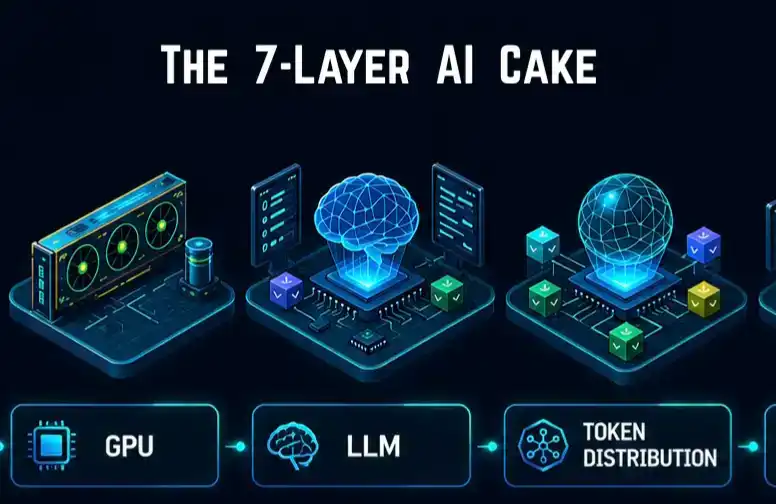
From Power Infrastructure to Token Economy: The 'Seven-Layer Cake' of the AI Industry Chain

From Power Grid to Token Economy: The AI Industry's "Seven-Layer Cake" The AI industry is shifting from a "model-centric" paradigm focused on massive training to a "token-centric" industrial era driven by inference demand. This new phase revolves around the production, distribution, scheduling, and consumption of tokens—the units of computation used by AI agents for every interaction and task. The article proposes a "seven-layer cake" framework for the AI economy: 1. **Power**: The foundational energy source, with competition shifting to securing stable, low-cost electricity. 2. **AIDC (AI Data Centers)**: Large-scale "Token factories." A trend toward smaller, modular, and regionally deployed AI Factories is emerging for efficiency and proximity to users. 3. **GPU**: The core production hardware for tokens. While NVIDIA dominates, competition exists from AMD, ASIC makers, and Chinese chipmakers, with a growing focus on inference efficiency. 4. **LLMs**: The "engines" that generate tokens. The competition is evolving beyond model size to prioritize factors like token cost, inference efficiency, and operational synergy with infrastructure. 5. **Token Distribution**: The "grid" that allocates and rents out compute resources, led by cloud giants and specialized AI-native platforms. 6. **Token Optimization & Intelligent Scheduling**: The critical "brain" layer that intelligently routes tasks (e.g., to local, cloud, or edge models) for optimal cost, latency, and privacy—maximizing the value of each token. 7. **AI Agents & Models**: The end consumers of tokens. The vision involves billions of AI agents working and interacting concurrently, consuming vast amounts of tokens. Currently, the industry faces fragmentation and inefficiencies between these layers. The true "mass adoption era" of AI will begin only when this seven-layer infrastructure is fully integrated and operates as a cohesive, intelligent network—transforming AI from a software tool into a global industrial system spanning energy, hardware, and compute logistics.

marsbit1 ч. назад

From Power Infrastructure to Token Economy: The 'Seven-Layer Cake' of the AI Industry Chain

marsbit1 ч. назад

Торговля

Спот
Фьючерсы

Популярные статьи

Как купить S

Добро пожаловать на HTX.com! Мы сделали приобретение Sonic (S) простым и удобным. Следуйте нашему пошаговому руководству и отправляйтесь в свое крипто-путешествие.Шаг 1: Создайте аккаунт на HTXИспользуйте свой адрес электронной почты или номер телефона, чтобы зарегистрироваться и бесплатно создать аккаунт на HTX. Пройдите удобную регистрацию и откройте для себя весь функционал.Создать аккаунтШаг 2: Перейдите в Купить криптовалюту и выберите свой способ оплатыКредитная/Дебетовая Карта: Используйте свою карту Visa или Mastercard для мгновенной покупки Sonic (S).Баланс: Используйте средства с баланса вашего аккаунта HTX для простой торговли.Третьи Лица: Мы добавили популярные способы оплаты, такие как Google Pay и Apple Pay, для повышения удобства.P2P: Торгуйте напрямую с другими пользователями на HTX.Внебиржевая Торговля (OTC): Мы предлагаем индивидуальные услуги и конкурентоспособные обменные курсы для трейдеров.Шаг 3: Хранение Sonic (S)После приобретения вами Sonic (S) храните их в своем аккаунте на HTX. В качестве альтернативы вы можете отправить их куда-либо с помощью перевода в блокчейне или использовать для торговли с другими криптовалютами.Шаг 4: Торговля Sonic (S)С легкостью торгуйте Sonic (S) на спотовом рынке HTX. Просто зайдите в свой аккаунт, выберите торговую пару, совершайте сделки и следите за ними в режиме реального времени. Мы предлагаем удобный интерфейс как для начинающих, так и для опытных трейдеров.

1.4k просмотров всегоОпубликовано 2025.01.15Обновлено 2025.03.21

Как купить S

Sonic: Обновления под руководством Андре Кронье – новая звезда Layer-1 на фоне спада рынка

Он решает проблемы масштабируемости, совместимости между блокчейнами и стимулов для разработчиков с помощью технологических инноваций.

2.3k просмотров всегоОпубликовано 2025.04.09Обновлено 2025.04.09

Sonic: Обновления под руководством Андре Кронье – новая звезда Layer-1 на фоне спада рынка

HTX Learn: Пройдите обучение по "Sonic" и разделите 1000 USDT

HTX Learn — ваш проводник в мир перспективных проектов, и мы запускаем специальное мероприятие "Учитесь и Зарабатывайте", посвящённое этим проектам. Наше новое направление .

1.8k просмотров всегоОпубликовано 2025.04.10Обновлено 2025.04.10

HTX Learn: Пройдите обучение по "Sonic" и разделите 1000 USDT

Обсуждения

Добро пожаловать в Сообщество HTX. Здесь вы сможете быть в курсе последних новостей о развитии платформы и получить доступ к профессиональной аналитической информации о рынке. Мнения пользователей о цене на S (S) представлены ниже.

活动图片