Solana Real-World Assets Gain Momentum With Significant Spike In Transfer Activity

bitcoinistОпубликовано 2026-06-11Обновлено 2026-06-11

Введение

Solana's price has declined recently, breaking key support levels. However, the network's activity, especially in the Real-World Assets (RWA) sector, shows strong momentum. The ecosystem recorded its largest daily transfer volume ever, surpassing $1.49 billion—a more than 2x increase, led significantly by preSPAX. This signals growing adoption of tokenized assets on Solana. Analyst Zensei highlights Solana as the leading platform for spot trading, noting the SOL/USDC pair's 24-hour volume of over $4.9 billion far exceeds other major markets. Another analyst, Crypto Patel, points out that SOL is trading within a key Fibonacci Retracement Zone, similar to a past pattern that preceded a major rally. While an "Altcoin Season" is seen as necessary for a potential push toward $1,000, the current accumulation zone is between $40 and $60.

Solana’s price action and its network performance are exhibiting separate characteristics and moving in different trajectories. Within the past week, SOL has been on a downward trend, breaking below key support levels. Meanwhile, the leading network has continued to see a persistent uptick in momentum and activity.

Transfer Activity For Solana-Based RWAs Jumps Sharply

While its price may be rocked with downside pressure, this is not the case for the Solana network, which appears to be experiencing steady growth across its ecosystem. Amid blockchain growth, the SOL network is gaining serious momentum, especially in the broadening tokenized assets space.

What this means is that the Solana Real-World Assets (RWAs) ecosystem has experienced a significant increase in transfer volume. A DeFi expert and crypto researcher, Zensei, revealed on X that the network’s real-world assets just recorded their biggest transfer volume day in its history, putting it in the spotlight for developers once again.

This notable increase indicates that activity among users and institutions leveraging blockchain technology shift and handle tokenized representations of traditional is witnessing its largest growth yet. When crypto blockchains see robust growth in this area, it is typically considered a sign of widening adoption and market participation.
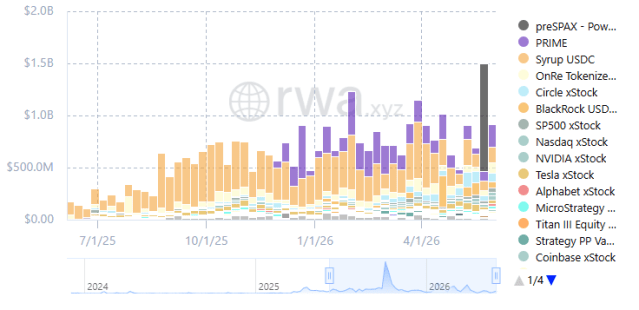
Source: Chart from Zensei on X

The development is quite significant for Solana since the RWA sector is emerging as one of the most promising use cases for blockchain technology in the current era. As shown in the chart, the daily transfer volume surged past $1.49 billion, representing a more than 2x growth from the previous day.

In the midst of this rise, preSPAX emerged as the dominant force, accounting for over $1 billion of the activity alone. Furthermore, this surge in activity only clarifies the growing demand for tokenized assets on the Solana blockchain.

Traders Are Choosing SOL For Their Operations

Zensei continues to flag SOL as the best platform for spot trading, because in his view, the altcoin always proves so. After seeing foreign assets such as Hyperliquid (HYPE) trade more efficiently on Solana, the expert stated that this is an indication of where traders are choosing to be.

At the time of this post, the SOL/UDSC pair recorded over $4.9 billion in trading volume in 24 hours. This figure is more than 6x the combined volume of the other top 9 SOL markets on major cryptocurrency exchanges. With this kind of growth, Zensei believes that it is becoming extremely hard to challenge its status as the best place to trade right now.

Crypto Patel shared that SOL’s price action is mirroring past trends that sent the altcoin sky high. Specifically, SOL is now trading inside the key Fibonacci Retracement Zone between 0.5 and 0.618. The last time the asset traded within this zone, it triggered a massive rally of over 2,200%, raising the potential for a strong rebound.

Currently, the accumulation zone is positioned between $40 and $60, but an Altcoin Season is required to trigger the anticipated upside move that could push its price to the $1,000 milestone. While it may seem too ambitious, Crypto Patel is confident in his prediction, noting that what matters is how well investors will be positioned for it.

SOL trading at $64 on the 1D chart | Source: SOLUSDT on Tradingview.com

Связанные с этим вопросы

QWhat is the main contradiction highlighted between Solana's price action and its network performance?

AWhile Solana's (SOL) price has been on a downward trend, breaking key support levels, its network performance and activity have shown a persistent uptick in momentum.

QWhat significant milestone did Solana's Real-World Assets (RWAs) ecosystem recently achieve?

ASolana's Real-World Assets (RWAs) ecosystem recorded its biggest transfer volume day in history, with daily transfer volume surging past $1.49 billion, representing more than 2x growth from the previous day.

QAccording to researcher Zensei, why is Solana considered the best platform for spot trading?

AZensei considers Solana the best platform for spot trading because assets like Hyperliquid (HYPE) trade more efficiently on it, indicating where traders are choosing to operate. The SOL/USDC pair alone recorded over $4.9 billion in 24-hour volume, significantly outpacing other top SOL markets.

QWhat historical price pattern is Crypto Patel referencing for SOL's current price action, and what potential does it suggest?

ACrypto Patel notes that SOL is trading inside the key Fibonacci Retracement Zone (between 0.5 and 0.618). The last time it traded in this zone, it triggered a massive rally of over 2,200%, raising the potential for a strong rebound.

QWhat condition does Crypto Patel state is necessary for SOL to potentially reach a $1,000 price milestone?

ACrypto Patel states that an Altcoin Season is required to trigger the anticipated upside move that could push SOL's price to the $1,000 milestone.

Похожее

Promised Year of Crypto IPOs? Only One Went Public in Six Months, Down 70%

The much-anticipated wave of crypto IPOs in 2026 has failed to materialize, with market conditions worsening dramatically. While SpaceX prepares for the largest IPO in history, raising $75 billion at a $1.75 trillion valuation, the crypto sector faces a frozen pipeline. The sole crypto IPO success this year, BitGo, serves as a cautionary tale. After launching on the NYSE in January at $18, its stock has plummeted approximately 70%. Other major contenders have stalled or delayed. Kraken, which secretly filed in late 2025, has put its plans on ice, seeing its valuation drop 33% to $13.3 billion. Consensys has postponed its filing until autumn at the earliest, and Bitpanda is poised to miss its self-imposed H1 deadline for a Frankfurt listing. This widespread retreat is driven by a severe liquidity crunch. Bitcoin has fallen below $60,000, with capital being diverted to AI stocks and the massive SpaceX offering. The poor performance of earlier crypto listings like Gemini and the stagnant price of Coinbase further dampen investor appetite. A key underlying pressure is the impending US midterm elections in November, which could alter the currently favorable regulatory landscape. Companies had hoped to go public during this window of policy certainty, but challenging market dynamics have overridden those plans. The transparency that comes with being a public company is now seen as a potential liability rather than a benefit in a down market. The industry's fate now hinges on a few critical watchpoints: whether Kraken restarts its process in H2, if Consensys files in the fall, and if SpaceX's debut can revitalize market liquidity. Otherwise, the promised "crypto IPO year" will likely be pushed beyond the election.

marsbit4 мин. назад

Promised Year of Crypto IPOs? Only One Went Public in Six Months, Down 70%

marsbit4 мин. назад

Behind Musk and Huang Jen-hsun's 'AI Factories', an Unseen Battle for Freshwater Has Begun

Behind the "AI factories" of Elon Musk and Jensen Huang lies a hidden battle for a critical resource: fresh water. As AI models like ChatGPT and Claude process billions of prompts daily, they consume vast amounts of water for cooling. By 2030, global AI infrastructure is projected to use 9.3 trillion liters annually—enough to meet the basic needs of 1.3 billion people. This "water grab" stems from the massive heat generated by high-powered GPUs. Over 70% of data centers use evaporative cooling systems, where water absorbs heat and evaporates into the atmosphere, depleting local groundwater. Training models like GPT-4 can consume over 600 million liters of water. Tech giants like Google and Microsoft report skyrocketing water usage, sparking conflicts with local communities over resources. A flashpoint occurred in Memphis, Tennessee, where Musk's xAI built the Colossus supercomputer. It draws nearly 3.8 million liters of drinking water daily from local aquifers, leading to public outrage and legal action. In response, xAI is building an $80 million water recycling plant to use treated wastewater instead. Facing pressure, companies like Microsoft promote "waterless" closed-loop cooling systems. However, these systems increase electricity consumption by 20-30%, shifting the water burden to power plants, which require immense cooling water themselves—a case of indirect water footprint transfer. For China's AI industry, this crisis offers a strategic warning and opportunity. Instead of replicating the West's resource-intensive model, China can leverage its "East Data, West Computing" policy to locate data centers in cooler, water-rich regions like Guizhou. Furthermore, developing lightweight edge computing for smart homes and embodied AI robots can drastically reduce the need for constant cloud queries, cutting both water and energy consumption at the source. The freshwater war underscores a fundamental question: Will AI be a tool for human advancement or a silicon-based monster competing for our planet's last drops of clean water? The answer is becoming clearer as the water vapor rises.

marsbit51 мин. назад

Behind Musk and Huang Jen-hsun's 'AI Factories', an Unseen Battle for Freshwater Has Begun

marsbit51 мин. назад

AGI is Just One Step Away

The article discusses Anthropic's release of the Fable 5 model, a heavily restricted version of its powerful Mythos model. Initially unveiled in April, Mythos reportedly identified over 10,000 high-risk vulnerabilities for 50 enterprise clients, causing significant concern. Due to its dangerous capabilities in areas like autonomous cyber-attacks and biochemical weapons design guidance (classified as CB-1 level), the unaltered Mythos 5 remains limited to about 200 vetted entities like government agencies. Fable 5, released with a safety classifier, demonstrates extraordinary performance, leading benchmarks in coding (SWE-Bench Pro), software engineering, and research. It exhibits true "long-horizon agency," autonomously planning and executing complex, multi-step tasks like migrating 50 million lines of code in a day, moving beyond simple question-answering. The article positions Fable 5 at OpenAI's Level 3 ("Agent") and progressing toward Level 4 ("Innovator"), suggesting AGI (Artificial General Intelligence) is within reach, potentially 18-24 months away. To mitigate risks, Anthropic implemented a two-layer safety "cage": a silent routing system that redirects dangerous queries to a weaker model, and a mandatory 30-day data retention policy for all Mythos traffic to detect patterns of malicious use. Despite its high cost ($10/$50 per million input/output tokens), the model targets the enterprise market, where its unparalleled productivity and defensive capabilities against AI-powered cyber threats justify the premium. This signals a market maturation where top-tier AI becomes a strategic, high-value tool for businesses, potentially widening the gap with consumer-focused models and accelerating the rise of "one-person companies" while disrupting labor markets.

marsbit1 ч. назад

AGI is Just One Step Away

marsbit1 ч. назад

AI Investors' 2026 Anxiety: When Models Devour Everything, What Moat Is Left for Startups?

In 2026, a wave of investor anxiety questions the defensibility of AI startups as models improve, fearing that most companies are just "thin wrappers" destined to be absorbed by foundation models or chipmakers. The author argues against this despair, positing that true moats lie not in benchmark performance but in areas models cannot easily reach. The logic of despair is that if models excel at all measurable tasks, only compute and cutting-edge model weights hold lasting value. However, the essay contends that the most valuable work is inherently "untrainable." Benchmarks measure what can be measured and thus optimized for, but real-world correctness often resides in private, complex systems. Examples include legacy codebases, intricate legal transactions, or hospital workflows. This kind of correctness is proprietary, costly to establish, and cannot be validated quickly—it requires time and trust within an organization. As models commodify visible, measurable tasks from both above (labs absorbing scaffolding) and below (saturation by cheaper models), value shifts to "untrainable ground." This encompasses work where correctness is a private truth, locked behind integration barriers, licenses, liability frameworks, and entrenched user habits. Trust and adoption are slow, human-centric processes that smarter models cannot accelerate. Successful companies defend their position by embedding deeply into client operations, owning the definition of "good" within a specific domain (e.g., Harvey in law, OpenEvidence in medicine), and pricing on outcomes rather than tokens. While labs compete fiercely, they are incentivized to keep the application layer vibrant. The future belongs not to those competing on generic benchmarks but to those navigating unscoreable terrain, doing the "unsexy work" of translation between models and messy human realities. The most cited benchmark scores are thus maps of territory about to become worthless, signaling who will lose the right to define what counts as good.

marsbit2 ч. назад

AI Investors' 2026 Anxiety: When Models Devour Everything, What Moat Is Left for Startups?

marsbit2 ч. назад

Торговля

Спот
Фьючерсы

Популярные статьи

Обсуждения

Добро пожаловать в Сообщество HTX. Здесь вы сможете быть в курсе последних новостей о развитии платформы и получить доступ к профессиональной аналитической информации о рынке. Мнения пользователей о цене на SOL (SOL) представлены ниже.

活动图片