CoinQuant Introduces Trading Infrastructure for the Agent Economy

TheNewsCryptoОпубликовано 2026-05-26Обновлено 2026-05-26

Введение

CoinQuant, an AI-powered no-code trading platform with over 15,000 users, is expanding its infrastructure to serve the emerging "agent economy." The company is introducing a unified trading intelligence architecture designed for both human traders and autonomous AI agents. This system acts as a trust layer, ensuring all trading strategies—whether human-created or AI-generated—undergo rigorous validation, backtesting, and risk analysis before live deployment. The core of the platform is an intelligence engine that combines institutional-grade backtesting, structured market data, AI optimization, and a proprietary Domain Expert system. Human traders interact via a natural language interface, while AI agents connect through APIs. Every validated strategy contributes to an anonymized aggregate intelligence layer. CoinQuant plans to launch an automated execution layer on HyperLiquid and is currently raising a $3 million Seed round to scale its product and infrastructure, including the development of HYDRA, a hierarchical multi-agent architecture. The company aims to become the foundational intelligence backbone for algorithmic trading in the agent-driven financial era.

The agent economy is reshaping financial markets. Open-source agent frameworks are accelerating autonomous financial activity, with AI agents increasingly executing trades, managing portfolios, and interacting directly with exchanges. Yet the financial infrastructure supporting this shift has not evolved at the same pace.

CoinQuant, the AI-powered no-code trading platform that has attracted over 15,000 users since launch, today announces its expansion into a unified trading intelligence architecture built for both human traders and autonomous AI agents.

“Autonomous trading is no longer theoretical. It is already happening. The next phase requires structured validation, disciplined risk management, and intelligence infrastructure. That is what CoinQuant delivers,” said Maan Ftouni, Founder and CEO of CoinQuant.

The trust layer for autonomous AI agents

As AI agents increasingly connect directly to exchanges and wallets, many rely on raw APIs without structured backtesting, risk analysis, or validated data pipelines. CoinQuant introduces a structured intelligence layer between trading intent and live capital deployment.

No strategy goes live unvalidated, whether built by a human or generated autonomously. Backtesting, risk metrics, and parameter optimization are embedded directly into the workflow, ensuring capital is deployed only after systematic evaluation.

From no-code platform to trading intelligence architecture

CoinQuant’s expansion reflects the evolution of its core engine. At the center of the platform is a unified intelligence system combining institutional-grade backtesting, structured market data from providers including Kaiko and Financial Modeling Prep, AI-powered optimization, and CoinQuant’s proprietary Domain Expert system.

Human traders interact through a natural language interface that allows them to describe, test, optimize, and deploy strategies without writing code. AI agents connect programmatically through API and MCP integrations to validate strategies and access structured data at scale.

The interface is only the surface. The intelligence engine beneath it is the product.

One engine, two growth vectors

This expansion represents a natural extension of CoinQuant’s business model. The platform’s growing base of over 15,000 traders validates product-market fit and generates structured strategy intelligence. The agent interface multiplies that value through high-volume programmatic validation and automation workflows.

Every strategy built, tested, and deployed contributes to an anonymized aggregated intelligence layer, creating a proprietary dataset mapping trading intent to logic, validation metrics, and performance outcomes across market conditions.

“The same engine that powers a trader’s first backtest can validate hundreds of strategies for autonomous systems in parallel. We are building one intelligence foundation for both humans and AI agents,” Ftouni added.

Automation layer launching next

CoinQuant is preparing to launch its automated strategy execution layer on HyperLiquid as its second major revenue stream.

The automation layer will enable validated strategies to transition seamlessly from backtest to live deployment within the same intelligence framework.

Raising $3 million to scale

CoinQuant is currently raising a $3 million Seed round to support product development, infrastructure scaling, and global expansion. The company is also developing HYDRA, a hierarchical multi-agent architecture designed for advanced research, risk modeling, and strategy optimization.

With over 15,000 users validating demand for structured trading intelligence, CoinQuant aims to become the intelligence backbone of algorithmic trading in the agent-driven financial era.

About CoinQuant

CoinQuant is an AI trading platform that enables traders and AI agents to build, validate, optimize, and automate trading strategies using natural language. Headquartered in Dubai, CoinQuant integrates with major exchanges and institutional data providers to deliver professional-grade trading infrastructure to a global community.

  • Websitehttps://coinquant.ai
  • Xhttps://x.com/CoinQuantX
  • Discordhttps://discord.gg/StNxg33z
  • Instagramhttps://www.instagram.com/coinquant.ai/
  • TikTokhttps://www.tiktok.com/@coinquant.ai
  • LinkedInhttps://www.linkedin.com/company/coinquant

Media contact:

Disclaimer: TheNewsCrypto does not endorse any content on this page. The content depicted in this Press Release does not represent any investment advice. TheNewsCrypto recommends our readers to make decisions based on their own research. TheNewsCrypto is not accountable for any damage or loss related to content, products, or services stated in this Press Release.

TagsCoinQuantPress Release

Связанные с этим вопросы

QWhat is the core challenge that CoinQuant's new trading infrastructure aims to address for the agent economy?

AIt addresses the lag in financial infrastructure evolution, which has not kept pace with the rapid growth of autonomous AI agents in trading. It aims to provide structured validation, disciplined risk management, and intelligence infrastructure that are currently missing when AI agents connect directly to exchanges.

QWhat are the two primary user groups or growth vectors for CoinQuant's unified trading intelligence architecture?

AThe two primary user groups are human traders and autonomous AI agents. Human traders use the natural language interface, while AI agents connect programmatically via API and MCP integrations. Both groups utilize the same underlying intelligence engine.

QAccording to the article, what is the specific function of the intelligence layer CoinQuant introduces for autonomous AI agents?

AThe intelligence layer acts as a structured 'trust layer' between trading intent and live capital deployment. It enforces mandatory backtesting, risk analysis, and parameter optimization for all strategies—human or AI-generated—before they can go live, ensuring systematic evaluation.

QWhat are the two main components CoinQuant is developing or launching with the $3 million Seed funding, as mentioned in the article?

AThe two main components are: 1) The automated strategy execution layer launching next on HyperLiquid as a new revenue stream. 2) HYDRA, a hierarchical multi-agent architecture designed for advanced research, risk modeling, and strategy optimization.

QHow does CoinQuant's platform benefit from the strategies created by its user base?

AEvery strategy built, tested, and deployed contributes to an anonymized, aggregated intelligence layer. This creates a proprietary dataset that maps trading intent to logic, validation metrics, and performance outcomes across market conditions, enhancing the platform's core intelligence foundation.

Похожее

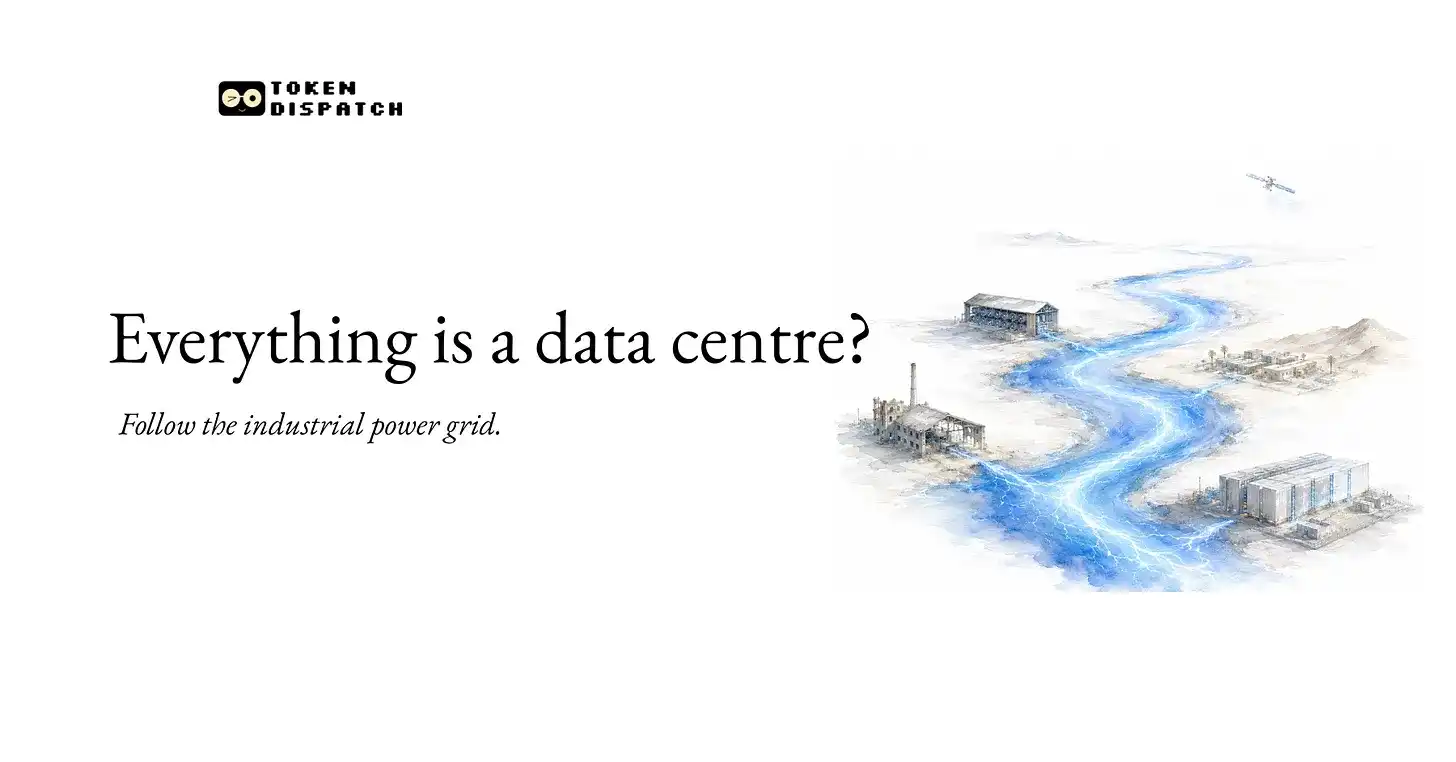
A History of Technological Evolution Powered by Electricity: Aluminum, Bitcoin, and AI

The journey from the Rockdale aluminum smelter in Texas to space-based data centers illustrates a core economic principle: whoever controls the cheapest electricity dictates the use of computing power. The evolution is clear. Old industrial sites with pre-existing, high-capacity power grids are being repurposed. In Rockdale, a former Alcoa plant now houses vast Bitcoin mining rigs, which are increasingly being replaced by AMD chips for AI training. The logic is purely financial: while smelting aluminum yields $0.17–0.27 per kWh and Bitcoin mining $0.05–0.11, AI inference on H100 GPUs generates $1.27–3.67 per kWh. Recent deals confirm the rush for power infrastructure. Riot Platforms leases space to AMD; TeraWulf bought an old Kentucky aluminum plant for its grid; NYDIG secured a New York site for its cheap hydropower to mine Bitcoin. As AI giants like Anthropic, Microsoft, Google, and Amazon aggressively expand, they now directly compete with crypto miners for the same industrial power resources, often outbidding them. This has led to a decline in Bitcoin's global hash rate and a wave of miner conversions to AI data centers. This "digital resource curse" extends globally. Gulf nations, long offering subsidized power to attract heavy industry like aluminum, are now pivoting to become AI and cloud computing hubs—exporting computational power instead of physical commodities. Similarly, Bhutan halted its sovereign Bitcoin mining to sell hydropower directly to India for a steadier return. The frontier is space. Projects like Starcloud plan orbital solar-powered data centers, leveraging constant sunlight and natural cooling, with Bitcoin mining as a secondary use for surplus power. Even consumer brands are transforming; Allbirds shifted from footwear to AI infrastructure, causing its stock to surge. Meanwhile, crypto projects like Bittensor, Render, and Akash propose a decentralized alternative, creating markets to aggregate distributed, idle computing resources from individual hardware. The underlying infrastructure—the power grid—remains constant. As profit margins shift, the facilities built upon it will continue to evolve, from aluminum to Bitcoin to AI and beyond, always chasing the highest yield per kilowatt-hour, whether in Texas, Abu Dhabi, or low Earth orbit.

marsbit10 мин. назад

A History of Technological Evolution Powered by Electricity: Aluminum, Bitcoin, and AI

marsbit10 мин. назад

Conquering is easy, governing is hard: Polymarket must bow to regulations to plant its flag globally

Polymarket, a decentralized prediction market platform, faces significant regulatory hurdles in its global expansion. Its "permissionless" model, which bypasses traditional identity and financial controls, has led to widespread crackdowns. India recently blocked the site, categorizing it as illegal online gambling under new 2025 laws. Brazil also banned it and similar platforms, though it simultaneously authorized a regulated, investor-only version on its national exchange. Across Europe, countries like France, Portugal, and the Netherlands are enforcing bans based on existing gambling and financial regulations. To enter key markets, Polymarket is adopting a pragmatic, compliant approach. In the U.S., it paid a $1.12 million fine, acquired a CFTC-licensed exchange, and now operates a regulated, KYC-mandatory platform for American users. It also secured a major investment from Intercontinental Exchange (ICE), which will distribute its prediction data to institutional investors. In Japan, where gambling laws are strict, Polymarket has begun a long-term lobbying effort, aiming for legalization by 2030 through building institutional partnerships and community presence. Despite these challenges, the prediction market industry is booming, with global volume projected to surge from $51 billion to potentially $1 trillion by 2030. Polymarket's core dilemma remains: adapting its decentralized, anonymous model to fit within sovereign regulatory frameworks focused on licensing, consumer protection, and anti-money laundering rules. Its survival in each market depends on navigating this complex political and legal landscape.

marsbit12 мин. назад

Conquering is easy, governing is hard: Polymarket must bow to regulations to plant its flag globally

marsbit12 мин. назад

It's Easier to Conquer than to Govern: Polymarket Must Bend to Every Rule to Plant Its Flag Globally

Polymarket, a decentralized prediction market platform, is facing significant regulatory hurdles as it expands globally, illustrating the tension between permissionless, crypto-native platforms and national legal frameworks. The platform, which allows users to bet on event outcomes, was recently blocked in India under new online gambling laws and faces similar outright bans in Brazil and Ukraine, the latter citing moral objections to wagering on active war events. In Europe, countries like France, the Netherlands, and the UK are restricting access by enforcing existing gambling and financial derivatives regulations, forcing Polymarket to geo-block users or operate in view-only modes. To navigate this complex landscape, Polymarket is adopting a market-by-market, compliant strategy. In the U.S., it paid a $1.4 million CFTC fine, acquired a licensed exchange (QCEX) for $112 million, and now operates a regulated U.S. entity with strict KYC, abandoning anonymity. It also secured a major investment from Intercontinental Exchange (ICE), which will distribute its prediction data to institutional investors. In Japan, a high-potential market, it has begun a long-term lobbying effort aiming for legalization by 2030, acknowledging the country's strict anti-gambling laws and slow regulatory processes. The article concludes that while the global prediction market is growing rapidly—projected to reach $2.4 trillion by 2030—Polymarket's core challenge is transforming its decentralized model to fit sovereign regulatory systems built on licensing, consumer protection, and anti-money laundering rules. Its survival depends on proving its legitimacy in each jurisdiction.

链捕手17 мин. назад

It's Easier to Conquer than to Govern: Polymarket Must Bend to Every Rule to Plant Its Flag Globally

链捕手17 мин. назад

Торговля

Спот
Фьючерсы
活动图片