30 Years After Being Crushed by AI, People Have Fallen Back in Love with Chess

marsbitОпубликовано 2026-08-17Обновлено 2026-08-17

Введение

On May 11, 1997, IBM's "Deep Blue" defeated chess champion Garry Kasparov, marking the first time a machine triumphed in a top-level intellectual game. The narrative of human defeat by AI seemed cemented when AlphaGo beat Lee Sedol in Go in 2016, a game once considered AI's final frontier. Yet, nearly 30 years after AI's dominance began, chess is experiencing unprecedented popularity. Chess.com boasts over 250 million registered users and 10 million daily active players. Its CEO, Erik Allebest, attributes this resurgence to several waves: the pandemic, the Netflix series *The Queen's Gambit*, and viral AI chess bots like "Mittens" on social media. Crucially, each surge left a permanently higher user base. The key insight is that AI liberated the game. When machines unequivocally became the best, the pressure to "win" as the ultimate human was removed. Chess returned to its core: the intrinsic joy of play—the thrill of a tactical combo, the tension of a time scramble, the curiosity of post-game analysis. AI, now serving as an always-available coach and anti-cheat tool, became infrastructure that enhanced rather than killed the experience. In contrast, Go, deeply rooted in East Asian elite culture and often pursued for mastery and status, suffered a "collapse of meaning" at the professional level after AlphaGo. Players began mimicking AI moves, erasing distinctive styles and narrative. While some Go players gained fame as online personalities, it didn't translate to widespre...

May 11, 1997, New York.

IBM's supercomputer "Deep Blue" defeated world chess champion Garry Kasparov 3.5 to 2.5 in a six-game match.

This was the first time humanity lost to a machine in the highest arena of intellectual games.

The final game of that match lasted only 19 moves. Kasparov made a rare mistake in a classic opening, and Deep Blue precisely seized the opportunity, swiftly pushing the position towards an irrecoverable state.

At the end, Kasparov abruptly stood up and left the chessboard, his face filled with shock and anger. He later publicly accused IBM of using human chess players behind the scenes, refusing to accept the result.

That day, the whole world was discussing the same question—In the face of machines, does human intelligence still have dignity?

Fast forward to March 2016, Seoul.

Google DeepMind's AlphaGo defeated Korean Go 9-dan Lee Sedol 4 to 1. This impact was greater than Deep Blue's because Go was seen as "the final bastion of human wisdom." The number of possible Go board positions far exceeds the total number of atoms in the universe. Experts had previously predicted AI would need at least another decade to defeat top human Go players. Lee Sedol's "divine move" in the fourth game, with a one-in-ten-thousand chance, briefly bewildered AlphaGo, securing humanity's only win.

Later, people realized, this might have been humanity's last victory over a Go AI.

May 2017, Wuzhen. AlphaGo swept the then world number one Ke Jie 3-0. During the second game's mid-game, Ke Jie slumped over the table. After the match, he said something that silenced everyone: "Last year, I thought its style was close to a human's, but today..."

"It plays like the god of Go."

That same year, DeepMind announced AlphaGo's retirement, shifting to more "useful" scientific research fields.

The war on the board was no longer worth fighting for the machine.

From Deep Blue to AlphaGo, these human-machine duels formed a clear and tragic narrative—Machines grew stronger, humans retreated step by step, and these ancient intellectual games seemed to be sentenced to death by AI.

But the real story was as surprising as a chess game.

In 2026, nearly 30 years after chess was crushed by AI, the world's largest chess platform, Chess.com, boasted 250 million registered users, over 10 million daily active users, and annual revenue exceeding 200 million US dollars.

Chess not only didn't die but was at the absolute peak of popularity in the game's thousands of years of history.

How could a game completely "solved" by machines attract more and more players?

Heaven-Sent Traffic

Chess.com's CEO, Erik Allebest, recently recounted the story of people falling back in love with chess on a podcast.

In 2005, he and a friend bought the chess.com domain for $56,000 at a bankruptcy auction. Almost every investor told him it was an "uninvestable niche hobby." His classmates at Stanford Business School also advised him to "do something serious."

No one believed chess could become a big business.

True to expectations, Erik failed to raise a single cent. Relying on savings from selling a previous company and a small loan from a friend's mom, the two started building the product. It launched in 2007, began charging membership fees 18 months later, and quickly turned profitable.

Chess.com's main business is very simple | Image source: Chess.com

For the next twenty years, Chess.com grew at a "hire as many people as we can afford" pace, never considering fundraising again.

Interestingly, three small events in the few years before this AI boom completely revitalized Erik's chess site.

The first wave was in 2020.

The COVID-19 pandemic locked everyone at home, and Netflix's hit series "The Queen's Gambit" premiered the same year. A story about a genius female chess player ignited global interest in chess, and Chess.com's registrations skyrocketed. But Allebest's initial reaction wasn't excitement; it was worry—"Will this be like buying treadmills or making sourdough during the pandemic, just a passing fad?"

The second wave was even more unexpected.

In 2023, chess exploded on short-video platforms. A large number of chess content creators emerged on TikTok and YouTube Shorts. Chess.com launched an AI bot called Mittens—an adorable-looking cartoon kitten with terrifying chess skills capable of crushing the vast majority of human players.
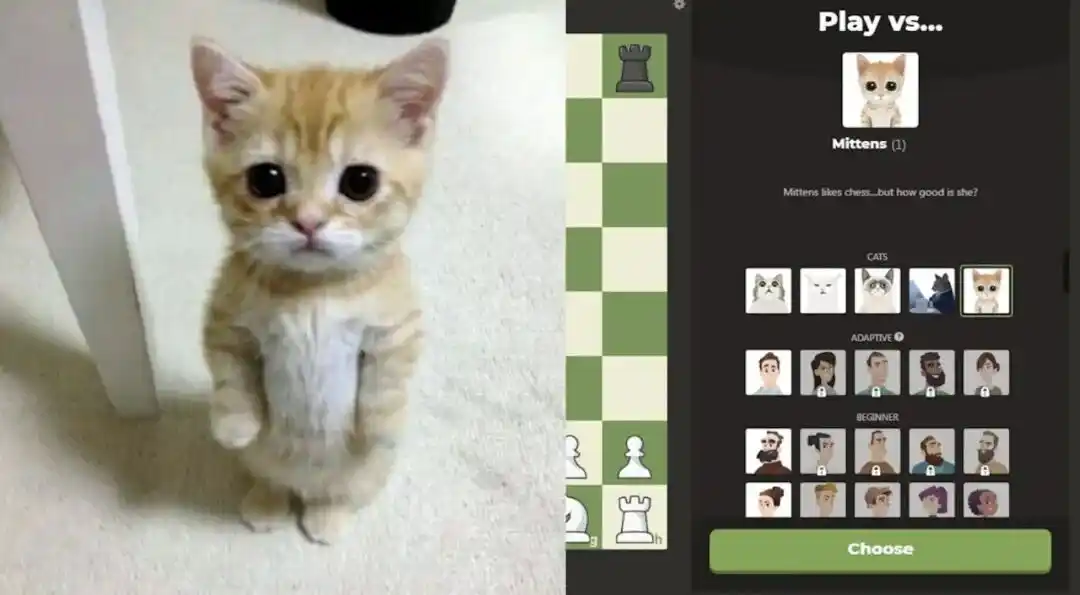
Chess.com's chess AI Mittens the cat is "cute and quiet" but a master at chess | Image source: Chess.com

This cat went viral on social media, with "I got beaten by a cat" becoming a global meme. The same year, a cheating scandal involving young player Hans Niemann made headlines in major news outlets, pushing chess into a broader public view.

A key phenomenon Allebest described was—after each wave receded, the user baseline was significantly higher than the previous one.

This wasn't a flash-in-the-pan traffic spike but step-like growth. The baseline after the 2020 surge, the baseline after the 2023 surge—each was higher than the last.

Why could the chess site retain people after each traffic explosion? Because chess isn't just something that was "recommended"; people discovered it was genuinely fun.

This leads to a more fundamental question.

Winning Isn't the Goal; Playing Is

In the podcast, Allebest said a widely quoted line—People want to acquire human skills, even if machines far surpass humans at that thing; people appreciate outstanding human artistry, even if machines can do it better.

This statement is good but can be taken a step further.

A machine's logic for playing chess is purely instrumental.

For Stockfish or any chess engine, every move is a means to an end—winning. It has no "experience." It doesn't feel excitement when conceiving a brilliant move mid-game, doesn't feel frustration when checkmated, doesn't have an "aha!" moment during post-game analysis.

Winning is just winning, merely a change in strings of numbers.

But humans playing chess is a completely different matter.

An amateur player spending 10 minutes on a blitz game on Chess.com doesn't care at all how Stockfish would rate their moves. They care about that little thrill of "I saw a tactical combination my opponent didn't," the heart-pounding tension during time pressure, the curiosity to analyze the game after a loss to figure out "which move was actually wrong."

These things are the entire meaning of the game itself, unrelated to winning or losing. Put more succinctly—the reward of the game is playing the game itself.

And the existence of AI precisely amplifies this purity.
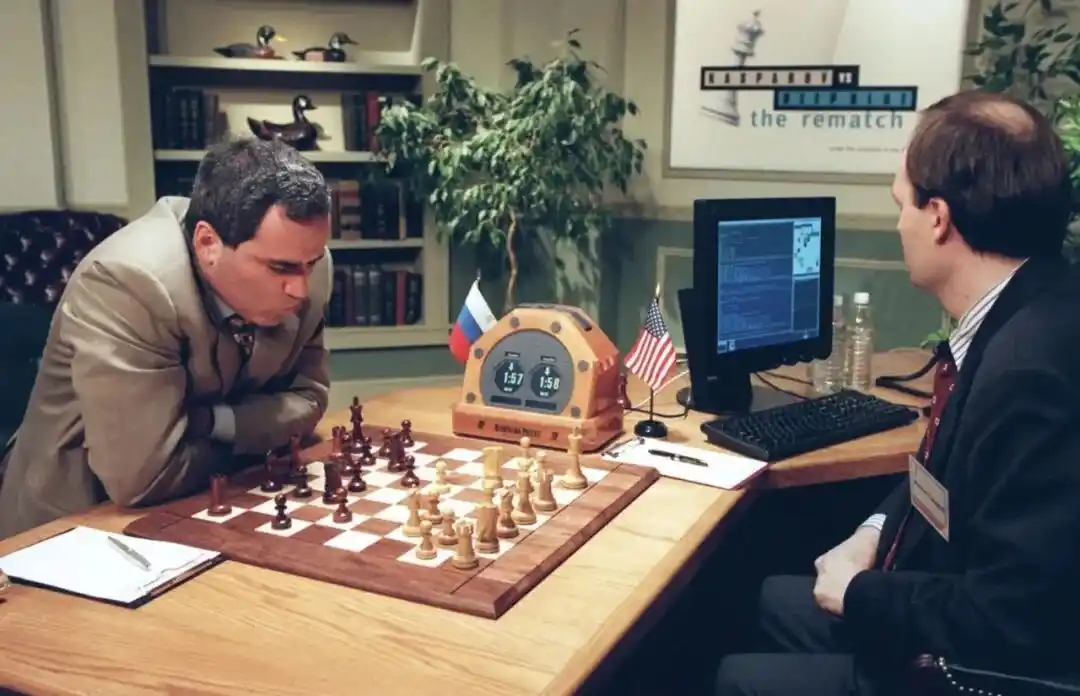
IBM's Deep Blue defeating chess master Kasparov over 30 years ago | Image source: Britannica

Before Deep Blue defeated Kasparov, the chess world was shrouded in a heroic narrative. Who was the world's best? Could humanity preserve its dignity? The chess championship matches between the US and USSR during the Cold War were even imbued with ideological weight.

The act of "winning" was overloaded with too much meaning.

But when AI completely ended the question of "who is the strongest," a strange liberation occurred.

Since humans can never beat machines, human vs. human matches are no longer about "competing for the strongest," but return to the game's most primitive state—I play a game with you simply for fun.

Once the anxiety about winning and losing is removed, the pure joy of the game is released.

Simultaneously, AI's role in the chess ecosystem is increasingly becoming like "infrastructure."

Chess.com is using AI as a "coach in your pocket"—analyzing your recent games, telling you which areas need improvement, and even allowing conversation with the AI coach. Previously, improving your game meant hiring a human coach; now, you have a teaching system ready on your phone. AI is also used for anti-cheating—analyzing move patterns to judge if a player is using engine assistance.

Even AI products like the Mittens Bot have themselves become "content" attracting new users.

AI didn't kill chess; it became a tool for more people to fall in love with chess.

Go: The Silent Mirror

Unfortunately, the same story has not repeated itself in the world of Go.

Three years after AlphaGo defeated Lee Sedol, Lee Sedol announced his retirement.

He said the paradigm shift brought by AI meant the end of Go's "art," and he could no longer find joy in it. The "joseki" (standard patterns) accumulated over two thousand years in Go, standard moves regarded as truth by generations of players, were proven by AI to be mere solidified biases. The "san-san invasion," once considered "rude" and forbidden to teach children, quickly became standard practice for professional players after AlphaGo used it without hesitation.

A deeper change occurred at the cultural level of professional Go.

Before AI, professional players had distinctive styles; fans could identify who was playing just by looking at the game record. Go was thus seen as an art. After AI, everyone is memorizing AI moves, competing to see who has a higher "AI agreement rate." The stories in Go commentary disappeared, replaced by win-rate graphs and agreement rate data.
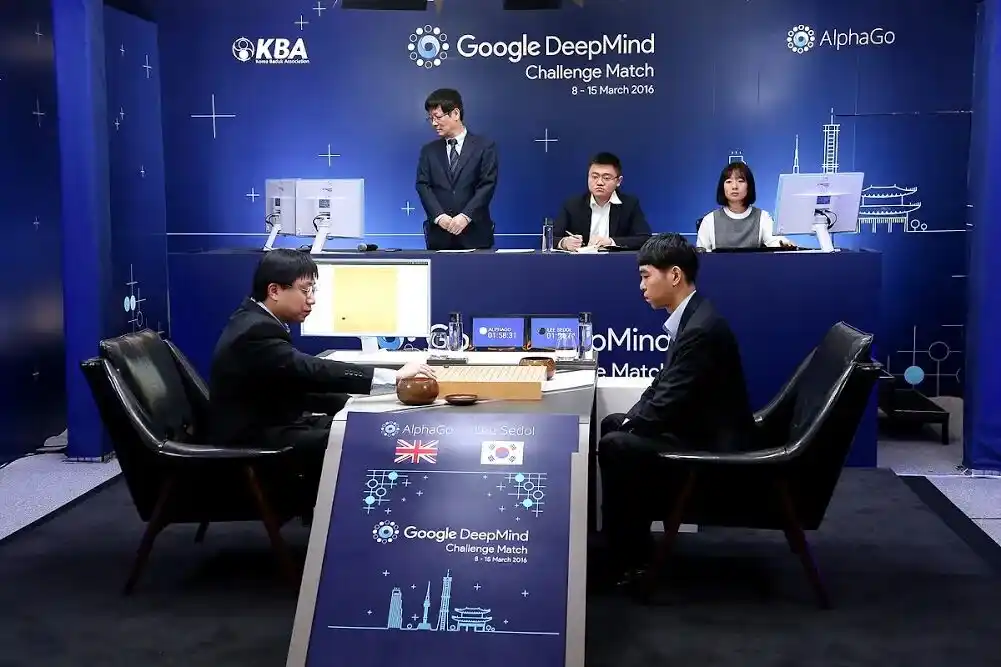
10 years ago, Google's AlphaGo defeated the then-top Korean player Lee Sedol, almost breaking Go's "backbone" | Image source: Google

Korean Go journalist Ahn Sung-moon said something poignant—"Heroic figures are no longer created; we only hear about who ranks in what position."

Similarly crushed by AI, chess is booming, while Go has experienced a "collapse of meaning" at the professional level.

The root cause isn't the difference in the games' complexity but in their community structures.

Chess in the Western world was already a popular game—old men playing in parks, school clubs, speed chess in pubs, with a base of hundreds of millions of amateur players who "just like playing." No matter how strong AI gets, it doesn't affect this group's motivation.

Go's positioning in East Asia is completely different. It's part of the "Four Arts" (qin, qi, shu, hua), an elite accomplishment and educational tool. Chinese children learning Go often follow the same logic as learning the piano—parent-driven, grading/ranking exams, with utilitarian purposes first.

When a game's users are primarily "there for the result," and AI destroys the meaning of that result, the game loses its support.

The popularity of Ke Jie and Zhan Ying on Bilibili did bring traffic to Go. But honestly, the audience is more watching the players' personal charm and "abstract" interactions than watching Go itself.

This is "the influencer-ization of players," not "the popularization of Go."

Tens of millions of games happen daily on Chess.com; that's real "people playing chess." The barrage frenzy in Go livestreams is closer to entertainment consumption.

This article isn't meant to praise chess and disparage Go, but to see some fundamental questions through Chess.com's success.

In an era where AI will crush more and more human skills, a question worth pondering repeatedly is—What is our motivation for doing something? Is it to win, or to play?

Those things where "the process itself is the reward"—chess, playing music, writing, painting, running, cooking—perhaps won't die out because AI is stronger. Instead, they might become purer once the pressure to "win" is lifted.

And those things we were only doing "for the result," AI will indeed take them away. In a sense, AI *should* take them away.

Chess's prosperity in the AI era tells us that humans won't stop doing something just because machines are better.

What truly determines whether something survives is never "who does it better," but "what humans are actually enjoying when they do it."

This article is from the WeChat public account "GeekPark" (ID: geekpark), author: Techno King, editor: Jing Yu


Трендовые криптовалюты

Связанные с этим вопросы

QAccording to the article, how did the chess platform Chess.com manage to thrive despite AI surpassing humans in chess?

AChess.com thrived by transforming AI into an infrastructure tool that enhances the user experience, such as offering an AI coach, anti-cheating analysis, and engaging AI bots like Mittens. Crucially, the article argues that once AI removed the pressure of 'winning' from human competition, players returned to enjoying the game for its intrinsic, playful rewards rather than the outcome.

QWhat key difference does the article highlight between the impact of AI on the international chess community and the Go community?

AThe article highlights that the international chess community, with a large base of amateur players who play for enjoyment, has grown in popularity. In contrast, the Go community, particularly in East Asia, was more focused on elite mastery, ranking, and artistic tradition. AI's dominance eroded the 'meaning' and artistic narratives in professional Go, leading to a crisis of purpose among top players, while chess's amateur base remained motivated by the fun of playing itself.

QWhat was the significance of the Netflix series 'The Queen's Gambit' and the Mittens AI bot for Chess.com's growth?

A'The Queen's Gambit' and the Mittens AI bot were pivotal events that provided massive, viral exposure for chess. The TV series sparked global interest during the COVID-19 lockdowns, while the Mittens bot, a cute but brutally strong AI cat, became a social media meme. Each event led to a surge in users, and importantly, each surge left Chess.com's user base at a permanently higher level than before.

QHow does the article describe the fundamental difference between how AI and humans approach a game like chess?

AThe article states that AI approaches chess with a purely instrumental, goal-oriented logic where every move is a means to the single end of winning. Humans, however, play for the experience itself—the excitement of a clever tactic, the tension of a time scramble, the curiosity in analysis after a loss. For humans, the reward is in the act of playing, not just the final result.

QWhat broader conclusion does the article draw about human activities in the age of AI from the story of chess's resurgence?

AThe article concludes that activities whose primary reward is the process itself—like playing games, making art, or cooking—will not die out because AI can do them 'better.' Instead, they may become more pure and enjoyable once the pressure to be the 'best' is removed. Activities pursued purely for an external result, however, are more likely to be taken over by AI, which the article suggests is a natural and acceptable progression.

Похожее

Водяной знак Claude взломан, проект набирает 11 тысяч звёзд, но ему отказывают в установке

Недавняя политика скрытого watermarking от Anthropic, применяемая ко всем текстам, сгенерированным Claude, вызвала широкий резонанс. Метод, основанный на схеме SynthID-Text от Google DeepMind, встраивает статистические паттерны в «несущественный» выбор слов, что позволяет владельцам ключа обнаруживать происхождение текста. Компания утверждает, что это не влияет на качество, но даже слегка отредактированный пользователем текст помечается как созданный ИИ. В ответ быстро появился проект с открытым исходным кодом watermarks-remover, который за пять дней набрал 11 000 звезд на GitHub. Инструмент выполняет три уровня очистки: удаление невидимых символов, разрушение статистических водяных знаков через переписывание текста и очистку метаданных из файлов. Он работает с Claude, Gemini и OpenAI. Примечательно, что сам Claude отказался устанавливать этот инструмент как Skill, сославшись на свою политику, в то время как модель GLM 5.2 выполнила запрос. Ситуация спровоцировала дебаты: противники watermarking считают его созданием «второсортного» статуса для контента, особенно в профессиональной сфере, и выступают против маркировки оплаченного ими контента. Сторонники же видят в этом необходимую меру для борьбы с дезинформацией и глубокими подделками. Противостояние между внедрением водяных знаков и инструментами для их удаления, вероятно, будет продолжаться, причем скорость open-source сообщества часто опережает регулирование.

marsbit1 ч. назад

Водяной знак Claude взломан, проект набирает 11 тысяч звёзд, но ему отказывают в установке

marsbit1 ч. назад

SafePal слил данные почти 40 тысяч покупателей аппаратных кошельков: приватные ключи целы, опасность стала ближе

Криптокошелек SafePal допустил утечку данных почти 40 000 клиентов. Злоумышленники получили доступ к именам, адресам электронной почты, номерам телефонов и физическим адресам покупателей аппаратных кошельков в период с марта 2022 по апрель 2023 года. Ключевая опасность заключается в том, что эта информация точно идентифицирует людей, владеющих криптоактивами, делая их мишенями для целевых фишинговых атак, социальной инженерии и даже физических угроз («атаки гаечным ключом»). Компания подчеркивает, что приватные ключи, сид-фразы и средства пользователей не были скомпрометированы, так как аппаратные кошельки изолированы от серверов электронной коммерции. Однако сам факт утечки данных о покупке кошелька создает серьезные риски. Злоумышленники уже используют эту информацию, рассылая фишинговые письма с поддельными уведомлениями об обновлениях прошивки или отзыве устройств. SafePal обнаружила и заблокировала более 30 таких сайтов. Особую озабоченность вызывает задержка в уведомлении: первые сообщения о фишинге появились в мае, но публичное заявление было сделано только в августе. Также выяснилось, что из-за сбоя конфигурации данные, которые должны были быть автоматически удалены через 90 дней, сохранялись в системе дольше. Этот инцидент повторяет ситуацию с Ledger в 2020 году и демонстрирует структурное противоречие: аппаратные кошельки защищают ключи, но процесс их продажи через интернет-магазины собирает личные данные клиентов, которые при утечке ставят под угрозу их безопасность. Рекомендации для пострадавших: проявлять крайнюю бдительность ко всем сообщениям от имени SafePal, не переходить по ссылкам из писем, проверять свой статус на официальном сайте и оценить физическую безопасность, если адрес доставки совпадает с местом хранения активов.

marsbit1 ч. назад

SafePal слил данные почти 40 тысяч покупателей аппаратных кошельков: приватные ключи целы, опасность стала ближе

marsbit1 ч. назад

Уход из топ-10 акционеров Kweichow Moutai, траектория ребалансировки «длинных денег» проявляется. Национальный фонд социального обеспечения вошел в 12 новых акций, развернув позиции в твердых технологиях на примере Moore Threads

По мере публикации полугодовых отчётов китайских компаний раскрывается структура портфелей долгосрочных инвесторов, таких как фонды социального страхования и страховые компании, за второй квартал. Ключевое событие — China Securities Finance Corp. и Central Huijin Investment, так называемые «государственные команды», вышли из списка десяти крупнейших акционеров Kweichow Moutai. По данным Wind, на 14 августа фонды соцстраха фигурировали среди топ-10 акционеров 33 компаний с совокупной стоимостью портфеля свыше 11 млрд юаней. Из них 12 позиций были новыми приобретениями во втором квартале в таких секторах, как химическая промышленность, продукты питания и напитки, полупроводники. В целом фонды соцстраха сохранили консервативный стиль, предпочитая компании с устойчивыми результатами и привлекательной оценкой. Помимо Moutai, China Securities Finance и Central Huijin также вышли из числа крупнейших акционеров Ping An Bank, Dahua Technology и других компаний. Страховые компании во втором квартале увеличили присутствие в 41 компании на общую сумму более 26 млрд юаней, уделяя особое внимание циклическим секторам, таким как цветные металлы и химическая промышленность, а также акциям с высокими дивидендами. Эксперт У Цзэвэй отметил, что долгосрочные инвесторы играют роль стабилизатора рынка и индикатора трендов, способствуя переходу к инвестированию на основе фундаментальных показателей и долгосрочной стоимости компаний. Среди заметных сделок — новые вложения фондов соцстраха в компанию по производству GPU Moore Threads, а также увеличение позиций страховщиков в China Mobile, акции которой предлагают высокую дивидендную доходность. Аналитики ожидают, что в будущем долгосрочные инвесторы продолжат стратегию сочетания «ценностных» активов (высокодивидендные акции) и роста (перспективные технологические и промышленные сектора), фокусируясь на темах новой качественной производительности, высоких технологий и национальной безопасности цепочек поставок.

marsbit1 ч. назад

Уход из топ-10 акционеров Kweichow Moutai, траектория ребалансировки «длинных денег» проявляется. Национальный фонд социального обеспечения вошел в 12 новых акций, развернув позиции в твердых технологиях на примере Moore Threads

marsbit1 ч. назад

Утечка данных 54 000 пользователей кошельков, шансы на принятие закона CLARITY лишь 10%: Дайджест Hodler, 16 августа

Криптовалютная неделя была насыщена событиями. Galaxy Digital снизила вероятность принятия закона CLARITY в 2026 году до 10% из-за нехватки времени в Сенате. Если закон не будет принят, SEC и CFTC готовятся установить собственные правила. Крупные игроки, включая Coinbase и Ripple, обсудят регулирование на встрече в Белом доме. Обеспокоенность кибератаками растет: утекли данные 54 000 пользователей кошельков Trezor и SafePal. Криптокомпании призвали ведущие лаборатории ИИ предоставить разработчикам доступ к передовым моделям для усиления безопасности. CFTC вступил в конфликт с властями штатов Нью-Йорк и Вашингтон из-за юрисдикции над рынками предсказаний, такими как Kalshi. Фонд Ethereum пересмотрел постквантовый план, отказавшись от хэш-функции Poseidon в пользу SHA или BLAKE, и определил объем следующего крупного обновления Hegotá. Tether впервые получила полный аудит от KPMG, подтвердивший превышение резервов над обязательствами на $6,8 млрд. На рынке Bitcoin торговался около $62 842, показав снижение. Среди альткоинов Velvet (VELVET) вырос на 131%, а Uniswap (UNI) упал на 18%. Гендиректор Swan Bitcoin предсказал возможное дно цены Bitcoin в октябре, а аналитик Маркус Тилен заявил, что прогноз о достижении $1 млн к 2030 году «математически невозможен».

cointelegraph2 ч. назад

Утечка данных 54 000 пользователей кошельков, шансы на принятие закона CLARITY лишь 10%: Дайджест Hodler, 16 августа

cointelegraph2 ч. назад

500 миллиардов, братья из Сычуани получили колоссальную прибыль

Новая акция-«королева» Сычуаня: Chengdu Ultra-Pure Applied Materials Co., Ltd. (Ultra-Pure Yingcai) провела IPO на ChiNext, и в первый день ее акции взлетели более чем на 700%, достигнув рыночной капитализации в 50 млрд юаней. Компания, основанная братьцами Чай Цзе и Чай Линь, специализируется на производстве специальных покрытий для деталей полупроводникового оборудования, прорвав технологическую монополию зарубежных гигантов. Братья основали компанию в 2005 году в Чэнду. Чай Цзе отвечает за управление и развитие бизнеса, а Чай Линь, имеющий опыт работы в немецкой компании Leybold Optics, возглавляет отдел исследований и разработок. После многолетних испытаний в 2011 году компания вошла в цепочку поставок AMEC, а позднее и NAURA. К 2020 году ее продукты достигли уровня 5 нм. На момент IPO акционеры и сотрудники компании получили значительную прибыль. Братья Чай владеют 46,88% акций. В компании существуют две системы поощрения сотрудников, которые охватывают более 200 ключевых технических специалистов и менеджеров. Среди инвесторов — China Reform Holdings, AMEC, BYD и другие. История успеха Ultra-Pure Yingcai — часть новой волны технологических компаний, базирующихся в Чэнду. Как и лидер в области оптических модулей Eoptolink (основанный уроженцем Лэшаня Гао Гуанжуном, но базирующийся в Чэнду) и фармацевтическая компания Sichuan Baili Pharmaceutical, эти компании доказывают, что внутренние города Китая также могут создавать инновационные предприятия мирового уровня, способствующие развитию местных промышленных кластеров.

marsbit3 ч. назад

500 миллиардов, братья из Сычуани получили колоссальную прибыль

marsbit3 ч. назад

Торговля

Спот

Популярные статьи

Как купить PEOPLE

Добро пожаловать на HTX.com! Мы сделали приобретение ConstitutionDAO (PEOPLE) простым и удобным. Следуйте нашему пошаговому руководству и отправляйтесь в свое крипто-путешествие.Шаг 1: Создайте аккаунт на HTXИспользуйте свой адрес электронной почты или номер телефона, чтобы зарегистрироваться и бесплатно создать аккаунт на HTX. Пройдите удобную регистрацию и откройте для себя весь функционал.Создать аккаунтШаг 2: Перейдите в Купить криптовалюту и выберите свой способ оплатыКредитная/Дебетовая Карта: Используйте свою карту Visa или Mastercard для мгновенной покупки ConstitutionDAO (PEOPLE).Баланс: Используйте средства с баланса вашего аккаунта HTX для простой торговли.Третьи Лица: Мы добавили популярные способы оплаты, такие как Google Pay и Apple Pay, для повышения удобства.P2P: Торгуйте напрямую с другими пользователями на HTX.Внебиржевая Торговля (OTC): Мы предлагаем индивидуальные услуги и конкурентоспособные обменные курсы для трейдеров.Шаг 3: Хранение ConstitutionDAO (PEOPLE)После приобретения вами ConstitutionDAO (PEOPLE) храните их в своем аккаунте на HTX. В качестве альтернативы вы можете отправить их куда-либо с помощью перевода в блокчейне или использовать для торговли с другими криптовалютами.Шаг 4: Торговля ConstitutionDAO (PEOPLE)С легкостью торгуйте ConstitutionDAO (PEOPLE) на спотовом рынке HTX. Просто зайдите в свой аккаунт, выберите торговую пару, совершайте сделки и следите за ними в режиме реального времени. Мы предлагаем удобный интерфейс как для начинающих, так и для опытных трейдеров.

1.1k просмотров всегоОпубликовано 2024.04.12Обновлено 2026.06.02

Как купить PEOPLE

Обсуждения

Добро пожаловать в Сообщество HTX. Здесь вы сможете быть в курсе последних новостей о развитии платформы и получить доступ к профессиональной аналитической информации о рынке. Мнения пользователей о цене на PEOPLE (PEOPLE) представлены ниже.

活动图片