Robinhood, the First Stock in the Predictive Market Concept

marsbitОпубликовано 2026-06-16Обновлено 2026-06-16

Введение

The online brokerage Robinhood, which previously partnered with prediction market platform Kalshi to offer event contract trading to its users, is now becoming a direct competitor. This shift began after Robinhood, through a joint venture, acquired and rebranded a CFTC-regulated exchange (now Rothera Exchange). Robinhood's motivation stems from the rapid growth of prediction markets on its platform, which significantly boosted its "other transaction revenue." Recognizing that its vast retail user base is the most critical asset, Robinhood aims to capture more value by routing orders to its own exchange instead of sharing fees with Kalshi. It strategically launched its Rothera platform during the high-traffic 2026 FIFA World Cup, successfully processing tens of millions of contracts in its initial days. This move signals a pivotal power shift in the prediction market industry: control over user distribution and access is emerging as a more decisive advantage than the underlying market infrastructure itself. The future competition may increasingly revolve around which platforms control the major user gateways.

Author: Azuma, Odaily Planet Daily

The battle of the World Cup has begun, and the total trading volume of the predictive market continues to hit new highs. However, as the industry leader, Kalshi might not be in the best mood right now.

The reason is not due to fluctuations in Kalshi's own business data, but because Kalshi now "suddenly" faces another formidable rival besides Polymarket, and this opponent was once its most important ally.
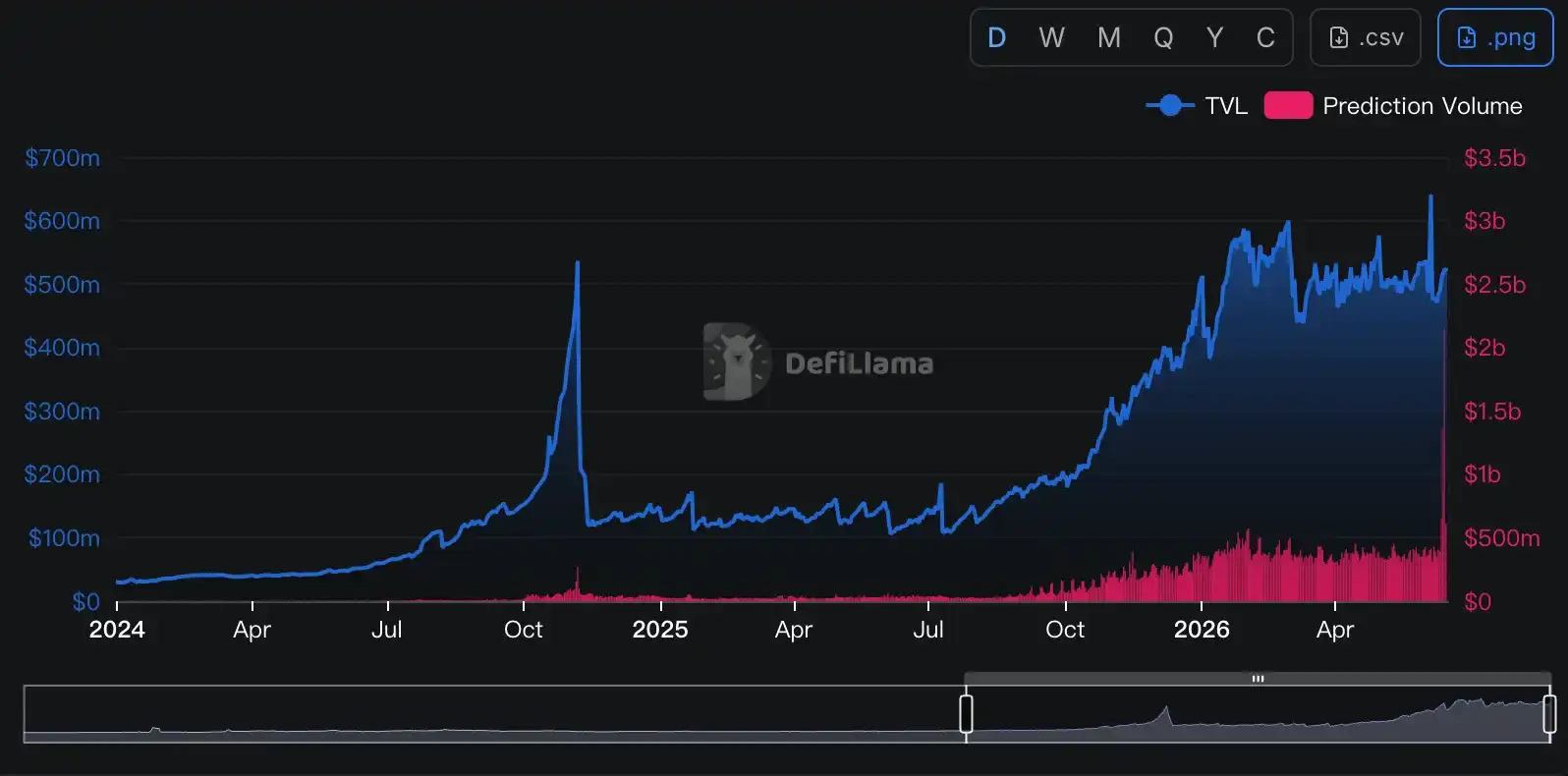
  • Odaily Note: Data sourced from Defillama.

Kalshi's Most Important Traffic Channel — Robinhood

Rewind to March 2025. At that time, Kalshi announced a partnership with the US online broker Robinhood, where the latter would use Kalshi's services to offer its users predictive market trading, allowing them to place bets on events like politics, economics, and sports.

From a business model perspective, this was a typical case of "mutual benefit" — Robinhood, responsible for user access and transaction distribution, could directly use Kalshi's mature product; Kalshi, responsible for the underlying market, matching, clearing, and regulatory compliance systems, could reach Robinhood's massive retail user pool.

The subsequent story proved the "win-win" outcome of this partnership. Through Robinhood's channel distribution, Kalshi indirectly gained massive users and transaction volume. Piper Sandler analysts once estimated that "trading volume completed through Robinhood's channel accounted for about 25%-35% of Kalshi's total trading volume." These orders ultimately translated into revenue for both parties — Robinhood would independently charge for all Kalshi event contracts traded through its channel, a fixed fee of $0.01 per contract per direction, and then share the revenue with Kalshi (the specific proportion was not disclosed).
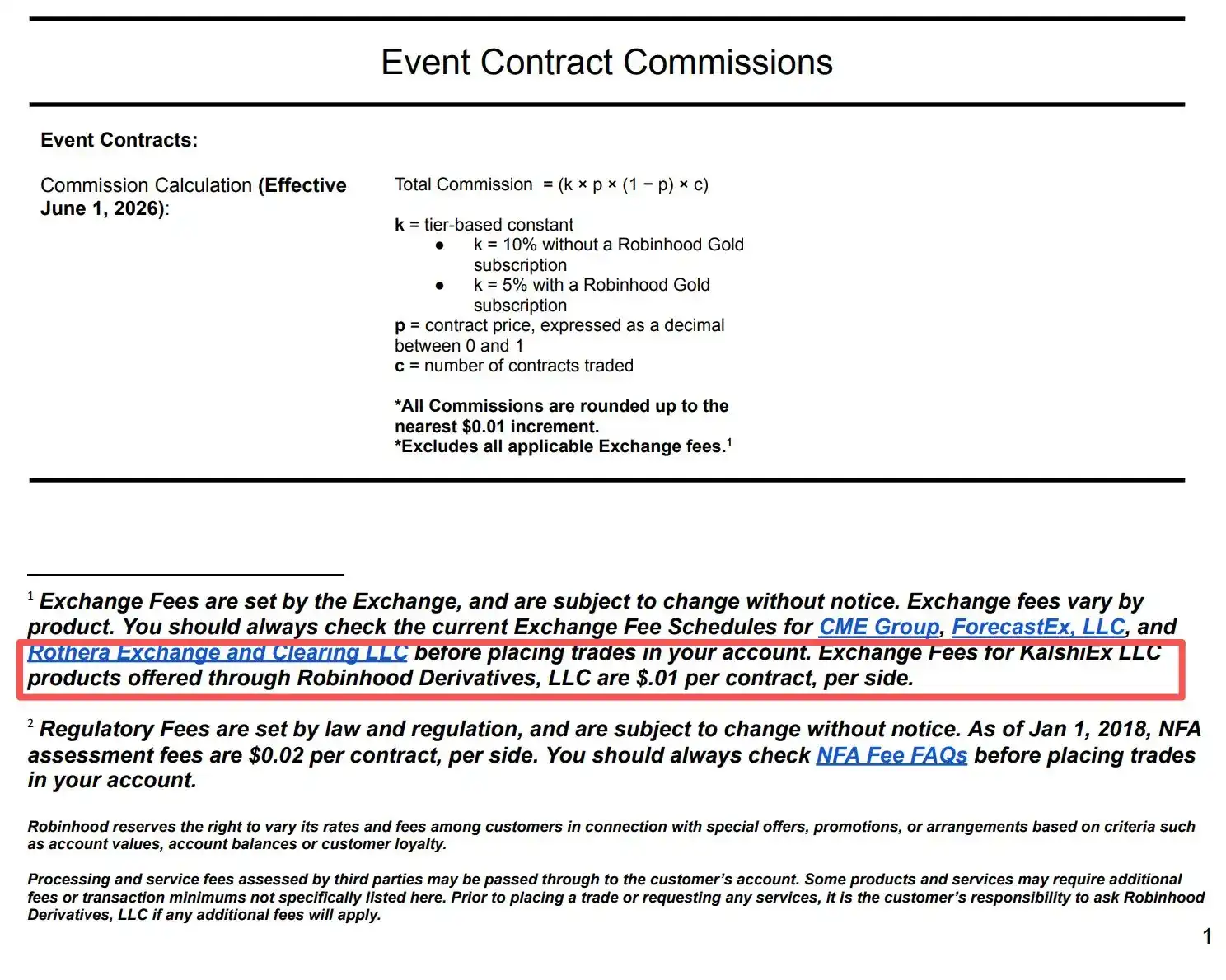
The Q1 financial report disclosed at the end of April showed that Robinhood facilitated the trading of 8.8 billion event contracts in Q1, driving "other trading revenue" to grow by 320% year-on-year, reaching $147 million. The predictive market has become the brightest new growth engine in Robinhood's product line.

However, recently, this relationship has undergone some subtle changes.

Robinhood's Ambition: Taking Back the Cake Shared with Kalshi

As internet history has proven countless times, when a channel gains enough leverage, it is no longer content with being just a channel. Robinhood is no exception.

Although the partnership with Kalshi also brought substantial revenue to Robinhood, as the predictive market became one of the fastest-growing new businesses on the platform, Robinhood was no longer satisfied with the current revenue-sharing arrangement.

In their cooperation model, Kalshi was responsible for providing the market and infrastructure, while Robinhood was responsible for providing users and order flow. However, as the partnership deepened, Robinhood gradually realized that what is truly scarce might not be the market itself, but the user access it firmly controls. After all, for most Robinhood users, they don't care whether their orders are ultimately executed on Kalshi or another platform — users only see a trading entry within the Robinhood app, not the underlying infrastructure provider.

In other words, Robinhood always held one of the most critical resources for the predictive market — distribution power. If the users belong to Robinhood, why should the order flow go to someone else?

In fact, just as Robinhood was quickly validating the demand for predictive markets through Kalshi, a Plan B was quietly launched shortly thereafter.

In November 2025, Robinhood announced the formation of a joint venture with Wall Street quantitative trading giant Susquehanna and planned to acquire the CFTC-regulated derivatives exchange MIAXdx. According to the official statement, this joint venture would operate an independent futures and derivatives exchange and clearing organization in the future, with predictive markets being one of its key focus areas. At the time, the outside world largely viewed it as an infrastructure investment. However, as more information was disclosed later, people gradually realized Robinhood's goal was far beyond just finding a new partner for predictive markets.

In January 2026, the transaction was completed. Robinhood and Susquehanna gained 90% control of MIAXdx, simultaneously acquiring a complete CFTC regulatory framework, including Designated Contract Market (DCM) and Derivatives Clearing Organization (DCO) licenses. Subsequently, MIAXdx was renamed Rothera Exchange, and its clearing organization was renamed Rothera Clearing.

At this point, Robinhood possessed the core elements needed to independently operate a predictive market, lacking only a mature product comparable to Kalshi. However, for Robinhood, with its rich experience in internet product development, this was evidently not a difficult task.

Rothera's Opportunity: The World Cup

In June 2026, after about half a year of accelerated development, the Rothera product gradually took shape, and Robinhood finally made the move that was almost destined to happen — gradually shifting the orders that originally flowed to Kalshi into its own controlled system.

Robinhood specifically chose an ideal launch battleground for Rothera — the World Cup. For predictive markets, the World Cup is undoubtedly one of the most high-traffic trading themes. Whether it's match outcomes, advancement results, or champion predictions, related markets can attract a large number of new users to trade in a short period. For the newly launched Rothera platform, there is no better scenario for a cold start than the World Cup.

According to Robinhood's official disclosure, during this World Cup with a total of 104 matches, some event contracts will be directed to Rothera for matching and clearing, including markets for single World Cup match results, the ultimate World Cup champion, total goals in a single match, and others. Compared to the previous model that relied entirely on Kalshi, this marks the first time Robinhood has introduced predictive market orders into its own trading system on a large scale.
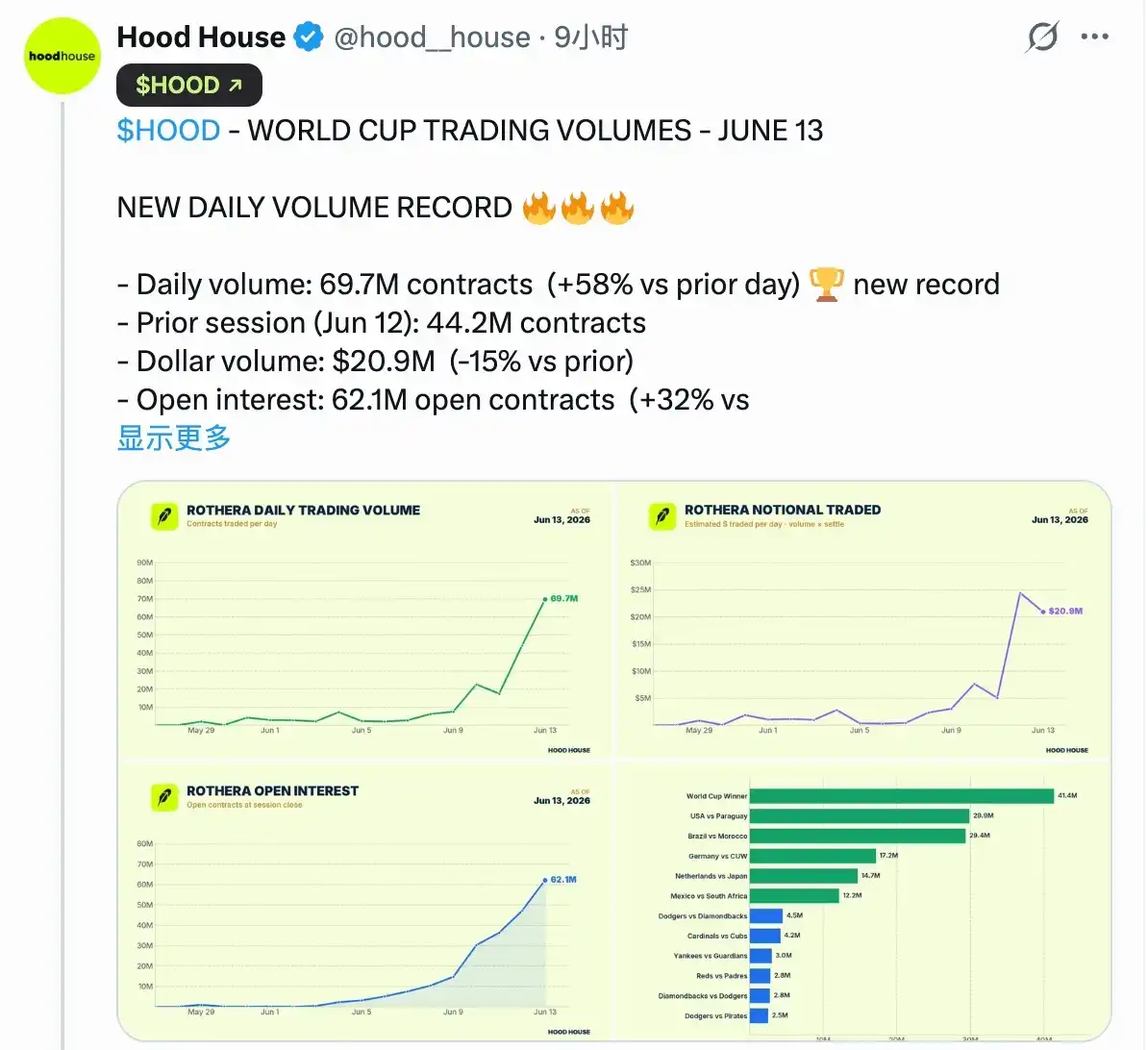
Judging by the results, Rothera clearly seized this opportunity. According to data disclosed by Hood House, an investment research media tracking Robinhood's activities, on June 12, Rothera completed 44.2 million contract trades, corresponding to a dollar trading volume of approximately $24.4 million; on June 13, Rothera completed 69.7 million contract trades, corresponding to a dollar trading volume of approximately $20.9 million... Although these figures still lag behind Kalshi's popular markets, which often involve hundreds of millions of dollars, considering that Rothera has literally just launched a few days ago, this performance is sufficiently successful.

For both Robinhood and Kalshi, this signifies that the balance of their cooperation has begun to tilt. From Robinhood's perspective, the transaction fee revenue that previously had to be shared with Kalshi can now be kept more within its own ecosystem. From Kalshi's perspective, this means that one of its most important growth engines has begun to show signs of weakening.

And the World Cup is clearly just the beginning of Rothera's encroachment on Kalshi. Looking further into the future, Robinhood will inevitably expand Rothera's coverage to more sporting events, as well as economic and political themes. Those orders that originally flowed to Kalshi will be intercepted one by one by Rothera.

Since Robinhood and Kalshi have never publicly disclosed their revenue-sharing ratio (some reports say 50%:50%, but no official information is available), we cannot know the exact monetary value of this interception. However, considering that Robinhood alone generated $147 million in predictive market-related revenue in Q1, and the Q2 World Cup and the more distant mid-term elections will likely bring even larger-scale trading activities, calculated on an annual basis, the value of this interception could reach several billion dollars.

Who Controls Distribution, Controls Everything

The drama of Robinhood and Kalshi moving from allies to opponents once again illustrates a logic repeatedly proven in the internet market — products are easy to build, but traffic is hard to find; whoever controls distribution controls everything.

Over the past few years, the market generally believed that Kalshi's core moat came from regulatory licenses, exchange qualifications, and clearing capabilities. Therefore, whether it was brokers like Robinhood or various media, communities, and traffic platforms, they were essentially just Kalshi's channel partners and traffic inlets. However, the emergence of Rothera proves one thing: in today's landscape of severe product homogenization, the product itself might not be the most critical element. What is truly scarce is always the user.

Where the users are, the liquidity is; where the liquidity is, the market will be. When Robinhood controls the access to tens of millions of retail users, it has the full capability to direct these users to any trading venue. For users, they don't care whether their orders are ultimately executed on Kalshi or Rothera. As long as the experience doesn't significantly differ, it doesn't matter who is matching or clearing behind the scenes.

If the theme of the predictive market industry in the past few years was the market battle between Polymarket and Kalshi, then the theme for the coming years might become a channel war. Robinhood incubating Rothera is essentially a reverse integration initiated by the channel side towards the market layer. As more and more platforms with traffic inlets begin to realize the strategic value of predictive markets, similar stories are highly likely to continue occurring. Whether it's exchanges, brokers, social platforms, or media platforms, they could all become new predictive market entry points.

And when inlets start to control the market, and channels begin to have pricing power, the ultimate winner in the predictive market industry might no longer be the platform responsible for order matching, but the one closest to the user and most capable of controlling distribution.

This was true in the internet era and the mobile internet era. This time, there's no exception either.

Связанные с этим вопросы

QAccording to the article, why did Robinhood partner with Kalshi initially?

ARobinhood partnered with Kalshi in March 2025 to leverage Kalshi's established product and regulatory infrastructure to offer prediction market trading services to its users. This allowed Robinhood to enter the prediction market quickly while Kalshi gained access to Robinhood's large retail user base.

QWhat is the core reason Robinhood decided to develop its own prediction market platform, Rothera Exchange?

AThe core reason is that Robinhood realized it controlled the most critical resource: the user distribution channel. Since users only interacted through the Robinhood app and didn't care about the backend infrastructure, Robinhood saw an opportunity to capture more revenue by diverting orders from Kalshi to its own controlled platform, thereby keeping more of the transaction fees.

QWhat event did Robinhood choose to launch Rothera Exchange, and why was it strategic?

ARobinhood strategically chose the 2026 FIFA World Cup to launch Rothera Exchange. The World Cup is a major event that generates high trading volume and attracts many new users to prediction markets, making it an ideal scenario for the platform's initial growth and market penetration.

QHow significant was the volume of prediction market trades for Robinhood in Q1 of 2026 according to the article?

AAccording to the article, Robinhood's Q1 2026 earnings report showed it facilitated 8.8 billion event contracts, driving a 320% year-over-year growth in 'other transaction revenue' to $147 million. This made prediction markets the fastest-growing new business line for Robinhood at the time.

QWhat broader industry shift does the article suggest is occurring with the rise of Rothera and similar moves by other platforms?

AThe article suggests the industry is shifting from a market-centric competition (like between Polymarket and Kalshi) to a 'channel war' or 'distribution war.' Platforms with large user bases and distribution power (like Robinhood, brokerages, social media) are recognizing the value of prediction markets and may integrate or build their own, challenging the dominance of pure infrastructure providers.

Похожее

Do Robots Also Need Encrypted Wallets? Stablecoin Giant Tether Bets on German Company NEURA Robotics

Do Robots Need Crypto Wallets? Stablecoin Giant Tether Bets on German Firm NEURA Robotics German robotics company NEURA Robotics has secured up to $1.4 billion in what is claimed to be the largest-ever funding round in the full-stack robotics industry, valuing the company at $7 billion. The Series C round attracted major investors like Tether, Qualcomm, Amazon, NVIDIA, Bosch, and the European Investment Bank. NEURA, founded in 2019, initially focused on AI-powered collaborative robots (cobots) for industrial automation, later expanding to autonomous mobile robots, service robots, and humanoid robots. Its core strategy is evolving from a hardware manufacturer to the operator of "Neuraverse," a platform designed to enable different robots to share learned experiences and data, creating network effects. A key, crypto-focused aspect of this investment is Tether's involvement. Tether plans to integrate its open-source Wallet Development Kit (WDK) into NEURA's robot platforms. This would embed self-custody wallet functionality, allowing robots to autonomously handle payments and settlements for tasks under pre-set rules—envisioning use cases in logistics or Robotics-as-a-Service (RaaS) models. This move could position stablecoins and crypto wallets as potential "machine payment infrastructure." Additionally, the partnership will see Tether's QVAC (QuantumVerse Automatic Computer) edge-AI framework tested and deployed within Neuraverse. This aims to enable low-latency, offline-capable AI decision-making directly on robots, reducing reliance on cloud computing for critical, time-sensitive operations. The investment underscores Tether's broader ambition to expand beyond being just a stablecoin issuer into AI, energy, and digital infrastructure, with NEURA's robotics network serving as a testbed for merging crypto-based financial layers with edge-based intelligence for the future of automation.

marsbit10 мин. назад

Do Robots Also Need Encrypted Wallets? Stablecoin Giant Tether Bets on German Company NEURA Robotics

marsbit10 мин. назад

AMD Launches Compact AI Host, Directly Challenging NVIDIA DGX Spark

In June 2026, AMD announced the Ryzen AI Halo, a compact AI developer desktop to rival NVIDIA's DGX Spark. Both feature 128GB unified memory for running 200B+ parameter models locally. Priced from $2,949 to $3,999, AMD undercuts NVIDIA's $3,999+ DGX Spark. The core divergence lies in architecture and philosophy. Ryzen AI Halo uses an x86-based Ryzen AI Max+ 395 APU (CPU+GPU+NPU), runs standard Windows/Linux, and emphasizes general-purpose PC flexibility. DGX Spark uses an ARM-based Grace Blackwell Superchip, runs a custom DGX OS, and includes a high-speed ConnectX-7 NIC for cluster prototyping, anchoring it to NVIDIA's full-stack CUDA ecosystem. AMD's ROCm software has improved, with simpler installation and support for major frameworks, but still lags behind CUDA's 17-year maturity in community support and cutting-edge library availability. AMD's broader strategy focuses on becoming a viable second-source supplier. Key moves include acquiring design capabilities via ZT Systems (while outsourcing manufacturing) and securing two major 6GW GPU supply deals with OpenAI and Meta in late 2025/early 2026. These contracts validate AMD's role in diversifying the AI supply chain, rather than outright beating NVIDIA. NVIDIA counters with a tightly integrated stack from desktop (DGX Spark) to data center, emphasizing seamless scalability and enterprise software subscriptions (AI Enterprise). In summary, Ryzen AI Halo represents AMD's pragmatic path: offering a cost-effective, open-ecosystem alternative for developers wary of vendor lock-in, while its large data center contracts aim to capture share from customers seeking a second GPU supplier. The choice boils down to a familiar, flexible PC environment with potential software gaps (AMD) versus a premium, optimized, but locked-in ecosystem (NVIDIA).

marsbit10 мин. назад

AMD Launches Compact AI Host, Directly Challenging NVIDIA DGX Spark

marsbit10 мин. назад

Sharplink CEO: One Million Ethereum Developers, Who Can Compete?

Etherean Ecosystem: One Million Developers and a Formidable Moat The Ethereum network has surpassed a significant milestone: over one million unique lifetime developers, with approximately 232,000 active in the past year. This vast and growing talent pool is Ethereum's core advantage, far more critical than transient metrics like speed or transaction fees. The central question is not which blockchain is fastest, but where the best builders choose to build long-term. Ethereum's answer lies in a decade-long accumulation of infrastructure, standards, tools, liquidity, and collaborative culture that is exceptionally difficult to replicate. It has become the default operating system for programmable finance. This massive developer base is actively working on complex, high-risk challenges that deepen Ethereum's strategic moat: * **Glamsterdam Upgrade (2026):** Focused on core protocol scalability (ePBS, parallel execution) while preserving core values like credible neutrality. * **Synchronous Composability:** Aims to make numerous Rollups interoperate like a single chain, directly addressing fragmentation concerns. * **Quantum Resistance:** Ethereum leads mainstream ecosystems in coordinated preparation for post-quantum cryptography, with a targeted migration plan around 2029. This developer advantage is self-reinforcing, fueled by: * **Deep Composability:** Applications interact like interoperable financial Lego bricks via shared standards (e.g., EVM, Solidity). * **Credible Neutrality:** Secured by over 900,000 validators, making it trusted by major institutions. * **Modularity:** Rollups (Base, Arbitrium, etc.) expand, rather than fracture, the ecosystem into a tightly connected modular internet economy. * **Culture:** Attracts top-tier researchers and standard-setters who guide the entire industry. In essence, while other chains generate activity, Ethereum is consolidating as the trusted, long-term coordination layer for internet-native finance. Its future is being built now by the architects of the next-generation financial infrastructure.

Odaily星球日报1 ч. назад

Sharplink CEO: One Million Ethereum Developers, Who Can Compete?

Odaily星球日报1 ч. назад

Ethereum Reaches the Milestone of One Million Developers, Sharplink CEO Delves Deep into Ethereum's Future Possibilities

Ethereum Surpasses One Million Developers Milestone: A Look at Its Unshakeable Dominance and Future Joseph Chalom, CEO of Sharplink, reflects on his recent Asia trip where he engaged deeply with Ethereum developers and ecosystem leaders. The most striking takeaway was not just the industry's vibrancy, but the rigorous, long-term vision of local builders. This context brings to life a pivotal statistic: Ethereum has now surpassed one million cumulative developers (1,012,824), with approximately 232,000 remaining active in the past year—a talent pool unmatched by any other crypto ecosystem. The critical question isn't which blockchain is fastest, but where top developers choose to build long-term. Ethereum's answer is unequivocal. Its decade-long lead stems from a unique convergence of technology, institutional culture, economic systems, and composability, cementing its role as the foundational operating system for programmable finance. This massive developer base is tackling the industry's hardest problems, continuously strengthening Ethereum's moat. Key initiatives include: * **The Glamsterdam Upgrade (planned 2026):** Introducing ePBS and Block-level Access Lists for parallel execution and higher throughput while preserving core values like credible neutrality and fair MEV distribution. * **Synchronous Composability:** Projects are working to enable atomic transactions across dozens of Rollups, making them function as one unified chain and eliminating ecosystem fragmentation. * **Post-Quantum Security:** Ethereum is far ahead in preparing for quantum computing threats, with a dedicated foundation working group and testnets targeting a full migration by ~2029—a crucial factor for institutional adoption. Beyond developers, Ethereum's core network effects are its unparalleled composability and unified standards (like EVM and Solidity), which create a powerful flywheel: more developers → better tools → greater liquidity → more institutional participation. Its other decisive advantages include credible neutrality (over 900k validators), a secure modular architecture with interconnected Rollups, and a deeply entrenched culture shaped by top-tier researchers. Ultimately, there's a vast difference between generating short-term activity and becoming the trusted, long-term coordination layer for global native finance. Major institutions prioritize security, trust, and liquidity—areas where Ethereum holds dominant mindshare. The industry's trajectory shows resources consolidating around unified standards, deep liquidity, and developer consensus. After meeting the builders in Seoul and Hong Kong, Chalom is more convinced than ever: Ethereum's unshakeable future is being built right now.

Foresight News1 ч. назад

Ethereum Reaches the Milestone of One Million Developers, Sharplink CEO Delves Deep into Ethereum's Future Possibilities

Foresight News1 ч. назад

Saylor's Latest Long Read: Bitcoin is Not Money, It's Digital Capital, and Money is Built Upon It

Michael Saylor presents his "Digital Asset Stack" theory, positioning Bitcoin as the foundational layer of digital capital. He argues Bitcoin itself should remain unchanged—no staking, inflation, or protocol alterations. Instead, a five-layer financial architecture should be built atop it: Digital Capital (BTC), Digital Credit (e.g., yield instruments like STRC), Digital Currency (stable, yield-bearing instruments pegged to fiat), Digital Yield (leveraged/structured products), and Digital Equity (e.g., MSTR stock, absorbing residual volatility). Saylor asserts this stack transforms Bitcoin's high-volatility, high-energy capital into tailored products: stable currencies for payments/savings, yield instruments for income seekers, and equity for growth investors. This approach meets diverse needs—corporate treasuries, banks, retirees, emerging market users—without compromising Bitcoin's core properties (scarcity, decentralization). The "killer use case" is rebuilding global money, credit, and capital markets on Bitcoin, bridging the fiat world with a superior digital asset foundation. The system leverages traditional finance principles (risk layering, structured products) while using Bitcoin as the ultimate collateral. This expands Bitcoin's utility, drives adoption, and offers a better monetary experience: digital, yield-bearing, stable-value tools for everyday use.

marsbit1 ч. назад

Saylor's Latest Long Read: Bitcoin is Not Money, It's Digital Capital, and Money is Built Upon It

marsbit1 ч. назад

Торговля

Спот
Фьючерсы

Популярные статьи

Как купить T

Добро пожаловать на HTX.com! Мы сделали приобретение Threshold Network Token (T) простым и удобным. Следуйте нашему пошаговому руководству и отправляйтесь в свое крипто-путешествие.Шаг 1: Создайте аккаунт на HTXИспользуйте свой адрес электронной почты или номер телефона, чтобы зарегистрироваться и бесплатно создать аккаунт на HTX. Пройдите удобную регистрацию и откройте для себя весь функционал.Создать аккаунтШаг 2: Перейдите в Купить криптовалюту и выберите свой способ оплатыКредитная/Дебетовая Карта: Используйте свою карту Visa или Mastercard для мгновенной покупки Threshold Network Token (T).Баланс: Используйте средства с баланса вашего аккаунта HTX для простой торговли.Третьи Лица: Мы добавили популярные способы оплаты, такие как Google Pay и Apple Pay, для повышения удобства.P2P: Торгуйте напрямую с другими пользователями на HTX.Внебиржевая Торговля (OTC): Мы предлагаем индивидуальные услуги и конкурентоспособные обменные курсы для трейдеров.Шаг 3: Хранение Threshold Network Token (T)После приобретения вами Threshold Network Token (T) храните их в своем аккаунте на HTX. В качестве альтернативы вы можете отправить их куда-либо с помощью перевода в блокчейне или использовать для торговли с другими криптовалютами.Шаг 4: Торговля Threshold Network Token (T)С легкостью торгуйте Threshold Network Token (T) на спотовом рынке HTX. Просто зайдите в свой аккаунт, выберите торговую пару, совершайте сделки и следите за ними в режиме реального времени. Мы предлагаем удобный интерфейс как для начинающих, так и для опытных трейдеров.

862 просмотров всегоОпубликовано 2024.03.29Обновлено 2026.06.02

Как купить T

Обсуждения

Добро пожаловать в Сообщество HTX. Здесь вы сможете быть в курсе последних новостей о развитии платформы и получить доступ к профессиональной аналитической информации о рынке. Мнения пользователей о цене на T (T) представлены ниже.

活动图片