Trade.xyz's Rebase Refusal Sparks Controversy, On-Chain Pre-IPO Market Faces Major Pricing Test

marsbitОпубликовано 2026-06-11Обновлено 2026-06-11

Введение

The debate surrounding Trade.xyz's refusal to adjust its SPCX (SpaceX pre-IPO) perpetual contract pricing amid updated share count revelations highlights a key challenge for on-chain pre-IPO markets. While several centralized exchanges (CEXs) paused and repriced their contracts after SpaceX's filing showed a ~10% increase in total shares, Trade.xyz maintained its market-driven pricing logic, which tracks expected per-share price sentiment rather than fundamental valuation metrics like market cap. This discrepancy triggered cross-platform arbitrage and caused leveraged long positions on Trade.xyz to suffer significant losses, as the platform's HIP-3 architecture lacks a native "Rebase" mechanism to neutrally adjust all user positions following such corporate actions. The incident underscores the difficulty for decentralized perpetual exchanges (Perp DEXs) to implement Rebase—a process CEXs handle by centrally pausing markets and adjusting ledger data. On-chain, this requires complex smart contract modifications, increasing gas costs, complexity, and potential attack surfaces. While some DEXs have managed similar adjustments, Trade.xyz's current design does not natively support it, though the team is reportedly exploring solutions for future events like stock splits. Ultimately, the controversy serves as a critical case study for the nascent on-chain pre-IPO sector, raising questions about price discovery reliability, transparent rule disclosure, and the readiness of DeFi inf...

Author: Nancy, PANews

While crypto enthusiasts were happily posting their SpaceX subscription slips on social media, sharing the joy of participating in this super IPO feast, Trade.xyz on Hyperliquid found itself in the eye of a storm. Its SPCX pre-IPO perpetual contract pricing rules triggered a wave of controversy, making it the focal point of market debate.

After SPCX Pricing Turmoil, Trade.xyz Faces Trust Test

On June 10, Trade.xyz issued a statement formally responding to the recent pricing controversy surrounding its SPCX pre-IPO perpetual contract.
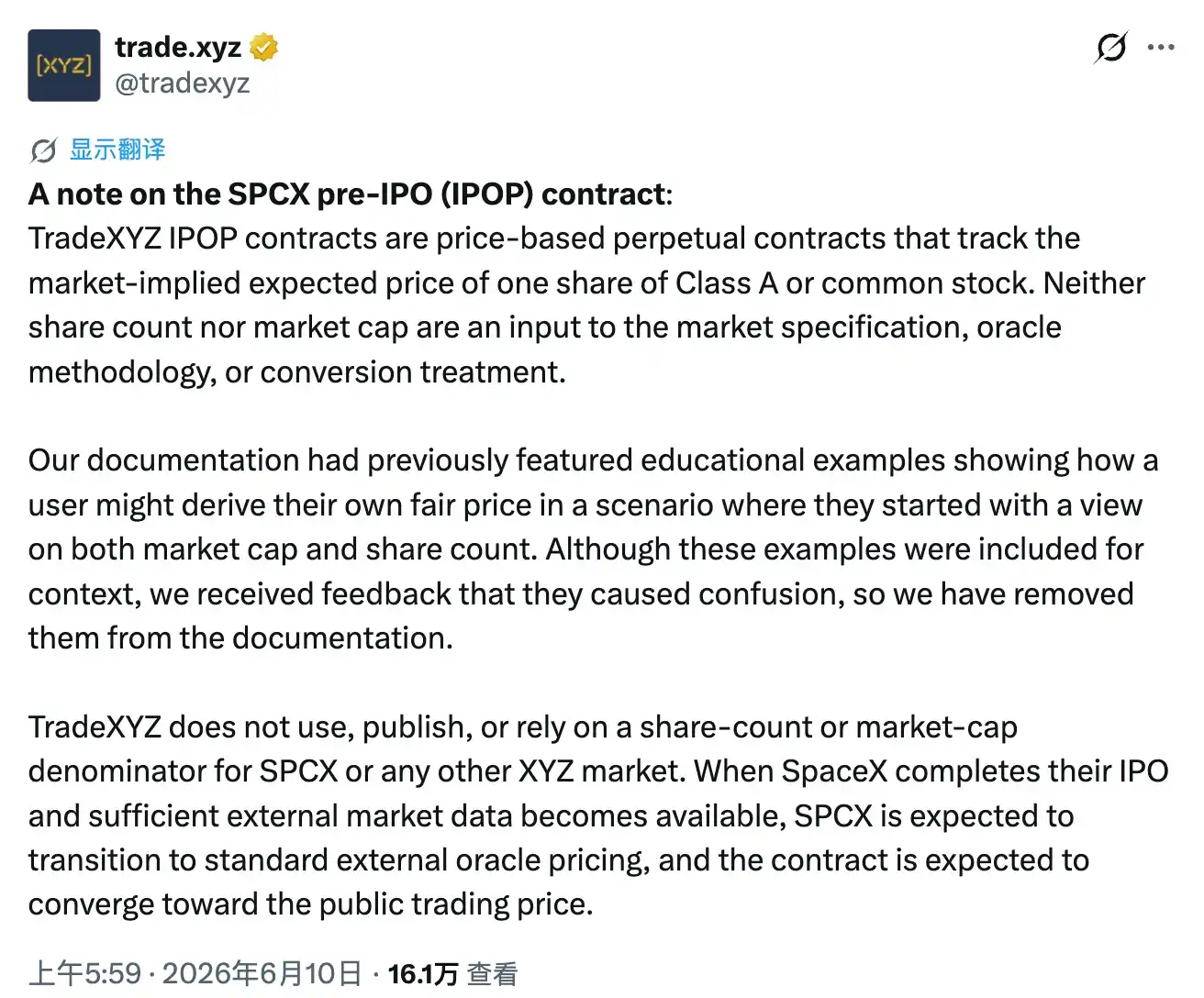
According to the statement, Trade.xyz's IPOP contract is a price-type perpetual contract. Its core goal is to track the market's expectation for the price per share of Class A common stock, rather than reflecting the company's overall valuation. Therefore, information such as the company's total share count or market capitalization is not part of the contract rules, oracle pricing logic, or future contract conversion mechanisms. In other words, the SPCX price on Trade.xyz is more akin to an indicator reflecting market sentiment and trading expectations, not a theoretical share price calculated based on company fundamentals.

Trade.xyz also mentioned that early product documentation included some tutorial examples demonstrating how users could derive a reasonable per-share price based on their own judgment of the company's valuation and total share count. Although these examples were solely for understanding the product mechanism, some users mistakenly believed the platform itself would price based on market cap or share count data. Consequently, these examples have now been removed from the official documentation.

The statement emphasized: Trade.xyz will not use, publish, or rely on share quantities or market capitalization as a pricing benchmark for SPCX or any other XYZ market.

The catalyst for this controversy was the recently disclosed SpaceX prospectus. The document revealed SpaceX's actual total share count to be 13.08 billion shares, approximately 10% higher than the previously long-held market assumption of 11.87 billion shares. This means that, with the company's overall valuation unchanged, the corresponding theoretical per-share price for SpaceX would need to be adjusted downward by about 10%.

Following the announcement, several centralized exchanges (CEXs) suspended trading of relevant contracts, repriced them based on the new share count data, and then resumed trading. However, Trade.xyz adhered to its product logic of not relying on share count data and therefore did not adjust its pricing framework. These two different pricing systems triggered a wave of cross-platform arbitrage, swiftly pushing Trade.xyz into the center of public criticism.

Regarding resolving this discrepancy in the future, Trade.xyz stated that once SpaceX officially completes its IPO and sufficient external trading data is formed in the public market, SPCX will switch to a standard external oracle pricing mechanism. At that point, the contract price is expected to gradually converge towards the actual trading price of SpaceX stock in the public market.
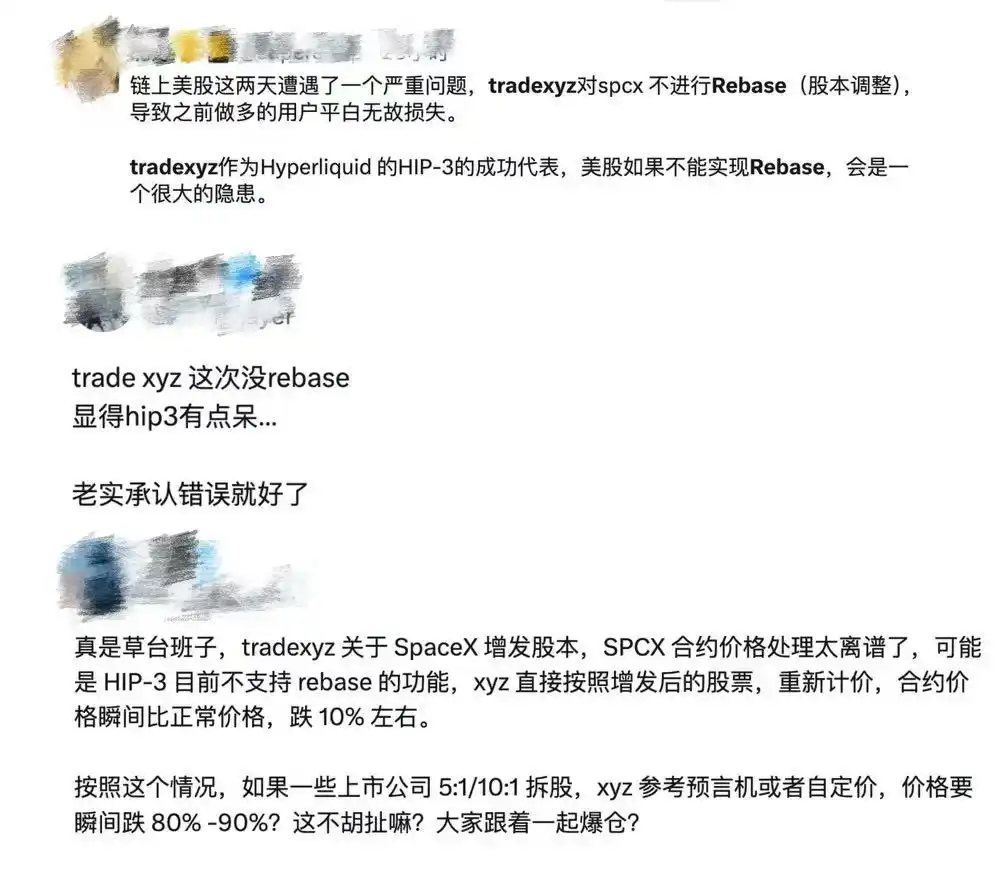
Feedback from some community members

However, this clarification further fueled market controversy. Many users believe that at the product's launch, Hyperliquid did not sufficiently or clearly disclose the contract rules. Descriptions in the UI interface and official documentation that were prone to misinterpretation existed for a long time. Only as the IPO approached and controversy erupted did the platform hastily issue clarification announcements and amend documentation. This post-facto correction approach was difficult to accept as credible.

Greater dissatisfaction stemmed from users' real financial losses. Because the HIP-3 mechanism itself lacks the Rebase capability of traditional exchanges, when the market repriced according to SpaceX's latest share count, the SPCX contract price could only be passively adjusted downward in a gap. Consequently, long positions lost about 10% of their value almost instantly. Many users employing high leverage were forced to liquidate their positions or even faced immediate liquidation. These losses directly translated into profits for short sellers and arbitrageurs.

From the perspective of these affected users, the platform not only failed to show sufficient concern for the losses nor proposed any compensation or mitigation plan, but instead responded with "that's how the product mechanism works," appearing very indifferent and lacking in responsibility.

In a sense, this debate surrounding SPCX pricing authority also serves as a reference case for the design and rule disclosure of more on-chain Pre-IPO assets in the future.

Rebase Dilemma Remains, On-Chain Pre-IPO Faces Major Test

For Perp DEXs, lacking Rebase capability implies that any future Pre-IPO asset encountering common corporate actions in traditional stock markets, such as stock splits, secondary offerings, or dividends, could lead to instantaneous contract price revaluation. This could trigger large-scale chain liquidations, unfair losses, and ultimately weaken user trust in the platform.

To understand the importance of Rebase, one must first understand what Rebase is and why it becomes a critical component in the design of Pre-IPO perpetual contracts.

Simply put, Rebase is a value-neutral adjustment mechanism. The platform adjusts the contract price and user position quantity proportionally, ensuring the trader's overall position value remains largely unchanged before and after the adjustment. This mechanism is necessary because during the Pre-IPO phase, a company's actual total share count is often not publicly disclosed. Exchanges can only design the initial contract price and multiplier based on market-estimated share counts. When the company officially files S-1/S-1A documents and discloses the true share count, if there's a discrepancy with the estimate, Rebase is needed to calibrate contract parameters. Otherwise, the contract price gradually deviates from the true per-share value, creating arbitrage opportunities across platforms and forcing unilateral position holders to passively bear losses.

However, compared to CEXs, implementing Rebase on a Perp DEX is more challenging.

Specifically, CEXs rely on centralized databases and professional risk control teams. They can quickly suspend trading after a corporate action (like a share increase or stock split), uniformly adjust all user positions, and then resume market trading. This entire process is handled by the exchange's backend, ensuring user position notional values remain smooth and continuous. However, even for large CEXs with mature trading systems and technical teams, such Rebase operations involving synchronized adjustments across all market positions remain complex engineering tasks.

Moreover, Perp DEXs operate matching, liquidation, and position states entirely on smart contracts, preventing direct data modification like CEXs. Achieving a similar Rebase effect often requires designing additional monitoring logic, special hooks, or upgrading contract mechanisms. This not only increases gas costs and system complexity but also expands the potential attack surface, introducing new security risks.

Beyond this, Rebase could further exacerbate the inherent liquidity fragmentation problem in decentralized markets. The same Pre-IPO asset might exist simultaneously on multiple DEXs, each with limited market depth. Faced with the additional uncertainty brought by Rebase, Liquidity Providers (LPs) might reduce their willingness to deploy capital, ultimately leading to decreased liquidity, increased slippage, and a further deterioration of the trading experience.

Of course, Rebase is not entirely impossible in a decentralized architecture. Community users have pointed out that platforms like Aster have already completed Rebase adjustments for similar assets. This suggests the real challenge is not that DEXs are inherently incapable, but rather whether platforms are willing to design additional mechanisms for it and bear the associated development and operational costs.

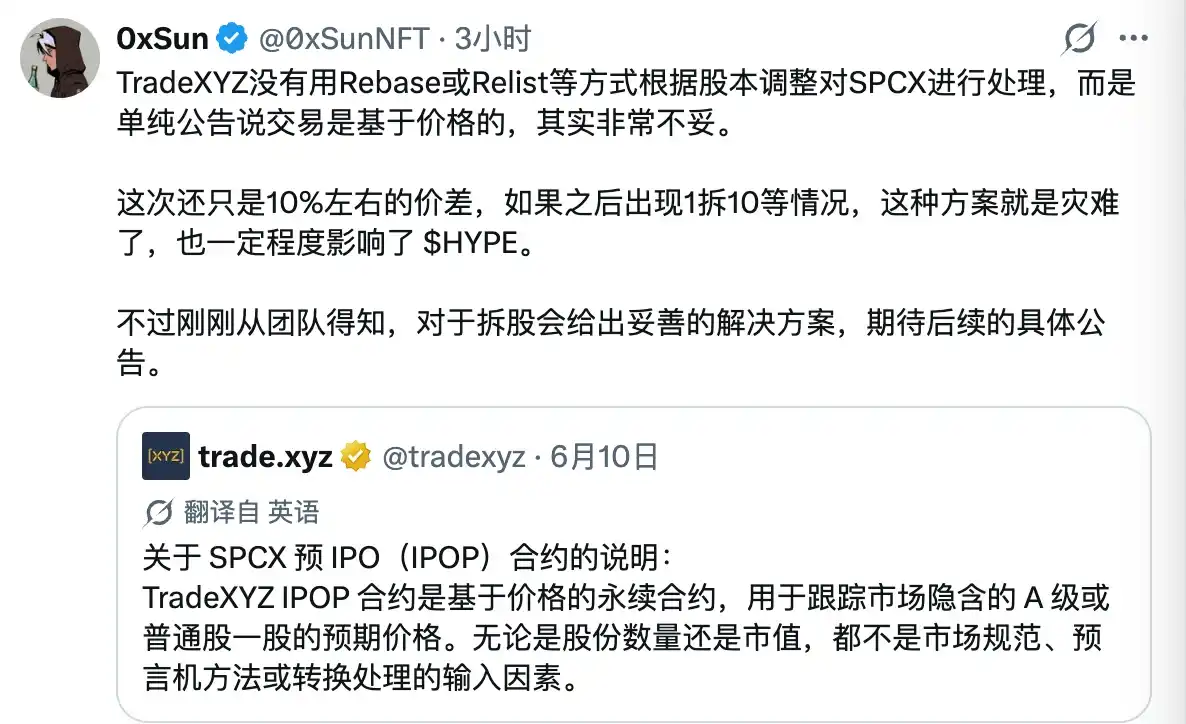
In contrast, besides adhering to a more market-oriented pricing philosophy, Trade.xyz, built on the HIP-3 architecture, allows developers to independently deploy their own Perp markets. While this model inherits Hyperliquid's high-performance order book system, each market has completely independent contract specifications, oracle definitions, and parameter settings, lacking native, platform-level unified Rebase support. Therefore, easily implementing batch adjustments for all positions is not feasible. However, community sources have also revealed that Trade.xyz is researching corresponding solutions for potential future events like stock splits.
From a broader perspective, the issues exposed by the SPCX pricing are not merely a product design flaw but represent a practical challenge Perp DEXs must confront while exploring RWA (Real World Asset) assets. In the future, as more Pre-IPO assets are tokenized on-chain, serving as pre-trading markets before public market price formation, a key question remains: Can on-chain Pre-IPO perpetual contracts establish a sufficiently reliable price discovery mechanism? Can they withstand the test of real corporate actions and information disclosures, or will they devolve into capital games detached from fundamentals? Only time and the market will tell.

Связанные с этим вопросы

QWhat was the main cause of the controversy surrounding Trade.xyz's SPCX pre-IPO perpetual contract?

AThe controversy stemmed from Trade.xyz's refusal to perform a 'Rebase'—a value-neutral adjustment—after SpaceX's latest SEC filing revealed the company's actual total outstanding shares were about 10% higher than previously estimated by the market. While other centralized exchanges (CEXs) paused trading and repriced their contracts based on the new data, Trade.xyz maintained its market-driven pricing logic, leading to a price gap, arbitrage opportunities, and significant losses for leveraged long positions when the price eventually adjusted downwards.

QHow does Trade.xyz define the purpose of its IPOP (Pre-IPO) perpetual contracts?

ATrade.xyz defines its IPOP contracts as price-tracking perpetual contracts. Their core goal is to track the market's expectation of the price per share of a company's Class A common stock, rather than reflecting the company's overall valuation. The platform explicitly states it does not use, disclose, or rely on share counts or market capitalization as a pricing benchmark for SPCX or any other market.

QWhat is 'Rebase' in the context of Pre-IPO trading, and why is it particularly challenging for Perpetual Decentralized Exchanges (Perp DEXs) to implement?

A'Rebase' is a value-neutral adjustment mechanism. When a company's actual share count (e.g., from an S-1 filing) differs from initial market estimates, the exchange proportionally adjusts both the contract price and users' position sizes to keep the total position value roughly the same. For Perp DEXs, implementing this is challenging because their matching, clearing, and position states are on-chain in smart contracts, which cannot be directly modified like a CEX's central database. Adding Rebase logic increases complexity, gas costs, potential attack vectors, and can fragment liquidity across different DEXs.

QWhat was a major point of user dissatisfaction with Trade.xyz's handling of the SPCX situation?

AA major point of user dissatisfaction was that Trade.xyz did not offer any compensation or mitigation plan for users who suffered losses. Due to the platform's lack of a Rebase mechanism, the SPCX contract price had to gap down sharply when the market repriced based on the new share count, causing leveraged long positions to lose about 10% of their value, leading to forced liquidations and losses. Users felt the platform's response, which essentially stated 'this is how the product mechanism works,' was冷漠 (cold) and lacked responsibility.

QAccording to the article, what broader challenge does the SPCX pricing incident highlight for the future of on-chain Pre-IPO markets?

AThe incident highlights the fundamental challenge Perp DEXs face when tokenizing Real World Assets (RWA), especially Pre-IPO assets. It questions whether on-chain Pre-IPO perpetual contracts can establish a reliable price discovery mechanism that can withstand the test of real corporate actions (like share count changes, stock splits) and信息披露 (information disclosure) before a public listing. The key issue is whether these markets will evolve into genuine price discovery tools or devolve into speculative gambling detached from company fundamentals.

Похожее

Raising Interest Rates Is Not a Tech Killer, EPS Is: A Strategy for Discarding the Weak and Retaining the Strong After the AI Theme's Sharp Decline

**Summary: Rising Interest Rates Are Not the Killer of Tech; EPS Is: The "Keep the Strong, Ditch the Weak" Strategy After the AI Theme Plunge** The author argues that the sharp sell-off in tech and AI-related stocks, triggered by a strong US jobs report that heightened Fed rate hike fears, represents a "pullback to pick up passengers" rather than a "car crash." The true end of a tech bull market is not determined by an extra 25 basis point hike, but by industry overcapacity and the disproval of earnings per share (EPS) expectations. Historical analysis shows that during past rate hike cycles, the Nasdaq-100 often outperformed, provided EPS growth remained strong. The current phase is seen as a shift from a "broad narrative-driven rally" to a "focused verification stage" for AI. The investment strategy should be to "keep the strong, ditch the weak." * **Retain exposure** to high-conviction AI infrastructure leaders with clear order visibility, stable margins, strong cash flow, and upward EPS revisions (e.g., AI servers, advanced packaging, optical modules, key cloud suppliers). * **Reduce exposure** to high-beta, narrative-driven stocks with unclear profit paths (e.g., some quantum computing, space, or speculative chip stocks), especially on rebounds. Valuation concerns should focus on whether earnings can catch up to high multiples, not on high P/E alone. Crowded positioning signals a concentration into quality assets, not necessarily a market top. The upcoming Q2 earnings season will be a key validation point. The core principle is to hold stocks with proven EPS, while using macro events (CPI data, central bank meetings) to manage timing and risk.

marsbit1 ч. назад

Raising Interest Rates Is Not a Tech Killer, EPS Is: A Strategy for Discarding the Weak and Retaining the Strong After the AI Theme's Sharp Decline

marsbit1 ч. назад

Торговля

Спот
Фьючерсы

Популярные статьи

Как купить S

Добро пожаловать на HTX.com! Мы сделали приобретение Sonic (S) простым и удобным. Следуйте нашему пошаговому руководству и отправляйтесь в свое крипто-путешествие.Шаг 1: Создайте аккаунт на HTXИспользуйте свой адрес электронной почты или номер телефона, чтобы зарегистрироваться и бесплатно создать аккаунт на HTX. Пройдите удобную регистрацию и откройте для себя весь функционал.Создать аккаунтШаг 2: Перейдите в Купить криптовалюту и выберите свой способ оплатыКредитная/Дебетовая Карта: Используйте свою карту Visa или Mastercard для мгновенной покупки Sonic (S).Баланс: Используйте средства с баланса вашего аккаунта HTX для простой торговли.Третьи Лица: Мы добавили популярные способы оплаты, такие как Google Pay и Apple Pay, для повышения удобства.P2P: Торгуйте напрямую с другими пользователями на HTX.Внебиржевая Торговля (OTC): Мы предлагаем индивидуальные услуги и конкурентоспособные обменные курсы для трейдеров.Шаг 3: Хранение Sonic (S)После приобретения вами Sonic (S) храните их в своем аккаунте на HTX. В качестве альтернативы вы можете отправить их куда-либо с помощью перевода в блокчейне или использовать для торговли с другими криптовалютами.Шаг 4: Торговля Sonic (S)С легкостью торгуйте Sonic (S) на спотовом рынке HTX. Просто зайдите в свой аккаунт, выберите торговую пару, совершайте сделки и следите за ними в режиме реального времени. Мы предлагаем удобный интерфейс как для начинающих, так и для опытных трейдеров.

1.4k просмотров всегоОпубликовано 2025.01.15Обновлено 2026.06.02

Как купить S

Sonic: Обновления под руководством Андре Кронье – новая звезда Layer-1 на фоне спада рынка

Он решает проблемы масштабируемости, совместимости между блокчейнами и стимулов для разработчиков с помощью технологических инноваций.

2.3k просмотров всегоОпубликовано 2025.04.09Обновлено 2025.04.09

Sonic: Обновления под руководством Андре Кронье – новая звезда Layer-1 на фоне спада рынка

HTX Learn: Пройдите обучение по "Sonic" и разделите 1000 USDT

HTX Learn — ваш проводник в мир перспективных проектов, и мы запускаем специальное мероприятие "Учитесь и Зарабатывайте", посвящённое этим проектам. Наше новое направление .

1.8k просмотров всегоОпубликовано 2025.04.10Обновлено 2025.04.10

HTX Learn: Пройдите обучение по "Sonic" и разделите 1000 USDT

Обсуждения

Добро пожаловать в Сообщество HTX. Здесь вы сможете быть в курсе последних новостей о развитии платформы и получить доступ к профессиональной аналитической информации о рынке. Мнения пользователей о цене на S (S) представлены ниже.

活动图片