Weekly Token Unlock: STRK Unlock Volume This Week Accounts for 4.4% of Circulating Supply

marsbitОпубликовано 2026-03-07Обновлено 2026-03-07

Введение

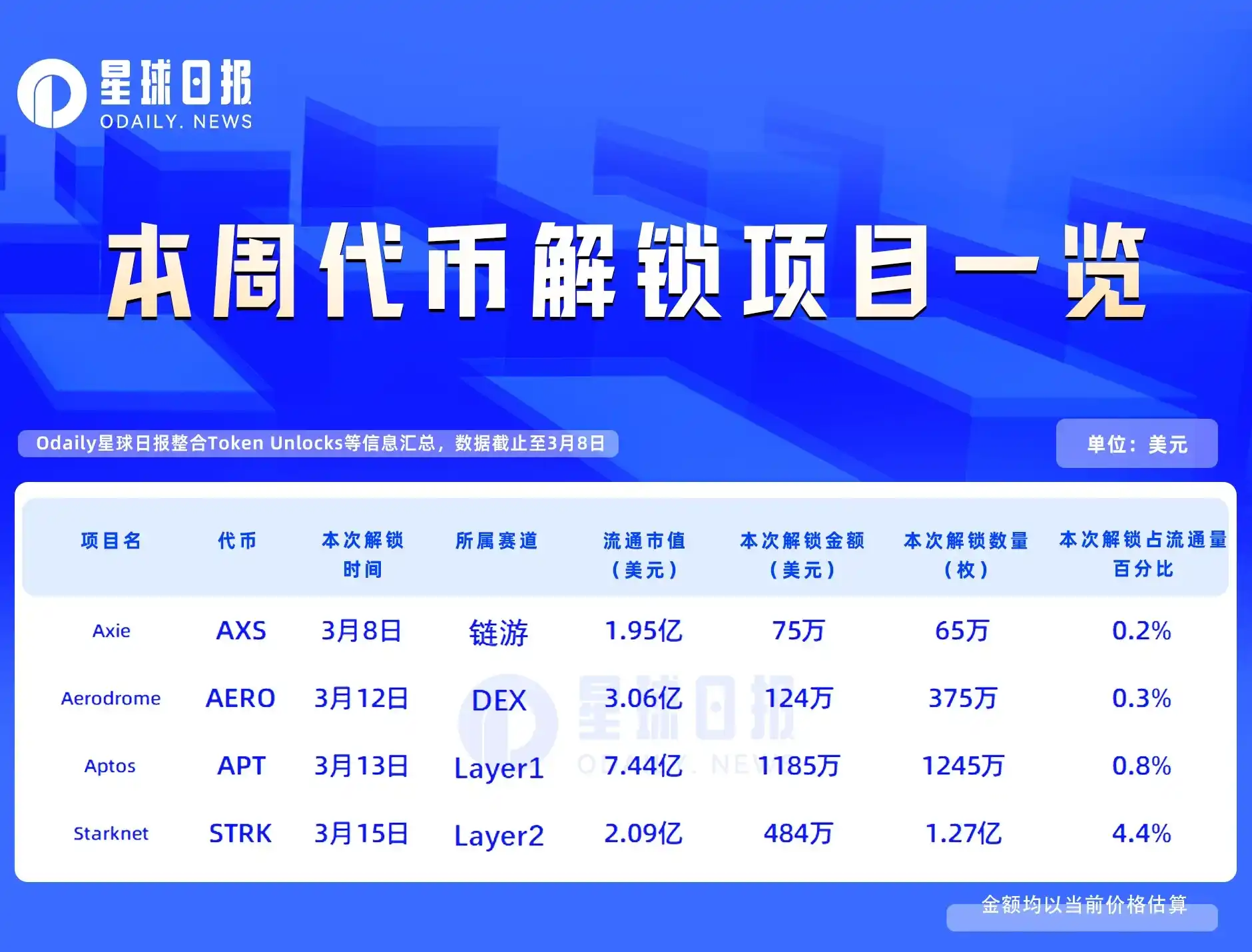
Starknet Token Unlock: STRK to Release 4.4% of Circulating Supply This Week Starknet, an Ethereum Layer 2 scaling solution using zk-STARKs technology to enable faster and cheaper transactions, is set to unlock 127 million STRK tokens this week. The unlock is valued at approximately $4.84 million and represents 4.4% of the token's circulating supply. Developed by StarkWare, which was founded in 2018 and is based in Israel, Starknet aims to improve Ethereum’s scalability by offloading transaction verification and computation from the mainnet. This approach significantly reduces the computational burden and increases network throughput. The release is part of Starknet’s predefined token emission schedule.

Starknet

Project Twitter: https://twitter.com/Starknet

Project Website: https://starknet.io/

This Unlock Amount: 127 million tokens

This Unlock Value: Approximately $4.84 million

Starknet is an Ethereum Layer 2 that utilizes zk-STARKs technology to make Ethereum transactions faster and reduce fees. StarkNet's parent company, StarkWare, was founded in 2018 and is headquartered in Israel. Its main products include Starknet and StarkEx. By using STARK, Starknet verifies transactions and computations without requiring all network nodes to validate each operation. This significantly reduces the computational burden and increases the throughput of the blockchain network.

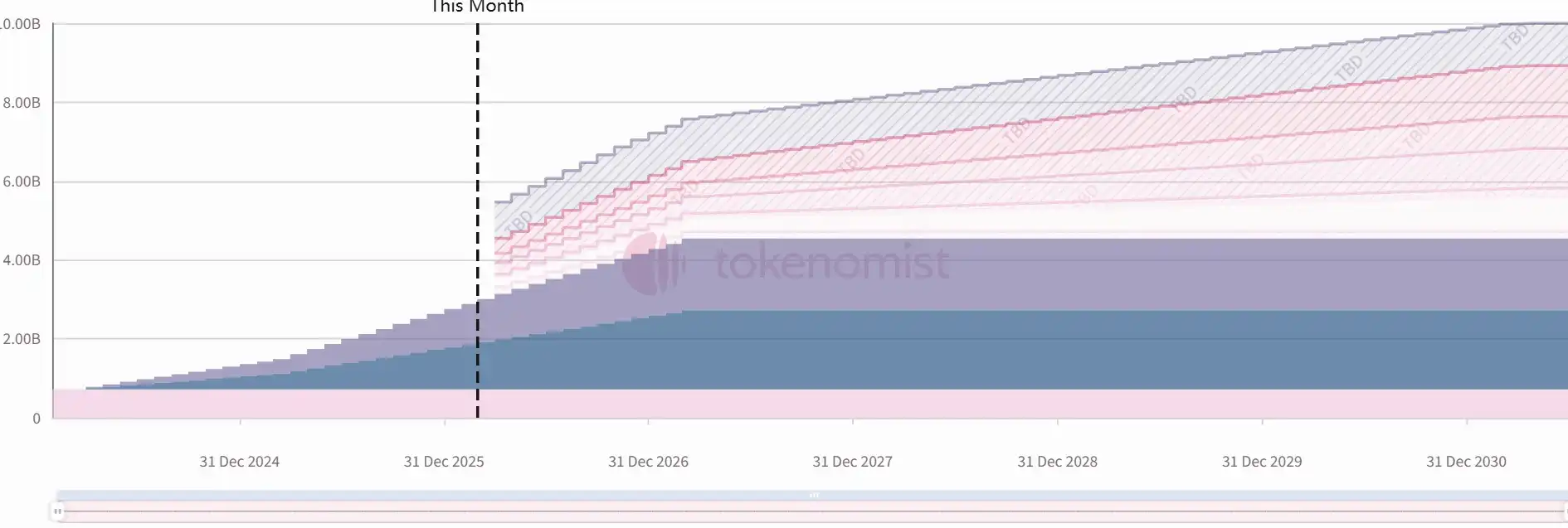
The specific release curve is as follows:

Связанные с этим вопросы

QWhat is the amount of STRK tokens being unlocked this week?

A127 million tokens.

QWhat is the approximate value of the STRK tokens being unlocked this week in USD?

AApproximately $4.84 million.

QWhat is the percentage of the circulating supply that this week's STRK unlock represents?

A4.4% of the circulating supply.

QWhat is Starknet and what problem does it aim to solve?

AStarknet is an Ethereum Layer 2 that uses zk-STARKs technology to make Ethereum transactions faster and cheaper by verifying transactions without requiring all network nodes to validate each operation.

QWho is the parent company of Starknet and what are its other main products?

AThe parent company is StarkWare, which was founded in 2018 and is headquartered in Israel. Its other main product is StarkEx.

Похожее

Altman Drops Bombshell While Musk is Away: He Once Wanted His Children to Inherit OpenAI

In a California court, Sam Altman testified for the first time in the ongoing legal battle between Elon Musk and OpenAI. Altman made a striking claim: Musk once suggested that control of OpenAI could one day be passed down to his children. This statement reframes the long-standing conflict not as a simple governance dispute but as a foundational power struggle. Altman sought to counter the narrative that OpenAI betrayed its original non-profit, idealistic mission. He argued that from the beginning, it was Musk who sought increasing control over the organization, including a larger equity stake and ultimate decision-making authority. Altman opposed this, citing OpenAI's core principle that AGI should not be controlled by any single individual. He also addressed the key point of contention about OpenAI's shift to a for-profit structure, claiming Musk was aware of and initially supportive of exploring such a model to secure the massive funding needed for advanced AI research. Altman framed the change as a practical necessity, not a betrayal. Further testimony revealed internal concerns after Musk left OpenAI's board, with worries he might take retaliatory action. Altman critiqued Musk's management style as unsuitable for a research lab, damaging morale and culture. Throughout his testimony, Altman's focus appeared to shift from technological idealism to the realities of organizational governance and resource requirements. Regarding his brief ouster in 2023, Altman stated he seriously considered joining Microsoft but ultimately returned because OpenAI was too important to abandon.

marsbit6 мин. назад

Altman Drops Bombshell While Musk is Away: He Once Wanted His Children to Inherit OpenAI

marsbit6 мин. назад

How the $900 Billion Anthropic Was Built?

Anthropic, the AI startup behind Claude, is reportedly in early talks to raise at least $30 billion in new funding, targeting a valuation exceeding $900 billion. This would propel it past OpenAI's recent $852 billion valuation. The funding round is expected to close by late May 2026. The company's valuation surge is driven by extraordinary revenue growth, reportedly reaching an annualized $30 billion by March 2026 from $1 billion in December 2024. However, OpenAI questions this figure, suggesting a net revenue closer to $22 billion after cloud platform fees. Despite high revenue, Anthropic's gross margin is reportedly around 40%, and it is not yet profitable, with breakeven projected for 2028. A significant portion of the new capital would fund massive, pre-committed computing infrastructure with partners like Amazon, Google, and Microsoft. This highlights a new AI financing model where high valuations fuel compute spending, which in turn requires even higher future valuations to sustain. Notably, many early-stage investors are reportedly sitting out this round. Bankers privately estimate a potential IPO valuation between $400-500 billion, creating a rare scenario where the final private funding round valuation ($900B+) could far exceed the expected public market debut. Anthropic is targeting an IPO between October 2026 and the first half of 2027. Its public listing is poised to be a critical test for the entire AI sector's valuation logic, potentially validating or challenging the high-stakes "valuation-compute-valuation" cycle that has defined private market investments.

链捕手1 ч. назад

How the $900 Billion Anthropic Was Built?

链捕手1 ч. назад

UBS Enters the Fray, 20 Swiss Banks Now Offer Crypto Trading, Covering 2.5 Million Accounts

Global wealth management giant UBS has entered the cryptocurrency market, offering Bitcoin and Ethereum trading to select private banking clients in Switzerland as of January 2026. This move is part of a broader trend in Switzerland, where approximately 20 banks now provide crypto services, collectively covering over 2.5 million accounts. Client data from Zurich Cantonal Bank (ZKB) challenges the stereotype of crypto being solely for the young, revealing that the average buyer is aged 30-50 and predominantly male. Notably, over 40% of these clients previously held no investment portfolio, indicating crypto is activating dormant capital. The business case is proving substantial. For several Swiss banks, crypto-related activities already contribute a significant and disproportionate share of profits, with unit economics often outperforming traditional banking services. This institutional adoption in Switzerland reflects a global trend, with a recent survey showing 73% of institutional investors planning to increase crypto allocations in 2026. Switzerland's early regulatory clarity through its DLT Act and established custody infrastructure have provided a foundation for this growth. However, upcoming challenges include the implementation of the OECD's Crypto Asset Reporting Framework (CARF) in 2027 and ongoing reforms by Swiss regulator FINMA. The final shape of these regulations will be crucial in determining whether Switzerland can maintain its leading position in the global banking crypto sector.

marsbit1 ч. назад

UBS Enters the Fray, 20 Swiss Banks Now Offer Crypto Trading, Covering 2.5 Million Accounts

marsbit1 ч. назад

Торговля

Спот
Фьючерсы
活动图片