POLY's Appearance Hints Keep Coming, How Far Is the Airdrop?

marsbitОпубликовано 2026-05-19Обновлено 2026-05-19

Введение

The article discusses growing speculation around the potential launch and airdrop of the POLY token by prediction market platform Polymarket. It outlines a timeline of official hints, starting from CEO Shayne Coplan mentioning POLY alongside major cryptocurrencies in October 2025 to confirmations from other team members about a future token and airdrop. Recent developments include the appearance of POLY preview pages on CoinGecko and CoinMarketCap in April, and further product-related hints from the team in May about staking and airdrop criteria. Market prediction data suggests a 56% probability of a token launch before year-end, with significant potential market capitalization. The author's personal view is that Polymarket is unlikely to issue the token before the World Cup, prioritizing platform stability and infrastructure development for the high-traffic event instead. The article advises strategies like hedging trades and engaging on social media to potentially qualify for a future airdrop.

Recently, due to constant hints from Polymarket officials regarding POLY token-related content, various airdrop-farming communities have been analyzing the timing and scale of the POLY airdrop from different angles.

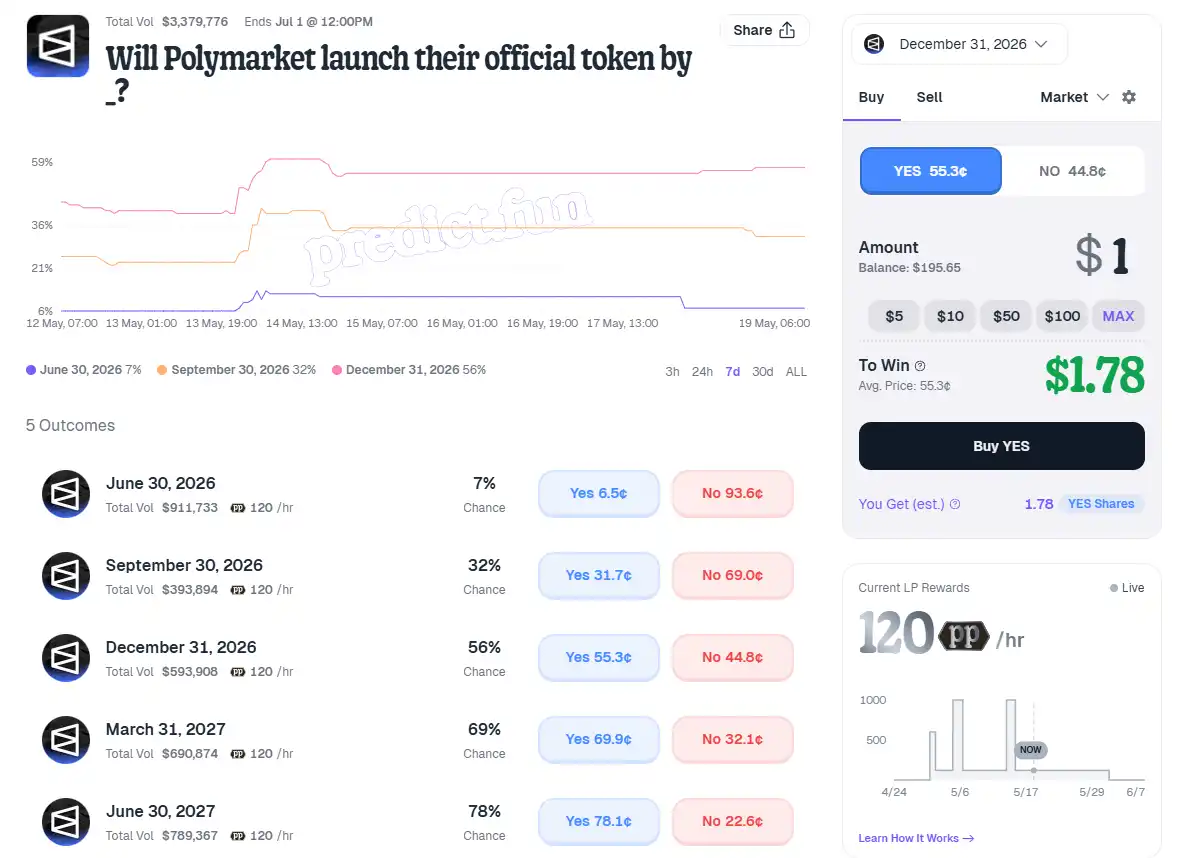
According to predict.fun data, the probability of the event "Polymarket will launch its official token before the end of this year" is currently 56%; there is even a 7% probability that "Polymarket will launch its official token before Q2 of this year."
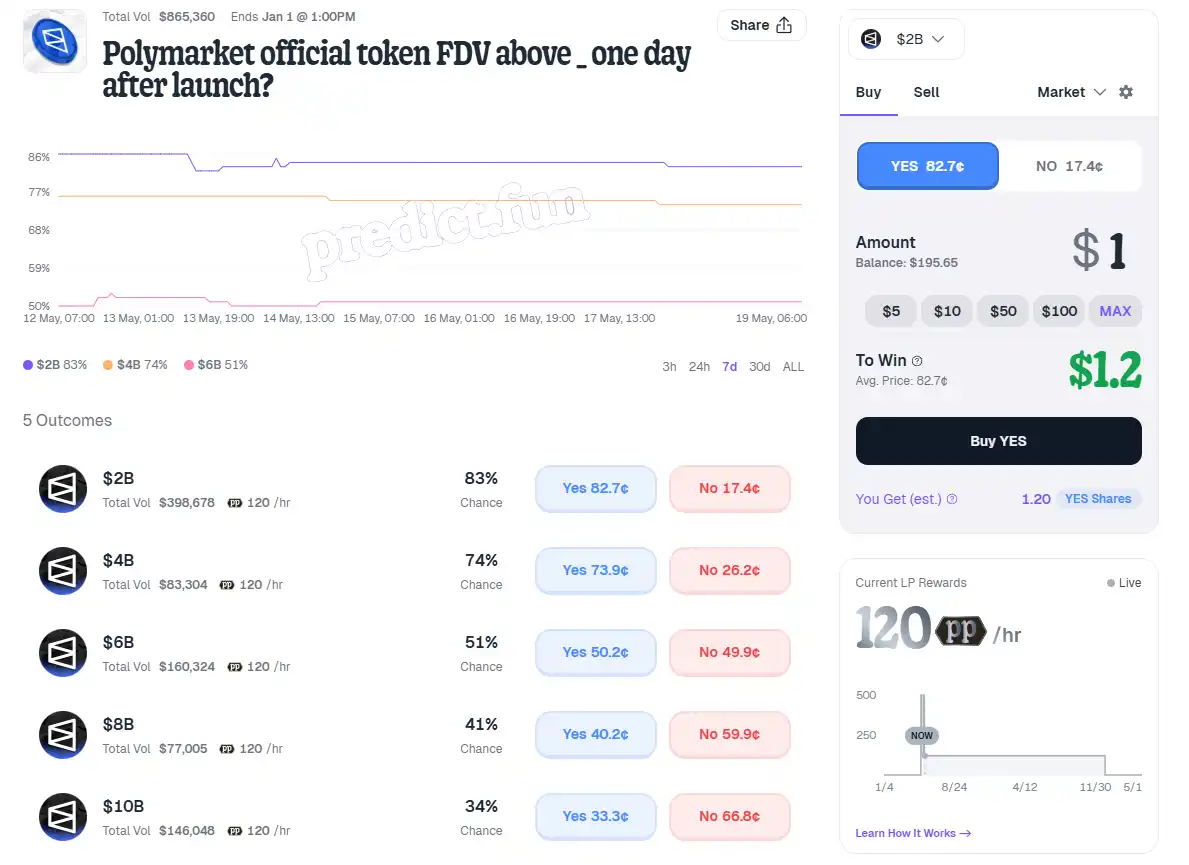
Additionally, regarding market cap, the probability for the event "Polymarket's FDV exceeds $6 billion one day after listing" is currently 51%; there is a 34% probability for "Polymarket's FDV exceeds $10 billion one day after listing."
Timeline of Official Polymarket Token Hints

October 2025: Initial Hints and Official Confirmation of the POLY Token

Official signals surrounding the POLY token from Polymarket can be traced back to last October.

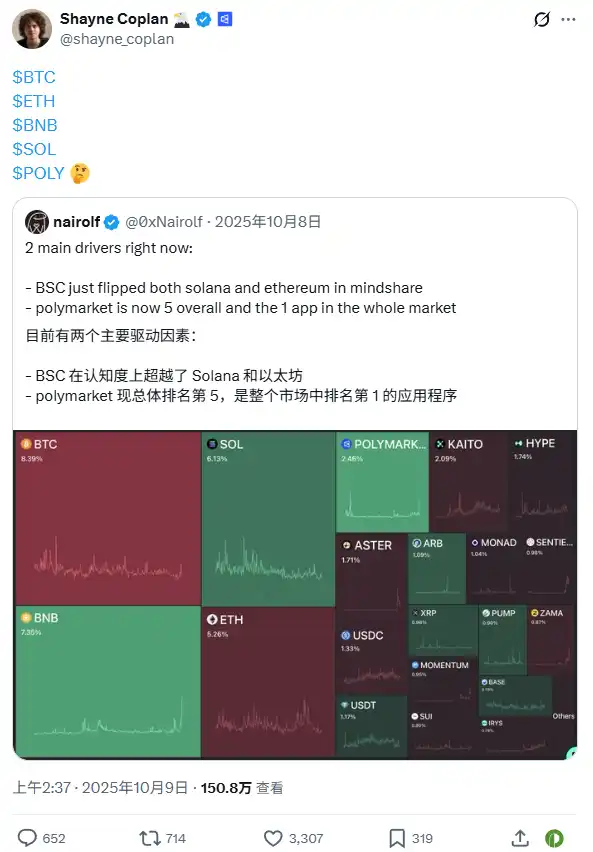
On October 8, 2025, Polymarket CEO Shayne Coplan posted on X, listing POLY alongside BTC, ETH, BNB, and SOL, sparking community speculation about a Polymarket token launch.

Although this was not an official token announcement, for the market, the founder personally writing $POLY was sensitive enough. Since then, community discussion about a Polymarket token launch has noticeably heated up.
The airdrop expectation was further brought into public discussion by official team members. On October 23, 2025, Polymarket Growth Lead William LeGate mentioned "prospective airdrop farmers" in a podcast or related discussion. While not a formal rule explanation, this essentially acknowledged the existence of user behavior and expectations around a Polymarket airdrop in the market.

The expectation for the POLY token was further solidified on October 24, 2025. Polymarket CMO Matthew Modabber explicitly stated in a podcast, "Polymarket will have a token, and it will have an airdrop." This statement became a key turning point for Polymarket's token expectation, shifting from community speculation to official confirmation.

Entering November, the focus of official discussion began to shift from whether there would be an airdrop to what kind of behavior would *not* qualify for an airdrop. On November 11, 2025, William LeGate, responding to Sybil farming, clearly stated, "I can confidently tell you these sybil-farmed accounts are not going to result in any airdrop allocations, they're just wasting their time."

April of This Year: Major Price Tracking Platforms Launch POLY Preview Pages

Entering April of this year, POLY token expectations have extended to major crypto price-tracking websites.

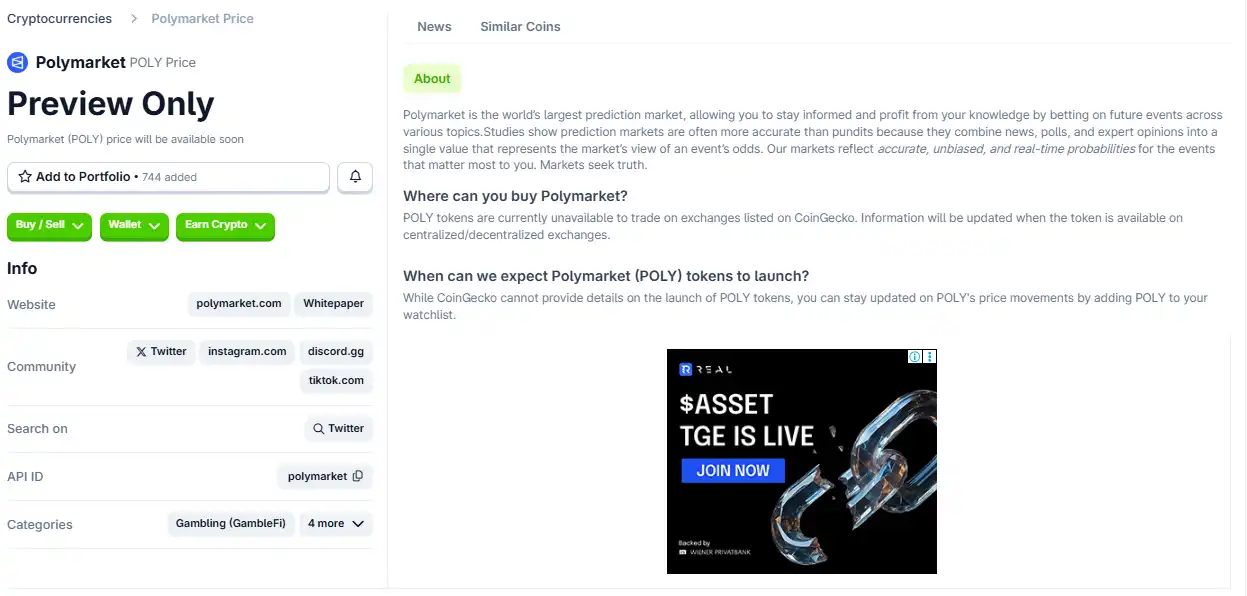
Currently, preview pages for Polymarket (POLY) have appeared on both CoinGecko and CoinMarketCap. While these pages are not equivalent to the official token launch nor do they represent Polymarket announcing a TGE timeline, the fact that external platforms are reserving pages for $POLY further strengthens the community's expectation of a Polymarket token launch.

May of This Year: POLY Token Moves from Airdrop Expectation to Product Hints

Entering May, the discussion around the POLY token has moved further towards specific functions and airdrop qualifications.

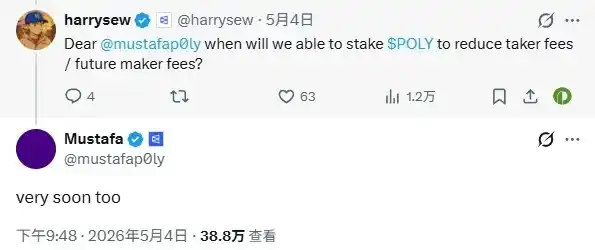
On the evening of May 4th, Polymarket official team member Mustafa responded to questions about the POLY token in a community interaction. A user asked when they could stake POLY to reduce taker fees, or potentially future maker fees.

Mustafa's reply was: "Soon." The community quickly interpreted this official response as Polymarket preparing for the token launch.
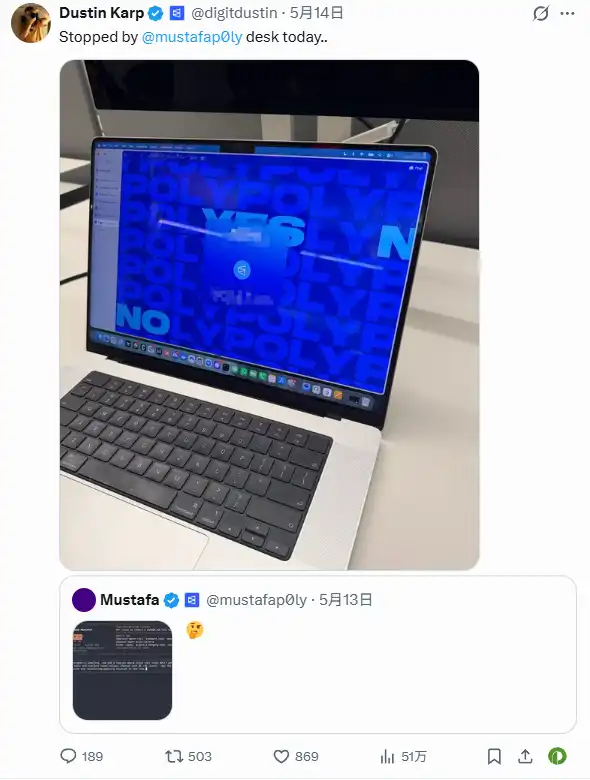
On May 13th, clues surrounding the POLY token continued to increase.

Polymarket Product Lead Dustin Karp posted a photo of his workstation, saying he passed by Mustafa's desk. The photo appeared to show an internal page related to the POLY token airdrop. The community zoomed in and found an "Airdrop" tab visible, further heightening expectations for a POLY token airdrop.
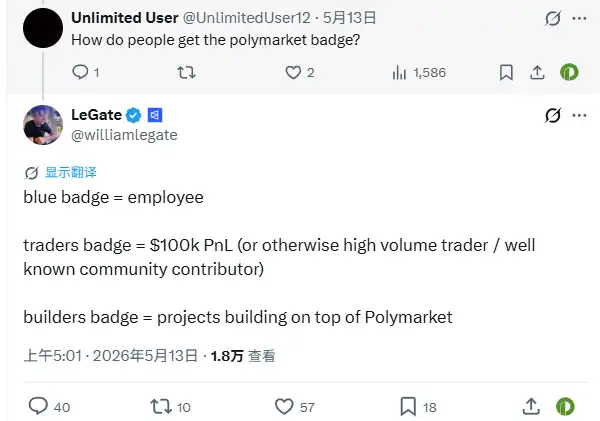
Subsequently, Polymarket Growth Lead LeGate also responded to questions about official badges in community discussions.

LeGate replied that the blue badge represents Polymarket employees; the "Traders" badge is primarily for traders with cumulative profits reaching $100,000, or other high-volume users (in other tweets, he mentioned a trading volume exceeding $10 million and said if users are active on Polymarket, the profit and volume thresholds can be slightly adjusted), and notable community contributors; the "Builders" badge is for projects building and developing based on the Polymarket ecosystem.
Badges might not be the only criteria for receiving an airdrop. The community inquired whether content contributions on X would be rewarded with POLY tokens. LeGate replied that linking your X account to your Polymarket account is only one-third of the conditions.

In addition, users should probably also put their Polymarket profile link in their X bio, actively share their trades, profit records, and market views on X, and maintain interaction with the community.
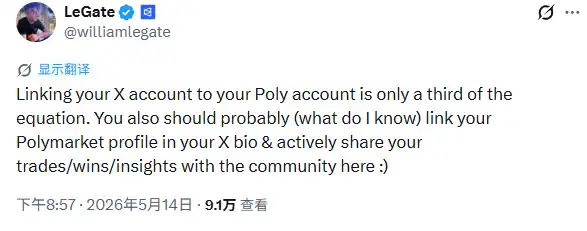
Although this reply did not explicitly confirm whether "shitposting" ("zui lu") could genuinely earn an airdrop, various communities were relatively optimistic and actively posted Polymarket-related content on X to seek potential token airdrops.

Personal Strategy

For someone who has been deeply involved in prediction markets throughout the first half of this year, I am still leaning towards the belief that Polymarket will not launch its token before the World Cup.

The reason is simple. Polymarket's more important task right now may not be to launch a token immediately, but to first refine the trading experience and infrastructure. Whether it's the continuous optimization of V2 or even a chain migration, it's essentially to prepare for high-traffic, high-frequency trading scenarios like the World Cup.

For Polymarket, if the platform experience is unstable during the World Cup, launching a token in advance would hardly help truly onboard new users and trading volume.

Therefore, recent trading has primarily been focused on hedging, placing orders on predict.fun to farm points, and then hedging positions received on Polymarket. At the same time, participating in various events on Polymarket with profitability as the goal.

Additionally, I am also linking my personal X account information on Polymarket and posting Polymarket-related content on X, hoping that when the token is launched in the future, a portion of the airdrop will also be allocated to "shitposting users" ("zui lu users").


Связанные с этим вопросы

QWhat is the main subject of the article and what community activity does it discuss?

AThe main subject is the potential launch and airdrop of the POLY token by Polymarket. The article discusses extensive analysis and speculation within crypto 'airdrop farming' communities regarding the timing and scale of the airdrop.

QAccording to prediction market data, what is the estimated probability for Polymarket launching its official token before the end of this year?

AAccording to data from predict.fun, the probability of the event 'Polymarket will launch its official token before the end of this year' is currently reported at 56%.

QWhen did the first significant official hint about the POLY token occur, and who was involved?

AThe first significant hint occurred on October 8, 2025, when Polymarket CEO Shayne Coplan listed '$POLY' alongside major cryptocurrencies like BTC and ETH on X, sparking community speculation about a token launch.

QWhat two types of user badges did Polymarket's Growth Head, William LeGate, mention, and what are their general criteria?

AWilliam LeGate mentioned 'Traders' badges for users with over $100,000 in cumulative profit or high trading volume (over $10 million), and 'Builders' badges for projects developing on the Polymarket ecosystem.

QWhat is the author's personal prediction for the POLY token launch timeline and the primary reason behind it?

AThe author personally predicts that Polymarket will not launch the token before the FIFA World Cup. The primary reason is that the platform's priority is likely to optimize trading experience and infrastructure to handle the high traffic expected during the World Cup event.

Похожее

IOSG: After the Number of Developers Halved, Crypto Did Not Die

The crypto development community has undergone a significant transformation, with monthly active developers on GitHub halving from 45K in 2022 to approximately 23K by 2026. This decline is largely attributed to the departure of newcomers, whose roles were often tied to market-driven hype cycles like NFTs and forked DeFi protocols, leading to a 52% churn rate among those with less than a year of experience. However, the core of the industry has strengthened. Established developers with over two years of experience have reached a record high, contributing about 70% of the code. They are consolidating around ecosystems with genuine users and revenue, such as Bitcoin and Solana, while moving away from narrative-driven projects. The talent shift represents a "deleveraging" and an increase in core density. This core group has developed a unique skillset by operating in an environment of "code is law," with zero tolerance for error and no external recourse. They have learned to build trust and functional systems from the ground up without central authorities, as demonstrated by protocols like Uniswap and MakerDAO. These capabilities are now being repriced and leveraged in the AI era. The structural challenges of AI scaling—such as trust, coordination, and verification—mirror those long addressed in crypto. Examples include CoreWeave pivoting from GPU mining to AI compute, OpenSea's founder applying NFT market logic to AI model routing with OpenRouter, and projects like NEAR and Catena Labs transitioning crypto-native architectural and financial insights into AI infrastructure and agent banking. Key areas where crypto-bred skills are directly applicable to AI include: 1. **Compute Aggregation & Optimization**: Using token incentives and cryptographic verification (e.g., Proof of Sampling & Privacy) to create trusted, decentralized GPU networks, as seen with Hyperbolic. 2. **AI Governance & Incentive Design**: Applying economic mechanism design from DAOs and tokenomics to align the goals of multiple, fast-acting AI agents, a direction explored by EigenLayer's EigenCloud. 3. **AI Agent Autonomous Payments**: Leveraging stablecoins and programmable, permissionless blockchains to enable the micro-transactions required for AI agent economies, exemplified by protocols like x402. The role of the crypto builder is evolving from writing smart contracts to designing trust mechanisms for autonomous AI systems. This convergence is reflected in hiring trends at major firms and significant capital allocation from funds like Paradigm and a16z crypto, which are investing at the intersection of crypto and AI. Regional differences exist, with the US favoring foundational protocol innovation and Asia focusing on compliant application-layer integration, but the underlying trend is clear. The industry's "deleveraging" has not signaled its demise but rather a maturation, positioning its core builders to solve critical trust and coordination problems in the age of AI.

marsbit16 мин. назад

IOSG: After the Number of Developers Halved, Crypto Did Not Die

marsbit16 мин. назад

Currency and Stock Market Barometer: Strategy Invested Over $2 Billion to Buy Over 24,800 BTC Last Week; Bitmine's ETH Holdings Increase to 4.37% of Total Supply (May 19)

Crypto & Stock Market Watch: Institutional BTC Buying Surges, ETH Holdings Grow Major listed companies aggressively accumulated Bitcoin last week, with net purchases skyrocketing over 44x to $2.03 billion. Strategy (formerly MicroStrategy) led the charge, spending approximately $2.01 billion to buy 24,869 BTC, bringing its total holdings to 843,738 BTC. Overall, listed firms (excluding miners) now hold 1,113,841 BTC, valued at ~$86.16 billion. On the Ethereum front, Bitmine purchased 71,672 ETH in the past week. It now holds 5,278,462 ETH, worth $11.56 billion and representing 4.37% of ETH's total supply. A significant portion (4,712,917 ETH) is staked, generating an annualized yield of $289 million. Industry leaders note a divergence from the MicroStrategy model, with ETH treasury firms increasingly focusing on staking yields and simpler balance sheets. In traditional markets, Morgan Stanley warns of a potential significant U.S. stock market correction if bond yields and volatility continue rising. Investment giants like Berkshire Hathaway and Bridgewater adjusted portfolios in Q1, with Bridgewater notably increasing its stakes in chipmakers like Nvidia, Broadcom, and Micron while shedding software stocks. Among other crypto-focused public companies, Solana treasury firm Upexi reported a widened net loss of $109 million for its fiscal Q3, driven by a decline in its crypto holdings' value. Meanwhile, Hyperion DeFi, a HYPE token treasury company, reported a Q1 net profit of $8.8 million and increased its HYPE holdings past 2 million tokens.

marsbit17 мин. назад

Currency and Stock Market Barometer: Strategy Invested Over $2 Billion to Buy Over 24,800 BTC Last Week; Bitmine's ETH Holdings Increase to 4.37% of Total Supply (May 19)

marsbit17 мин. назад

24-Year-Old "Wall Street Newcomer" Portfolio Adjustments Revealed: Shorts Chips Heavily in Q1, Bullish on Energy and AI Infrastructure

A 24-year-old Wall Street prodigy, Leopold Aschenbrenner, has disclosed the Q1 portfolio adjustments for his fund, Situational Awareness LP. The fund's assets under management skyrocketed from $5.52 billion to $13.7 billion. The most significant move was a massive bearish bet on the semiconductor sector. The fund established $8.46 billion in put options, targeting chipmakers like NVIDIA ($1.6B in puts) and the VanEck Semiconductor ETF (SMH, $2B in puts). This bearish stance extended to Broadcom, Oracle, AMD, Micron, ASML, Intel, Corning, and TSMC. However, the fund made a selective bullish exception, adding shares and call options for memory chip maker SanDisk. The fund maintained its core bullish thesis on energy and AI infrastructure. Bloom Energy remained its largest long equity holding. It also increased stakes in cryptocurrency mining/data center firms like CleanSpark, Riot Platforms, Applied Digital, and IREN Limited, viewing them as providers of critical ready-to-use infrastructure—land, power, and grid permits—for AI expansion. The 13F filing was submitted one day late. Overall, the fund's strategy involves substantial bearish semiconductor bets while maintaining concentrated, high-volatility investments in selective tech, computing, and infrastructure plays aligned with AI growth.

marsbit36 мин. назад

24-Year-Old "Wall Street Newcomer" Portfolio Adjustments Revealed: Shorts Chips Heavily in Q1, Bullish on Energy and AI Infrastructure

marsbit36 мин. назад

Global Long-Term Bonds Break Down: The Fiscal Illusion of the Low-Interest Era is Collapsing

Global long-term bonds are experiencing a widespread breakdown, as the fiscal illusion of the low-interest-rate era collapses. Sovereign yields are hitting multi-year highs in the US, UK, Japan, and France, signaling a market repricing driven by a common reality: unsustainable debt and deficits outpacing economic growth, compounded by renewed inflationary pressures from energy shocks. The direct trigger is the blockade of the Strait of Hormuz, which has pushed oil prices higher and reignited inflation fears. This squeezes central bank policy space, with expectations shifting from future rate cuts to potential hikes. The core "fiscal Ponzi scheme" is becoming evident—governments rely on new debt to service existing obligations, but as growth lags and borrowing costs rise, investors demand higher yields. Key developments include the US 30-year yield surpassing 5% for the first time since 2007, with tepid auction demand; Japan's 30-year yield reaching 4%, threatening its long-standing low-rate financial system; and political paralysis in the UK and France making meaningful fiscal consolidation unlikely. The marginal buyer for US debt is also shifting from foreign central banks to more price-sensitive private investors. While debt managers may adjust issuance, fundamental drivers—deteriorating fiscal paths, persistent inflation, and constrained central banks—remain. The market is conclusively repricing the end of the low-interest-rate financing model for highly indebted developed economies.

marsbit44 мин. назад

Global Long-Term Bonds Break Down: The Fiscal Illusion of the Low-Interest Era is Collapsing

marsbit44 мин. назад

Following the KelpDAO Hack: $40 Billion in Assets Flee LayerZero, Chainlink Emerges as the Primary 'Beneficiary'

Following a major security breach in April where KelpDAO's bridge using LayerZero was attacked for approximately $292 million, a significant shift is underway in the cross-chain infrastructure landscape. An estimated $40 billion in assets is in the process of migrating or has already migrated from LayerZero to Chainlink's Cross-Chain Interoperability Protocol (CCIP). The attack exploited a single-point-of-failure vulnerability due to KelpDAO's 1-of-1 validator configuration within the LayerZero network. Attackers corrupted RPC nodes and used DDoS attacks to force the system to rely on compromised nodes, allowing fraudulent messages. While LayerZero acknowledged a serious error in allowing its validator network to service high-value transactions with such a configuration, the incident highlighted critical security risks. This triggered a rapid migration wave. Starting with KelpDAO on May 6th, several major protocols—including Solv Protocol, Re, Tydro, Kraken, and Lombard—announced switching their cross-chain infrastructure exclusively to Chainlink CCIP. The combined value of these migrations is estimated to be around $40 billion. This movement followed earlier major adoptions by Coinbase (in late 2025) and Circle (in early 2024). Market sentiment reflected this shift, with LINK's price showing relative stability while ZRO (LayerZero's token) declined significantly. Data indicates a net outflow of approximately $20.1 billion from the LayerZero network over 30 days. The migration is largely driven by perceived security differences. Chainlink CCIP employs a decentralized oracle network as its default consensus layer, featuring multiple independent node operators, a separate Risk Management Network, and built-in safeguards like rate limits. In contrast, LayerZero's highly modular architecture offers flexibility but places more responsibility on application developers to configure security settings, a risk underscored by the KelpDAO incident. LayerZero has since apologized for its communication handling post-attack and stated the protocol itself was not compromised, but rather its Labs DVN's internal RPC was poisoned. An official post-mortem report with external security partners is forthcoming.

marsbit1 ч. назад

Following the KelpDAO Hack: $40 Billion in Assets Flee LayerZero, Chainlink Emerges as the Primary 'Beneficiary'

marsbit1 ч. назад

Торговля

Спот
Фьючерсы
活动图片