JP Morgan Mid-Year Research Report Analysis: The AI Supercycle is Not Over, Reduce Cash Holdings + Allocate to Real Assets

marsbitОпубликовано 2026-06-08Обновлено 2026-06-08

Введение

JP Morgan's 2026 Mid-Year Outlook argues the AI supercycle is far from over, despite market pessimism. The report advises clients to reduce cash holdings, increase allocations to real assets as an inflation hedge, and focus on emerging markets. Key conclusions include: 1. **AI Supercycle Intact**: Hyperscalers' 2026 capex forecasts exceed $650B, with AI contributing to GDP growth. However, their financial profile is shifting toward heavy investment, compressing free cash flow. 2. **SaaS Disruption**: Traditional software companies are being negatively impacted by AI, with significant stock declines and pressure in credit markets. 3. **Persistent Inflation**: Core inflation is structurally higher post-pandemic. Holding excess cash and bonds leads to real wealth erosion. Recommendations include commodities, infrastructure, real estate, and gold. 4. **Geopolitical Shocks & Opportunities**: The Hormuz Strait blockade caused a major oil shock, but JP Morgan views the subsequent equity market pullback as a buying opportunity. "Fragmentation" is creating pockets of value, notably in resource-rich Latin America, AI-supply-chain-linked East Asia, and deeply discounted Chinese equities, where a policy shift could trigger a re-rating. 5. **Regional Views**: The firm is cautious on Europe due to high energy costs and lower innovation investment, preferring US and select EM exposures. In short, JP Morgan sees market volatility as an entry point but recommends a portfolio pivot: fav...

Author: David, Tide Research

Tide Research Guide:

J.P. Morgan's wealth management division issued a mid-year 2026 outlook report on June 1st, essentially advising its high-net-worth clients on how to invest for the second half of the year.

Against the backdrop of the Strait of Hormuz blockade pushing up oil prices, resurgent inflation, and the AI narrative shifting from fervor to skepticism, the overall tone of this report is cautiously optimistic, albeit with a change in specific investment allocations.

J.P. Morgan believes the market is overly pessimistically pricing the world's three major risks (fragmentation, inflation, AI's disruptive potential), and the current market volatility is precisely a window of opportunity to enter.

The overall judgment is:

Continue betting on the AI supercycle and US stocks, hedge inflation with real assets and alternative strategies, reduce cash holdings, and pay attention to emerging markets.

If you hold US tech stocks or are considering whether to add to or reduce your positions in the second half of the year, the framework and data in this report are worth a look; we have condensed and interpreted the original report, rearranging the priorities according to investment relevance.

Six Key Conclusions:
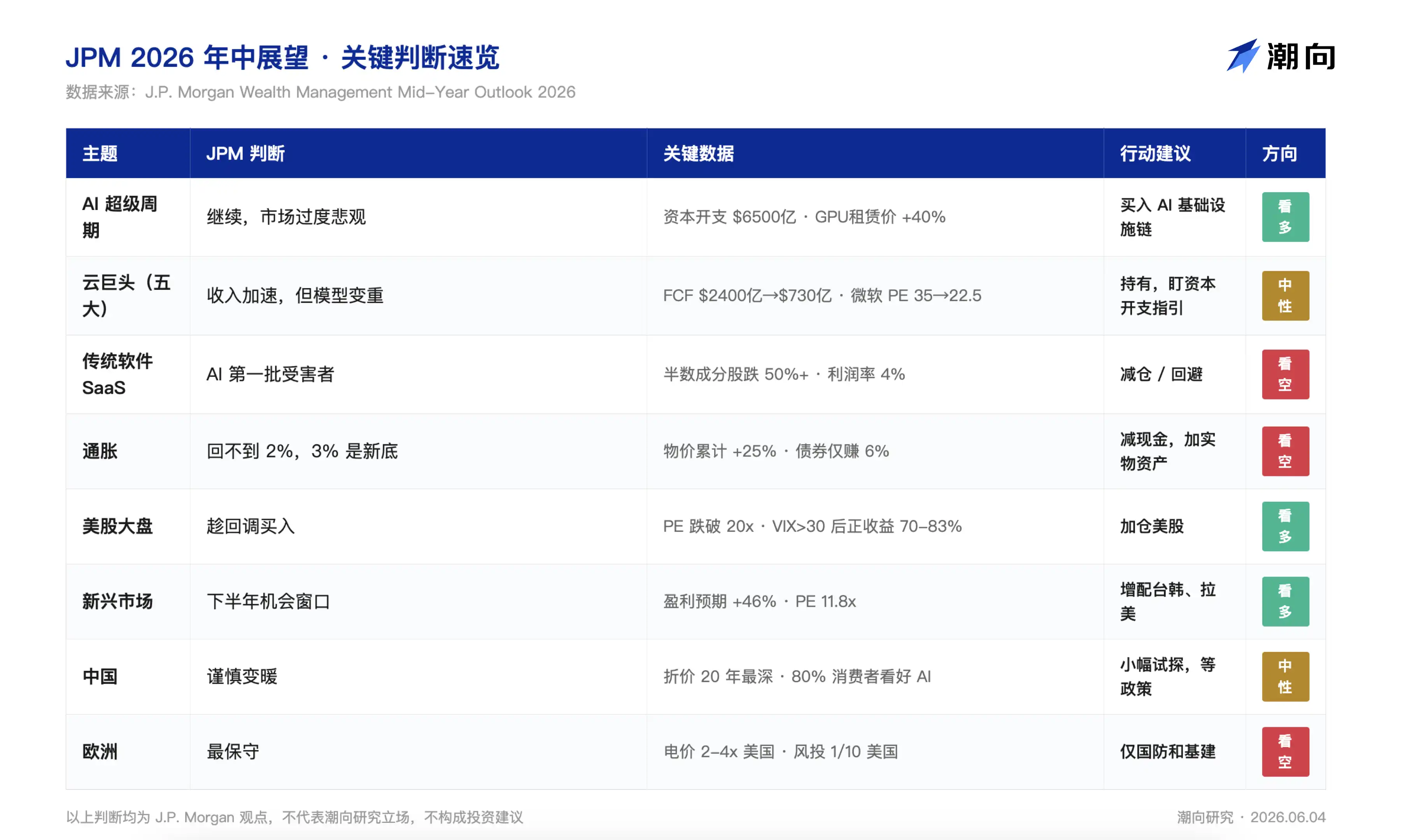
1. The AI supercycle is not over; the market is overly pessimistic.

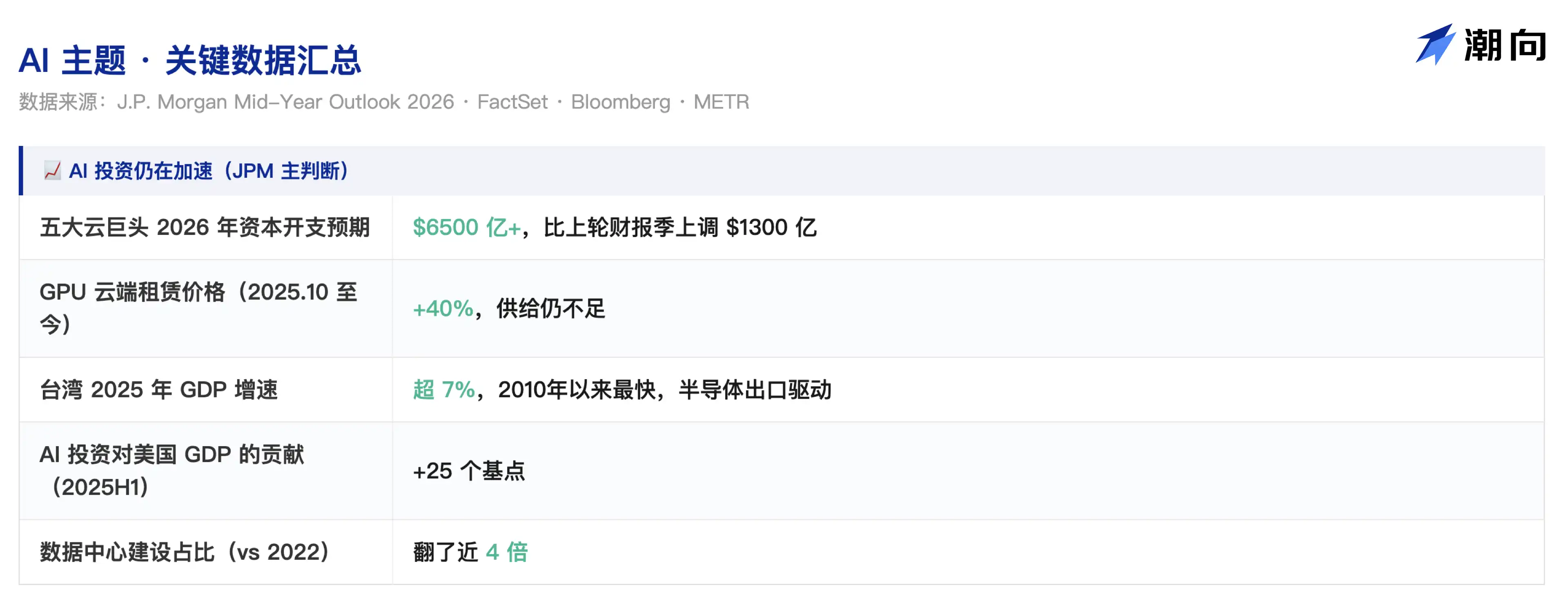
The five Hyperscalers (Microsoft, Meta, Oracle, Google, Amazon) are expected to have 2026 capital expenditures exceeding $650 billion, revised up by $130 billion from the last earnings season. AI-related investment contributed 25 basis points to US real GDP growth in 2025. Taiwan's GDP growth exceeded 7%, the fastest since 2010, driven primarily by semiconductor exports. JPM believes the market is pricing in an "AI peak," but the data does not support this narrative.

2. However, the financial characteristics of Hyperscalers are changing.

Free cash flow is projected to drop from $240 billion in 2024 to $73 billion by the end of 2026. Microsoft's Forward P/E has fallen from an AI-era high of 35x to 22.5x. These companies are transitioning from "light-asset, high-return" to "heavy-asset, high-investment," and the market is still digesting this shift.

3. SaaS is undergoing an underwater massacre.

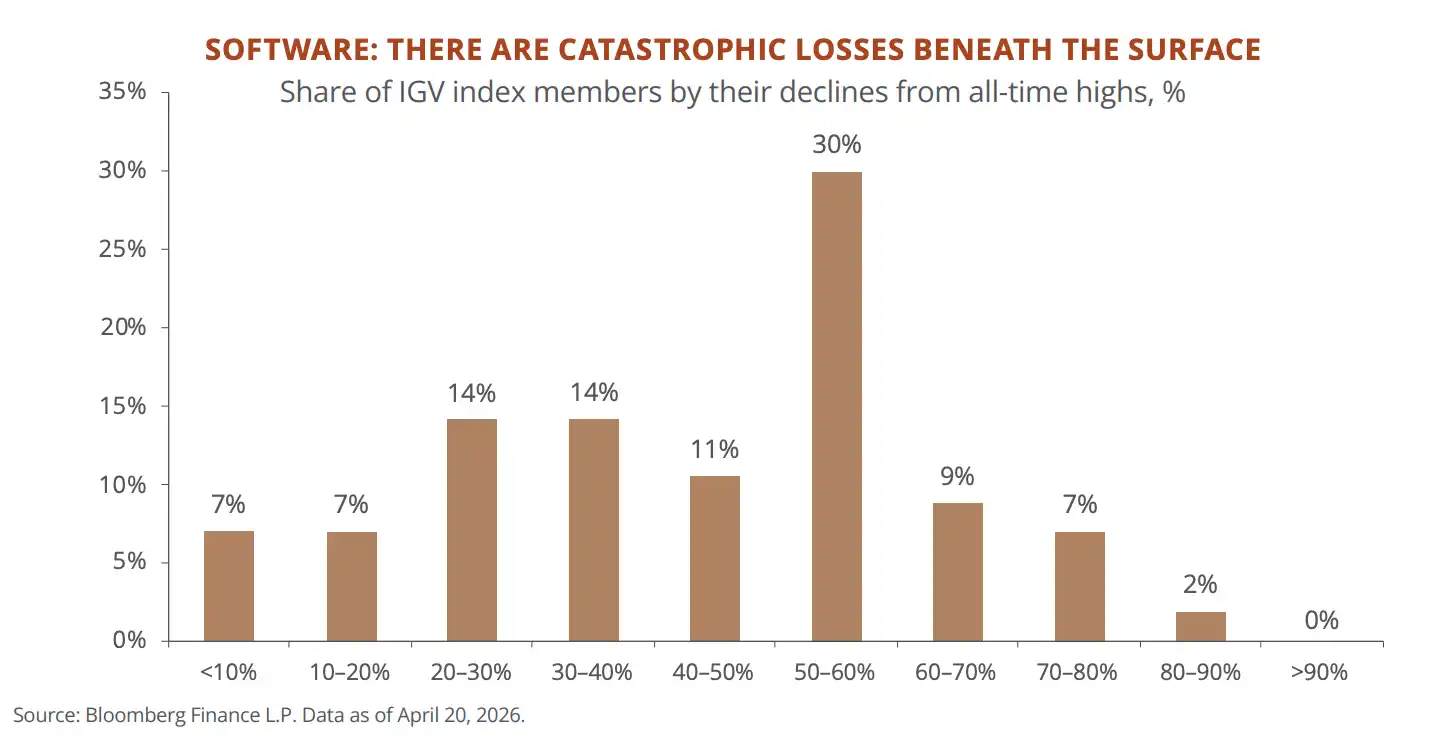
Approximately half of the constituents in the S&P Software Index (IGV) have fallen more than 50% from their all-time highs. JPM's tracked "AI Vulnerable Basket" is down nearly 20% this year. In the private credit market, 21% of exposure is to software companies, rising to 40% when combined with tech and business services. The impact of AI on the subscription-based software business model is already happening.

4. The inflation floor is higher than pre-pandemic; cash is slowly bleeding value.

US core PCE was already sticky at around 3% before the energy shock. Consumer prices have cumulatively risen 25% since 2020, while core fixed income has only returned 6%. Nearly 20% of JPM's clients' assets are in cash and short-term bonds. The report's message is clear: you think you're taking shelter, but you're actually losing money.

5. The Strait of Hormuz blockade is the largest oil supply shock since WWII, but JPM believes you should buy the dip.

Oil prices have nearly doubled, US stocks experienced a roughly 10% correction, and the S&P 500's P/E briefly fell below 20x. JPM's historical data shows that buying after the VIX breaks above 30 yields a 70% to 83% probability of positive returns within 6 months, with an average return of 12.4%.

6. Emerging markets could be an opportunity in the second half.

EM corporate earnings are expected to grow 46%, with a P/E of only 11.8x. Taiwan and South Korea are core nodes in the AI hardware supply chain. Latin America holds over 40% of the world's copper and nearly 60% of its lithium reserves. The discount of Chinese stocks relative to other Asian markets is at its deepest in 20 years, and JP's stance is "cautiously warming."

On AI: The Market is Pricing a "Peak," JP Morgan Thinks It's Too Early
JPM opens by stating that Wall Street's narrative on the AI supercycle has "already become too pessimistic."

Core data supporting this judgment:

  1. Microsoft, Meta, Oracle, Google, and Amazon, the five cloud giants, have a combined 2026 capital expenditure expectation exceeding $650 billion. GPU (core chips for training AI models) cloud rental prices have risen 40% since last October, indicating supply still lags demand. Nvidia's stock trades at a 40% discount to its average P/E over the past decade. The market is pricing in "chip sales peaking," but cloud business revenue is still accelerating.
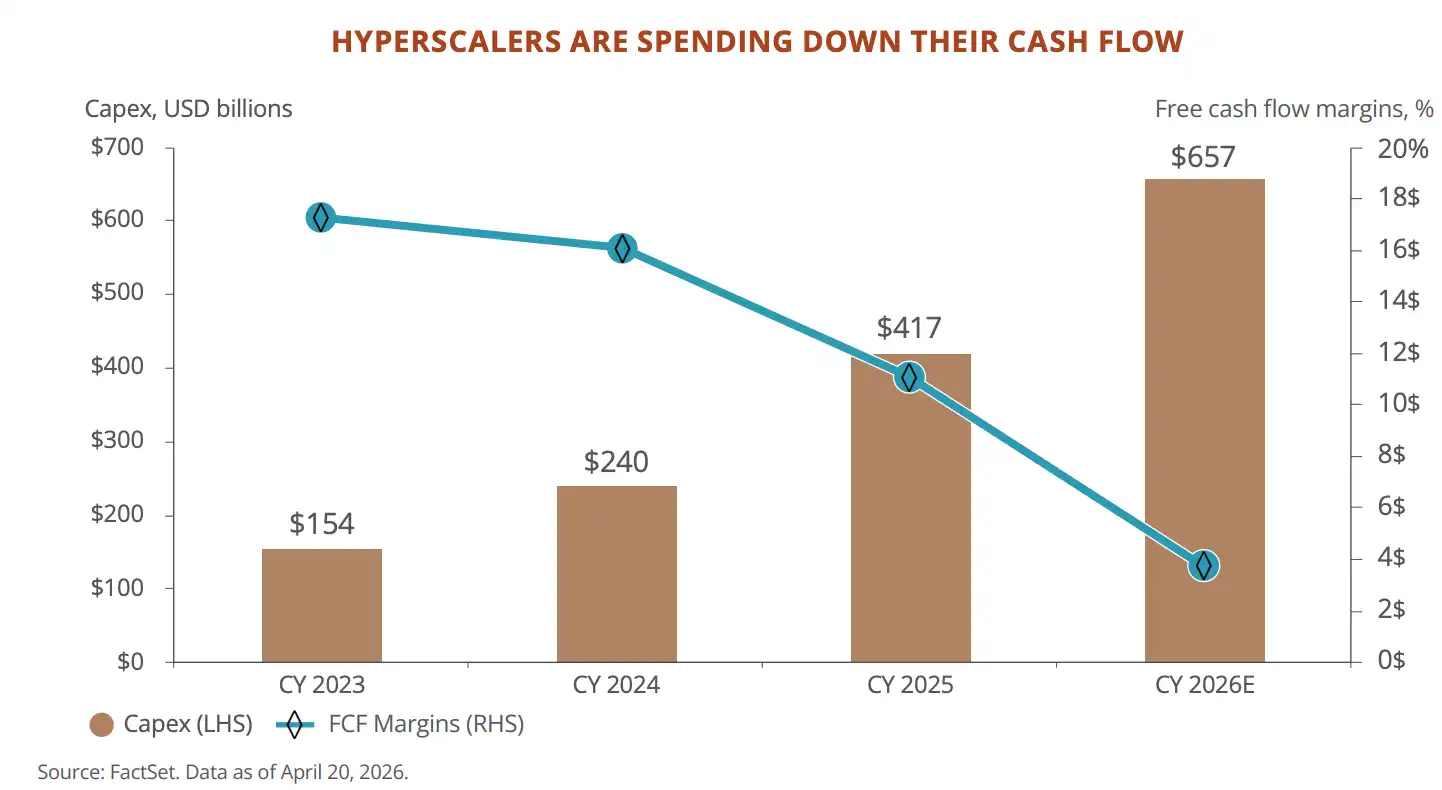
Simultaneously, the financial characteristics of these five companies are changing. Free cash flow is projected to drop from $240 billion in 2024 to $73 billion by end-2026, Microsoft's P/E has fallen from an AI-era high of 35x to 22.5x. The light-asset model that attracted investors over the past decade is being rewritten by heavy capital investment. JPM believes the focus at this stage should be on revenue growth rather than cash flow, but this also means that once demand slows, these investments could become a drag.

A few other judgments on AI serve as localized risk warnings within the larger trend:

Traditional software companies are the first real victims of AI. About half of the constituents in the US software sector index have fallen more than 50% from their highs, with a median operating profit margin of only 4%. The logic of the impact is simple: SaaS (subscription software) charges per head, AI reduces heads. This has already transmitted to the lending market, with about 21% of money in the US direct lending market lent to software companies, and publicly traded tech-focused loan fund prices falling close to the lows of the last cycle. JPM's stress tests show potential leveraged losses could reach 4% in extreme scenarios, but it does not yet constitute a systemic risk.
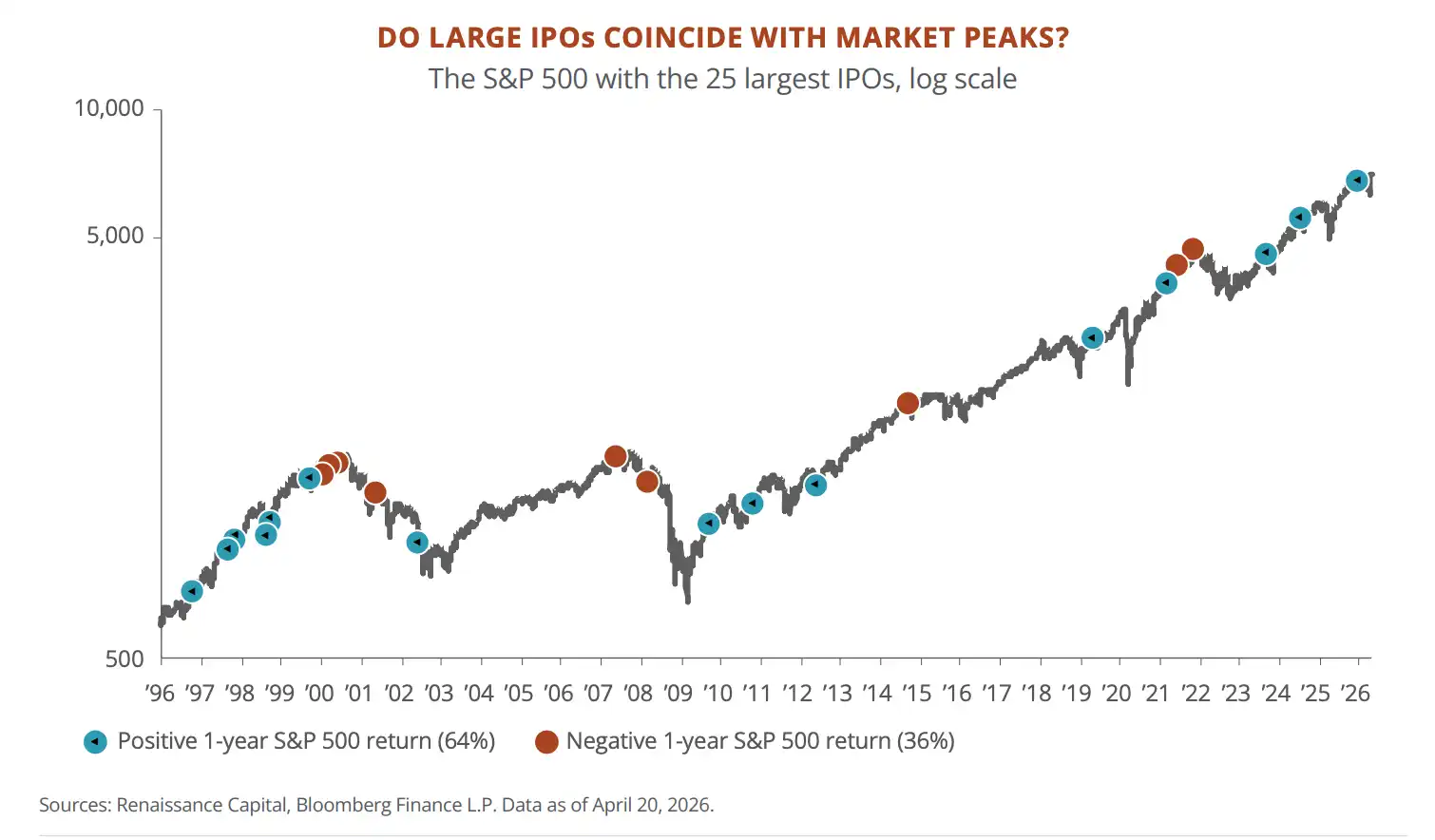
SpaceX, Anthropic, and OpenAI might crowd into IPOs this year, which historically is not a good sign. Following the 25 largest IPOs in the past, the median new stock underperformed the market by 30 percentage points in the first year, with 12 out of 18 falling in their first year. In years with mega IPOs, the median annual market return was only 3%, far below the long-term average of 10%. JPM doesn't say it's definitely a peak, but it is clearly watching the market reaction to SpaceX's IPO as a cycle thermometer.
On Inflation: Inflation Won't Return to 2%, Your Cash and Bonds Are Losing Money

The key point in the inflation section is not that the Strait of Hormuz has pushed up oil prices, but that US inflation hadn't returned to normal even before oil prices were pushed up.

In January 2026, core PCE was at 3.1% year-on-year, with particularly solid increases in local service categories like dining and personal care. Then oil prices doubled. The Fed's model shows that for every $10 increase in oil prices per barrel, inflation rises by about 0.3 percentage points; this time it's a $40 increase.
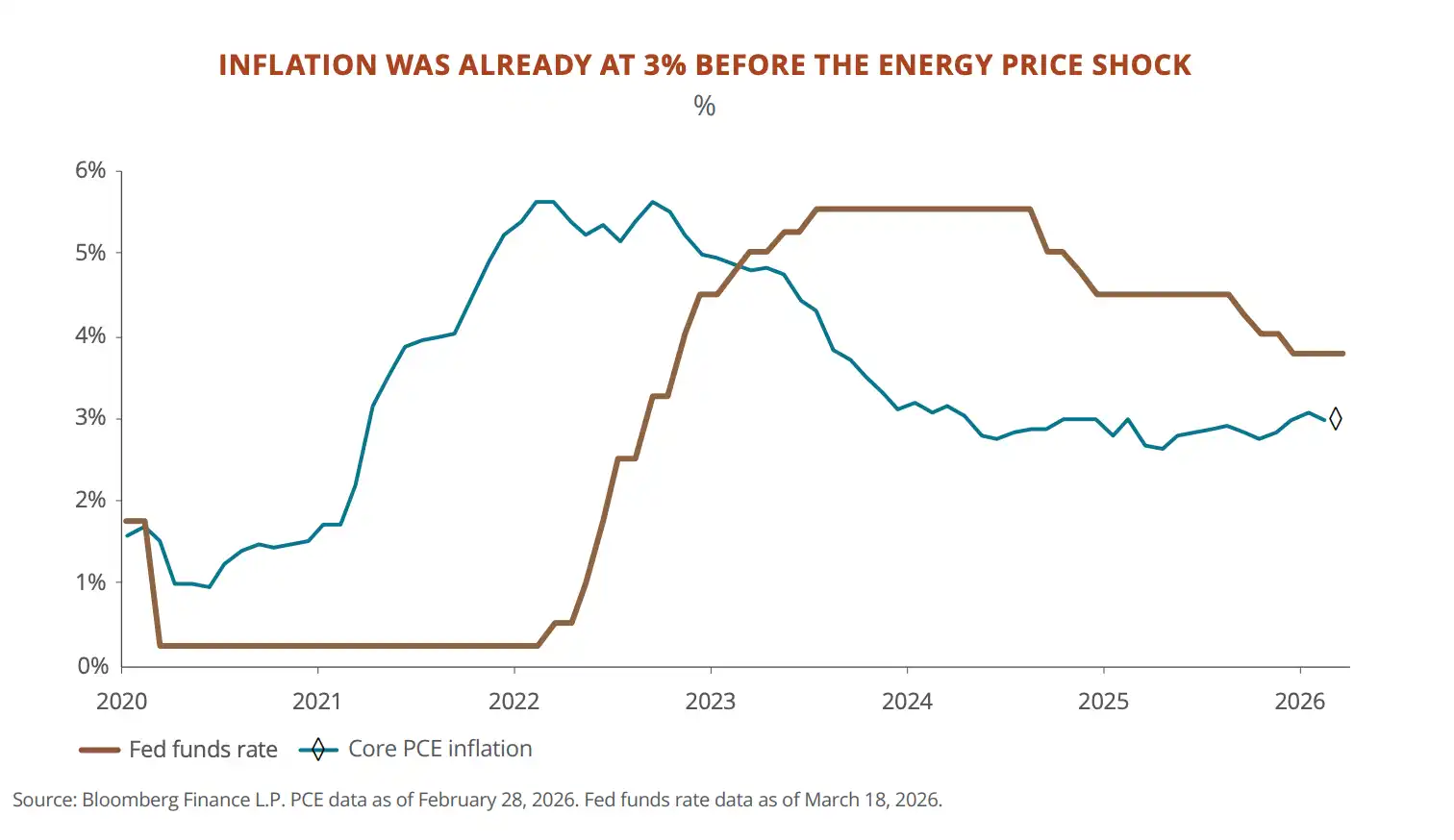
JPM believes a full 1970s-style replay is unlikely. The labor market isn't showing a wage-price spiral, the quit rate is declining, housing inflation has dropped from over 5% at the end of 2024 to just over 3%, and China's overcapacity is also suppressing global goods prices. However, the inflation floor is a notch higher than pre-pandemic, likely oscillating around 3%.

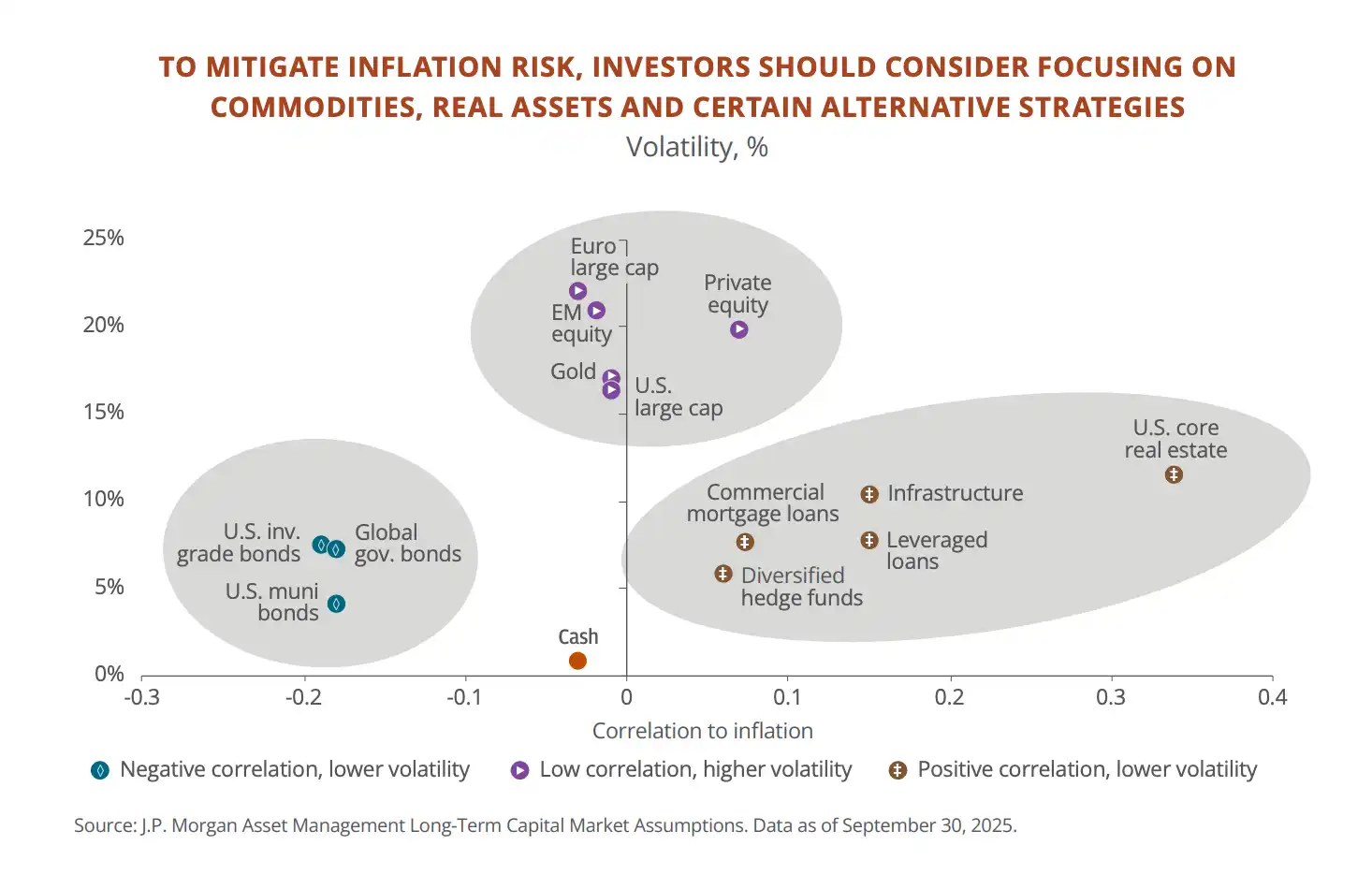
JPM's proposed countermeasure is to increase allocation to real assets.

Since 2020, US prices have cumulatively risen 25%, while bonds have only returned 6%, and cash even less. You think your money is sitting still, but it's actually shrinking every year. Among JPM's own clients, nearly 20% of assets are still in cash and short-term bonds.

Therefore, its suggestion is to move some money into assets that are linked to inflation:

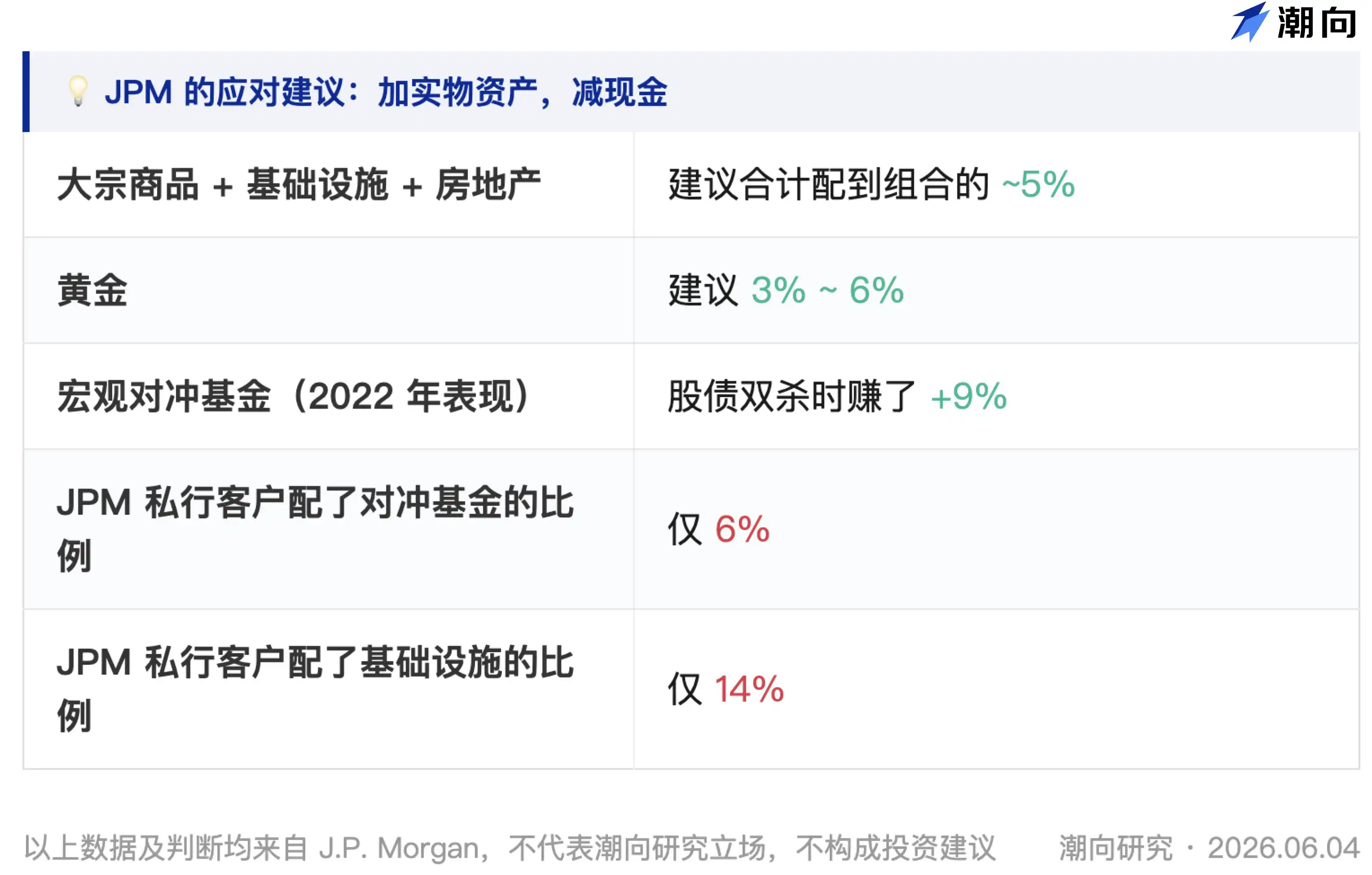
  1. Commodities, infrastructure, real estate—things that rise with prices—are suggested to be allocated around 5% of the portfolio in total.
  2. Gold is separately suggested at 3% to 6%.
  3. Then there are hedge funds. In 2022, when stocks and bonds fell together, macro strategy hedge funds gained 9%. However, JPM also acknowledges that 94% of its private banking clients have never bought hedge funds, and 86% haven't bought infrastructure-like products.
To sum up this section in one sentence:

Inflation may not spiral out of control, but it won't return to 2%. If your portfolio is still the traditional 60/40 stock/bond mix with a pile of cash, JPM thinks you're preparing for a world that no longer exists.

On Geopolitics: Chinese Equities May Be Poised for Structural Revaluation

This section covers the most diverse content, from Middle East conflicts to US-China competition to Europe's troubles. We'll only focus on what directly relates to investment decisions.

1. The Strait of Hormuz blockade is the biggest market shock of the first half of this year. About 20 million barrels of oil pass through this chokepoint daily, accounting for one-fifth of global oil consumption. After the US-Israel joint strikes on Iran, oil prices nearly doubled within days, and European natural gas prices rose nearly 100% in two days. QatarEnergy's CEO said 15% of LNG (liquefied natural gas) capacity could be offline for up to five years. Qatar also supplies about 30% of the world's helium, essential for chip manufacturing, and South Korea has warned of potential chip factory shutdowns.

JPM believes the conflict is moving towards de-escalation, but physical damage and energy risk premiums won't disappear quickly.

Therefore, their advice to investors is: Use the pullback to add to US equity positions.

US stocks fell about 10% in the first half, with the S&P 500 P/E briefly falling below 20x. Historically, buying after the VIX (fear index) breaks above 30 yields a 70% to 83% probability of positive returns within 6 months, averaging a 12.4% gain.

2. The US and China are each building their own ecosystems, and markets may accelerate into two camps. The US is restricting chip exports to China, teaming up with the Netherlands and Japan to control semiconductor equipment. China is expanding exports to non-US markets, with Belt and Road investment hitting a record high in 2025, investing $53 billion in Brazil in one year, and its trade volume with Latin America already exceeds that with the US. JPM's judgment is that future investment returns may increasingly depend on which camp your assets belong to, not just the company's own growth.

But fragmentation is also creating opportunities, especially in emerging markets.

JPM lists several directions:

  1. Latin America holds over 40% of the world's copper and nearly 60% of its lithium, along with abundant nickel, rare earths, and agricultural resources. Foreign direct investment has doubled in the past two decades, central banks' ability to control inflation is stronger than in developed countries, and politics are shifting towards more pragmatic, business-friendly governments.
  2. Middle Eastern Gulf countries are using oil revenues to build AI data centers. Saudi Arabia partnered with Blackstone on a $3 billion data center project, with costs 30% lower than in the US.
  3. East Asia (Taiwan China, South Korea) controls key nodes in the AI hardware supply chain. If AI capital expenditures continue to accelerate, these economies' exports and pricing power will further strengthen.
  4. Chinese equities are at their deepest discount relative to other Asian markets in 20 years; 80% of Chinese consumers are excited about AI products (38% in the US), and electricity costs are about half of those in the US. JPM's stance is "cautiously warming." If policy signals become more clearly business-friendly, Chinese equities may be poised for structural revaluation.

In contrast, Europe is the market where JPM is most conservative. Electricity prices are two to four times those in the US, R&D spending as a share of GDP is only 2.2% (US 3.6%, South Korea 5.2%), and venture capital scale is one-tenth that of the US.

The energy shock is also forcing the ECB to potentially consider re-tightening. In Europe, JPM only recommends buying defense and infrastructure-related stocks, avoiding autos and consumer sectors.
What JPM is Betting On, and What It's Not

Condensing a 60-page report into one sentence: Volatility is an entry opportunity, but the entry stance must change.

What You Should Bet On:

  • AI infrastructure chain (chips, optical modules, power), emerging market equities and bonds, real assets (commodities, infrastructure, gold), defense-related stocks, Chinese AI concepts (cautious addition).

What You Should Not Bet On:

  • Cash, traditional subscription-based software companies, European autos and consumer sectors, and relying solely on a traditional 60/40 stock/bond portfolio model to navigate the second half of this year.

Link to the original research report:

https://www.jpmorgan.com/content/dam/jpmorgan/documents/wealth-management/mid-year-outlook-2026.pdf

This article is Tide Research's compilation and interpretation of J.P. Morgan Wealth Management's Mid-Year Outlook Report 2026. The judgments and recommendations cited in the article are the views of JPM and do not represent the stance of Tide Research, nor do they constitute any investment advice.

Sell-side reports are inherently bullish; JPM is also an investment banking services provider for many of the mentioned companies. The value of the report lies in its framework and data, not in any single conclusion. Look at the logic, not just the direction.

The market carries risks; decision-making should be independent.

Data sources: J.P. Morgan Wealth Management Mid-Year Outlook 2026 · Bloomberg · FactSet · U.S. Bureau of Labor Statistics · IEA · METR · Renaissance Capital

Tide Research · 2026 June 4

Связанные с этим вопросы

QAccording to the J.P. Morgan report, why does the firm believe the AI supercycle is not over, despite market skepticism?

AThe report cites that the five Hyperscalers (Microsoft, Meta, Oracle, Google, Amazon) have increased their 2026 capital expenditure expectations to over $650 billion, an upward revision of $130 billion from the previous earnings season. It also notes that AI-related investments contributed 25 basis points to US real GDP growth in 2025. JPM believes the market is pricing in an 'AI peak' narrative, but the underlying data does not support this conclusion.

QWhat significant change is J.P. Morgan observing in the financial profile of major AI infrastructure companies (Hyperscalers)?

AThe report highlights a shift from a 'light-asset, high-return' model to a 'heavy-asset, high-investment' model. Their collective free cash flow is projected to drop from $240 billion in 2024 to $730 billion by the end of 2026. Microsoft's forward P/E ratio has also fallen from a peak of 35x during the AI era to 22.5x, indicating the market is still digesting this fundamental transformation.

QHow does the report characterize the impact of persistent inflation on traditional cash and bond holdings, and what is JPM's suggested response?

AThe report states that while US consumer prices have risen 25% cumulatively since 2020, core fixed income has only returned 6%, meaning cash and bonds are losing real value. JPM notes that nearly 20% of its clients' assets are in cash and short-term bonds. The suggested response is to reduce cash holdings and increase allocation to real assets like commodities, infrastructure, and real estate (to about 5% of the portfolio) and gold (3-6%) to hedge against inflation.

QWhat opportunity does J.P. Morgan see in emerging markets (EM) for the latter half of the year, and what are the key drivers?

AJPM sees potential in EM due to attractive valuations (P/E of 11.8x) and strong expected earnings growth (46%). Specific drivers include: Taiwan and Korea as core nodes in the AI hardware supply chain; Latin America possessing over 40% of global copper and nearly 60% of lithium reserves; and Gulf states investing oil revenues into cost-competitive AI data centers. The report also notes a historically deep discount for Chinese stocks relative to other Asian markets.

QRegarding the geopolitical risk of the Hormuz Strait blockage, what is J.P. Morgan's historical data-based advice for equity investors?

ADespite the oil price shock causing an approximately 10% market correction and the S&P 500 P/E dipping below 20x, JPM advises using the pullback as a buying opportunity for US equities. Their historical data shows that buying after the VIX (volatility index) breaks above 30 has resulted in a 70% to 83% probability of positive returns within six months, with an average return of 12.4%.

Похожее

Different Choices After the Plunge: Institutions Buy the Dip, Traders Shift to US Stocks

Title: Diverging Strategies After the Crash: Institutions Buying the Dip, Traders Shifting to US Stocks Following a sharp decline where Bitcoin briefly fell below $60,000 on June 6th, market sentiment remains "extreme fear" despite a partial recovery. This has led to varied responses from major market participants. Several institutional figures and analysts present a cautiously optimistic long-term view for Bitcoin. Glassnode's co-founder identifies $46k-$54k as a probable key bottom range based on historical on-chain models, while a Standard Chartered executive suggests the bottom is nearly formed. Strive's CEO points to Bitcoin touching its 200-week moving average as a historically reliable buy signal. Analysts highlight metrics like MVRV ratio and the "Power Law" model indicating Bitcoin is in an extremely undervalued zone. Conversely, some traders are exiting the crypto space. One trader cited a more attractive risk/reward profile and deeper research opportunities in US stocks, particularly with AI-related equities outperforming and capital rotating away from crypto. This shift is partly attributed to perceived ongoing risks, including those related to Strategy's Bitcoin sales. Market prediction data suggests a high probability (72%) of Bitcoin falling below $55,000, but lower odds for a deeper crash below $35k-$40k. The overall picture is one of division: institutions and long-term analysts see a accumulating opportunity, while some active traders are seeking alpha elsewhere amidst the volatility and shifting capital flows.

marsbit21 мин. назад

Different Choices After the Plunge: Institutions Buy the Dip, Traders Shift to US Stocks

marsbit21 мин. назад

Tech Stocks in the Midst of Deleveraging: Rather Than Rushing to Buy the Dip, Wait for the Macro Environment to Stabilize First

"Technology Stocks in Deleveraging Phase: Wait for Macro Stability Before Buying the Dip" The current sell-off in tech/AI stocks is primarily driven by macro headwinds, not a breakdown in AI fundamentals. After a parabolic rise, the market faced a perfect storm: an overcrowded trade, a massive SpaceX IPO draining liquidity, pre-CPI/PPI/FOMC hedging, and strong jobs data renewing "higher-for-longer" rate fears. This triggered a concentrated deleveraging in hot tech names. Key historical context: Unlike the December 2023 sell-off focused on AI capex returns, the current correction centers on the "denominator" – rising concerns over rates, inflation, the Fed, geopolitics, and liquidity. Leading memory stocks like Micron have seen ~20% pullbacks, significant but not yet at panic levels seen in March. The intense selling wave may be largely over, but a quick V-shaped recovery is unlikely. The market will likely churn in high volatility, awaiting clarity. The immediate catalyst needed for a sustainable reversal is a "stop-bleeding" signal from macro conditions. This doesn't require a major positive shock (like the April Iran ceasefire), but simply a halt to further deterioration: CPI not surprising hotter, Treasury yields stabilizing, the Fed not turning more hawkish, and post-SpaceX IPO liquidity easing. Once macro pressure plateaus, the intact AI investment thesis – centered on persistent compute/memory shortages and accelerating commercialization – can quickly regain market focus. The strategy is clear: prioritize monitoring macro stabilization over rushing to bottom-fish individual AI stories. Patience is key.

marsbit28 мин. назад

Tech Stocks in the Midst of Deleveraging: Rather Than Rushing to Buy the Dip, Wait for the Macro Environment to Stabilize First

marsbit28 мин. назад

South Korean Stocks Plunge, Global Funds Liquidate: Has the Semiconductor Fundamentals Really Changed?

South Korean stocks experienced their sharpest decline of the year, with the KOSPI index plunging nearly 9% on Monday, triggering a market circuit breaker. Leading semiconductor firms Samsung Electronics and SK Hynix were heavily sold off, raising questions about whether the AI-driven bull market has reached an inflection point. This sell-off was largely triggered by a significant drop in the U.S. semiconductor sector late last week. Concurrently, NVIDIA CEO Jensen Huang visited Seoul over the weekend, meeting with top executives from SK Group, Samsung, LG, and NAVER. He announced a new multi-year partnership with SK Hynix to co-develop next-generation memory products for AI data centers. Huang emphasized that AI infrastructure build-out remains in its early stages, creating a stark contrast between market panic and ongoing, strengthened industry collaboration. The article argues that South Korea has become one of the most sensitive markets for global AI-related capital flows, functioning like a large AI memory ETF due to the heavy weighting of its chipmakers. The current market turmoil reflects a shift in investor focus: from simply betting on overall AI growth to scrutinizing which companies will actually capture the profits from that growth. This "profit pool reassessment" phase is causing high volatility based on supply chain news and earnings guidance. Ultimately, the direction of the Korean market will be determined by external factors—NVIDIA's orders, HBM supply-demand dynamics, and capital expenditures from cloud service providers—rather than domestic conditions. The disconnect between sharp price corrections and continued strong signals from the industry core leaves the market at a crossroads, awaiting clearer data on the durability of AI infrastructure demand.

marsbit1 ч. назад

South Korean Stocks Plunge, Global Funds Liquidate: Has the Semiconductor Fundamentals Really Changed?

marsbit1 ч. назад

Trump in Talks with AI Companies Over Profit Sharing, A Narrative Pressure of Industrial Revolution Scale Begins

In recent AI market discussions, a new dimension beyond growth and profits has emerged: the question of how the immense wealth potentially generated by AI should be shared with the wider public. Triggered by reports of White House officials discussing "voluntary equity transfers" with top AI firms, similar to models like Alaska's Permanent Fund, the conversation focuses on public wealth funds. OpenAI's own whitepaper proposes such funds, allowing households without direct tech stock ownership to benefit from AI gains. More radical proposals, like Bernie Sanders' call for high public equity stakes and board seats, represent an extreme end of the spectrum. Currently, these are early-stage policy probes, not enacted laws. OpenAI's initiative is seen as an attempt to secure "social license" for its future expansion, mitigating risks of public backlash, stricter regulation, or anti-trust actions as AI's economic impact grows. The core market implication is the introduction of a "policy discount" to AI valuations, particularly for private model companies like OpenAI, Anthropic, and xAI. Investors must now consider not just future earnings but also what portion might be allocated to public mechanisms. The impact varies greatly based on the mechanism. A small, voluntary transfer of non-voting economic rights (e.g., 5%) acts as a quantifiable long-term cost. Government acquisition of economic rights via warrants tied to support differs from direct equity with governance power. The most disruptive scenario would be forced high-percentage public ownership affecting control and innovation incentives. Key signals to watch include whether other AI companies follow suit, if the White House formalizes proposals, related disclosures in future IPO documents, and any market price reactions. For now, this represents a shift from pricing pure AI growth to pricing its potential distribution. A manageable, voluntary economic share is akin to an insurance cost for societal acceptance, while a forced shift toward control and governance would fundamentally alter valuation logic.

marsbit1 ч. назад

Trump in Talks with AI Companies Over Profit Sharing, A Narrative Pressure of Industrial Revolution Scale Begins

marsbit1 ч. назад

From Record Highs to a Two-Week Low: Why Did AI Concept Stocks Suddenly Pull Back?

From Record Highs to Two-Week Lows: Why Did AI Stocks Suddenly Pull Back? U.S. stock indices, led by the tech-heavy Nasdaq 100, fell sharply to two-week lows. This marked a reversal from earlier in the week when AI infrastructure and semiconductor stocks had propelled major indices to record highs. Investors are rotating out of these previously high-flying tech sectors into other areas. The sell-off was driven by profit-taking and concerns that the AI rally had become overextended, exacerbated by chipmaker Broadcom's sales outlook falling short of lofty market expectations. The decline accelerated following a stronger-than-expected U.S. May nonfarm payrolls report, which showed 172,000 jobs added versus an estimated 88,000. This data sparked a jump in bond yields, with the 10-year Treasury yield rising to 4.553%, as it reinforced market speculation that the Federal Reserve's next move could be a rate hike rather than a cut. Globally, equities also declined, with European and Asian markets falling. Within the U.S. market, chip and AI-related stocks like Super Micro Computer and Arm Holdings led the losses, dropping over 7%. Cryptocurrency-linked stocks and mining shares also fell sharply amid drops in Bitcoin and commodity prices. While the overall Q1 earnings season remained solid, with 83% of S&P 500 companies beating estimates, the weakness was concentrated in tech. Excluding the tech sector, Q1 earnings growth was around 3%, the weakest in two years.

marsbit1 ч. назад

From Record Highs to a Two-Week Low: Why Did AI Concept Stocks Suddenly Pull Back?

marsbit1 ч. назад

Торговля

Спот
Фьючерсы

Популярные статьи

Неделя обучения по популярным токенам (2): 2026 может стать годом приложений реального времени, сектор AI продолжает оставаться в тренде

2025 год — год институциональных инвесторов, в будущем он будет доминировать в приложениях реального времени.

1.8k просмотров всегоОпубликовано 2025.12.16Обновлено 2025.12.16

Неделя обучения по популярным токенам (2): 2026 может стать годом приложений реального времени, сектор AI продолжает оставаться в тренде

Обсуждения

Добро пожаловать в Сообщество HTX. Здесь вы сможете быть в курсе последних новостей о развитии платформы и получить доступ к профессиональной аналитической информации о рынке. Мнения пользователей о цене на AI (AI) представлены ниже.

活动图片