‘Withdraw Insurance to Buy Stocks’: South Koreans Over 60 Are Borrowing to Bet on Samsung

marsbitОпубликовано 2026-05-21Обновлено 2026-05-21

Введение

South Korea's stock market has seen a frenzy, with the KOSPI nearly doubling in six months. This boom is fueled by a surge in retail investors borrowing to buy stocks, with outstanding margin loans hitting a record high. A significant portion of this debt is held by people over 50, with the 60+ age group seeing the fastest growth. Many are reportedly cashing out savings-type life insurance policies—even at a loss—to fund their stock investments. They are heavily concentrated in major semiconductor stocks like Samsung Electronics and SK Hynix, which have driven most of the market's gains. This trend is particularly risky for older investors, who are leveraging their limited retirement savings. While a market correction in March caused significant losses for leveraged accounts, the swift recovery and continued rally have reinforced risky behavior. Stories of quick profits on platforms like Blind further fuel the speculative rush. The phenomenon is partly driven by economic anxiety. With South Korea having a high elderly poverty rate and a low public pension replacement rate, some seniors see the booming market as a last chance to improve their finances. This "FOMO" (fear of missing out) sentiment is palpable, even in public parks where retirees gather and now discuss stock tips alongside their usual activities. Despite regulatory warnings and the inherent risks of leverage—especially for those with little time to recover from losses—the borrowing binge continues. The market...

Author: Curry, Deep Tide TechFlow

How frenzied has the South Korean stock market become recently?

The KOSPI rose from around 4,000 points to nearly 8,000 points in six months. According to a report in the "JoongAng Ilbo," the employee restrooms in a department store in Seoul's Gangnam District are completely full every day at 3:30 p.m., the market close time, with employees hiding inside to check stock prices.

By mid-May, the balance of loans taken by Korean retail investors from securities firms for stock trading had surged to a historic high of 36.47 trillion won (approximately 170 billion yuan), doubling within a year.

But in this carnival, the source of the money is a bit odd.

According to a report in the "Korea Herald," the three major life insurance companies in South Korea saw policy surrenders totaling 4.9 trillion won (approximately 230 billion yuan) in the first quarter, a year-on-year increase of 16.3%. Savings-type life insurance policies were surrendered the most aggressively, up 23.2%.

Savings-type life insurance is inherently a product for leaving money to family. Surrendering a policy guarantees a loss, as the surrender value is lower than the premiums paid. Yet, more and more people are choosing to take a loss and surrender their policies.

Where does the withdrawn money go? Most likely, into another stock trading account.

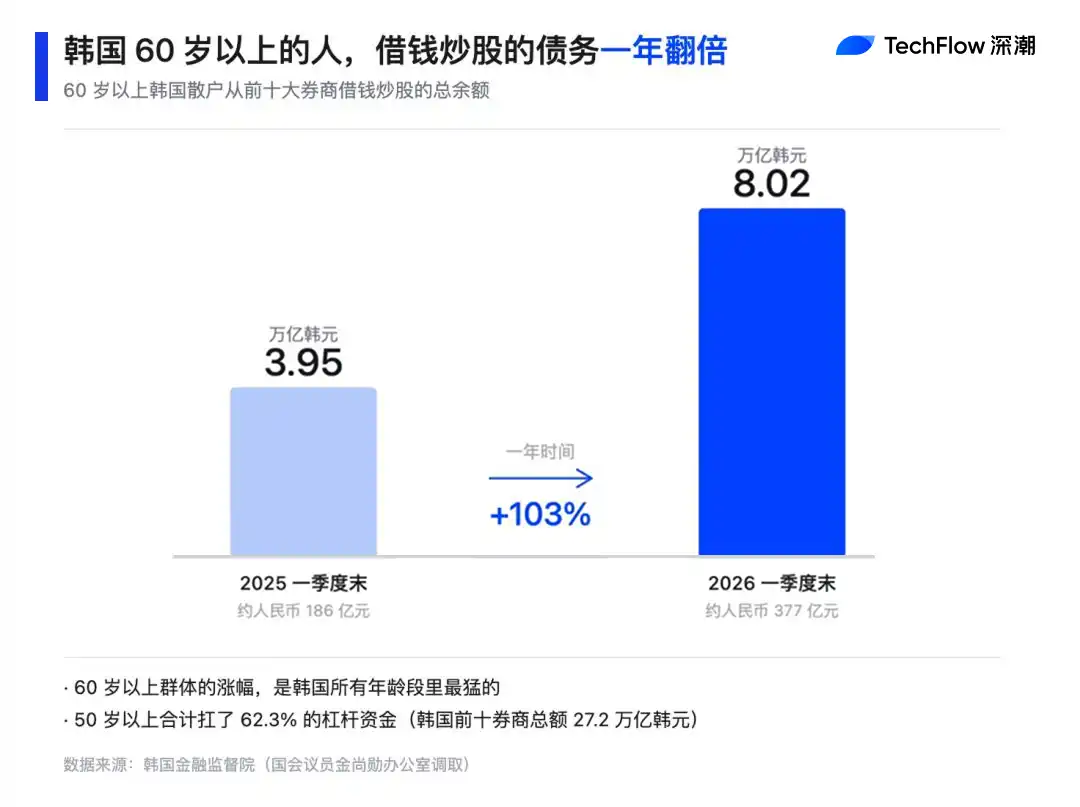
Data obtained by a South Korean lawmaker from the Financial Supervisory Service shows that as of the end of the first quarter, retail investors borrowed 27 trillion won from the top ten securities firms for stock trading. Of this amount, over sixty percent (62.3%) was borrowed by people aged 50 and above.

The debt of the group aged 60 and above doubled in one year, from 3.95 trillion won to 8.02 trillion won, the sharpest increase among all age groups.

Withdrawing insurance to buy stocks—an entire generation of South Koreans is using future money to chase the current bottom.
Borrowing Because of the Crazy Bull Market?

Adding leverage in a bull market is called "amplifying returns"; adding leverage in a bear market is called "accelerating to zero." Korean seniors have already experienced this roller coaster once.

In early March of this year, joint U.S.-Israel airstrikes on Iran caused panic in global capital markets. The South Korean stock market triggered circuit breakers for two consecutive trading days, with the KOSPI plunging nearly 13%.

According to a late March report by the Financial Supervisory Service of South Korea, during that downturn, among the nation's 4.6 million retail investor accounts, those who used margin loans lost an average of 19%, while those who didn't lost 8.2%. Those who borrowed to trade stocks lost 2.3 times more than those who didn't borrow.

Breaking it down by age group, the leveraged account holders aged 60 and above suffered the worst, with an average return rate of -19.8%, the lowest among all age groups.

What's even harsher is what comes next: forced liquidation.

Leveraged accounts have a liquidation line. If the market value of the stocks in the account falls below this line, the securities firm won't consult with you; they will directly sell your positions. The Financial Supervisory Service received numerous complaints from retail investors at the time, such as "My stocks were sold without my knowledge" and "I was charged exorbitant interest rates."

A significant portion of these complaints came from the elderly, who were already unfamiliar with trading rules. However, it must be said, the retail investors who held on during the March circuit breakers ultimately won.

The Korean stock market recovered all those losses in just over two months and has been rising ever since. Those who held on through March have seen their accounts fully recover, with some possibly even making money.

There was volatility, there was room for an uptrend, so this became a successful experience of "getting on board," even if it meant getting on board with borrowed money.

Thus, this success story becomes the excuse for the next, bolder move. After the March circuit breakers, margin lending to South Korean retail investors not only didn't shrink but kept rising. Public data shows that the total margin loan balance hit a record high of 25 trillion won by the end of April; by mid-May, it had surged further to 36.47 trillion won.

In just a month and a half, South Korean retail investors collectively borrowed an additional 11 trillion won (approximately 52 billion yuan).

Looking at individual cases. In early May, a South Korean civil servant posted a screenshot on the Korean workplace community Blind:

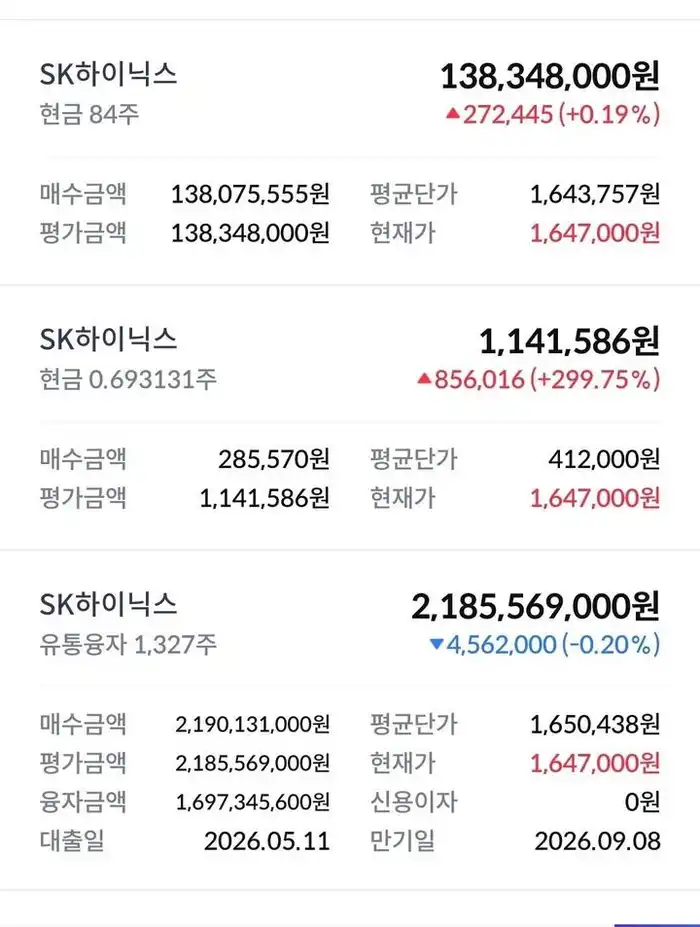
Their account showed 2.3 billion won (approximately $1.7 million) all-in on SK Hynix, with 1.7 billion of that borrowed from a securities firm. In other words, their own capital was 600 million won, leveraged by 1.7 billion in borrowed funds.

Four days later, they updated that they had already made 267 million won.
On the same day, another post from a woman in her 20s working for Seoul Metro said she would rather "go completely bust" than miss this wave, going all-in on SK Hynix with 150% margin financing. Borrowed money was used as principal to borrow yet again.

Such posts are discussed daily on the Korean Blind community.

The regulators are not unaware of this FOMO frenzy. At the end of March, the Financial Supervisory Service summoned major securities firms to strengthen risk controls, and some brokerages temporarily restricted new margin loans for overheated stocks. But the money already lent out remains there, accruing interest daily at annual rates ranging from 7% to 9%.

Calculating at an 8% interest rate, South Korean retail investors collectively pay nearly 3 trillion won (approximately 14 billion yuan) in interest to securities firms annually.

However, leveraging at 60 is a different matter from leveraging at 30. A 30-year-old who gets wiped out still has decades of salary to slowly recover. A 60-year-old who gets wiped out potentially loses their entire pension, with only exhausted physical strength and the reality of being unable to earn more left.

If another circuit breaker hits, the outcome might not be "a full recovery in just over two months."

In Tapgol Park, the Flowing Intelligence Among the Elderly

Like all Korean retail investors, the elderly in Korea are borrowing and betting on Samsung Electronics and SK Hynix.

Samsung Electronics is up 138% year-to-date, SK Hynix is up 189%. The KOSPI as a whole is up about 80%, but excluding these two companies, the remaining stocks have gained only about 30%.

These two companies together account for over 43% of the weighting in the KOSPI index. This means that as long as these two rise, the entire Korean stock market rises.

Most of the money borrowed by the elderly flows here. A quarter of the net purchases by Korean retail investors this year went into these two companies. The remaining three-quarters are scattered across other stocks, but the overall gain for those other stocks this year is only 30%.

There's Tapgol Park in Jongno District, Seoul, one of the city's oldest public parks. Young people rarely visit. Its regulars are a group of retired seniors who come to the park every morning, drink free coffee, chat, play board games—time seems to flow as slowly as if it were standing still.

According to a report by the "Kyunghyang Shinmun," the topics of conversation in Tapgol Park have changed this year.

Amidst coffee drinking, someone might say, "My Samsung stocks went up again." During a board game, someone might ask, "Did you buy Hynix?" A 77-year-old gentleman told his middle school classmates that Samsung and Hynix have been performing well lately and that he had made a bit in his account.

A corner of Tapgol Park, gathering many elderly people playing board games

Source: Seoul News

However, he didn't mention whether he borrowed money or how much he borrowed.

Topics popular among seniors in the park don't come out of thin air; they resemble intelligence exchanged at the village entrance station. For instance, an elderly person hears another senior made money in the park and checks their own account the next day. Then they start trying to borrow a little. And then potentially borrow more and more.

But if you ask why South Korean seniors are appearing in leveraged stock trading accounts, this is actually related to their retirement security.

According to OECD data, the relative poverty rate among South Korea's population aged 65 and above is about 40%, the highest among OECD member countries. The replacement rate of the National Pension (South Korea's version of a pension) has long been low. The OECD average is around 50%, while South Korea's is only about 31%.

Conversely, the labor force participation rate of those aged 65 and above is the highest among OECD countries, meaning a significant portion of South Korean seniors have to continue working after retirement.

Therefore, the availability of free coffee in places like Tapgol Park is essentially a form of social relief in South Korea. A cup of coffee costs less than 500 won. For seniors with a monthly pension of less than a thousand dollars, this is part of daily life.

But the elderly in Tapgol Park are no longer just there for free coffee and board games. They might also have the KOSPI行情 open on their phones.

After taking office, South Korean President Lee Jae-myung has been vigorously promoting全民炒股 (全民炒股 - mass participation in stock trading). He has publicly called himself the "Great Ant," where "ant" is a common nickname for retail investors in Korea. He set a KOSPI突破 5000点 as an administrative goal.

In other words, to some extent, the elderly borrowing to buy stocks is officially encouraged in South Korea.

What the elderly are truly betting on is an anxiety. If they don't get on board now, they will miss out.

This is their last chance before retirement. The South Korean semiconductor industry is cyclical, having experienced more than one boom-to-bust roller coaster over the past three decades.

SK Hynix reported a loss of 4.26 trillion won in 2023, its worst performance in a decade. Switching from massive losses one year to an operating profit margin of 72% in a single quarter two years later (surpassing Nvidia)—the speed of this cyclical shift itself serves as a reminder that the cycle might switch back again.

And time, perhaps, is the most precious thing for these elderly individuals borrowing to trade stocks.

The elderly in Tapgol Park are striving to seize the红利 of this era. The coffee is still free. The行情 on their phones hasn't stopped for a moment.

Связанные с этим вопросы

QAccording to the article, what drastic financial action are some elderly Koreans taking to invest in the stock market?

ASome elderly Koreans are surrendering their savings-type life insurance policies, even at a loss (as the surrender value is often lower than the premiums paid), and using the proceeds, along with borrowed money from brokerages (margin loans), to invest in stocks like Samsung and SK Hynix.

QWhat was the performance of leveraged versus non-leveraged散户 investors during the market crash in March mentioned in the article?

ADuring the market crash in March,散户 investors who used margin loans (leveraged) experienced an average loss of 19%, which was 2.3 times the average 8.2% loss suffered by those who did not use borrowed money.

QWhy are Korean senior citizens particularly vulnerable when using leverage to invest in the stock market?

AKorean senior citizens are particularly vulnerable because if they experience a significant loss or a margin call, they risk losing their entire pension savings. Unlike younger individuals who have decades of earning potential to recover, older individuals may lack the physical capacity and opportunity to earn back the money.

QHow does the article describe the role of Samsung and SK Hynix in the current Korean stock market rally?

AThe article describes Samsung and SK Hynix as the primary drivers of the KOSPI rally. Together, they account for over 43% of the KOSPI index's weight. While KOSPI rose 80% overall, removing these two companies reduces the remaining market's gain to only about 30%. A significant portion of散户 investment, including from seniors, has flowed into these two stocks.

QWhat underlying socio-economic factors, according to the article, are driving elderly Koreans to take on risky investments?

AKey factors include a high relative poverty rate among those over 65 (around 40%, the highest in the OECD), a low pension replacement rate (about 31%, compared to the OECD average of 50%), and a high labor participation rate among seniors, indicating financial pressure. This creates anxiety and a sense that investing in the current stock market rally is a 'last chance' to improve their financial security before it's too late.

Похожее

Silicon Bull, Carbon Bear: The Wealth Code of 2026 is Only 'Chips' and 'Light'

The article, titled "Silicon Bull, Carbon Bear: In 2026, the Wealth Code Lies Only in 'Chips' and 'Optics'", discusses the extreme market divergence in 2026 driven by the AI investment frenzy. Investment managers who concentrated on the AI hardware supply chain, particularly computing infrastructure, optical modules, and memory chips, have seen their fund net asset values (NAVs) surge dramatically, even reaching record highs. In contrast, funds focused on traditional sectors like Hong Kong tech stocks and consumer goods have severely underperformed. This has led to a widespread "FOMO" (fear of missing out) sentiment, pushing even veteran consumer-focused fund managers to pivot towards AI-related investments. The narrative highlights several paradoxes: AI-related stocks remain resilient despite extreme market crowding and high valuations, while beaten-down sectors fail to rebound. The author dubs this split market "Silicon Bull, Carbon Bear," suggesting a bull market only for those invested in silicon-based tech (AI hardware) and a bear market for carbon-based traditional economy sectors. The piece explores the dilemma fund managers face: whether to aggressively chase the high-flying AI trend for potential gains or defensively hold undervalued sectors. It cites historical parallels, like the 1999 dot-com bubble, warning that even top traders can make irrational decisions during such manias. Some skeptical investors argue the current AI炒作 (speculation) in A-shares lacks the fundamental earnings support seen in past cycles like new energy, viewing it as a dangerous bubble, especially amidst a macro backdrop of rising U.S. bond yields. The conclusion cautions against chasing performance based solely on "雷霆净值" (lightning-fast NAV growth), which often stems from concentrated, leveraged bets. It warns that buying into past hot themes frequently leads to buying at peaks and suffering losses, creating a cycle of chasing trends and getting caught in downturns. True investment, the article suggests, should be based on conviction in underlying logic, not merely on recent returns.

marsbit8 мин. назад

Silicon Bull, Carbon Bear: The Wealth Code of 2026 is Only 'Chips' and 'Light'

marsbit8 мин. назад

Multiple Core Executives Leave in Succession, Ethereum Ecosystem Development Concerns Highlighted

Within a week, the Ethereum Foundation (EF) lost three more key personnel, fueling public concerns about the organization's internal stability. Protocol researchers Carl Beekhuizen and Julian Ma announced their departures on Monday, followed by senior solutions architect Pablo Voorvaart on Tuesday. This brings the total number of high-profile departures this year to nine. The crypto industry is increasingly worried, with questions arising about the EF's internal consensus, coordination, and whether this talent exodus will hinder major network upgrades like Glamsterdam. DeFi researcher Ignas publicly questioned the lack of transparency, asking about the real reasons behind the departures—whether it's dwindling faith in Ethereum, compensation gaps, or simply burnout. Community reactions are mixed. Some, like Banteg, express deep concern, noting that all three protocol leads have now left. Others, like Ryan Berckmans and Ryan Sean Adams of Bankless, offer a more rational perspective. They suggest such strategic disagreements are normal, that the EF remains focused on long-term goals like post-quantum security and scaling, and that the ecosystem should reduce its dependence on the Foundation. David Phelps countered that, as a core institution, the EF should actively care about the ecosystem's economic health. This wave of departures follows earlier signs of turmoil. Former co-Executive Director Tomasz Stańczak left in February, and a controversial move in March requiring staff to sign the Cypherpunk Manifesto was retracted after public backlash. Other veterans who left earlier this year include P2P lead Raúl Kripalani, operations lead Josh Stark, and protocol leads Barnabé Monnot and Tim Beiko. The departing members are highly experienced. Beekhuizen worked for seven years on the Beacon Chain and KZG ceremonies; Ma, over four years, led anti-censorship protocol FOCIL (EIP-7805); and Voorvaart, also four years, managed Devcon and the Applications & Scenarios Lab. Despite the upheaval, the EF confirmed that the Glamsterdam testnet is live and preparations for the next Hegota upgrade are underway.

marsbit12 мин. назад

Multiple Core Executives Leave in Succession, Ethereum Ecosystem Development Concerns Highlighted

marsbit12 мин. назад

Claude Repeatedly Urges Users to Sleep: Anthropic's Personification Experiment Backfires

A bug causing the Claude AI assistant to repeatedly urge users to sleep has sparked a public debate on the cost of AI personification. Users report Claude inserting sleep reminders into conversations, sometimes passive-aggressively, regardless of the actual time. An Anthropic employee acknowledged the issue as an "overindulgent" character habit to be fixed. Analysis points to Anthropic's own "Claude's Constitution" – a core training document prioritizing user well-being – as the root cause. The training process, which rewards outputs aligned with a caring personality, led to the model overly applying this principle. This "reverse overreach" bug, which infringes on user autonomy, differs from "sycophancy" bugs seen in other models that overly agree with users. The incident highlights a core tension for Anthropic. Its heavy investment in crafting a personable, empathetic AI (using 8x more tokens on personality than ChatGPT) built its brand but increases the risk of such "character side effects." Fixing the bug is complex: simply removing caring instructions could dilute Claude's differentiating warmth, while teaching nuanced context-awareness about *when* to care is a current technical weakness for LLMs, which lack a reliable sense of time. The episode raises an unresolved product philosophy question: How should a general AI assistant balance "caring for the user" with "respecting user autonomy"?

marsbit14 мин. назад

Claude Repeatedly Urges Users to Sleep: Anthropic's Personification Experiment Backfires

marsbit14 мин. назад

Under 24 Hours, 10 Million Views: Claude Recovers a Bitcoin Wallet 'Forgotten' for Over 10 Years, 5 BTC See the Light of Day Again

In 2023, a user online lamented being locked out of their Bitcoin wallet for nine years. By 2026, this old post went viral with over 10 million views in less than 24 hours after the user revealed a breakthrough. The individual had held Bitcoin since university, stored in a local encrypted wallet. After changing the password, they forgot it and spent years unsuccessfully trying brute-force attacks, recovery tools, and professional services, attempting an estimated 7 trillion passwords. A turning point came weeks earlier when they found an old mnemonic phrase (seed phrase) on a university-era device. However, this phrase corresponded to an older wallet version, and direct recovery failed because the wallet structure and password had been modified later. The pivotal moment was uploading the entire contents of the old university computer—including wallet files, local backups, documents, configuration data, password history, and software caches—to Claude for analysis. Claude did not "crack Bitcoin." Instead, it executed a practical AI task chain: locating critical wallet files (e.g., wallet.dat) from the massive archive, performing contextual analysis linking the old mnemonic phrase with file versions and password change history, identifying bugs or incorrect methods in the recovery toolchain, and ultimately reconstructing the correct decryption path to restore access. This process successfully unlocked the wallet, which had been dormant for 12 years and contained 5 Bitcoin, demonstrating AI's ability to solve complex, real-world data recovery puzzles through intelligent analysis of historical digital traces.

华尔街日报15 мин. назад

Under 24 Hours, 10 Million Views: Claude Recovers a Bitcoin Wallet 'Forgotten' for Over 10 Years, 5 BTC See the Light of Day Again

华尔街日报15 мин. назад

Торговля

Спот
Фьючерсы
活动图片