Is Cardano Over? Charles Hoskinson Warns Of A “Wave Of Failures” — And His Own Community Is Furious

bitcoinistОпубликовано 2026-06-04Обновлено 2026-06-04

Введение

Cardano co-founder Charles Hoskinson has issued a severe warning, predicting a "wave of failures," forced consolidation, and DeFi shutdowns across the Cardano ecosystem in the second half of 2026. His comments followed the sudden shutdown announcement of TapTools, a major analytics and infrastructure platform for Cardano, citing unsustainable costs. Hoskinson framed this not as an isolated incident but a sign of deeper ecosystem stress, acknowledging that a proposed treasury-funded index to support projects never materialized. He subsequently announced he was "taking a break." The crypto community reacted with strong criticism. Prominent figures accused Hoskinson of overselling Cardano's potential and failing to deliver on promises, leaving investors to suffer. The ecosystem faces significant challenges: Cardano's Total Value Locked (TVL) ranks only 28th, its 2026 summit was canceled, engineering funding was slashed, and ADA's price has fallen below $0.20 for the first time in over five years. Hoskinson's own bleak assessment raises fundamental questions about Cardano's ability to reverse its current trajectory.

Charles Hoskinson, co-founder of Cardano and Input Output Global, sparked one of the most uncomfortable public debates in the blockchain’s history this week — warning in a video posted on YouTube that the second half of 2026 will bring a wave of project failures, forced consolidation, and DeFi shutdowns across the ecosystem, as ADA fell below $0.20 for the first time in more than five years.

The catalyst was the June 2 announcement by TapTools — Cardano’s most widely used analytics and infrastructure platform, serving over one million users and powering backend data for hundreds of Cardano-native token protocols across four years — that it will wind down operations within two weeks.

The closure follows the departure of five senior team members including both co-founders, the COO, the CTO, and a backend developer who had stepped into technical leadership after the founders left, per TapTools’ official statement. Infrastructure costs, software development expenses, and support obligations had become impossible to sustain, the company said. TapTools added it remains open to acquisition discussions.
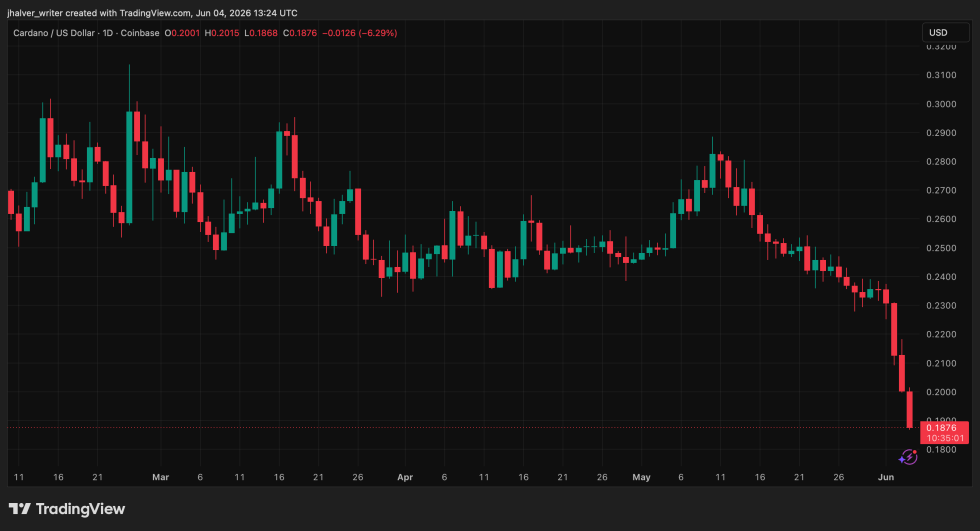
ADA's price trends to the downside on the daily chart. Source: ADAUSD on Tradingview

Hoskinson’s Warning — And The ADA Fallout

Responding in a video on the same day, Hoskinson framed TapTools’ exit not as an isolated event but as a leading indicator of deeper ecosystem stress. A substantial portion of older Cardano projects are no longer in an investable state, he said — and the H2 2026 environment will force many into the same position.

He pointed to JX Door’s earlier collapse as a warning sign that went unheeded, and acknowledged that a treasury-funded index he had proposed to backstop struggling ecosystem projects never materialized. “I came up with the plan of an index. It did not get executed,” he said in the video, per the YouTube posting, placing partial responsibility on Cardano’s governance community for failing to act when opportunities were available.

Hoskinson subsequently posted on X that he is “taking a break” — three words that landed heavily given the timing.

The Community Fires Back

The response from prominent voices in the crypto community was swift and pointed. Andreas Svanevik (@ASvanevik), CEO of Nansen, addressed Hoskinson’s implicit question about what he could do to help directly: “It’s not about what he can do NOW,” Svanevik wrote on X. “The problem is he sold Cardano as something it never was. And people believed him. Now they will all suffer the consequences together.”

The post drew significant engagement and amplified a sentiment that had been building in the community for months — that Hoskinson’s long-standing promises about Cardano’s institutional potential and developer adoption had set expectations the network could not match. @Pledditor’s post on X added further community context to the criticism, reflecting frustration that had been building across ADA holders as the ecosystem continued to lose ground.

The Structural Picture

The numbers behind the debate are difficult to argue with. Cardano’s total value locked stands at approximately $123.85 million — placing it 28th by chain TVL on DeFiLlama, behind Stellar, NEAR, Aptos, and Mantle, and roughly two orders of magnitude below Ethereum’s $39.9 billion.

The 2026 Cardano Summit was canceled after the community voted down treasury funding. Engineering proposals for 2026 were cut to $46.8 million from $97.5 million the prior year. The van Rossem hard fork was postponed to allow further testing. ADA is currently trading at approximately $0.20 — its lowest level in more than five years.

The question Hoskinson’s own comments raise — whether Cardano can reverse a trajectory that its own founder is now publicly describing in near-apocalyptic terms — is one the ecosystem has no clean answer to heading into what he himself calls the hardest half of the year.

Cover image from Grok, ADAUSD chart from Tradingview

Связанные с этим вопросы

QWhat specific event did Charles Hoskinson cite as a catalyst for his warning about Cardano's ecosystem, and what was its impact?

AThe catalyst was the announcement by TapTools, Cardano's most widely used analytics and infrastructure platform, that it would wind down operations within two weeks. This event signaled deeper ecosystem stress to Hoskinson, contributing to his warning about a coming wave of project failures.

QHow did prominent voices in the crypto community, like Andreas Svanevik, respond to Hoskinson's warning and his role in Cardano's situation?

AAndreas Svanevik, CEO of Nansen, responded critically on X. He argued that the problem stemmed from Hoskinson selling Cardano as something it never was, setting unrealistic expectations about its institutional potential and developer adoption that the network failed to meet.

QWhat are some key metrics mentioned in the article that illustrate Cardano's current challenges in the broader blockchain landscape?

AKey metrics include Cardano's Total Value Locked (TVL) of approximately $123.85 million, ranking 28th among chains, and ADA's price falling below $0.20 for the first time in over five years. The article also notes the 2026 Cardano Summit was canceled and engineering proposals were significantly cut from $97.5 million to $46.8 million.

QWhat internal failure did Hoskinson acknowledge regarding a proposed plan to support struggling Cardano projects?

AHoskinson acknowledged that a treasury-funded index he had proposed to backstop struggling ecosystem projects never materialized. He stated, 'I came up with the plan of an index. It did not get executed,' placing partial responsibility on Cardano's governance community for failing to act.

QWhat major implication does Charles Hoskinson's warning raise for the future of the Cardano ecosystem according to the article's conclusion?

AHoskinson's warning raises the question of whether Cardano can reverse its current negative trajectory, which he himself describes in near-apocalyptic terms. The ecosystem faces this challenge heading into what he calls the hardest half of the year (H2 2026), with no clear answer provided.

Похожее

From 'Old Dogs' to 'New Darlings': How AI is Revaluing Old Infrastructure, from Dell to Nokia

"Old Dogs" Become AI's New Darlings: Revaluing Legacy Infrastructure The AI investment narrative is shifting. Beyond the spotlight on core chipmakers like Nvidia, a new wave of interest is rising for legacy tech companies—Dell, HPE, Nokia, Cisco, Corning, Western Digital—once labeled as slow-growth, outdated stories. This resurgence stems from AI's evolution from model development to real-world deployment, creating massive demand for physical infrastructure. As AI moves into data center construction and enterprise adoption, the focus turns to who can actually build and deliver complex systems. These established players hold decades of experience in supply chains, integration, networking, and enterprise delivery—assets now critical for scaling AI. The revaluation can be grouped into three key infrastructure areas: 1. **Servers & Integration (e.g., Dell, HPE):** They are becoming essential system integrators, transforming GPUs into full-scale AI servers with networking, power, and cooling, then delivering them to clients. Strong recent earnings and AI-specific revenue/order growth for Dell and HPE underscore this shift. 2. **Networking & Connectivity (e.g., Corning, Nokia, Cisco):** As AI clusters grow, high-speed data transfer becomes paramount. Corning benefits from fiber demand for data center links, Nokia is exploring AI-integrated wireless networks (AI-RAN), and Cisco sees surging orders for data center switches—all critical for efficient AI operations. 3. **Storage (e.g., Western Digital, Seagate):** The AI data explosion requires vast capacity. Beyond high-speed memory (HBM), there's growing need for high-capacity HDDs to store training data, logs, video, and cold/archival data cost-effectively. This revaluation, however, is not a blanket endorsement. True reassessment requires concrete proof: AI-driven orders and revenue growth, upward revisions to company guidance, and sustainable improvements in profit quality, not just top-line sales. In essence, AI is not turning all old tech firms into high-growth stocks; it is selectively re-pricing the "old assets" of companies that are mission-critical for building the new AI infrastructure, transforming their legacy capabilities into renewed growth engines.

marsbitТолько что

From 'Old Dogs' to 'New Darlings': How AI is Revaluing Old Infrastructure, from Dell to Nokia

marsbitТолько что

Probability in the Price: How World Cup Odds Are Calculated

**The Probability in the Price: How World Cup Odds Are Calculated** Two major systems released their "championship probabilities" before the 2026 World Cup, and they disagreed on the favorite. Prediction market aggregators listed France at around **17%**, while the Opta supercomputer gave European champion Spain **16.1%**. These numbers look similar, but their production methods are fundamentally different. The market's **17%** is the **price** that clears after hundreds of millions of dollars in trading across platforms like Polymarket and Kalshi, where contracts trade between 0 and 100 cents, directly representing implied probability. This liquidity is provided by crypto-native market makers like Wintermute, though the market still has "the liquidity profile of an early-stage" asset class. In contrast, Opta's **16.1%** is a **simulated frequency**. Its model uses team data (including betting market odds as an input) to estimate match probabilities, then runs **10,000 full tournament simulations**, counting how often each team wins. Which is more accurate? There is **no rigorous, cross-tournament academic study** directly comparing their track records. However, a persistent **longshot bias**—where low-probability outcomes are systematically overvalued—observed in traditional betting for nearly a century, has also been found in modern crypto prediction markets. Research shows low-price contracts on Kalshi/Polymer less likely to pay out than their implied odds suggest. Unlike traditional bookmakers, prediction markets operate on **public blockchain ledgers**, making every transaction auditable and enabling such research. However, price formation is also influenced by **regulatory uncertainty**, as seen in recent US state-level bans and legal battles over jurisdiction. In summary, the "probability" you see is either a **market-clearing price** subject to behavioral biases and liquidity constraints, or a **model-simulated frequency** that partially incorporates market data. The question of which method is more reliable remains open, highlighting the importance of asking: **How was this number produced?**

marsbit29 мин. назад

Probability in the Price: How World Cup Odds Are Calculated

marsbit29 мин. назад

Торговля

Спот
Фьючерсы

Популярные статьи

Как купить ADA

Добро пожаловать на HTX.com! Мы сделали приобретение Cardano (ADA) простым и удобным. Следуйте нашему пошаговому руководству и отправляйтесь в свое крипто-путешествие.Шаг 1: Создайте аккаунт на HTXИспользуйте свой адрес электронной почты или номер телефона, чтобы зарегистрироваться и бесплатно создать аккаунт на HTX. Пройдите удобную регистрацию и откройте для себя весь функционал.Создать аккаунтШаг 2: Перейдите в Купить криптовалюту и выберите свой способ оплатыКредитная/Дебетовая Карта: Используйте свою карту Visa или Mastercard для мгновенной покупки Cardano (ADA).Баланс: Используйте средства с баланса вашего аккаунта HTX для простой торговли.Третьи Лица: Мы добавили популярные способы оплаты, такие как Google Pay и Apple Pay, для повышения удобства.P2P: Торгуйте напрямую с другими пользователями на HTX.Внебиржевая Торговля (OTC): Мы предлагаем индивидуальные услуги и конкурентоспособные обменные курсы для трейдеров.Шаг 3: Хранение Cardano (ADA)После приобретения вами Cardano (ADA) храните их в своем аккаунте на HTX. В качестве альтернативы вы можете отправить их куда-либо с помощью перевода в блокчейне или использовать для торговли с другими криптовалютами.Шаг 4: Торговля Cardano (ADA)С легкостью торгуйте Cardano (ADA) на спотовом рынке HTX. Просто зайдите в свой аккаунт, выберите торговую пару, совершайте сделки и следите за ними в режиме реального времени. Мы предлагаем удобный интерфейс как для начинающих, так и для опытных трейдеров.

2.2k просмотров всегоОпубликовано 2024.03.29Обновлено 2026.06.02

Как купить ADA

SNEK: ведущий мемкоин на блокчейне Cardano, открывающий новую эпоху для экосистемы Cardano

SNEK - это дефляционный мемкоин, выпущенный на блокчейне Cardano. Он создаёт децентрализованную культурную и развлекательную ценность за счёт участия глобального сообщества.

2.1k просмотров всегоОпубликовано 2025.10.15Обновлено 2025.10.15

SNEK: ведущий мемкоин на блокчейне Cardano, открывающий новую эпоху для экосистемы Cardano

Неделя обучения по популярным токенам 8: запуск основной сети Ouroboros Leios для ADA ожидается в 2026 году

Основная сеть Ouroboros Leios для ADA, как ожидается, будет запущена в 2026 году, а хардфорк до версии протокола 11 запланирован на I квартал 2026 года.

2.0k просмотров всегоОпубликовано 2026.02.10Обновлено 2026.02.12

Неделя обучения по популярным токенам 8: запуск основной сети Ouroboros Leios для ADA ожидается в 2026 году

Обсуждения

Добро пожаловать в Сообщество HTX. Здесь вы сможете быть в курсе последних новостей о развитии платформы и получить доступ к профессиональной аналитической информации о рынке. Мнения пользователей о цене на ADA (ADA) представлены ниже.

活动图片