Japan's Central Bank on the Verge of Raising Rates, Can the AI Bull Market Still Hold?

marsbitОпубликовано 2026-06-15Обновлено 2026-06-15

Введение

TL;DR: The impending Bank of Japan (BOJ) interest rate hike is shifting global market focus this week, raising questions about its potential impact on the AI-driven bull market and cryptocurrencies like Bitcoin. For years, the yen has served as a cheap global "funding currency," enabling carry trades where investors borrowed yen at low rates to buy higher-yielding assets. This dynamic amplified liquidity and risk appetite in global markets, benefiting high-beta assets like AI tech stocks and crypto. The BOJ's expected move to raise rates from 0.75% to 1.0% signals a shift away from this era of ultra-low-cost funding. The core concern isn't the 1% rate itself, but the direction of change and its potential to reduce global leverage and risk tolerance. An unwinding of yen carry trades could force investors to sell global assets to buy back yen for repayment, potentially triggering synchronized volatility in overvalued sectors. While AI fundamentals and crypto-specific drivers remain intact, the market impact will depend on whether the BOJ signals a faster-than-expected pace of normalization. Post-decision, watch for correlations between a strengthening yen, rising Japanese bond yields, and simultaneous pressure on tech stocks and cryptocurrencies to gauge if the market is pricing in a broader tightening of cheap global liquidity.

TL;DR

If you regularly follow the price fluctuations of NVIDIA, Microsoft, Bitcoin, or Ethereum, you typically focus on tracking core variables such as U.S. inflation data, the Federal Reserve's interest rate policy path, AI-related revenue realization, and on-chain capital flows. But this week, the market's attention has been captured by what seems like a more distant variable: the direction of the Bank of Japan's interest rates.

The reason is not complicated. For many years, the yen has been one of the cheapest funding currencies in the world. Investors could borrow low-interest yen, convert it into dollars or other currencies, and then buy higher-yielding, faster-appreciating assets. This is the yen carry trade, simply put, borrowing low-interest yen to buy high-yield assets.

It may not directly appear on a particular AI stock or a specific Bitcoin address, but it can affect global risk appetite and leverage costs. Now, the Bank of Japan is exiting its long-term ultra-low interest rate environment, and the market is beginning to recalculate how much longer this 'low-interest credit card' can be swiped.

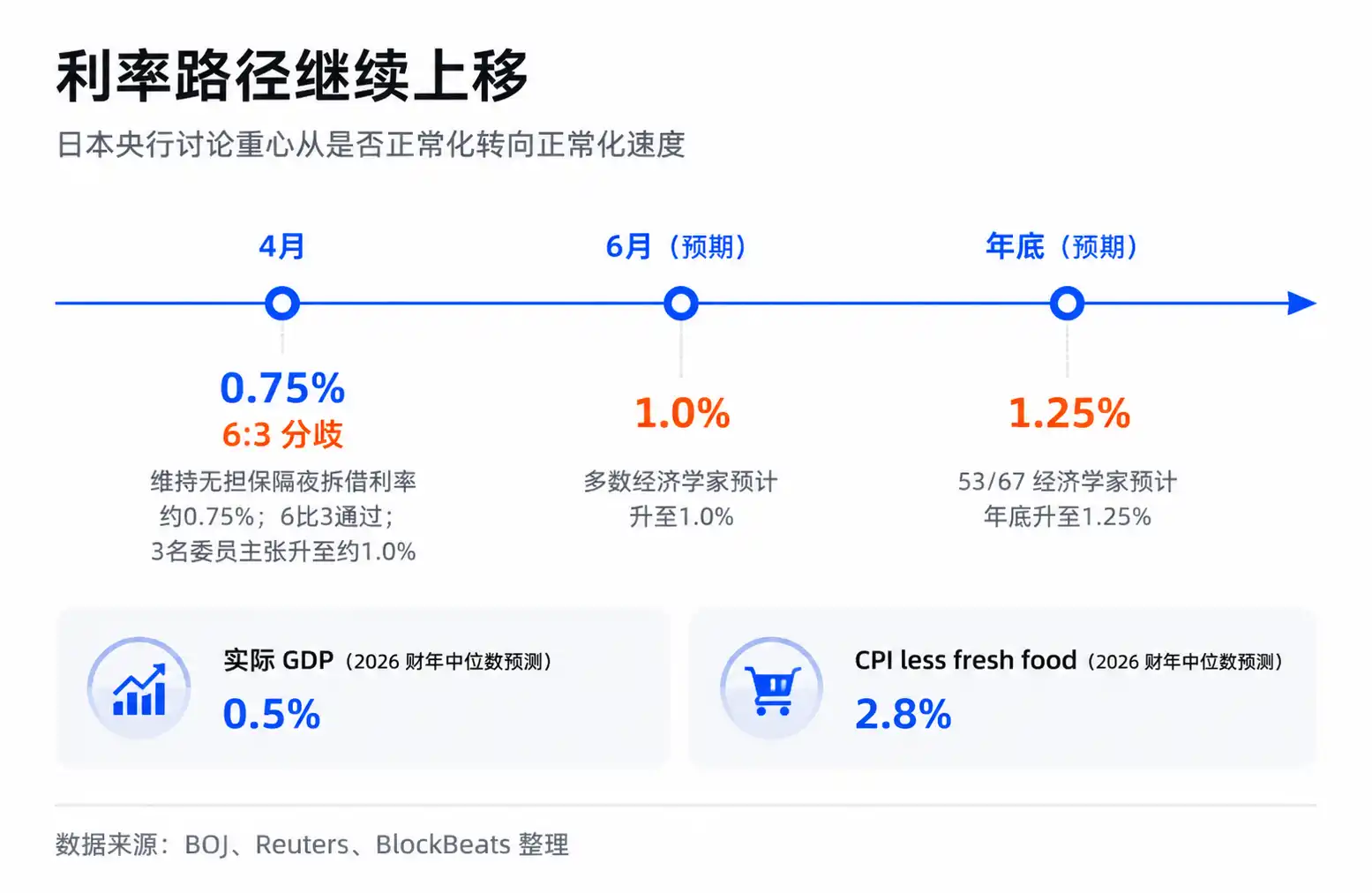
According to a Reuters report on June 10, 66 out of 70 economists expect the Bank of Japan to raise its policy rate from 0.75% to 1.0% at its June meeting. In another survey, 53 out of 67 economists expect the rate to rise to 1.25% by year-end. This meeting will conclude on June 16th. As of June 15th, 1.0% remains the economists' survey expectation, not an already announced result.
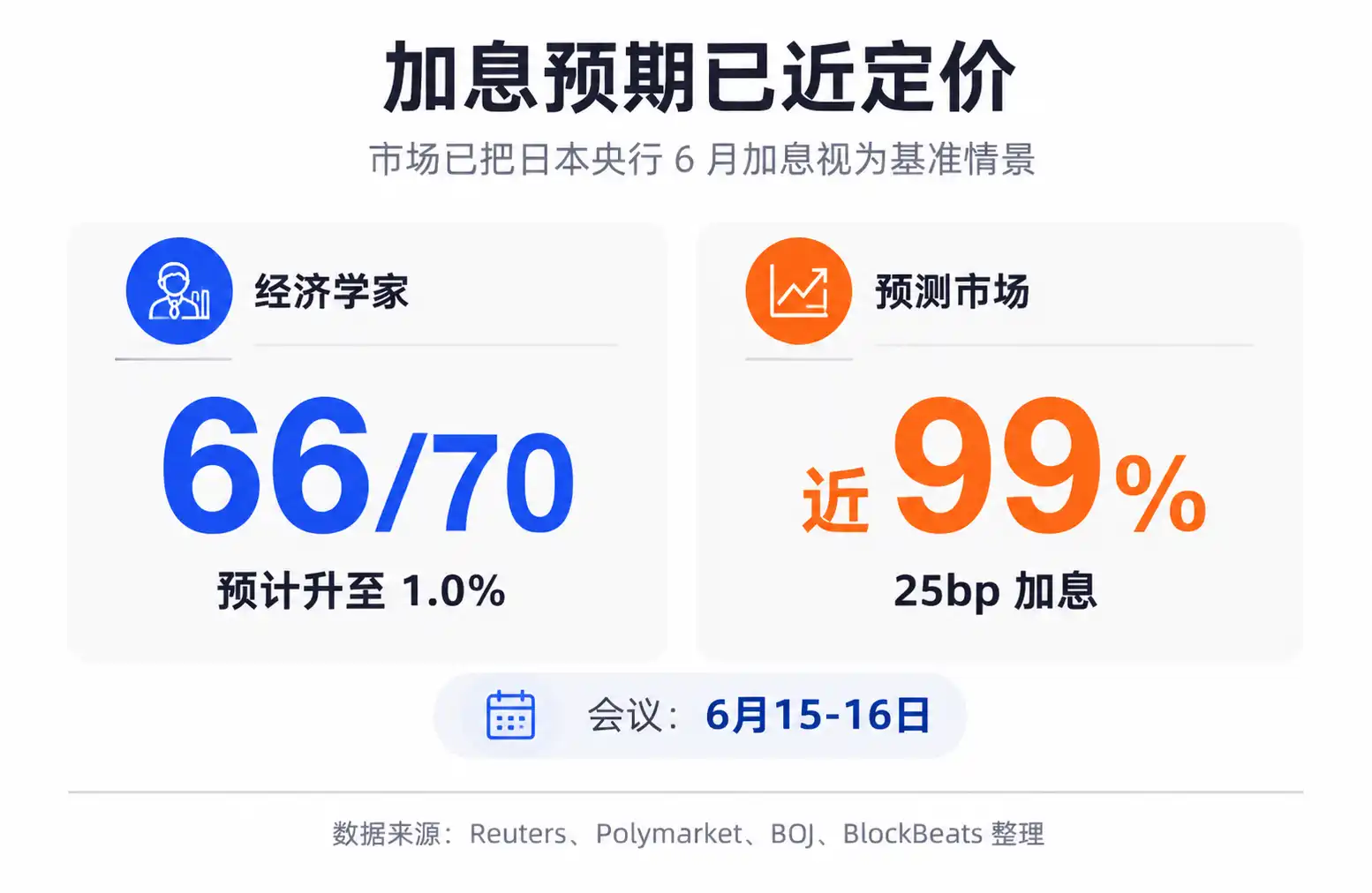
25 basis points may seem small. What the market fears is not the number 'Japanese interest rates reaching 1%', but whether assets that have relied on cheap funding, crowded positions, and high-risk appetites will be repriced after long-term cheap money starts to become more expensive. AI mega-tech and crypto are precisely the most sensitive terminals on this chain.

The Bank of Japan Affects the Global Funding Foundation

Think of the yen carry trade as a low-interest credit card. As long as the borrowing cost is low enough, the exchange rate stable enough, and the target assets rise fast enough, investors are willing to swipe this card to add leverage. The yen has long played the role of this global credit card.

This card is important because it doesn't just serve the Japanese market. Low-interest yen can be converted into dollars, flowing into U.S. stocks, bonds, emerging markets, commodities, and also indirectly affecting the risk appetite in crypto markets. When global asset prices rise, carry trades amplify liquidity. When the yen appreciates or Japanese interest rates rise, this chain works in reverse, forcing some funds to reduce positions, repay loans, and cut leverage.

Therefore, investors cannot judge its market impact solely based on 'the size of the Japanese economy.' The Bank of Japan is changing not the profit outlook of one local industry, but a long-term, low-cost foundation within the global funding map.

The April meeting already signaled this. At that time, the BOJ maintained the uncollateralized overnight call rate at around 0.75%, but the vote was 6 to 3, with 3 members already advocating an immediate hike to around 1.0%. In its Outlook Report that same month, the BOJ lowered its real GDP forecast for fiscal 2026 to 0.5% and raised its core CPI forecast to 2.8%. The policy discussion has shifted from whether to normalize to how fast normalization should be.
The market consensus remains relatively mild: the BOJ will raise rates gradually, with ample policy communication, and part of the yen carry trade has already been unwound during past bouts of volatility. But the risk framework looks at something else. As long as residual leverage remains, what triggers volatility is often not the absolute level of interest rates, but the speed of change in interest rate differentials and exchange rate expectations.

For AI stocks and crypto, this speed matters. They are both high-beta assets, meaning assets with greater price elasticity. They rise more sharply when liquidity is loose and fall faster when risk appetite declines. AI leaders have real revenue and industry trend support, and Bitcoin also has ETFs, the halving cycle, and on-chain structures, but their marginal pricing still highly depends on global risk appetite.

When cheap money diminishes, the market may not immediately reject the AI or crypto narratives, but it may lower the valuation multiples it is willing to pay for future growth.

25bp Amplified by Leverage and Exchange Rates

Looking solely at 25 basis points, a Japanese rate hike shouldn't seem likely to shock global assets. The problem is that carry trades are not simple comparisons of deposits and loans; they are a system layered with leverage, exchange rates, and crowded positions.

A typical yen carry trade has three sources of return: low borrowing cost in yen, high returns on purchased assets, and a stable or depreciating yen. As long as these three hold, the trade is comfortable. Once Japanese rates rise, the first source of return is compressed. If the market begins to expect yen appreciation, the third source becomes a risk. Investors not only earn less but may also lose money on the exchange rate.

That's why 1% itself isn't necessarily scary, but moving from 0.75% towards 1.0%, with the market expecting 1.25% by year-end, changes the calculus for capital. What carry trades fear most is not a slow rise in cost, but everyone simultaneously realizing the same trade is no longer profitable and then rushing to unwind.

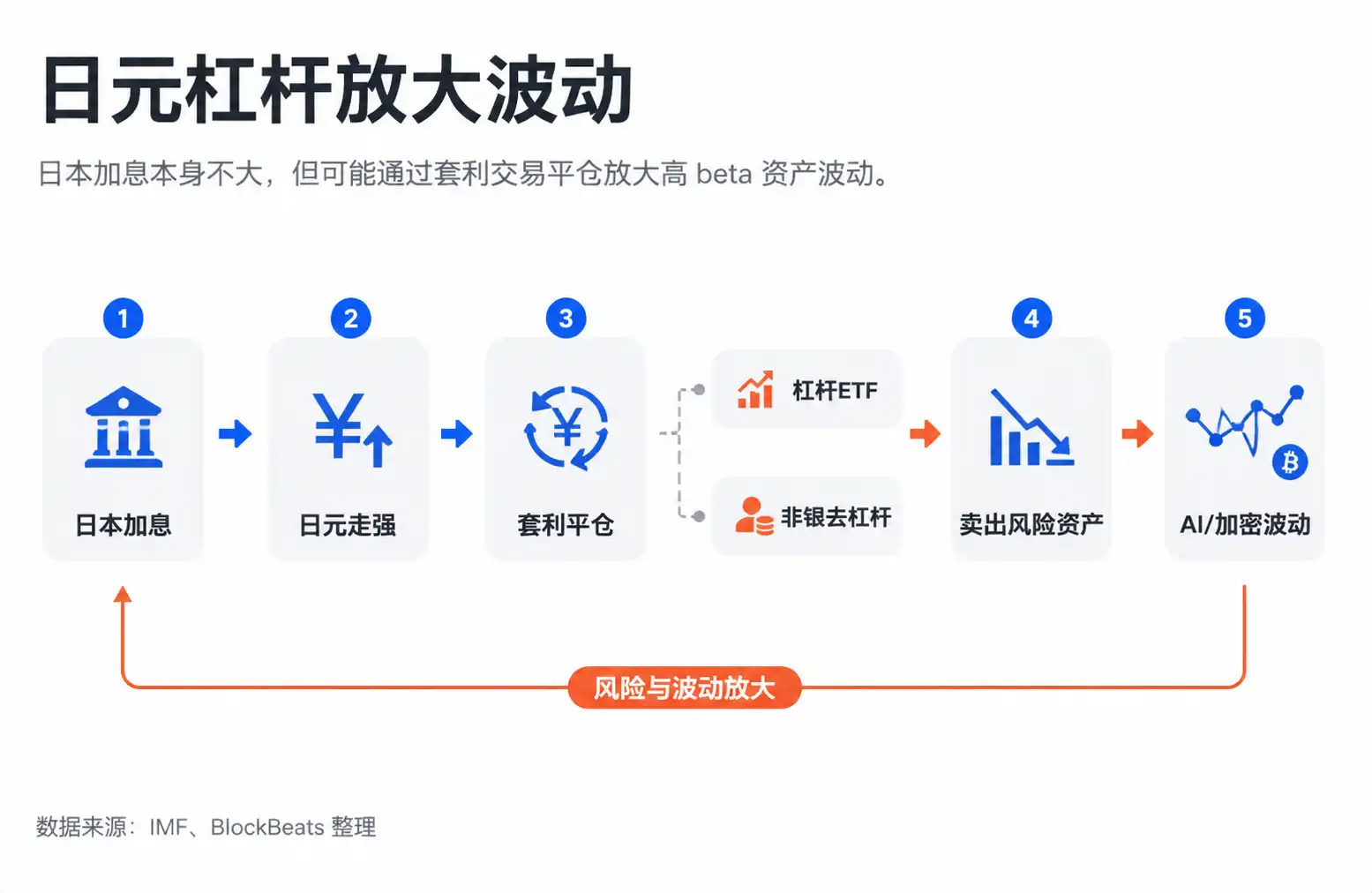
Unwinding transmits local Japanese policy to global risk assets. Investors need to buy back yen to repay debt, potentially selling dollar-denominated assets, tech stocks, crypto, commodities, or emerging market positions. If many funds act similarly at the same time, price declines can trigger more risk controls, margin calls, and volatility model adjustments, creating secondary amplification.

The IMF noted in its April 2026 Global Financial Stability Report that carry trade unwinding could amplify market volatility through channels like capital flows, bond yield volatility, leveraged ETFs, and non-bank financial institution deleveraging. The key point here is not that a particular downturn is solely caused by the BOJ, but that this mechanism exists and can exacerbate shocks when liquidity is tight.
Over the past two years, the market has repeatedly seen similar phenomena: momentum stocks, AI tech stocks, and Bitcoin experiencing synchronized volatility without clear new Fed signals or a sudden deterioration in single-company fundamentals. Institutional analysis often cites yen carry trade unwinding as one explanation. Strictly speaking, this can only prove a high temporal coincidence and a plausible mechanism, not sole causation. But for trading, correlation and transmission mechanisms are sufficient to constitute a risk variable.

The Market Is Trading on Higher Funding Hurdles

More precisely, the market is not trading on 'Japan's rate hike destroying AI,' but on 'higher funding hurdles for global risk assets.' These are two different things.

The AI rally still has its own main drivers. Cloud provider capital expenditures, GPU demand, model application deployment, enterprise software revenue—these are the long-term fundamentals for companies like NVIDIA and Microsoft. Bitcoin also has its own main drivers, including ETF inflows, regulatory frameworks, macro hedging narratives, and on-chain supply structure. The BOJ will not replace these variables.

But at high valuation stages, fundamentals answer whether there is long-term value, while liquidity answers what multiple the market is willing to pay for that future. When global low-cost funding is more abundant, investors are more willing to pay a high price for future growth. When funding costs rise and risk appetite falls, the same growth story may be discounted more heavily.

This is the meaning of implicit funding cost. It may not manifest as a rise in a specific company's loan rate, nor does it necessarily mean a specific fund directly borrowed yen. It's more like the overall leverage temperature of the market: when money is cheap, investors chase high-volatility assets. When money becomes expensive, the market's tolerance for losses, distant profits, and valuation bubbles declines.

Therefore, the market significance of this BOJ meeting does not lie in whether 1% is a high interest rate. In the U.S. or many emerging markets, 1% is certainly not high. But in the history of the yen as a global funding currency, it represents a change in direction. A pipeline of capital that has long provided cheap leverage is moving from extremely low cost towards normal cost.

'Most carry trades have already been unwound' also does not mean the risk disappears. Some trades have indeed been reduced in past volatility, and the market has also digested the June hike expectation in advance. But as long as residual exposure remains within the banking system, offshore yen lending, and non-bank leverage, prices will remain sensitive to the speed of normalization.

More importantly, the yen is just one visible anchor point. Global risk assets in recent years have not relied solely on the Fed but also on various low-cost funding currencies, offshore liquidity, and cross-market leverage. When these funding sources simultaneously become less cheap, a dovish Fed pivot may not fully offset the marginal tightening from other currency systems.

Post-Decision, Watch Linkage Between Yen, JGBs, and High-Beta Assets

The verification point for this narrative is clear: after the Bank of Japan's decision on June 16th, does the market just 'buy the rumor, sell the fact,' or does it begin repricing a faster normalization path?

If the BOJ raises to 1.0% as per the economists' survey expectation, but its tone is dovish, USD/JPY reacts calmly, and U.S. tech stocks and crypto do not come under synchronized pressure, then this looks more like a digested policy event. The market will continue to refocus on AI revenue, the Fed's path, and the U.S. earnings cycle, with Japan being a short-term disturbance.

If the decision or subsequent remarks lead the market to price in a year-end 1.25% or even higher path earlier, with the yen appreciating rapidly and Japanese bond yields rising, while NVIDIA, other momentum tech stocks, BTC, and ETH experience synchronized volatility, it would indicate investors are starting to trade not the 25 basis points, but a renewed contraction in the yen leverage chain.

Next, watch the linkage between prices: does yen strength accompany weakness in high-beta assets, does volatility rise without new U.S. negatives, do leveraged ETFs and crowded momentum stocks bear the brunt first. As long as these signals appear together, the Bank of Japan is no longer just the Bank of Japan—it is reminding the market that the map of global cheap money is becoming more expensive.


Связанные с этим вопросы

QWhat is the core market concern behind the Bank of Japan's potential rate hike, beyond the immediate interest rate change?

AThe market is not primarily concerned about Japan's interest rate reaching 1% itself. Instead, the worry is that as a long-term source of cheap money (the 'global credit card') begins to get more expensive, assets that have relied on low-cost financing, crowded positions, and high risk appetite may face repricing. The article highlights that AI stocks and cryptocurrencies are particularly sensitive 'terminal points' on this chain.

QAccording to the article, why is the potential impact of the Bank of Japan's policy greater than Japan's economic size might suggest?

AThe Bank of Japan's policy change is significant because it alters a key piece of low-cost 'foundation' in the global financing map. The Japanese yen has long served as a cheap funding currency for global carry trades. Investors borrow low-interest yen, convert it to dollars, and invest in higher-yielding assets worldwide. A policy shift in Japan thus does not just change a local industry's profit outlook but impacts the global cost of leverage and risk appetite.

QWhat are the three layers of profit in a typical yen carry trade, and how does a Bank of Japan rate hike threaten them?

AA typical yen carry trade has three profit layers: 1) The low cost of borrowing yen. 2) The higher return from the purchased asset. 3) The yen not appreciating (or even depreciating). A Bank of Japan rate hike directly compresses the first layer (higher borrowing cost). Furthermore, if the rate hike leads to market expectations of yen appreciation, the third layer turns into a risk, as investors could lose money on the currency exchange when repaying the loan.

QThe article distinguishes between 'fundamentals' and 'liquidity' for high-beta assets like AI stocks. What is the key difference in their roles?

AFor high-beta assets like AI stocks and Bitcoin, fundamentals answer the question of long-term value (e.g., cloud capital expenditure, GPU demand, ETF inflows, supply structure). Liquidity, on the other hand, answers the question of the valuation multiple the market is willing to pay for that future growth. When global low-cost financing is abundant, investors pay higher prices for future growth stories. When financing costs rise and risk appetite falls, the same growth story may be discounted at a lower multiple.

QWhat key market signals should investors watch after the Bank of Japan's June meeting to assess the impact on global risk assets?

AInvestors should watch for specific inter-market linkages: whether a stronger yen is accompanied by weakness in high-beta assets (like momentum tech stocks, BTC, ETH), whether market volatility rises without new U.S. catalysts, and whether leveraged ETFs and crowded momentum stocks lead the decline. The simultaneous appearance of these signals would indicate the market is trading on the theme of a broader contraction in global cheap funding, beyond just the immediate rate decision.

Похожее

The Most Advanced Large Models Are Now Subject to Export Controls Like Enriched Uranium

In an unprecedented move mirroring the control of enriched uranium, the US Commerce Department has imposed an export control ban on Anthropic's advanced AI models, Fable 5 and Mythos 5, forcing their global shutdown. This marks the first time a purely digital entity—a set of neural network weights—has been subjected to such hardware-like strategic export restrictions, based not on physical scarcity but on its concentrated "capability density." The article draws a direct parallel to the historical control of nuclear technology, arguing that just as uranium ore becomes a controlled substance only when enriched to a critical threshold, AI capabilities become subject to regulation when compressed into a single, potent, and easily accessible interface. This "enriched AI" is seen as crossing a threshold where its aggregated power poses a potential threat. The author predicts three major consequences over the next decade. First, capability auditing will become institutionalized, with governments setting compliance checklists and thresholds for model power, triggering automatic export controls. Second, jurisdictional boundaries will blur as US export controls extend their reach globally, governing any user of American AI services regardless of location, forcing non-US entities to reconsider their AI supply chain dependencies. Third, a technological bifurcation will occur, splitting the AI landscape into a restricted, high-risk track of advanced US proprietary models and a more reliable track of open-source or locally developed alternatives, where guaranteed access may outweigh raw performance. The core crisis exposed is the lack of a legal property rights framework for AI "intelligence." While companies invest heavily in integrating these models into their production systems, legally they only purchase a service that can be revoked at any time, leaving them with no recourse for their sunk investments. The conclusion warns of a permanently fractured digital world where the most capable models may not be the most usable, and clear, unassailable ownership of technology will become paramount.

marsbit12 мин. назад

The Most Advanced Large Models Are Now Subject to Export Controls Like Enriched Uranium

marsbit12 мин. назад

From a $300 Million Valuation to a 'Fire Sale' at Tens of Millions: What Happened to Messari?

On June 12, leading crypto data and capital markets platform Blockworks announced its acquisition of competitor Messari for over $10 million. This price represents a significant discount from Messari's 2022 valuation peak of approximately $300 million, highlighting the survival pressures faced by high-valuation startups during the bear market and a consolidation wave in data infrastructure. Blockworks, founded in 2018, began as a media and events company but has pivoted to focus on institutional-grade data, investor relations, and compliance tools. Its recent Series A extension round, valuing the company at $192 million, aimed to fund this shift and strategic acquisitions like this one. Messari, also founded in 2018, grew as a go-to platform for professional crypto research and data, raising a $35 million Series B at its $300 million valuation in late 2022. However, the prolonged bear market and subsequent internal changes, including founder Ryan Selkis's departure in 2024, increased operational pressures. The acquisition integrates Messari's extensive data platform and API capabilities with Blockworks's strengths in issuer-side disclosure, investor relations, and compliance workflows. The combined entity aims to build a unified "system of record" for the on-chain market. This reflects a broader industry trend where high-quality, structured data is becoming critical for institutional adoption, AI agents, and creating data moats akin to traditional financial platforms like Bloomberg. The deal exemplifies how market consolidation is reshaping the fragmented crypto data landscape.

marsbit40 мин. назад

From a $300 Million Valuation to a 'Fire Sale' at Tens of Millions: What Happened to Messari?

marsbit40 мин. назад

If the AI Bubble Is Already Bursting, Who Will Truly Survive?

If the AI Bubble is Bursting, Who Will Remain? The debate over an AI bubble is intensifying, with figures like Ray Dalio warning of high levels and Jensen Huang seeing immense, early-stage opportunity. Both views hold truth: a speculative bubble in capital markets likely exists, mirroring the dot-com era, but the underlying technological shift is real and transformative. History shows that while bubbles burst—wiping out overvalued companies and speculative capital—they often leave behind critical physical and digital infrastructure. The dot-com bust, for instance, eliminated many firms but left the global fiber optic networks and data centers that enabled the rise of Amazon, Netflix, and cloud computing. Today's massive AI infrastructure investments (projected at trillions by 2030) in data centers, power, cooling, and GPUs may follow a similar path, creating the foundation for future applications. A key divergence from past bubbles is the "Jevons Paradox" effect in AI. As the cost of AI inference has plummeted by over 99.7% since 2023, enterprise spending on AI has skyrocketed. Cheap "tokens" have unlocked vast, previously uneconomical use cases, moving AI from simple chatbots into core business workflows—code generation, legal document review, scientific simulation, and financial analysis. The market is now in a phase of self-correction, weeding out superficial "API-wrapper" startups, but this cleansing process strengthens the ecosystem. The long-term trajectory is clear. The value is gradually shifting from capital expenditure (CapEx) on hardware to operational expenditure (OpEx) on transformative applications. As AI becomes a utility, the winners will be firms that deeply integrate it to solve vertical industry problems in law, healthcare, finance, and manufacturing. The泡沫 will recede, but the foundational shift towards an AI-powered era across all sectors is irreversible. The underlying productive force of AI contains no bubble.

marsbit1 ч. назад

If the AI Bubble Is Already Bursting, Who Will Truly Survive?

marsbit1 ч. назад

Торговля

Спот
Фьючерсы

Популярные статьи

Что такое $BANK

Банк ИИ: Революционный шаг в будущее банковского дела Введение В эпоху, отмеченную быстрыми темпами технологического прогресса, Банк ИИ находится на пересечении искусственного интеллекта (ИИ) и банковских услуг. Этот инновационный проект стремится переопределить финансовый ландшафт, повышая операционную эффективность, меры безопасности и качество обслуживания клиентов с помощью ИИ. Приступая к этому изучению Банка ИИ, мы углубимся в то, что включает в себя проект, его операционную динамику, его исторический контекст и значительные вехи. Что такое Банк ИИ? В своей основе Банк ИИ представляет собой преобразовательную инициативу, направленную на интеграцию искусственного интеллекта в различные банковские операции. Этот проект использует возможности ИИ для автоматизации процессов, улучшения протоколов управления рисками иEnhancing взаимодействия с клиентами через персонализированные услуги. Основные цели Банка ИИ включают: Автоматизация банковских функций: Используя технологии ИИ, Банк ИИ стремится автоматизировать рутинные задачи, снижая нагрузку на человеческие ресурсы и повышая эффективность. Улучшение управления рисками: Проект использует алгоритмы ИИ для прогнозирования и выявления рисков, тем самым укрепляя меры безопасности против мошенничества и других угроз. Персонализация банковских услуг: Банк ИИ сосредоточен на предложении индивидуально подобранных финансовых продуктов и услуг, анализируя данные и поведение клиентов. Улучшение клиентского опыта: Внедрение решений на базе ИИ, таких как чат-боты и виртуальные помощники, направлено на предоставление пользователям более человеческого взаимодействия, революционизируя способ, которым клиенты взаимодействуют с банками. С этими целями Банк ИИ позиционирует себя как ключевого игрока в сделании банковских услуг более эффективными, безопасными и ориентированными на пользователей. Кто создатель Банка ИИ? Детали, касающиеся создателя Банка ИИ, остаются неизвестными. Таким образом, ни одно конкретное лицо или организация не были идентифицированы в доступной информации. Анонимность, окружающая начало проекта, поднимает вопросы, но не умаляет его амбициозного видения и целей. Кто инвесторы Банка ИИ? Подобно создателю проекта, конкретная информация о инвесторах или поддерживающих организациях Банка ИИ не была раскрыта. Без этой информации трудно описать финансовую поддержку и институциональную поддержку, которая может продвигать проект вперед. Тем не менее, важность наличия прочной инвестиционной базы является ключевой для поддержания развития в такой инновационной сфере. Как работает Банк ИИ? Банк ИИ работает на нескольких инновационных фронтах, сосредотачиваясь на уникальных факторах, которые отличают его от традиционных банковских рамок. Ниже приведены ключевые операционные особенности: Автоматизация: Применяя алгоритмы машинного обучения, Банк ИИ автоматизирует различные ручные процессы внутри банков. Это приводит к снижению операционных затрат и позволяет работникам перераспределять свои усилия на более стратегические деятельности. Совершенное управление рисками: Интеграция ИИ в практики управления рисками обеспечивает банки инструментами для точного прогнозирования потенциальных угроз, таких как мошенничество, обеспечивая безопасность информации и активов клиентов. Индивидуализированные финансовые рекомендации: Путем непрерывного обучения на основе взаимодействия с клиентами, системы ИИ развивают тонкое понимание потребностей пользователей, позволяя им предлагать персонализированные советы по финансовым решениям. Улучшенные взаимодействия с клиентами: Используя чат-боты и виртуальных помощников на базе ИИ, Банк ИИ обеспечивает более увлекательный клиентский опыт, позволяя пользователям быстро получать ответы на свои запросы, тем самым сокращая время ожидания и повышая уровень удовлетворенности. Все вместе эти операционные особенности позиционируют Банк ИИ как пионера в банковском секторе, устанавливающего новые эталоны для предоставления услуг и операционного совершенства. Хронология Банка ИИ Понимание траектории Банка ИИ требует взгляда на его исторический контекст. Ниже представлена хронология, подчеркивающая важные вехи и события: Начало 2010-х: Концепция интеграции ИИ в банковские услуги начала привлекать внимание, когда банковские учреждения осознали потенциальные преимущества. 2018: Произошел заметный рост внедрения технологий ИИ, когда банки начали использовать инструменты ИИ, такие как чат-боты, для базового обслуживания клиентов и системы управления рисками для улучшения безопасности. 2023: Сложность ИИ продолжала развиваться, при этом генеративный ИИ был представлен для выполнения более сложных задач, таких как обработка документов и анализ инвестиций в реальном времени. Этот год стал значительным шагом вперед в возможностях, которые ИИ-технологии предоставили банкам. 2024-Настоящее состояние: На данный момент Банк ИИ находится на восходящей траектории, с продолжающимися исследованиями и разработками, которые расширяют возможности в банковских операциях. Продолжение изучения приложений ИИ намекает на захватывающие события, которые еще предстоят. Ключевые моменты о Банке ИИ Интеграция ИИ в банковское дело: Банк ИИ сосредоточен на принятии искусственного интеллекта для оптимизации банковских процессов и улучшения пользовательского опыта. Автоматизация и фокус на управлении рисками: Проект сильно акцентирует внимание на этих областях, стремясь сместить бремя рутинных задач, одновременно усиливая системы безопасности с помощью предсказательной аналитики. Персонализированные банковские решения: Используя данные клиентов, Банк ИИ предоставляет индивидуально подобранные банковские услуги, которые учитывают потребности отдельных пользователей. Обязанность по развитию: Банк ИИ остается приверженным постоянным исследовательским и развивающим усилиям, обеспечивая свою адаптируемость и постоянную актуальность по мере того, как технологии продолжают развиваться. Заключение В заключение, Банк ИИ является важным шагом вперед в банковской индустрии, использующим искусственный интеллект для изменения операционных парадигм, повышения безопасности и повышения удовлетворенности клиентов. Несмотря на пробелы в информации о создателе и инвесторах, четкие цели и функциональные механизмы Банка ИИ обеспечивают прочную основу для его постоянной эволюции. Поскольку технологии ИИ продолжают развиваться и сливаться с банковским сектором, Банк ИИ хорошо позиционирован, чтобы существенно повлиять на будущее финансовых услуг, улучшая наш подход к пониманию и взаимодействию с банковским делом.

148 просмотров всегоОпубликовано 2024.04.06Обновлено 2024.12.03

Что такое $BANK

Как купить BANK

Добро пожаловать на HTX.com! Мы сделали приобретение Lorenzo Protocol (BANK) простым и удобным. Следуйте нашему пошаговому руководству и отправляйтесь в свое крипто-путешествие.Шаг 1: Создайте аккаунт на HTXИспользуйте свой адрес электронной почты или номер телефона, чтобы зарегистрироваться и бесплатно создать аккаунт на HTX. Пройдите удобную регистрацию и откройте для себя весь функционал.Создать аккаунтШаг 2: Перейдите в Купить криптовалюту и выберите свой способ оплатыКредитная/Дебетовая Карта: Используйте свою карту Visa или Mastercard для мгновенной покупки Lorenzo Protocol (BANK).Баланс: Используйте средства с баланса вашего аккаунта HTX для простой торговли.Третьи Лица: Мы добавили популярные способы оплаты, такие как Google Pay и Apple Pay, для повышения удобства.P2P: Торгуйте напрямую с другими пользователями на HTX.Внебиржевая Торговля (OTC): Мы предлагаем индивидуальные услуги и конкурентоспособные обменные курсы для трейдеров.Шаг 3: Хранение Lorenzo Protocol (BANK)После приобретения вами Lorenzo Protocol (BANK) храните их в своем аккаунте на HTX. В качестве альтернативы вы можете отправить их куда-либо с помощью перевода в блокчейне или использовать для торговли с другими криптовалютами.Шаг 4: Торговля Lorenzo Protocol (BANK)С легкостью торгуйте Lorenzo Protocol (BANK) на спотовом рынке HTX. Просто зайдите в свой аккаунт, выберите торговую пару, совершайте сделки и следите за ними в режиме реального времени. Мы предлагаем удобный интерфейс как для начинающих, так и для опытных трейдеров.

1.0k просмотров всегоОпубликовано 2025.05.09Обновлено 2026.06.02

Как купить BANK

Обсуждения

Добро пожаловать в Сообщество HTX. Здесь вы сможете быть в курсе последних новостей о развитии платформы и получить доступ к профессиональной аналитической информации о рынке. Мнения пользователей о цене на BANK (BANK) представлены ниже.

活动图片