The AI Bubble is Bursting

marsbitОпубликовано 2026-06-07Обновлено 2026-06-07

Введение

The article argues that while a bubble in the AI sector is real and is currently showing signs of deflation, this is a typical, even necessary, phase for a transformative technology. It draws parallels to the dot-com bubble, where speculative excess was followed by the consolidation of internet infrastructure, enabling the digital age. Similarly, today's massive investments in AI infrastructure (data centers, power, cooling) far outpace current application-layer revenue, creating a valuation imbalance. However, the author contends this apparent bubble is not a sign of failure but of a transition. Key drivers include the plummeting cost of AI inference (over 99.7% in two years), which, per Jevons Paradox, has unleashed massive new demand as AI moves from simple tasks to complex agentic workflows across all industries. The market is now cleansing itself of shallow, speculative ventures, shifting value from capital expenditure (CapEx) on hardware to operational expenditure (OpEx) on transformative AI applications. The conclusion is that the underlying productive force of AI is undeniable. The current financial correction will eliminate weak players, leaving behind robust infrastructure and efficient models. This will ultimately fuel an "AI+" era where intelligence becomes as ubiquitous and essential as the internet, embedding itself into every sector of the economy.

Original Title: The AI Bubble is Already Bursting

Original Author: Chengbei Xu Gong, Gelong

Recently, the market has experienced significant volatility, with "AI bubble theory" gaining widespread attention.

Ray Dalio, founder of Bridgewater Associates, said: There is a bubble in the AI market, and the level is "relatively high."

Jensen Huang, CEO of NVIDIA, said: AI presents a huge opportunity, and the demand for computing power has just begun to explode.

Who should we believe?

Both of them are correct.

Does the AI industry have bubbles? It certainly does.

However, bubbles in the tech sector are often the only way for society to pay tribute to disruptive advanced productive forces.

It is not merely a pejorative term.

In the long run, this is an inevitable phenomenon when advanced productive forces first emerge.

Many people compare the current situation to the 2000 dot-com bubble, feeling deeply anxious.

The dot-com bubble indeed caused the Nasdaq to plummet by nearly 78%, evaporating over $5 trillion in wealth.

But twenty years later, which industry can function without the internet?

Today, the value of the internet industry far exceeds that of the bubble period.

The AI bubble, at least superficially, appears to be a similar situation.

The bubbles present in the capital market cannot stop almost every industry in society from actively being empowered by AI.

AI+ is an unstoppable trend.

Just as no industry today can function without the internet, in the future, no industry will be able to function without AI.

01

In that era when any company with a .com in its name could go public and raise money, the Nasdaq surged nearly 600% from 1995 to 2000. Subsequently, a financial storm lasting two and a half years ensued.

Well-known names from that time: software company MicroStrategy, due to accounting scandals and exaggerated claims, plummeted 62% in a single day; Pets.com (selling pet food online), Webvan (pioneer of fresh food e-commerce) directly went bankrupt.

......

In the panic, almost everyone accused the internet of being a scam.

However, the physical infrastructure deposited by the excessive spending of speculative capital often nurtures the super giants of the next era at extremely low costs.

The reason the bubble burst was not due to problems with internet technology itself, but because the pace of physical infrastructure construction could not keep up with the market's rhythm.

For example, the once-dominant telecom companies (like WorldCom, Global Crossing) poured massive sums into laying global submarine cables and dense wavelength division multiplexing (DWDM) networks. While these companies themselves went bankrupt, these cheap "information superhighways" became the perfect breeding ground for the later rise of Netflix, Zoom, and the mobile internet.

Without the crazy, preemptive global investment in telecom infrastructure around 2000, there would have been no subsequent explosion of YouTube's video streaming, let alone later cloud computing infrastructure.

The most typical example is Amazon.

Its stock price fell from a high of $107 in 1999 to a mere $7 in 2001, a drop of over 90%.

But it survived because its underlying business logic, "reconstructing retail with networks", aligned with the direction of advanced productive forces.

This is a classic case of Amara's Law: overestimating the short-term impact of a new technology while severely underestimating its long-term impact.

At the beginning of a technological revolution, the狂热 of speculative capital inevitably leads to overinvestment, forming bubbles.

This is the intelligence tax that innovation must pay.

But when the bubble subsides, what remains will be even more unshakeable advanced productive forces.

02

Returning to 2026, the bubble in the AI industry appears even larger.

Just the five major cloud service providers—Amazon, Google, Meta, Microsoft, and Oracle—are projected to have capital expenditures of $690 billion in 2026, with total AI infrastructure investment expected to reach $5.3 trillion by 2030.

Of this, only about 25% is spent on GPUs; the remaining 75% is entirely invested in physical infrastructure: liquid cooling systems, power transmission, network switches, optical modules, and land.

In terms of revenue, all leading pure-play AI companies, including OpenAI, Anthropic, Cohere, Mistral, and Perplexity, are expected to have a combined total revenue of no more than $40 billion in 2026.

Nearly $700 billion invested in the foundational layer, while the application layer generates hundreds of billions in return.

Such severe asymmetry, is this not a bubble?

We cannot jump to such a simple and crude conclusion.

There is a crucial point that cannot be overlooked.

In March 2023, when OpenAI released GPT-4, the mixed cost per million tokens of input was about $30.

By April 2025, with the optimization of model architectures and improvements in inference computing power, the price for models of comparable intelligence level had plummeted to $0.1-0.15 per million tokens.

According to Stanford University's "AI Index Report" and TokenCost data: AI inference costs have fallen by over 99.7% in the past two years.

According to traditional linear thinking, with costs plummeting, corporate AI spending should decrease.

But the reality is that corporate AI cloud spending tripled between 2024 and 2025.

Why?

Because when the marginal cost of "intelligence" approaches zero, AI is no longer just a simple text summarizer or chatbot; it has entered a new era of agents and multimodal augmented retrieval.

Companies are now having AI agents automatically run thousands of task loops: writing code, scanning millions of legal contracts, simulating biological experiments.

Cheap tokens have unlocked vast amounts of long-tail demand that were previously uncommercializable due to cost constraints.

We can also see this by comparing NVIDIA in 2026 with Cisco, the network hardware giant in 2000.

Their ecological positions are extremely similar, but their underlying financial health is vastly different.
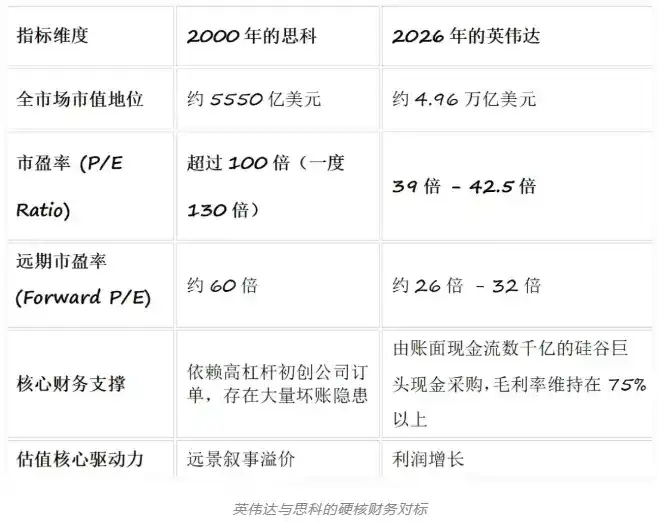
This precisely validates the economic concept of "Jevons paradox": technological progress improves energy efficiency, but instead of reducing energy consumption, it leads to greater demand due to lower costs.

Even after experiencing the so-called "DeepSeek moment" early last year, the market quickly sobered up in the following months: the more optimized the algorithms, the lower the barrier for enterprise AI adoption, ultimately causing total computing power consumption to rise exponentially.

It is precisely because of this that AI has the potential to gradually embed itself into almost every traditional industry.

Just as all industries have embraced internet+ over the past two decades.

From SaaS software to biomedicine, to advanced manufacturing robotics driven by embodied intelligence, in 2026, almost every industry is embracing AI+.

No one is discussing "should we use AI?", but rather worrying "is our data cleaned? Do we have enough API call quotas? Is our RAG architecture optimal?"

Currently, there is indeed a bubble in the AI industry.

But for businesses, if you don't embrace the bubble, you will be crushed by the times.

This has been proven by the internet era over the past two decades.

03

Currently, we are undoubtedly at a critical node in the technology lifecycle: on the eve of the "Trough of Disillusionment" on the Gartner Hype Cycle, or at a turning point in the "Technological Revolutions and Financial Capital" theory.

The AI bubble is already bursting, but many people haven't realized it.

Over the past few years, many venture capitalists (VCs) developed a fear of missing out (FOMO).

A few rookies could raise money with just a few dozen pages of PowerPoint, wrapping an API layer over OpenAI. Now, as the tide recedes, these companies without moats, only concepts, are dying in droves.

This is the market's self-purification, and it is also a manifestation of the bubble bursting.

But this is only the surface.

Three profound evolutions are occurring in the market's underlying logic:

First, the shift in value from CapEx to OpEx

Currently, the money is mostly being made by the shovel sellers: NVIDIA, TSMC, and those selling optical modules and server liquid cooling equipment have reaped most of the dividends.

However, as computing power gradually becomes "infrastructure-ized," like water and electricity, the true excess profits will gradually shift to the application layer.

That is, to those native AI companies that can truly solve vertical industry pain points and reshape business processes (OpEx optimization) using extremely low-cost tokens.

Second, valuation multiple compression and performance digestion

The market's high valuation for AI infrastructure does not necessarily mean an imminent crash.

In many cases, the high-speed growth of corporate profits can gradually "exchange time for space," digesting lofty valuations over time.

As long as the revenue growth of cloud computing giants keeps pace with the depreciation rate of capital expenditures, this game of hot potato can evolve into an unprecedented industrial upgrade.

For example, global automotive manufacturing and chip giants, by introducing end-to-end AI twin technology, have reduced the new product development-to-mass-production cycle by 35% and increased overall equipment effectiveness by 18%.

Also, in the financial industry, by 2026, quantitative trading, risk control, and credit assessment are fully dominated by multimodal Agents. AI is not only processing macroeconomic expectations with microsecond-level timestamps but also deeply involved in every micro-level asset pricing.

In highly knowledge-intensive industries such as law, healthcare, and auditing, AI has also completed its evolution from "junior assistant" to "partner-level expert."

Among the over 1 billion active users of ChatGPT, Gemini, and Claude, a significant portion use them as daily substitutes for high-intensity mental labor.

Including you and me.

All of the above are real, tangible events that everyone can see.

04

Looking back at the magnificent history of technology, the "creative destruction" proposed by Schumpeter is always playing out.

The capital market is always impatient, hoping that $1 invested today will yield $10 tomorrow.

When nearly $700 billion in infrastructure investment cannot be fully translated into profits at the application end in the short term, the market is bound to experience a brutal reshuffling.

It will eliminate those speculative shell companies that survive only on PowerPoint presentations and leave behind those with genuine technical substance and landing scenarios.

After the reshuffle, those cheap and massive computing centers and highly optimized model algorithms will serve all industries at extremely low prices.

After 2000, humanity entered a digital era where no industry could function without the internet.

Today, we are also irreversibly heading towards an era of intelligent supremacy where all industries are governed and empowered by AI.

Amidst the noise of bubbles, the underlying productive force potential has not a single drop of moisture.


Связанные с этим вопросы

QWhat is the main argument of the article regarding the AI bubble?

AThe article argues that while an AI bubble exists and is already bursting, this is a normal phase for a disruptive technology. The short-term speculative frenzy and market corrections are paving the way for long-term, widespread adoption and integration of AI into all industries, similar to the dot-com bubble preceding the internet age.

QHow does the article use the dot-com bubble of 2000 to explain the current AI situation?

AThe article draws parallels, noting that the dot-com bubble led to massive infrastructure overinvestment (like undersea cables) whose cheap, leftover capacity later enabled giants like Netflix and the cloud computing era. Similarly, today's massive AI infrastructure spending (on data centers, power, cooling) will create the foundational capacity for future AI applications to thrive, even after a market shakeout.

QWhat is the 'Jevons Paradox' mentioned in the article, and how does it apply to AI?

AThe Jevons Paradox states that technological progress that increases the efficiency of a resource (like energy or, in this case, AI computation) often leads to an *increase* in the total consumption of that resource. The article applies this to AI, explaining that as the cost of AI inference (per token) plummets, it unlocks vast new use cases, leading to exponentially higher total demand for AI compute power, not less.

QAccording to the article, what are the three deep market shifts happening beneath the surface of the AI bubble?

A1. A value shift from capital expenditure (CapEx) on infrastructure (like GPUs) to operational expenditure (OpEx) optimization by AI-native applications that solve real business problems. 2. Valuation compression being absorbed over time by rapid earnings growth from companies effectively using AI. 3. The practical, high-value integration of AI into core industries like manufacturing, finance, law, and healthcare, moving beyond hype to tangible productivity gains.

QWhat is the article's final conclusion about the relationship between the AI bubble and the technology's future?

AThe article concludes that the bursting of the speculative AI bubble is a necessary 'creative destruction' phase that will eliminate weak, concept-only companies. However, the underlying productive force of AI technology is real and unstoppable. The cheap, powerful infrastructure and algorithms left after the shakeout will propel society into an 'intelligent zenith era' where AI empowers all industries, just as the internet did after its own bubble.

Похожее

Has the 'Digital Gold' Narrative for BTC Failed?

**Title: Has the "Digital Gold" Narrative for Bitcoin Failed?** The article argues that Bitcoin's "digital gold" narrative remains valid despite a recent sharp price decline (from a peak near $126k in Oct 2025 to briefly under $61k in Feb 2026). It presents a long-term investment framework based on three core points: **1. Viewing Bitcoin as an Asset:** Bitcoin is presented as a superior potential store of value compared to gold. Key arguments are its absolute scarcity (21 million cap), superior portability, and transparent auditability via its public ledger. While acknowledging its current use in early, volatile stages (~3-4% global adoption), the author draws parallels to the early, disruptive phases of the internet and e-commerce. **2. Understanding the Recent Downturn:** The current ~50% correction is framed as a predictable, consensus-driven cycle following its post-halving peak (the 2024 halving preceded the Oct 2025 high). A crucial factor is a historic "changing of hands": the influx of new institutional buyers via ETFs allowed early, low-cost holders (miners, OG believers) to take profits. The author notes that while severe, Bitcoin's historical drawdowns (e.g., 93% in 2011, 77% in 2021-22) have been progressively smaller, suggesting maturing holder structure and decreasing volatility over time. **3. The Long-Term Perspective:** The long-term thesis hinges on Bitcoin capturing a portion of gold's market value. With Bitcoin's market cap at ~$1.4 trillion (at $70k) versus gold's ~$20 trillion, significant upside potential exists if the "digital gold" narrative is partially realized. However, the author strongly cautions that short-term risks remain, the bottom is unpredictable, and high volatility is inherent. The real risk is not Bitcoin failing but poor personal position management (over-leverage, wrong capital) and a lack of deep understanding, which can force investors out during severe downturns. The conclusion uses Amazon's 95% crash post-2000 dot-com bubble and subsequent 42x recovery as an analogy. The ultimate question is not if Bitcoin's price will rise, but if an investor's strategy and conviction can withstand the volatility to see the long-term play out. The recent divergence (gold up, Bitcoin down) is posed not as a narrative failure, but as potential evidence of this ongoing, painful transition from a speculative asset to a mainstream allocation.

marsbit2 ч. назад

Has the 'Digital Gold' Narrative for BTC Failed?

marsbit2 ч. назад

Has BTC's 'Digital Gold' Narrative Failed?

The article discusses Bitcoin's "digital gold" narrative, its recent price drop, and long-term outlook through the perspective of "Jason". It argues the narrative is not a failure but that Bitcoin represents a superior, new asset class due to its fixed supply (21 million), portability, and auditability. The piece compares its current ~3-4% global adoption rate to early internet/e-commerce, suggesting significant growth potential. Regarding the 2025-2026 price decline (from ~$126k to briefly under $61k), the author views it as a predictable, consensus-driven sell-off within Bitcoin's ~4-year cycle post-halving, exacerbated by a major "handover" from early, low-cost holders to new institutional buyers via ETFs. A key observation is that historical peak-to-trough drawdowns have lessened over time (e.g., 93% in 2011 to ~50% in 2026), indicating maturing volatility as holder structure changes. For the long term, the author uses a simple framework: Bitcoin's total market cap (~$1.4T at $70k) is only about 7% of gold's (~$20T). Even capturing 30-50% of gold's value would imply substantial upside. However, the article strongly cautions against viewing this as investment advice, emphasizing extreme volatility and the critical importance of risk management, position sizing, and deep fundamental understanding to survive severe drawdowns. It concludes by drawing a parallel to Amazon's 95% crash in 2000 and subsequent 42x recovery, stressing that the key is surviving market cycles to realize long-term potential.

链捕手2 ч. назад

Has BTC's 'Digital Gold' Narrative Failed?

链捕手2 ч. назад

From Code to Cognition: A Ten-Thousand-Word Guide to the Evolution of the Robot Brain

"From Code to Cognition: The Evolution of Robot Brains" The journey of robotic intelligence has shifted dramatically from manually coded systems to AI-driven brains. For decades, robots relied on layered software stacks—perception, state estimation, planning, control—each handcrafted. While predictable, they lacked adaptability. The 2010s saw deep learning revolutionize perception (e.g., object detection) and control (via reinforcement learning), but learned skills remained narrow. The arrival of Large Language Models (LLMs) marked a turning point. LLMs acted as high-level planners, interpreting natural language instructions and generating sequences of actions for traditional robotic systems to execute. However, true integration came with Visual-Language-Action (VLA) models, which fused vision, language, and motion prediction into a single network. Pioneered by models like RT-2 and open-source projects like OpenVLA, VLAs enable robots to reason and act directly from visual input and commands. The most advanced humanoid robots now employ a "dual-brain" architecture: a slow-thinking, large VLA (System 2) for reasoning and planning, and a fast-reacting, small network (System 1) for high-frequency motion control, sometimes with an even lower-level System 0 for balance. This split balances cognition with the physics of real-time movement. Computation is split between onboard hardware (e.g., NVIDIA Jetson) for safety-critical control loops and cloud/edge servers for non-critical tasks like learning and interfaces. A crucial driver is the open-source ecosystem—models like GR00T and OpenVLA allow startups to build upon pre-trained brains and fine-tune them with their own data, accelerating development. Despite progress, current systems struggle with recovery from errors, sample inefficiency, and long-horizon tasks. This has spurred the rise of **World Models**—neural networks that predict the consequences of actions. By simulating possible futures before acting (like NVIDIA Cosmos or Meta V-JEPA), robots can plan, recover, and generalize better. This represents the next frontier: shifting intelligence from learned reactions to an internal model of physics and cause-and-effect. The field is rapidly evolving. While not yet at its "ChatGPT moment," the convergence of cheaper hardware, scalable simulation, and world models points toward robots that are increasingly capable, adaptive, and useful. The question is shifting from "what can robots do?" to "what *should* they do?"

marsbit2 ч. назад

From Code to Cognition: A Ten-Thousand-Word Guide to the Evolution of the Robot Brain

marsbit2 ч. назад

AI Bubble Is Bursting

The AI Bubble is Bursting: A Necessary Purge on the Path to Ubiquitous Intelligence Market volatility has reignited debates about an AI bubble, with figures like Ray Dalio pointing to high valuations. However, this parallels the dot-com bubble, which, despite its crash, laid the physical infrastructure for today's internet era. The current AI investment frenzy, with tech giants planning trillions in infrastructure spending far outstripping current AI application revenues, appears similarly imbalanced. This 'bubble' is seen as an inevitable phase for a disruptive technology, paying the "innovation tax." Critically, AI inference costs have plummeted over 99.7% since 2023, making intelligence nearly free at the margin. This hasn't reduced spending but has instead unlocked massive new demand, as seen in enterprise AI cloud expenditure tripling. This follows the Jevons Paradox: efficiency gains lead to greater total consumption. The market is now entering a cleansing phase, weeding out speculative ventures lacking real moats. The deeper shift is a move from capital expenditure (CapEx) on hardware to value creation in operational expenditure (OpEx) through AI applications that solve real industry problems. While infrastructure valuations are high, rapid earnings growth from widespread AI adoption across sectors—from manufacturing and finance to law and healthcare—may digest these valuations over time. Ultimately, this creative destruction will leave behind robust infrastructure and optimized models, cheaply powering an AI-augmented future for all industries, much as the internet became indispensable after its own bubble burst. The core productive potential remains undiminished.

链捕手2 ч. назад

AI Bubble Is Bursting

链捕手2 ч. назад

Торговля

Спот
Фьючерсы

Популярные статьи

Неделя обучения по популярным токенам (2): 2026 может стать годом приложений реального времени, сектор AI продолжает оставаться в тренде

2025 год — год институциональных инвесторов, в будущем он будет доминировать в приложениях реального времени.

1.8k просмотров всегоОпубликовано 2025.12.16Обновлено 2025.12.16

Неделя обучения по популярным токенам (2): 2026 может стать годом приложений реального времени, сектор AI продолжает оставаться в тренде

Обсуждения

Добро пожаловать в Сообщество HTX. Здесь вы сможете быть в курсе последних новостей о развитии платформы и получить доступ к профессиональной аналитической информации о рынке. Мнения пользователей о цене на AI (AI) представлены ниже.

活动图片