RWA First Stock's Major Acquisition: Why Buy a 'Traditional' Mortgage Company?

Foresight NewsОпубликовано 2026-06-12Обновлено 2026-06-12

Введение

On June 10th, Figure Technology Solutions (Nasdaq: FIGR), a blockchain-native capital markets firm, announced a $717 million acquisition of Kiavi, a leading non-bank lender for residential real estate investors. The deal involves Figure acquiring Kiavi's technology and operations for approximately $538 million, while forming a joint venture with alternative asset manager Sixth Street to purchase Kiavi's existing loan portfolio. Sixth Street also provided a $3 billion forward purchase commitment. This acquisition marks a strategic shift for Figure, known as the "RWA (Real World Asset) first stock," allowing it to expand significantly into the larger market of first-lien mortgages. Kiavi specializes in non-qualified mortgage (Non-QM) loans, such as short-term fix-and-flip (RTL) and rental property (DSCR) loans—a segment traditionally underserved by major banks. The move is expected to increase Figure's first-lien loan origination to over $7 billion annually, aiming for these to constitute about 40% of its business by 2027. Both companies leverage AI for underwriting: Kiavi uses proprietary models to value renovated properties and automate document processing, dominating the fix-and-flip lending space. Figure plans to integrate these assets onto its blockchain platform, Provenance, using its new 'Adaptor' product to standardize and tokenize the loans for institutional investors on its Democratized Prime marketplace. While the integration poses challenges—including merging dif...


Author: Sanqing, Foresight News


On June 10th, blockchain-native capital markets company Figure Technology Solutions (Nasdaq: FIGR) announced the acquisition of Kiavi for $717 million. Kiavi is a non-bank residential real estate investor lending platform founded in 2013, with cumulative loan origination exceeding $30 billion.


In the deal, Figure acquires Kiavi's technology and operational platform, funding approximately $538 million through the issuance of about $600 million in senior unsecured notes. The remaining roughly $179 million is contributed by global alternative asset manager Sixth Street, with the two parties forming a joint venture to purchase Kiavi's existing loan portfolio on its balance sheet. Sixth Street also provides a $3 billion forward purchase commitment. The two companies have been long-term partners. Kiavi's current CEO, Arvind Mohan, will join Figure as Chief Business Officer after the deal closes, leading the business integration.
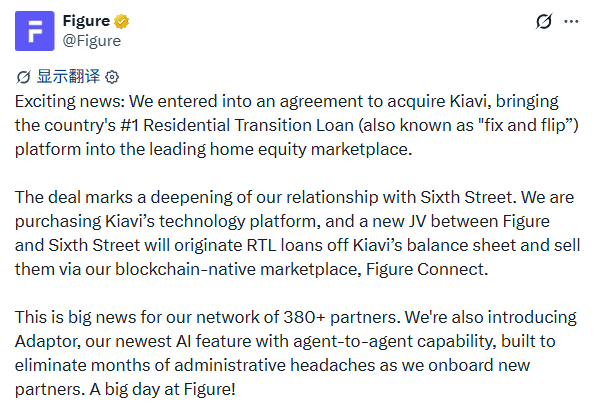

Image source: Figure tweet


After the announcement, FIGR's stock price opened higher, briefly touching $30.11 during the session, but later retreated, closing at $28.07, down 0.74%, with an intraday fluctuation of about 9%.


Kiavi


Kiavi's predecessor was LendingHome, founded in San Francisco in 2013 by Matt Humphrey and James Herbert, with backing from investors like Foundation Capital, Ribbit Capital, and Renren.com.


It primarily offers two types of products: short-term transition loans (Residential Transition Loan, RTL) for property renovation investors, and Debt Service Coverage Ratio (DSCR) loans for long-term rental properties.


It rebranded to Kiavi in 2021, and in June 2025 became the first private non-bank institution in the US to reach 100,000 cumulative loans originated.


According to the official announcement, Kiavi achieved revenue of over $250 million and EBITDA of over $100 million in 2025, both record highs; full-year origination volume was approximately $7.8 billion, up about 20% from approximately $6.5 billion in 2024.


First Lien


The origin of Figure dates back to late 2017. After leaving SoFi that year, co-founder Mike Cagney turned his attention to blockchain. In 2018, he and his wife June Ou founded Figure in San Francisco. The following year, they launched their first product on their self-built Provenance Blockchain: a home equity line of credit (HELOC) originated on-chain.


Mike Cagney | Image source: Bloomberg


Subsequently, the company expanded along the same logic—loan origination, financing, secondary market trading...—and gradually migrated these processes on-chain, building the consumer lending marketplace Figure Connect and the on-chain warehouse financing market Democratized Prime.


Following its Nasdaq listing in September 2025, Figure officially stated that it currently accounts for about 75% of the global tokenized RWA volume.


The problem is, HELOCs are second-lien loans.


Second liens rank behind first liens in repayment priority upon borrower default, carrying higher risk and supporting a smaller asset scale. Figure estimates that the market size for first liens is about 25 times that of second liens.


Kiavi's RTL and DSCR products are both first-lien loans, and they operate in the Non-Qualified Mortgage (Non-QM) space, which traditional banks have long avoided due to regulatory concerns—a space with strong demand but highly fragmented supply.


Figure is proactively shifting the focus of its asset classes.


Post-acquisition, Figure expects to add over $7 billion in new first-lien loan volume annually. According to CEO Michael Tannenbaum, Figure's first-lien business proportion had already increased from 10% to 20% in 2025, and the company expects this ratio to reach about 40% by the end of 2027.


AI


Both Figure and Kiavi excel at using AI to process non-standard data that traditional financial institutions are reluctant to touch, building moats in areas where manual processes cannot scale.


Kiavi's core technological asset is a proprietary "after-repair value estimation engine" and an automated document review system. An old, dilapidated property awaiting renovation is nearly impossible for traditional institutions to risk-quantify.


Kiavi's model can predict the post-renovation market value based on historical transaction data and renovation plans, enabling the scaling of credit decisions for loans like RTLs.


This capability has yielded significant market advantages. According to the Scotsman Guide's "2025 Top Private Lenders" rankings (underlying data from Forecasa), Kiavi's fix-and-flip loan origination volume in 2024 was approximately $5.5 billion, more than three times that of the second-place lender, and it continued to expand its lead in 2025.


Image source: Kiavi


Figure aims to solve the problem of what happens to assets after they leave Kiavi: how to put them on-chain, how to circulate them, and how to attract institutional capital. Figure's newly unveiled product in this deal, Adaptor, is designed precisely for this purpose.


It supports "Agent to Agent" automated integration, standardizing the diverse data formats from different originating institutions, thereby compressing the onboarding cycle for new partners.


Kiavi's assets will become the first real-world validation scenario for Adaptor after its launch. According to Figure's investor presentation materials, the company expects this transaction to achieve approximately $35 million in cost synergies within 24 months.


Two AI systems are being stitched together, pointing towards the same goal: making non-standard real estate loans priceable, tradable, and scalable on-chain.


Integration


Figure employs a dual-class share structure. According to the IPO prospectus, Cagney and his affiliates hold Class B shares, controlling about 69% of the total voting power at the time of the IPO; as of the latest proxy statement in April 2026, he still controls the majority of voting power, and Figure continues to be designated a "controlled company" by Nasdaq.


As a growth-stage company undertaking a major acquisition less than a year after its IPO, Figure also disclosed in its S-1 filing that previously existing material weaknesses in internal controls were yet to be remediated. The large-scale integration poses a non-negligible test for the execution team.


On Kiavi's side, its assets are sensitive to interest rate cycles. During the 2022 hiking cycle, lacking the backing of government-sponsored enterprises (GSEs) like Fannie Mae and Freddie Mac, the liquidity of Kiavi's assets in capital markets tightened, leading the company to make corresponding cost and personnel adjustments.


This vulnerability has already been validated during the high-interest-rate phase, and future interest rate changes will remain a significant external variable for RTL/DSCR origination volume.


Furthermore, Figure's existing assets are still heavily concentrated in HELOCs. Kiavi's asset types, data formats, and customer base are significantly different. It remains to be seen whether Adaptor can truly reduce integration costs and whether Kiavi's non-standard assets can be smoothly absorbed by institutional investors on Democratized Prime.


The good news is that Figure stated the deal will be accretive to earnings per share, with an unlevered cash payback period not exceeding 4 years, and reaffirmed its medium-term EBITDA margin target of around 60%; Kiavi's monthly loan flow exceeding $100 million will be directly fed into Democratized Prime.


Sixth Street's managed and committed capital scale of over $130 billion, along with its $3 billion forward purchase commitment, provides considerable capital buffer for the joint venture; Mohan's entry into the executive team means Kiavi's customer relationships and industry resources are retained within Figure's management structure.


The RWA narrative has been around for several years. This time, Figure is using $717 million to migrate an institution that has operated for 13 years and processes billions of dollars in real loans annually entirely onto the blockchain. This is one of the most structurally significant acquisitions in the RWA tokenization space to date.


The potential market space Figure points to is its estimated approximately $200 billion annual RTL/DSCR origination opportunity, underpinned by the long-term renovation and rental demand generated by the roughly $25 trillion stock of aging housing in the US.


If the integration proceeds smoothly, this could be a landmark node marking the transition of blockchain capital markets from "proof-of-concept" to "scale operations." Not just for Figure, but for the entire RWA credit asset market.

Связанные с этим вопросы

QWhat is the main reason for Figure Technologies Solutions' acquisition of Kiavi?

AThe primary reason for Figure Technologies Solutions' acquisition of Kiavi is to pivot its business focus towards first-lien loans, such as Kiavi's Residential Transition Loans (RTL) and Debt Service Coverage Ratio (DSCR) loans. These loans represent a significantly larger market compared to Figure's existing HELOC products, which are second-lien loans.

QWhat is the significance of the 'Adaptor' product introduced by Figure in this deal?

AThe 'Adaptor' product is significant as it is designed to standardize and automate the connection of data from various loan originators, like Kiavi, onto the blockchain. It aims to reduce the integration period for new partners and facilitate the tokenization and trading of non-standard real estate loan assets on Figure's platform.

QWhat core AI-driven capabilities does Kiavi bring to the combined entity?

AKiavi brings its proprietary 'renovation-after-value estimation engine' and automated document review system. These AI capabilities allow Kiavi to assess the risk and predict the post-renovation market value of older properties, enabling the scalable underwriting of non-standard loans like fix-and-flip (RTL) loans.

QWhat are the major challenges or risks associated with integrating Kiavi into Figure's operations?

AMajor challenges include: 1) The integration complexity for Figure, a growth-stage company with recent IPO and past internal control weaknesses. 2) The interest-rate sensitivity of Kiavi's loan assets, which have shown vulnerability in high-rate environments. 3) The uncertainty of whether Kiavi's non-standard assets can be seamlessly absorbed by institutional investors on Figure's Democratized Prime platform.

QWhat makes this acquisition a structurally significant event for the broader RWA tokenization market?

AThis acquisition is structurally significant because it involves migrating a large, established, and profitable real-world lending platform (Kiavi) with over a decade of operation and billions in annual loan volume onto a blockchain ecosystem. It represents a move from conceptual proof-of-concept to large-scale operational execution in the RWA tokenization space, targeting a massive underlying market of U.S. housing renovation and rental demand.

Похожее

Retail Ecology Dwindles, ZKsync Bets on Bank Pilots for a Breakthrough

Amidst declining retail activity, ZKsync is pivoting to target institutional banking as its primary growth strategy. The article explores this shift, contrasting it with the competitive "survival of the fittest" narrative by highlighting a cooperative model inspired by naturalist Peter Kropotkin. ZKsync is developing infrastructure like its private, permissioned Prividium suite for banks (e.g., Deutsche Bank's use case via Memento), enabling private transactions with public verifiability via zero-knowledge proofs. This appeals to institutions needing privacy, compliance, and Ethereum-based settlement security, unlike fully private chains (e.g., JPMorgan's Kinaxis) or consortium models (e.g., R3 Corda). However, this strategic focus has coincided with a steep decline in its public DeFi ecosystem, evidenced by plunging TVL and the departure of major protocols like Aave due to low fees. The network's future now hinges on banking adoption, with upcoming pilots like the Cari Network involving regional banks holding over $600 billion in deposits. A significant challenge is balancing this institutional focus with ZKsync's decentralized governance. Banks must operate on a network where rules and fees (denominated in the volatile ZK token) can be changed via community vote, and where a Security Council holds emergency control—a stark contrast to the predictable, contract-bound environments of traditional finance. The coming 18 months will test whether ZKsync can successfully onboard traditional banks onto a dynamically governed public chain or if institutions will ultimately revert to proprietary solutions.

Foresight News13 мин. назад

Retail Ecology Dwindles, ZKsync Bets on Bank Pilots for a Breakthrough

Foresight News13 мин. назад

The Recursive AI Anthropic Warned About: Tian Yuandong's New Company Has Just Taken the "First Step"

Anthropic recently highlighted the rapid progress toward "recursive self-improvement," where AI systems autonomously design and train their successors. In response, Recursive Superintelligence, a new company co-founded by former Meta researcher Tian Yuan Dong, has publicly demonstrated its first step toward automating AI research. The company released a system designed to autonomously execute the full AI research cycle: generating ideas, implementing code, running experiments, and learning from results. It validated this approach by achieving state-of-the-art results on three diverse benchmarks: 1. **NanoChat Autoresearch:** Optimizing a small language model's validation loss under a fixed 5-minute GPU budget, improving upon the community's best result. 2. **NanoGPT Speedrun:** Reducing the time to train a GPT model to a specific loss on 8 H100 GPUs from 79.7 seconds to 77.5 seconds, beating a highly optimized, human-driven community effort. 3. **SOL-ExecBench:** Improving the overall score on NVIDIA's suite of 235 GPU kernel optimization tasks by 18%, closing the gap to the hardware limit. The system discovered novel optimizations in this highly specialized domain without direct human expertise. Recursive's system operates as a general framework, capable of parallel exploration and cross-task knowledge transfer while incorporating safeguards against reward hacking. The company, backed by $650M in funding and a star-studded team including Richard Socher and Alexey Dosovitskiy, aims to create AI that recursively enhances its own research capabilities. This development represents an early but concrete move toward a new paradigm where AI accelerates its own advancement. It occurs alongside Anthropic's warnings about the need for industry coordination and potential pauses when recursive self-improvement thresholds are reached, highlighting the dual trajectory of rapid technical progress and growing calls for careful stewardship.

marsbit21 мин. назад

The Recursive AI Anthropic Warned About: Tian Yuandong's New Company Has Just Taken the "First Step"

marsbit21 мин. назад

The Gold Buy-on-the-Dip Guide: Watch Interest Rates, Not Just War

"Gold Buying Guide: Focus on Interest Rates, Not Just War" Four months ago, gold buyers likely didn't anticipate buying at a peak that even a war couldn't sustain. After hitting a record high of $5,596 on January 29, gold entered a bear market just 91 days later, its fastest decline since 2008. A key trigger was the Fed's hawkish shift, highlighting that monetary policy, not geopolitics, is the primary driver. The article argues that the traditional "buy gold in turmoil" script has changed. While the US-Iran conflict initially boosted prices, the sustained rally in oil prices heightened inflation fears, forcing central banks to maintain or consider tighter policy. Since gold yields no interest, higher rates increase its opportunity cost, eroding its appeal. This dynamic was evident when gold fell sharply on May 18 despite positive peace talks, as lower oil prices eased inflation and thus rate hike pressures. The recent sell-off is also part of a broader market deleveraging. Correlations between gold, Nasdaq, and Bitcoin spiked as leveraged investors sold liquid assets to cover losses, creating a synchronized downturn. Historically, gold bottoms align with policy shifts, not conflict resolutions. The 2008 and 2022 bear markets ended with shifts to extreme easing and peak inflation expectations, respectively. For potential buyers, the author suggests monitoring three signals: 1) Peak interest rate hike expectations, 2) Reopening of the Strait of Hormuz (to ease oil/inflation pressure), and 3) A return to net inflows for Gold ETFs, indicating the end of forced selling. While predicting the exact bottom is impossible, the author's personal strategy involves scaling into a position across price levels like $4000, $3700, and $3500, committing no more than 30% of the intended total allocation initially, and adding the remainder only if key signals emerge. The core conclusion: In turbulent times, watching interest rates is more crucial than watching wars.

marsbit27 мин. назад

The Gold Buy-on-the-Dip Guide: Watch Interest Rates, Not Just War

marsbit27 мин. назад

Recent On-Chain Review: No Clear Narrative Under U.S. Stock Market Pressure, Just Hype

This article analyzes the current state of the Solana meme coin and community token ecosystem, highlighting a market caught between two dominant forces: attention-based PvP and a gradual return to community-centric projects. The first part explores the "Attention PvP" dynamic, where success is driven by celebrity endorsements, viral events, and speed. Examples include $JOTCHUA, which surged after its meme creator's social media activity, and $WORLDCUP, which outperformed a similar Base chain project ($PITCH) largely due to influencer support. The recent "pump.fun GO" feature, allowing bounty tasks for token promotion, is critiqued for fostering sensationalist and often negative stunts—like people getting token tickers tattooed on their bodies for rewards—reminiscent of old internet shock content. In contrast, the article points to a resurgence of organic, community-driven tokens that survive market volatility through strong holder bases and shared ideology, not just hype. Influencer Ansem is cited, arguing that durable meme coins rely on communities willing to endure losses and promote their core message daily. Examples given are older tokens like $neet (anti-work ethos), $troll, $buttcoin, and $triplet, which have maintained relative price stability. A prime example of this community-build model is the new project $KINS, the token for the browser-based MMORPG Kintara. Its success stems not from advanced graphics but from consistently delivering updates, fostering player trust, and creating genuine engagement (e.g., in-game economies, events, property auctions). It has attracted a growing player base and even notable KOLs as participants, demonstrating that sustainable growth can come from building trust rather than orchestrating pumps. The article concludes by questioning whether the market is ultimately a game of mutual trust or mutual deception, expressing hope that such reflection might lead to a healthier ecosystem.

marsbit27 мин. назад

Recent On-Chain Review: No Clear Narrative Under U.S. Stock Market Pressure, Just Hype

marsbit27 мин. назад

Торговля

Спот
Фьючерсы

Популярные статьи

Как купить S

Добро пожаловать на HTX.com! Мы сделали приобретение Sonic (S) простым и удобным. Следуйте нашему пошаговому руководству и отправляйтесь в свое крипто-путешествие.Шаг 1: Создайте аккаунт на HTXИспользуйте свой адрес электронной почты или номер телефона, чтобы зарегистрироваться и бесплатно создать аккаунт на HTX. Пройдите удобную регистрацию и откройте для себя весь функционал.Создать аккаунтШаг 2: Перейдите в Купить криптовалюту и выберите свой способ оплатыКредитная/Дебетовая Карта: Используйте свою карту Visa или Mastercard для мгновенной покупки Sonic (S).Баланс: Используйте средства с баланса вашего аккаунта HTX для простой торговли.Третьи Лица: Мы добавили популярные способы оплаты, такие как Google Pay и Apple Pay, для повышения удобства.P2P: Торгуйте напрямую с другими пользователями на HTX.Внебиржевая Торговля (OTC): Мы предлагаем индивидуальные услуги и конкурентоспособные обменные курсы для трейдеров.Шаг 3: Хранение Sonic (S)После приобретения вами Sonic (S) храните их в своем аккаунте на HTX. В качестве альтернативы вы можете отправить их куда-либо с помощью перевода в блокчейне или использовать для торговли с другими криптовалютами.Шаг 4: Торговля Sonic (S)С легкостью торгуйте Sonic (S) на спотовом рынке HTX. Просто зайдите в свой аккаунт, выберите торговую пару, совершайте сделки и следите за ними в режиме реального времени. Мы предлагаем удобный интерфейс как для начинающих, так и для опытных трейдеров.

1.4k просмотров всегоОпубликовано 2025.01.15Обновлено 2026.06.02

Как купить S

Sonic: Обновления под руководством Андре Кронье – новая звезда Layer-1 на фоне спада рынка

Он решает проблемы масштабируемости, совместимости между блокчейнами и стимулов для разработчиков с помощью технологических инноваций.

2.3k просмотров всегоОпубликовано 2025.04.09Обновлено 2025.04.09

Sonic: Обновления под руководством Андре Кронье – новая звезда Layer-1 на фоне спада рынка

HTX Learn: Пройдите обучение по "Sonic" и разделите 1000 USDT

HTX Learn — ваш проводник в мир перспективных проектов, и мы запускаем специальное мероприятие "Учитесь и Зарабатывайте", посвящённое этим проектам. Наше новое направление .

1.8k просмотров всегоОпубликовано 2025.04.10Обновлено 2025.04.10

HTX Learn: Пройдите обучение по "Sonic" и разделите 1000 USDT

Обсуждения

Добро пожаловать в Сообщество HTX. Здесь вы сможете быть в курсе последних новостей о развитии платформы и получить доступ к профессиональной аналитической информации о рынке. Мнения пользователей о цене на S (S) представлены ниже.

活动图片