After the U.S. Banned Fable 5, Zhipu's Stock Soared 47%

marsbitОпубликовано 2026-06-16Обновлено 2026-06-16

Введение

On June 15, Chinese AI company Zhipu's stock surged up to 47.6% in Hong Kong, closing with a 32.82% gain. This sharp rise followed two key industry events. On June 12, Anthropic was compelled by a U.S. government export control order to suspend global access to its latest flagship models, Claude Fable 5 and Claude Mythos 5, impacting developers and businesses reliant on them. The next day, Zhipu announced it was opening access to its new open-source flagship model, GLM-5.2, for all Coding Plan users, with API and model weights (under the MIT license) to follow. The Anthropic incident highlighted a critical shift in the AI industry: beyond raw capability, the stability, continuous accessibility, and control over AI models are becoming equally vital, especially as AI integrates deeper into business workflows. Zhipu's move, emphasizing that "frontier intelligence should not belong to a few nor be subject to arbitrary revocation," positioned its open, accessible model as an alternative. GLM-5.2 focuses on "Long Horizon Tasks" with a 1M context window, aiming for consistency in complex, extended projects. Market analysts suggest this event exposes the risk of dependency on closed-source models subject to single jurisdiction policies, potentially accelerating a shift toward domestic base models and localized deployments. The investment response indicates a new valuation metric is emerging—prioritizing which companies can provide AI capabilities that are not only advanced but also...

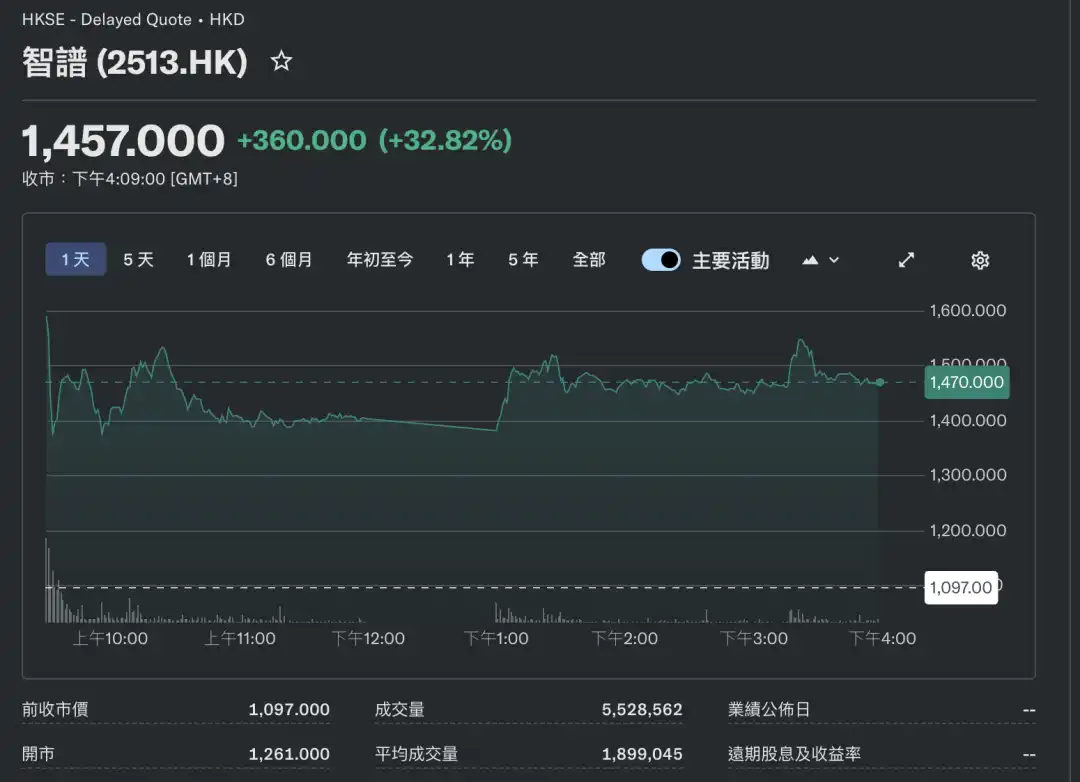
On June 15th, when the Hong Kong stock market opened, Zhipu AI's stock price surged continuously, reaching an intraday peak gain of 47.6%, setting a new record for single-day trading volume since its listing. By the close, the gain narrowed to 32.82%, with the total market capitalization surpassing HKD 649.6 billion.
The immediate catalyst came from two industry announcements two days prior.

On June 12th, due to U.S. government export control requirements, Anthropic suspended access to its latest flagship models, Claude Fable 5 and Claude Mythos 5. A day later, Zhipu announced that its latest open-source model, GLM-5.2, would be available to all Coding Plan users, with API access and model weights to be released the following week under the MIT license.

01 When the Most Advanced Models Become 'Potentially Unavailable'

On June 12th, Anthropic issued an official announcement stating that the U.S. government, exercising national security-related authority, issued an export control directive requiring the suspension of access to Claude Fable 5 and Claude Mythos 5 for all foreign nationals. The restrictions applied to foreign users both inside and outside the U.S., even including foreign employees within Anthropic.

Limited by the technical inability to accurately distinguish user nationality in real-time, Anthropic ultimately chose to temporarily disable the two models for all global customers to ensure compliance. This occurred only three days after the models' official release. As of now, both models are shown as unavailable on Anthropic's website, with no clear timeline for restoration.

As top-tier closed-source models in terms of current performance, the Claude series has been deeply integrated by numerous developers and enterprises for long-range tasks, code development, and complex document processing. The sudden service suspension directly disrupted many teams' workflows, sparking rapidly increasing discussions within the community about alternative solutions.

Just as the suspension news was gaining traction, on June 13th, Zhipu announced that its open-source flagship GLM-5.2 would be available to all Coding Plan users, covering Lite, Pro, Max, and Team editions. It also previewed that the API and model weights would be launched the following week, open-sourced under the MIT license.

In recent years, competition in the large model industry has primarily revolved around capability.

Whose reasoning is stronger, whose coding ability is better, who can first break through new capability boundaries—these factors almost dictated the choices of developers and enterprise customers.

However, the Anthropic incident highlights another issue previously often overlooked: beyond capability, whether a model can be accessed continuously and stably.

In this Anthropic event, for many developers and enterprises relying on overseas models for R&D work, even if they have accounts and paid subscriptions, they may face the risk of models suddenly becoming unavailable.

This is why this incident triggered far more discussion in the developer community than typical product updates.

As AI gradually evolves from a chat tool into infrastructure for software development, business operations, and even production processes, the stability, sustainability, and controllability of models are beginning to become metrics as crucial as model capability itself.

Zhipu stated in its announcement, "Cutting-edge intelligence should not belong only to a few, nor should it be subject to revocation by a few rules at any time." This statement, in essence, corresponds to the new reality facing the global AI industry today.

02 From 'Who is Stronger' to 'Who is More Accessible'

The capital market's swift reaction essentially represents an early pricing-in of this shift in industrial logic. Beyond the stock price performance, the market is more focused on the signals released by GLM-5.2 itself.

According to information disclosed by Zhipu, GLM-5.2 is its most capable open-source model to date, supporting a 1M context window and significantly enhancing long-horizon coding task capabilities. Zhipu positions it as a "truly usable 1M context" model, aiming to address the issue of models forgetting context during lengthy, multi-step engineering tasks.

A core keyword here is "Long Horizon Task." As AI Agents evolve from conversational tools into execution tools, models need to continuously handle thousands of tool calls, tens of thousands of lines of code, and large amounts of intermediate state information. The longer the context window, the stronger the model's ability to maintain project state and task continuity.

Current industry competition has shifted from "answering questions" to "sustained work." For developers, what truly matters is not parameter scale, but whether the model can maintain consistency and reliability over complex tasks lasting hours or even days.

Judging by the market reaction, investors have clearly recognized this change.

Oriental Securities pointed out in a research report that the Anthropic model incident exposed the risk of closed-source model access being subject to a single jurisdiction, which may drive more enterprises to shift their core AI capabilities toward domestic foundation models and localized deployment. Simultaneously, GLM-5.2 being open-sourced under the MIT license further lowers the barrier for enterprises to trial and integrate the model.

Over the past year, valuations assigned to large model companies by the capital market were largely based on model capability and market share. Today, as the global regulatory environment intensifies, a new valuation dimension is emerging—who can provide developers and enterprises with AI capabilities that are stable, sustainable, and reliably accessible in the long term.

When access to the world's most advanced models begins to be influenced by external factors, openness, accessibility, and autonomous controllability are becoming new bargaining chips in the AI competition.

Связанные с этим вопросы

QWhat was the direct trigger for the sharp rise in Zhipu's stock price on the Hong Kong stock exchange on June 15th?

AThe direct trigger was two industry news events from two days prior. On June 12th, Anthropic suspended access to its latest flagship models, Claude Fable 5 and Claude Mythos 5, due to U.S. government export control requirements. The next day, Zhipu announced that its latest open-source model, GLM-5.2, was available to all Coding Plan users, with API access and model weights to be released the following week under the MIT license.

QAccording to the article, what new factor is becoming as important as model capability in the AI industry competition?

AThe article states that the stability, sustainability, and controllability of model access are becoming as important as raw model capability. The Anthropic incident highlighted that even with accounts and paid access, developers and enterprises relying on overseas models could face sudden unavailability of the models they depend on.

QWhat key feature of Zhipu's GLM-5.2 model does the article highlight as particularly important for the evolution of AI Agents?

AThe article highlights its support for a 1M context window and enhanced capabilities for long-horizon coding tasks. This is important as AI Agents evolve from conversation tools to execution tools, requiring models to handle thousands of tool calls, tens of thousands of lines of code, and maintain consistency over long, complex tasks.

QHow did the U.S. export control instructions affect Anthropic's model deployment, according to its official announcement?

AAccording to Anthropic's official announcement, the U.S. government's export control instructions required suspending access to Claude Fable 5 and Claude Mythos 5 for all foreign nationals, including those outside the U.S. and even foreign employees within Anthropic. Due to technical difficulties in precisely distinguishing user nationality in real-time, Anthropic chose to temporarily disable the two models for all global customers to ensure compliance.

QWhat shift in the competitive landscape for large AI models is signaled by the market's reaction to the Zhipu and Anthropic news, according to the article's analysis?

AThe article's analysis suggests the market reaction signals a shift from competition based primarily on "who is stronger" (model capability) to competition based on "who is more accessible." As access to the most advanced models becomes susceptible to external factors like geopolitics, providing open, accessible, independently controllable, and sustainably available AI capabilities is becoming a new competitive advantage and valuation factor.

Похожее

Pricing OpenAI Pre-IPO: A New, Life-or-Death Business on Hyperliquid Lasting Half a Year

Pricing OpenAI Pre-IPO: Hyperliquid's High-Stakes, Six-Month Business Venture The article analyzes the nascent market for pre-IPO perpetual contracts on the Hyperliquid blockchain, exemplified by two contrasting teams: Trade.xyz and Ventuals. Trade.xyz, an anonymous team, successfully built the largest pre-market on Hyperliquid. Its strategy focused on near-term events, like the SpaceX IPO. By listing a SpaceX contract with a known launch date and price, the market had a tangible "anchor" (the eventual Nasdaq opening price) to converge upon, which kept speculation in check. This approach fueled significant growth. In stark contrast, Ventuals, backed by Paradigm, failed despite holding coveted contracts for OpenAI and Anthropic. Its critical flaw was its pricing mechanism for these companies, which have no imminent IPO. Ventuals' oracle price was half-derived from infrequent private market transactions and half from its own contract's moving average. This created a self-reinforcing loop where buying pressure artificially inflated the price, disconnecting it from real supply and demand. The market became illiquid and structurally skewed. Ventuals shut down nine months after launch, reportedly through an acquisition. Its final settlement prices—OpenAI at ~$1,341 and Anthropic at ~$1,618—were thus partially products of its flawed model. Ironically, some company employees and late-stage VCs reportedly used these prices for valuation reference, highlighting the desperate demand for price discovery in opaque private markets. The failure of Ventuals exposes the core challenge of this business: price for illiquid, non-public assets requires a robust, self-correcting market, which is absent without a definitive public listing event. Nevertheless, demand is driving major players like Coinbase and traditional finance (e.g., Citi) to enter the space, aiming to provide 24/7 trading for coveted private company shares. The venture's ultimate viability, however, hinges on solving the fundamental pricing problem Ventuals could not.

marsbit1 ч. назад

Pricing OpenAI Pre-IPO: A New, Life-or-Death Business on Hyperliquid Lasting Half a Year

marsbit1 ч. назад

Торговля

Спот
Фьючерсы

Популярные статьи

Как купить S

Добро пожаловать на HTX.com! Мы сделали приобретение Sonic (S) простым и удобным. Следуйте нашему пошаговому руководству и отправляйтесь в свое крипто-путешествие.Шаг 1: Создайте аккаунт на HTXИспользуйте свой адрес электронной почты или номер телефона, чтобы зарегистрироваться и бесплатно создать аккаунт на HTX. Пройдите удобную регистрацию и откройте для себя весь функционал.Создать аккаунтШаг 2: Перейдите в Купить криптовалюту и выберите свой способ оплатыКредитная/Дебетовая Карта: Используйте свою карту Visa или Mastercard для мгновенной покупки Sonic (S).Баланс: Используйте средства с баланса вашего аккаунта HTX для простой торговли.Третьи Лица: Мы добавили популярные способы оплаты, такие как Google Pay и Apple Pay, для повышения удобства.P2P: Торгуйте напрямую с другими пользователями на HTX.Внебиржевая Торговля (OTC): Мы предлагаем индивидуальные услуги и конкурентоспособные обменные курсы для трейдеров.Шаг 3: Хранение Sonic (S)После приобретения вами Sonic (S) храните их в своем аккаунте на HTX. В качестве альтернативы вы можете отправить их куда-либо с помощью перевода в блокчейне или использовать для торговли с другими криптовалютами.Шаг 4: Торговля Sonic (S)С легкостью торгуйте Sonic (S) на спотовом рынке HTX. Просто зайдите в свой аккаунт, выберите торговую пару, совершайте сделки и следите за ними в режиме реального времени. Мы предлагаем удобный интерфейс как для начинающих, так и для опытных трейдеров.

1.5k просмотров всегоОпубликовано 2025.01.15Обновлено 2026.06.02

Как купить S

Sonic: Обновления под руководством Андре Кронье – новая звезда Layer-1 на фоне спада рынка

Он решает проблемы масштабируемости, совместимости между блокчейнами и стимулов для разработчиков с помощью технологических инноваций.

2.3k просмотров всегоОпубликовано 2025.04.09Обновлено 2025.04.09

Sonic: Обновления под руководством Андре Кронье – новая звезда Layer-1 на фоне спада рынка

HTX Learn: Пройдите обучение по "Sonic" и разделите 1000 USDT

HTX Learn — ваш проводник в мир перспективных проектов, и мы запускаем специальное мероприятие "Учитесь и Зарабатывайте", посвящённое этим проектам. Наше новое направление .

1.8k просмотров всегоОпубликовано 2025.04.10Обновлено 2025.04.10

HTX Learn: Пройдите обучение по "Sonic" и разделите 1000 USDT

Обсуждения

Добро пожаловать в Сообщество HTX. Здесь вы сможете быть в курсе последних новостей о развитии платформы и получить доступ к профессиональной аналитической информации о рынке. Мнения пользователей о цене на S (S) представлены ниже.

活动图片